
Edwin Locke and Gary Latham built goal-setting theory on close to 400 studies showing that specific, difficult goals outperform vague ones. Our data from 420 companies and 29,987 key results backs their principles: teams with weekly check-ins hit their goals very consistently 60% of the time against 30% with monthly ones, and teams with one owner on every OKR hit 65% against 17%.
In the early 1970s, logging trucks at Weyerhaeuser were leaving the woods loaded to around 60% of their legal weight. Gary Latham gave the drivers one specific target, 94%, with no bonus or penalty attached, and within months loads were running above 90% and staying there. The drivers had been asked to do their best for years, and a single number gave them something to aim at and a way to see how close they were.
That study became one of the founding results of goal-setting theory, which Latham developed with Edwin Locke over the next three decades, and it remains the research that OKRs rest on. Our own data lines up with it closely. In our platform data covering 3,527 organizations and 29,987 key results, goals with an explicit deadline hit their target 67% of the time against 51% without one, which is Locke's clarity principle at work in real goals.
From Log Trucks to 400 Studies
Locke published the first formal statement of the theory in 1968, in a paper titled "Toward a Theory of Task Motivation and Incentives." His lab experiments kept producing the same result: people given a specific, difficult target outperformed people told to do their best, even when the second group was working just as willingly.
Latham took the idea into the field, starting with the logging crews, and the two combined their work in the 1990 book A Theory of Goal Setting and Task Performance. Their 2002 review in American Psychologist drew on close to 400 laboratory and field studies covering a wide range of tasks and settings, and the core finding held across almost all of them. Peter Drucker's management by objectives had already put goals at the center of management in 1954, and goal-setting theory supplied the evidence for why they work.
Specific, Difficult Goals Beat "Do Your Best"
The theory's central claim is that a goal changes behavior through four mechanisms. Each one explains part of why a specific target outperforms a general instruction, and each one is visible in how a team works through a quarter.
The first three take effect almost as soon as a goal is specific. Strategy takes longer to develop, which is why task complexity became one of the theory's five principles.
Locke and Latham also named the conditions that strengthen or weaken the effect: commitment to the goal, feedback on progress, the complexity of the task, the person's ability and the constraints of the situation. Those conditions became the five principles that management writing usually quotes, and each one can be checked against how teams run goals today.
Clarity: A Goal Needs a Number
A clear goal tells the owner exactly what success looks like and when it's due. Locke's experiments found that vague goals give people no clear point at which their effort is enough, since "improve customer satisfaction" lets almost any result count as success, which is the reason measurable goals outperform aspirations written as sentences.
Our platform data shows the same effect in written goals. Beyond the deadline gap, key results of 16 words or more hit their target 69% of the time against 35% for those of one to three words, because the longer version usually names the metric, the starting point and the target. The guidance on how to write OKRs follows directly from this principle: a number, a baseline, a target and a date on every key result.
Challenge: Hard Enough to Stretch, Close Enough to Reach
Locke found that performance rises with goal difficulty in a roughly straight line until people reach the limit of their ability or lose commitment to the goal. Easy goals produce easy effort, and people given a hard target outperform those given a moderate one, even when they fall short of it.
OKRs build this principle in through two types of OKRs. Committed goals are expected to land in full, while aspirational goals are set beyond what seems possible and count as a success at around 70%. Stretch goals work when the team believes they're reachable with a new approach, and they backfire when a miss gets punished, which is the main driver of sandbagging, setting targets low enough to be safe.
Commitment: People Work Hardest for Goals They Own
A difficult goal raises performance only when people accept it. Latham and Locke spent years debating Miriam Erez over whether participation in setting a goal raises commitment, and in 1988 the three ran joint experiments to settle it. They found that assigned goals worked about as well as participative ones, as long as the person assigning the goal explained the reasoning behind it.
In the OKR Benchmark Report, our survey of 420 companies running OKRs, commitment shows up most clearly in ownership. Teams that give every OKR one named owner hit their goals very consistently 65% of the time, against 17% where only some goals are owned.
Strategy set collaboratively goes with 58%, against 37% when the exec team sets it alone, which fits the 1988 finding: what builds commitment is understanding the goal, and a mix of top-down and bottom-up planning is the most reliable way to give a team that understanding.
Feedback: Progress Data Keeps the Goal in View
Locke and Latham found that goals and feedback work best together. A goal without feedback leaves people guessing whether their effort is enough, and feedback without a goal gives them data with nothing to measure it against.
In the benchmark, teams holding a weekly check-in hit their goals very consistently 60% of the time, against 30% for monthly check-ins, and teams that put a confidence score on every key result post 66%, against 22% when only some are scored. Timing matters as much as frequency: the OKR Pacing Benchmark found that key results at 50% progress by week four hit their target 84% of the time, against 55% for those below, so feedback read in the first month still leaves time to act.
Screenshot suggestion: an OKRs Tool key result showing its weekly check-in history, with progress, confidence score and a short comment for each week. Alt text: Weekly OKR check-in history showing progress and confidence on a key result, the feedback loop goal-setting theory describes.
Feedback also has to be accurate to help. In our platform data, owners corrected progress downward on 46% of key results with eight or more weeks of history, and those goals still hit their target almost as often as goals that only ever moved up.
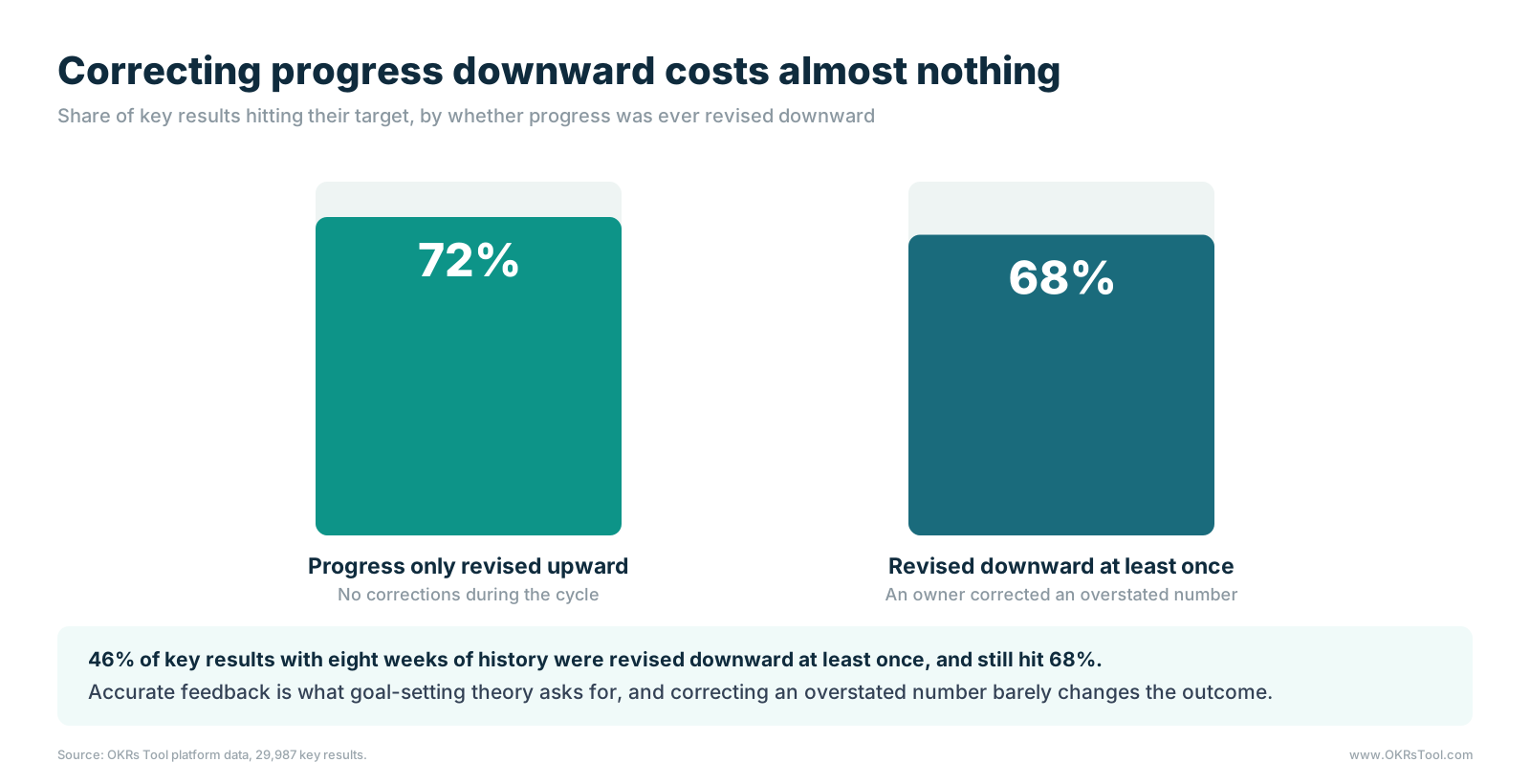
The four-point gap between 72% and 68% is small next to the cost of an inflated number. A correction usually means an owner looked closely and fixed a figure that was wrong, and updating OKRs that way keeps the feedback honest and stops the goal turning into a watermelon OKR, green on the outside while it's failing underneath.
Task Complexity: Learning Goals for Unfamiliar Work
The fifth principle limits the first four. On simple tasks, a hard performance target raises output almost immediately, while on complex, unfamiliar work, people under pressure to hit a number can rush into the first approach they find and stop searching for better ones.
Research by Gerard Seijts and Gary Latham found that people facing complex tasks did better with a learning goal, such as finding a set number of new ways to approach the problem, than with a hard performance target.
In an OKR program, that means a team entering a new market can set a key result for the number of pricing tests it runs in the first quarter, while keeping in mind the difference between outputs and outcomes: the learning goal is a step toward an outcome target once the team knows what works. The tests themselves belong in the team's initiatives.
Where Goal-Setting Theory Gets Criticized
In 2009, Lisa Ordóñez, Maurice Schweitzer, Adam Galinsky and Max Bazerman published "Goals Gone Wild," arguing that goal setting had been prescribed too widely and with too little attention to its side effects. They pointed to narrowed focus, more risk-taking, lower intrinsic motivation and unethical behavior, citing cases such as Sears auto centers in the early 1990s, where mechanics given hourly sales targets were accused of charging customers for unneeded repairs.
Locke and Latham replied that the critics' examples involved goals set without the conditions their theory specifies, such as clear limits, honest feedback and goals people could reach legitimately. Our own research shows the risk is real.
In The State of Goal Management, our survey of 210 employees, 92% admitted to at least one form of goal gaming, and 96% admitted to sandbagging when goals affected their performance rating, against 81% when goals and ratings were kept separate. Keeping OKR scores apart from pay, and using them as evidence in OKR-based performance reviews, protects the stretch that makes the theory work.
Goal-Setting Theory Inside an OKR Program
An OKR is goal-setting theory turned into a weekly routine. The objective gives direction, the key results supply the specific, difficult numbers, the owner carries the commitment and the check-in provides the feedback, and the benchmark data shows the gap each of those pieces makes.
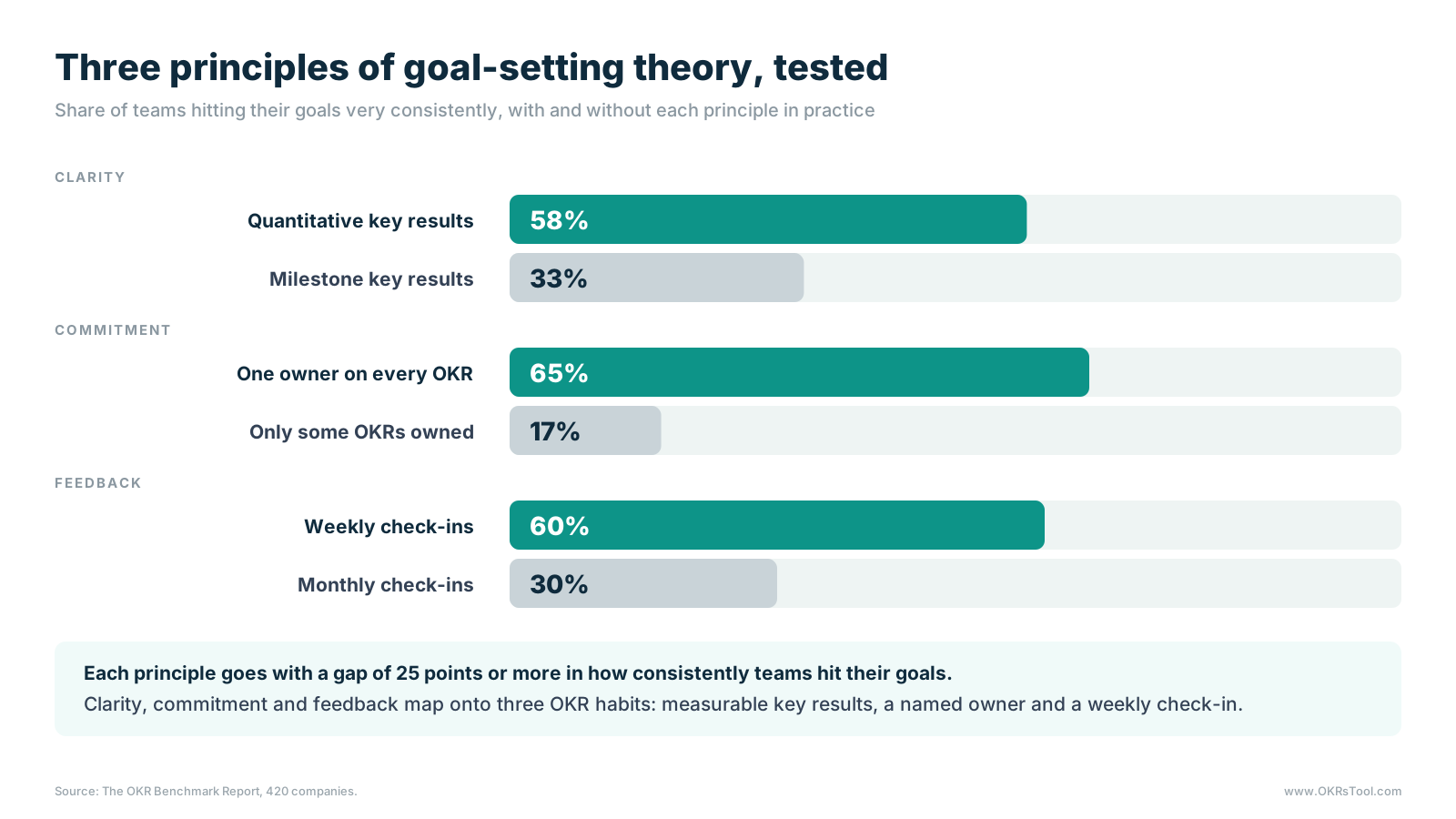
Clarity, commitment and feedback each go with a gap of 25 points or more, and they compound. Teams running none of the five core habits in the benchmark hit their goals very consistently 4% of the time, and teams running four or five of them hit 82%. Among the goal-setting frameworks teams use, OKRs follow the theory most closely, because the OKR framework adds the weekly feedback loop that SMART goals leave to the team.
Fifty Years of Research, One Weekly Habit
Goal-setting theory has held up across half a century of studies because its claims are simple and testable: specific, difficult goals raise performance when people are committed to them, get regular feedback and have room to learn on complex work. The data from today's goal programs points the same way, with the largest gaps appearing where the theory predicts them.
The practical lesson for a team is to give every goal a number and a date, one owner who understands why it matters, and a weekly look at progress that's honest enough to show when a goal is slipping. A platform that builds those conditions into how goals get set and tracked keeps the theory running every week without anyone having to chase it.
Data: The OKR Benchmark Report, The OKR Pacing Benchmark, The State of Goal Management and OKRs Tool platform data.