OKRs Tool's analysis of real goal systems found that 69% of all Key Results are set as committed goals — outcomes teams treat as must-deliver. Only 18% are genuinely aspirational. Just 13% are learning-oriented. That distribution explains a pattern that shows up consistently in teams that struggle with OKR credibility: they over-commit to outcomes before they understand the levers, and leave no room for stretch or discovery.
The three types of OKRs — Committed, Aspirational, and Learning — each serve a different purpose in the quarterly cycle. Teams tend to default heavily to one, and in doing so create the very execution problems they're trying to solve.
The pull toward committed goals is easy to understand. They feel the safest to write: the target is knowable, the path is clear, and hitting 100% reads as success on the board. Aspirational and learning goals ask a team to sit with uncertainty — either promising a stretch they might miss, or admitting they don't yet know the answer.
Left unchecked, that preference reshapes the whole portfolio, until a system built to drive ambition and discovery spends most of its energy recording work the team was always going to finish. The fix is to decide the mix on purpose before the cycle starts, rather than leaving it to habit.
Type 1: Committed OKRs — The Outcomes You Must Deliver
A committed OKR is a goal where 100% success is expected — not aspirational. These are grounded in stable baselines, understood levers, and outcomes the business depends on. They anchor the quarterly cycle. Missing a committed OKR has real consequences.
Committed OKRs belong in areas where the team already understands the problem and the path to improvement. They're where you perform, not where you stretch.
The most common mistake: treating all OKRs as if they're committed goals. That leads to either conservative targets that change nothing, or unrealistic promises that damage credibility by week three. Committed OKRs should anchor the quarter — not dominate it.
Type 2: Aspirational OKRs — The Goals That Stretch
An aspirational OKR is a goal where 60–70% achievement is considered a success. These represent meaningful bets — goals where full completion isn't guaranteed, and isn't expected. The intent is significant forward motion, not perfection.
Benchmark data identifies 70–80% completion as the OKR sweet spot. Teams consistently hitting 100% are sandbagging. Teams below 50% usually lack ownership or clarity. Aspirational OKRs are calibrated specifically for the 70–80% zone.
Aspirational OKRs give teams a realistic way to aim higher without breaking belief. The target changes the slope of the curve — not just the current value. Hitting 70% of an aspirational target is often more valuable than hitting 100% of a committed one.
Type 3: Learning OKRs — The Most Underused Type
A learning OKR defines what the team needs to discover or validate before committing to a performance target. It turns ambiguity into structured inquiry — and prevents wasted cycles where teams commit to outcomes they don't yet understand.
Teams often fail because they didn't yet know which goal would create the right outcome, rather than because the goal was poorly chosen. A learning OKR prevents that by making discovery an accountable, time-bound activity rather than something that happens informally in the background.
Learning OKRs are essential when new products, segments, or strategies are emerging. Their job is understanding the system that produces results, ahead of the results themselves.
How to Choose the Right Type
The decision is straightforward once the question is framed correctly. Use a committed OKR when the outcome is essential, the path is understood, and missing it creates real risk. Use an aspirational OKR when the goal accelerates progress beyond current trajectory and hitting 70% is still valuable. Use a learning OKR when the team can't yet accurately predict performance — when they're exploring, not optimizing.
The frame that helps: a committed OKR is a promise. An aspirational OKR is a bet. A learning OKR is a question. All three belong in the same OKR system — but they're evaluated differently at cycle end.
The Recommended Mix — and What Teams Actually Do
Based on patterns across high-performing OKR programs, the recommended mix is 50% committed, 30% aspirational, 20% learning. This balances reliability with ambition and leaves room for the discovery that feeds future committed goals.
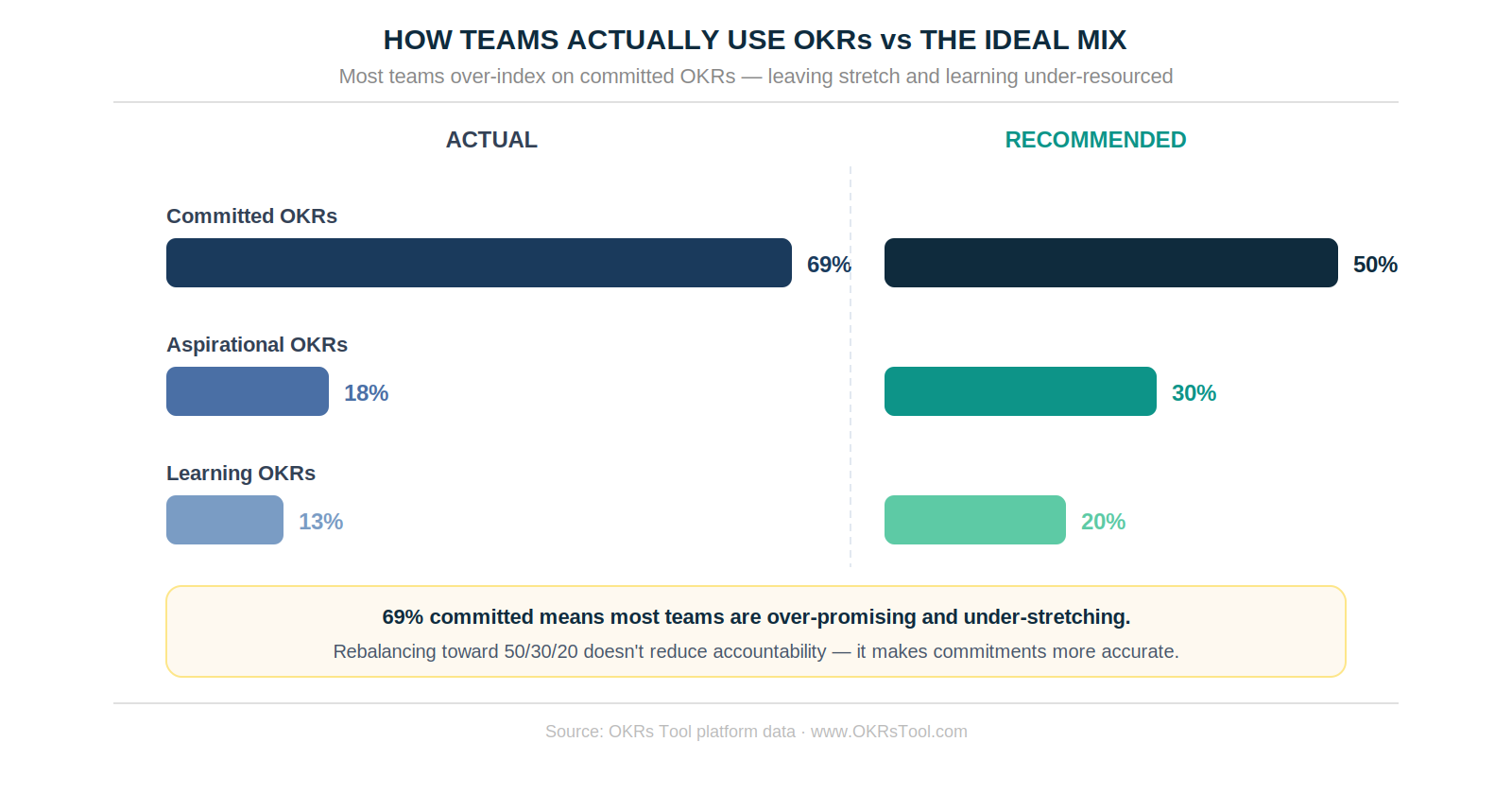
What teams actually do looks different. OKRs Tool's analysis of real goal systems found 69% committed, 18% aspirational, 13% learning — teams are over-indexed on committed goals by nearly 20 percentage points. The consequences are predictable: teams commit to outcomes before they understand the levers, aspirational goals get disguised as committed ones and erode trust when missed, and learning happens informally with no ownership or accountability.
Rebalancing toward 50/30/20 doesn't mean less accountability. It means more accurate commitments — and more deliberate investment in the discovery that makes next quarter's committed goals possible.
Type Is More Important Than Wording
Teams reach for better wording when what they actually need is a better mix of OKR types. A committed OKR stabilizes the quarterly cycle, an aspirational OKR expands it, and a learning OKR prepares it for the next leap.
When teams stop treating all OKRs as a single template and start treating them as a deliberate portfolio, execution becomes clearer and goal credibility improves. The weekly check-in rhythm is also easier to run when everyone knows what type of progress to expect from each goal — 100% from committed, honest partial progress from aspirational, a defined insight from learning. See how OKRs Tool structures the full cycle across all three types — free for up to 5 users.
Data: OKRs Tool platform data (876 organizations, 7,419 objectives, 20,952 key results), and the 2026 OKR Benchmark Report (200 organizations).