Goal-gaming is not a fringe integrity problem. It is the default behavior of people working inside systems that reward the number over the work. 92% of employees admit to at least one form of it — and the organizations whose goals actually work are the ones that have made honesty the rational choice.
Most goal research measures process — how often teams check in, how many OKRs they set, which framework they use. None of it measures the thing every operator quietly knows is happening.
Goals get padded. Progress gets inflated. Objectives get written to impress leadership rather than to change anything. And when the quarter ends, goals that were never going to happen quietly disappear without anyone saying so out loud.
For The State of Goal Management, we asked 210 full-time employees at growing companies a different kind of question: what do you actually do to your goals when no one is grading the answer?
The Headline Findings
The data came back sharper than expected.
- 92% of employees admit to at least one form of goal-gaming. Only 8% say they have never done any of it.
- 89% have set a goal they had already mostly achieved — what the report calls sandbagging.
- 70% have reported a goal as healthier than they knew it to be — the watermelon problem: green on the outside, red on the inside.
- 50% have written a goal mainly to impress leadership rather than to change anything.
- 43% admit to all three at the same time.
Goal-gaming isn't a minority integrity failure. It is the default behavior of people working inside systems that reward the number over the work.
The Incentive Paradox
The single most important finding in the report is also the most counterintuitive.
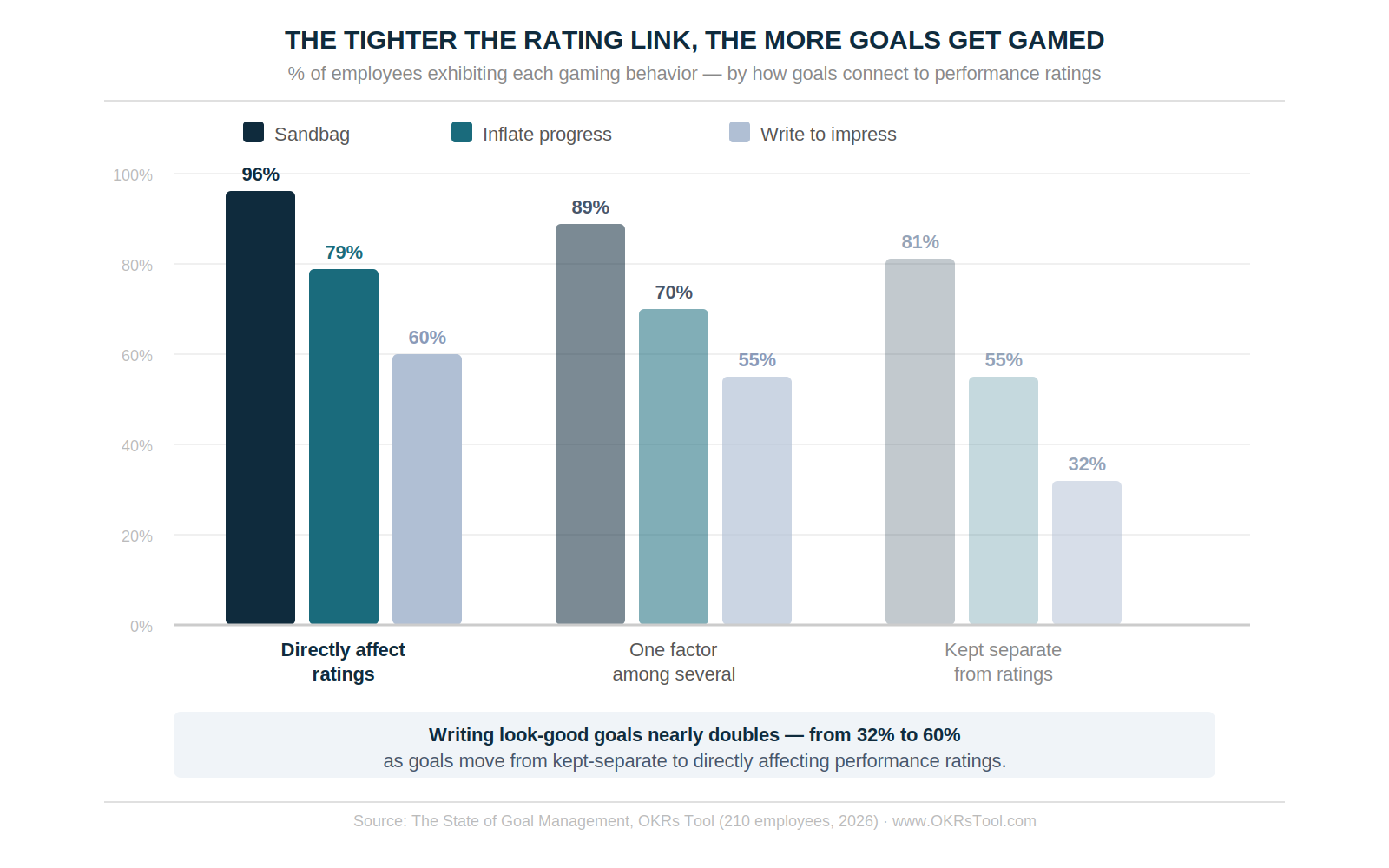
Conventional wisdom says goals work better when they carry weight — when hitting them affects how people are rated. The data says the opposite. As the link between goals and performance ratings tightens, every gaming behavior rises in lockstep.
When goals directly affect performance ratings, 96% of employees sandbag and 60% write look-good goals. When goals are kept separate from ratings, those figures fall to 81% and 32%. The mechanism most organizations reach for to make goals matter — accountability through performance reviews — is the same mechanism that quietly corrupts them.
When a missed goal becomes a mark against you, the rational move is to set a goal you have already hit. Accountability without psychological safety doesn't produce honesty. It produces better-looking dishonesty.
The Load-Bearing Test
A goal system is load-bearing when removing it would visibly change how people work. By that test, most aren't.
34% of employees say nothing about how they work would change if their goal tracker were deleted tomorrow. Only 17% say a lot would change. The rest — nearly half — say some things would change, which likely means the weekly status update would be slightly less structured.
The dividing line between load-bearing and decorative isn't tooling or framework. It's whether goals get a real ending. The dividing line is whether goals get a real ending — a retrospective, a manager conversation, a resource decision — and whether that ending happens every time. Consistency is what separates a load-bearing goal system from a decorative one.
The Recall Cliff
Before a goal even reaches the end of the cycle, two earlier signals predict whether it will matter: whether people can name it, and whether anyone watches it between reviews.
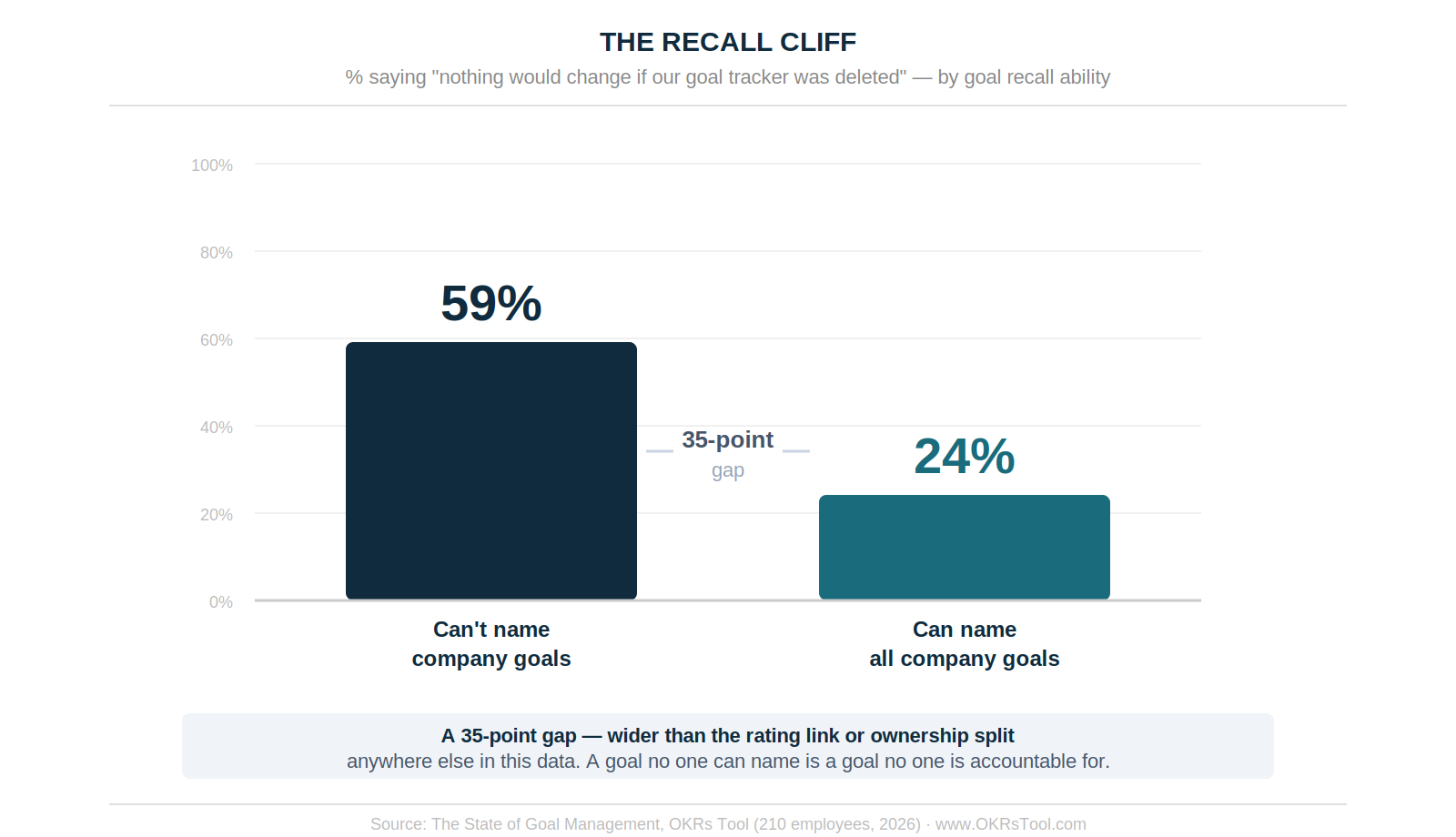
Only 30% of employees can name all of their company's current top goals without looking them up. Among employees who can't name their company's OKRs, 59% say nothing would change if the tracker disappeared. Among those who can name them all, just 24% say the same — a 35-point gap wider than any other variable in the data.
Visibility between reviews tells the same story. When nobody — or only the one person who maintains the tracker — checks goals between reviews, the share saying nothing would change and the share whose goals quietly vanished both climb to 45%. When the whole team watches, both fall to 27%.
A goal no one can name, and no one watches, is one no one is accountable for.
What the Highest-Performing Organizations Do Differently
The organizations whose goals actually work in 2026 don't have better templates or stricter scoring. They have more honest systems — four structural disciplines that show up consistently in the data.
Decouple goals from the verdict. The tighter goals are bound to ratings, the more they get gamed. The highest-performing organizations use OKR delivery data as informed context for performance conversations — not as a pass/fail score. This makes ambition safe to admit, so people set goals they might miss rather than ones they've already hit.
Make the real state always visible. Watermelon goals survive because their true health is only assembled at review time. When progress is visible continuously — through weekly check-ins and live dashboards — a goal can't be quietly inflated to quarter end. The 2026 OKR Benchmark Report found teams with automated weekly check-ins complete 43% more OKRs than those without. This is the same mechanism that makes gaming harder: when progress is visible live, inflation becomes immediately apparent.
Give every goal a real ending. Goals stop mattering the moment they can vanish without consequence. The end-of-cycle retrospective — naming what happened, scoring honestly, committing to specific structural changes — is what makes a goal system load-bearing. Without it, goals are quarterly planning exercises, not management tools.
Pair ownership with honest progress. Ownership drives commitment — but ownership without visible progress hands people the means to manage appearances. Required single ownership inside a system that surfaces real progress continuously rewards owners for truth, not polish. Teams with required single ownership see 26% higher completion rates than those without.
The Data Behind the Action Plan
None of these fixes are exotic. They are structural operating disciplines — visible progress, safe ambition, real endings, honest ownership — that the data consistently separates high-performing from decorative goal systems.
The full report includes the complete dataset, a self-assessment tool across six dimensions with a scoring framework, and a four-move action plan built entirely from what the highest-performing organizations in this study do differently.
The organizations whose goals work in 2026 are running honest systems. Everyone else is managing appearances on a dashboard nobody fully trusts. See how OKRs Tool enforces the structural disciplines the data shows separate load-bearing goal systems from decorative ones.
Data: The State of Goal Management, OKRs Tool (210 full-time employees at growing companies, 2026). The 2026 OKR Benchmark Report (200+ organizations).