
Per-user pricing turns a group-wide rollout into a headcount tax, and 61% of leaders still run strategy on spreadsheets because the tools priced them out of covering everyone. A flat organizational price changes that math.
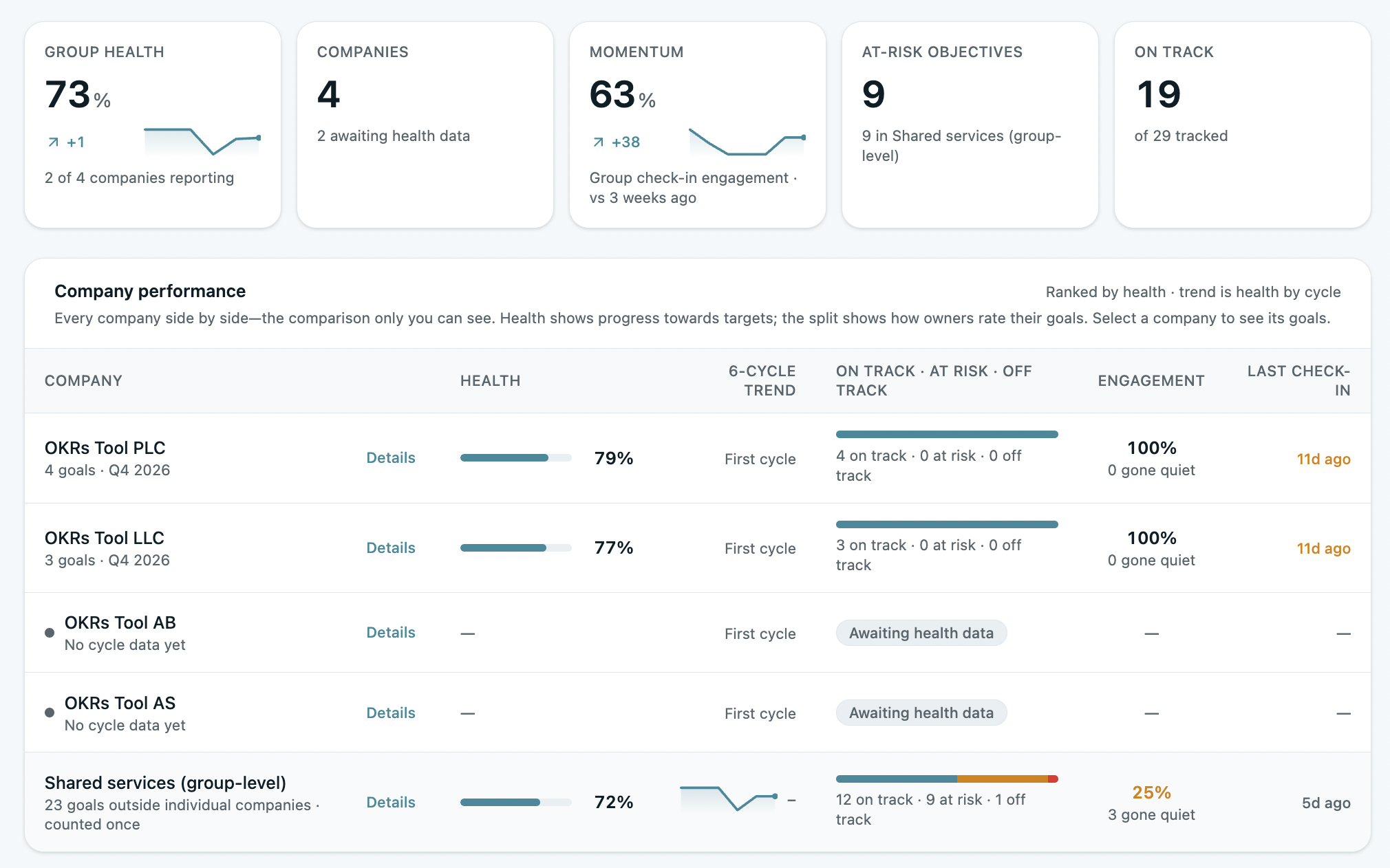
OKRs Tool rolls goals out across a group of companies under one flat, per-organization price, with no per-user fees. Each company in the group gets its own workspace and role-scoped access: the group head sees every company, while each company head sees only their own.
Every company's goals roll up into a single group portfolio, so leadership gets one live view across all of them. Data stays in the EU, setup takes an afternoon per company, and a 60% adoption guarantee backs the rollout. For a group that wants OKRs across all its companies at once, the pricing model and the role-scoped structure are the two things that decide whether it sticks.
How a Group Rollout Works in OKRs Tool
Each company in the group runs its own workspace, and access is scoped by role. The group head sees every company's goals in one place; each company head sees only their own company, down to its departments and teams. A company's head creates its departments and teams inside its own view, which is what ties that structure to the company.
Every company's objectives roll up into a group portfolio, so one person can read progress across all of them without logging into each. The same alignment map that connects a single company's team goals to its top objective also shows how each company's goals ladder up to the group, using the cascading structure OKRs run on.
A company objective that supports a group objective is shown with clear roll-up cues, and goals carry a Group or company label so nobody confuses the two levels.
This matters because a group is several companies setting their own objectives at once, each with team-level goals underneath. Without role-scoped access, every head either sees everyone else's numbers or sees nothing. The scoping is what lets a group buy one platform and still give each company a private view.
Why Per-User Pricing Punishes a Group Rollout
Per-user pricing charges for every person you add, so covering an entire group multiplies the bill by total headcount. At a representative $10 per user per month, a 600-person group runs about $72,000 a year before any discount, and the cost climbs every time another company joins. Teams respond by leaving people out of the tool to hold the price down, which is the surest way to kill adoption.
A flat-rate model removes that pressure. You pay per organization, with no per-user charge, so adding people or rolling OKRs out to the next company in the group never changes the per-head math.
The standard OKRs Tool plan is a flat monthly fee for the whole organization, and groups run on a flat Enterprise plan billed annually with unlimited users; the current numbers sit on the pricing page. The point holds at every size: the price tracks the organization rather than the seat count, which is why a flat-rate platform scores well among OKR software options for groups that need to cover everyone.
What a Group Needs Beyond the Price
Price gets a group in the door; structure and visibility are what make the rollout work. A group rollout needs role-scoped access, goal roll-up into one portfolio, fast adoption, and hosting that clears a compliance review — and few tools deliver all of it.
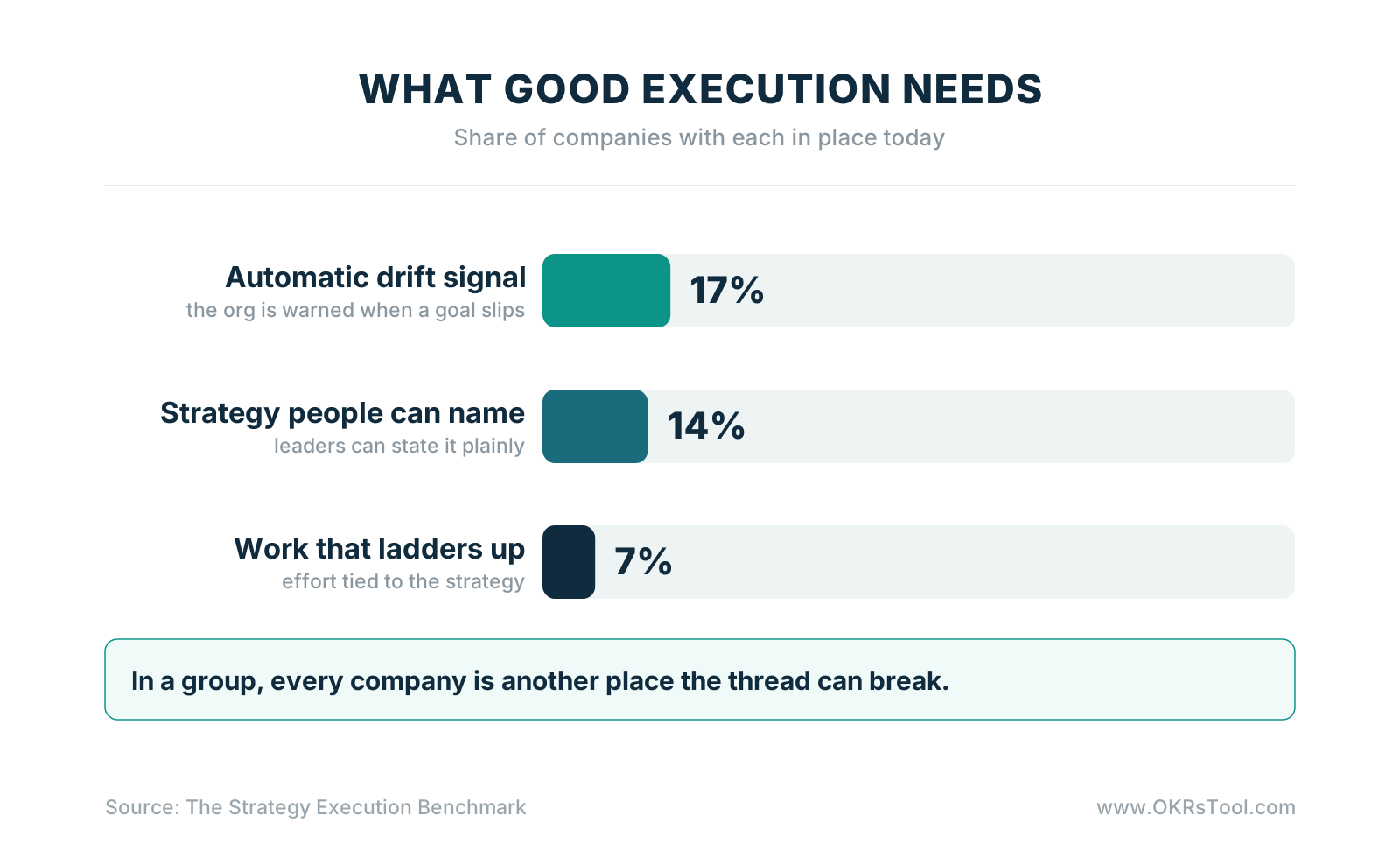
Visibility across the group is the hardest part to get right. In the Strategy Execution Benchmark, 86% of leaders could not name their company's strategy and only 7% said most of their work ladders up to it, so a portfolio that shows each company's goals laddering to the group does the job the benchmark says is usually missing.
On hosting, group data stays in the EU on AWS Ireland, under GDPR with a signed DPA on request, with per-tenant isolation and SSO and SCIM available on the Enterprise plan. Every company's goal ownership and check-in history stay inside that company's scope, drawn from the same platform data across 3,527 organizations that informs the product. OKRs Tool holds 4.6 on G2 and 4.6 on Gartner Peer Insights.
Getting Every Company Live in an Afternoon
A group does not need a consultant or a quarter-long implementation. Each company sets up in an afternoon, concierge migration moves existing goals off spreadsheets, and the automated check-in engine chases progress so heads are not doing it by hand.
Speed matters because rollouts die from neglect. The Death of OKRs study found half of programs abandoned on at least one team, with drop-off peaking at the second and third cycle rather than at launch — the exact point where manual upkeep wears a champion down. Built-in check-ins and progress tracking carry a group past that point, which is where so many rollouts stall.
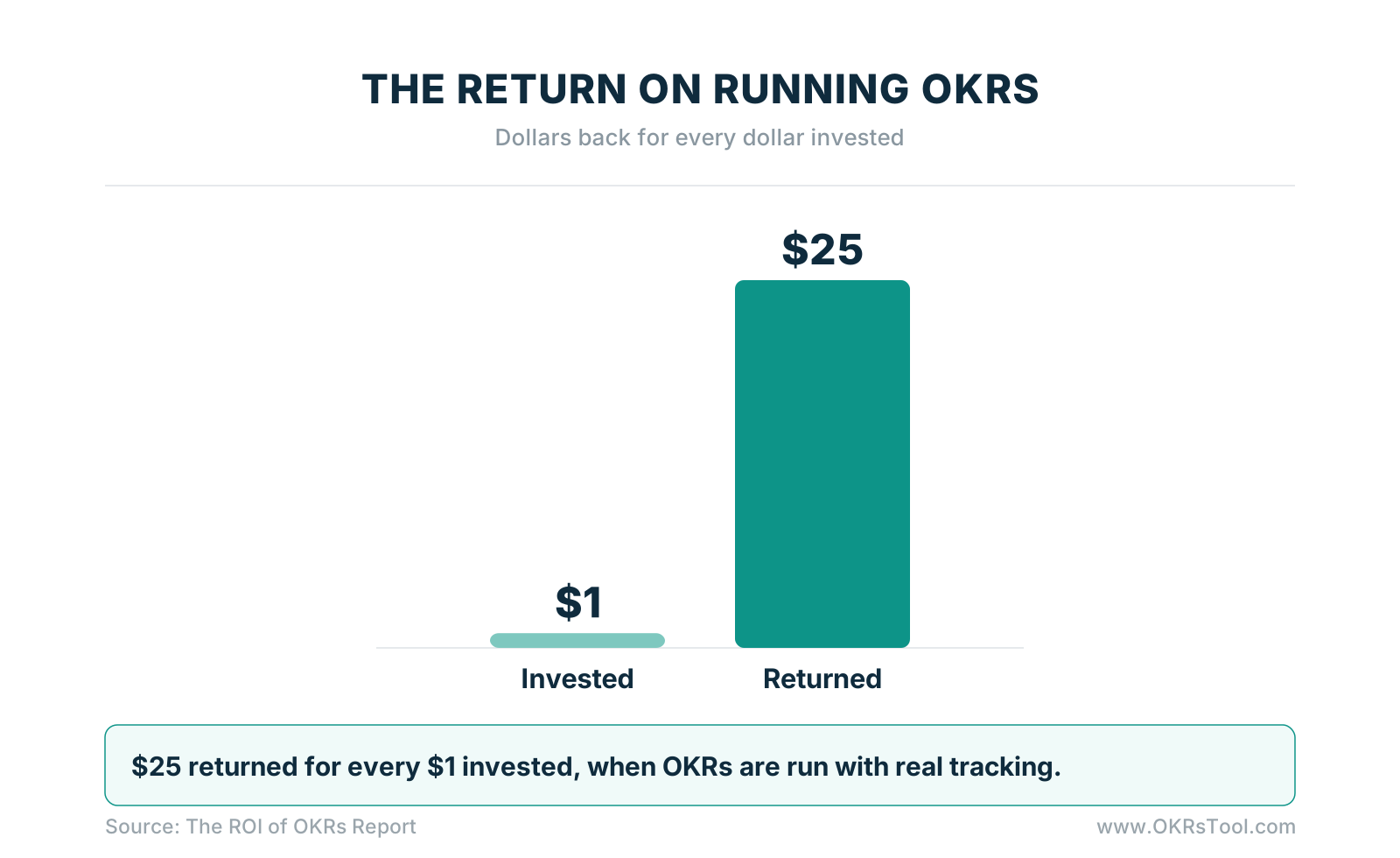
The teams that get past those early cycles see the return. The ROI of OKRs Report puts it at $25 for every $1 invested when OKRs are run with steady tracking rather than left to drift.
Every paid plan includes the 60% adoption guarantee: if your team isn't at 60% adoption in 30 days, you get a full refund — no forms, no disputes. It has not been invoked since 2024. For a group betting on one person's judgment to roll OKRs out across several companies, that guarantee carries the risk instead of the buyer. The practical steps for a first cycle are the same ones in the OKR rollout guide, and the broader method sits in the main OKR guide.
Common Questions About Group OKR Rollouts
Does OKRs Tool charge per user?No. OKRs Tool uses flat-rate pricing: you pay one fee per organization, with unlimited users and no per-seat charges. Adding people or rolling out to another company in the group does not raise the per-user cost.
Can each company in the group keep its goals private?Yes. Access is role-scoped. The group head sees every company, while each company head sees only their own company, its departments, and its teams. Every company's goals still roll up into a single group portfolio for leadership.
Where is group data hosted?Group data stays in the EU on AWS Ireland, under GDPR with a signed DPA on request and per-tenant isolation. SSO and SCIM are available on the Enterprise plan.
How fast can a group go live?Each company sets up in an afternoon, with concierge migration to move existing goals off spreadsheets. No consultant or formal implementation project is required.
What happens if adoption is low?Every paid plan includes a 60% adoption guarantee: if your team isn't at 60% adoption in 30 days, you get a full refund, with no forms and no disputes.
A Group Rollout Shouldn't Cost More Because It Grew
A group that standardizes on OKRs is trying to see every company in one place and keep each one accountable for its own goals. Per-user pricing works against that, charging more for every person included and nudging teams to leave people out.
Flat-rate pricing, role-scoped access, and a group portfolio let one leader roll OKRs out across all of it, give each company a private view, and read progress from a single screen. The structure covers the whole group, and the price does too.
Data: The Strategy Execution Benchmark, The ROI of OKRs Report, The Death of OKRs, and OKRs Tool platform data.