
Watermelon reporting is when a goal shows green status while the reality is red. It's not a character flaw. It's a rational response to systems that punish honesty. The State of Goal Management (OKRs Tool, 2026) found 70% of employees have reported a goal as healthier than they knew it to be. That number doesn't reflect bad intent — it reflects bad system design.
The term comes from produce, not technology. A watermelon looks green and healthy on the outside. Cut it open and it's red inside. The metaphor has been used in project management for decades to describe the same pattern: status reports that show everything is fine while the underlying reality is that things are not fine.
In OKR programmes, watermelon reporting is the most common and most corrosive failure mode. It's more damaging than missing goals outright — because it denies leadership the signal they need to intervene while there's still time to act.
How Common Watermelon Reporting Actually Is
The State of Goal Management asked employees directly what they do to their goals when nobody is grading the answer.
70% of employees admitted to reporting a goal as healthier than they knew it to be. This wasn't a fringe finding — it was the second most common form of goal-gaming after sandbagging, and it appeared across every seniority level, function, and company size in the dataset.
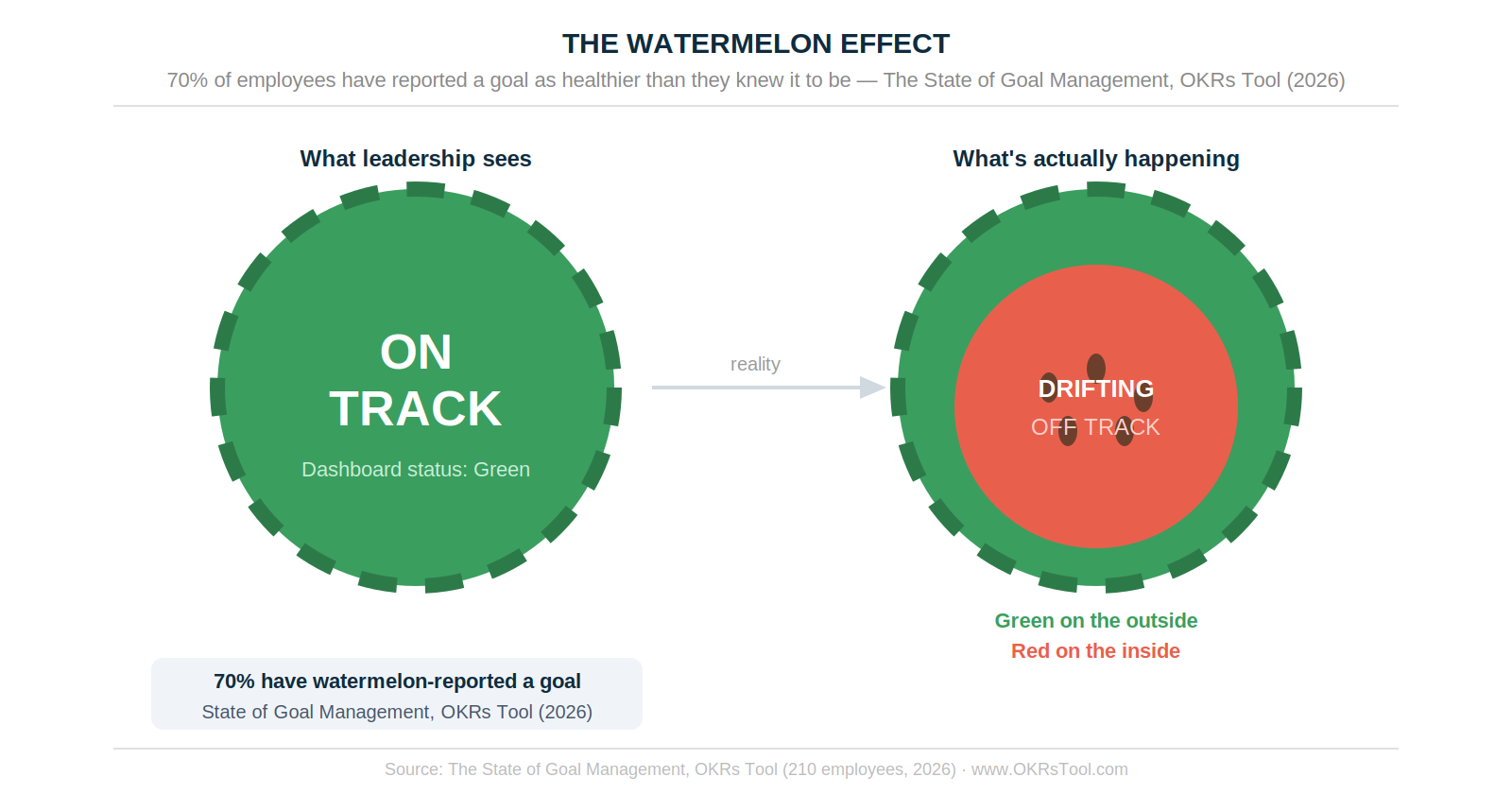
The 70% figure captures something important: watermelon reporting is not a minority behaviour. It's the default response of people working inside systems where reporting honestly has costs and reporting optimistically has none. The problem isn't the people — it's the incentive structure.
Why It Happens
Watermelon reporting is rational. That's what makes it persistent.
When a goal is behind, the owner faces a choice: report it accurately (and face questions, pressure, or a perception of underperformance) or report it optimistically (and buy time to recover, avoid the conversation, or manage the narrative). In most organizations, the honest path has more short-term cost than the optimistic one.
The State of Goal Management found that the incentive to misreport increases dramatically when goals are tied to performance ratings. When goals directly affect performance ratings, 79% of employees admit to inflating a goal's health — compared to 55% when goals are kept separate from ratings. Tying OKRs to compensation doesn't make people more honest. It makes them more careful about what they admit.
The second driver is visibility. Watermelon goals survive because their true health is only assembled at review time. When the only moment of scrutiny is the quarterly review, there's an entire quarter for problems to stay invisible — and for the optimistic narrative to calcify. Weekly check-ins don't just drive completion rates. They remove the conditions that make watermelon reporting low-risk.
What a Watermelon OKR Looks Like
The pattern is consistent. A Key Result starts the quarter with an ambitious target. In the first few weeks, updates are regular and optimistic. By week six, updates slow. The status stays green. Progress numbers edge upward slightly — not enough to be alarming, but enough to justify the status.
At cycle end, the true score emerges. The Key Result is at 35% of target. Leadership is surprised. The owner explains that things were more complex than expected. The retrospective produces vague commitments to "set more realistic targets next quarter."
The underlying problem — that the Key Result was off track from week four and nobody said so — is never addressed. The retrospective treats the miss as a planning failure rather than a reporting failure. And the same pattern repeats next cycle.
The Three Conditions That Produce Watermelon OKRs
Infrequent visibility. When progress is only reviewed monthly or quarterly, problems can hide for weeks. The 2026 OKR Benchmark Report found teams that check in weekly complete 43% more OKRs than those reviewing monthly — not because weekly check-ins make goals easier, but because problems surface in week four rather than week twelve.
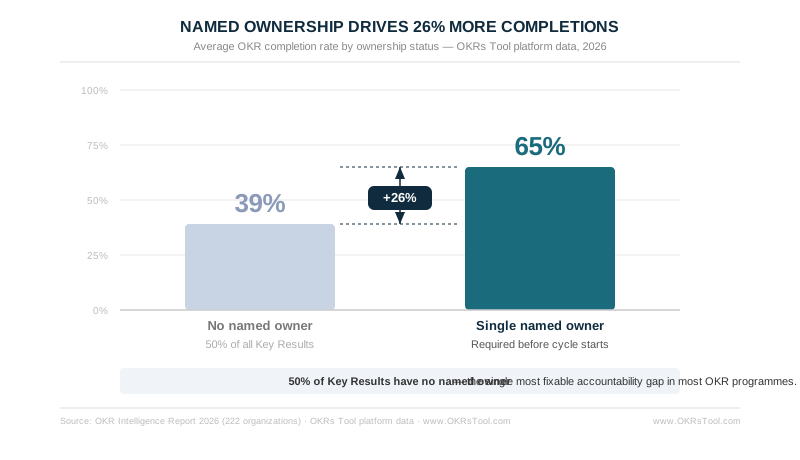
No single named owner. When ownership is shared or vague, watermelon reporting becomes a group behaviour. Nobody is individually responsible for the honest status — which means nobody is individually responsible for disclosing the real one. Teams with required single ownership per Key Result see 26% higher completion rates and, structurally, have one person whose name is attached to the true progress score every week.
Goals tied to performance ratings. This is the strongest predictor of watermelon reporting in the data. When the consequence of an honest red status is a negative performance mark, the rational response is to keep the status green for as long as possible. The OKR framework deliberately separates goals from compensation for exactly this reason — ambition requires psychological safety.
How to Fix It
Make the real state always visible. The most direct fix is structural: weekly check-ins with a required honest status update. When progress is visible continuously — updated every week with a current score, not a narrative — a goal can't be quietly inflated to quarter end without the drift being apparent in the data.
Reward honesty, not polish. When a team member flags a Key Result as at-risk in week four, the response from leadership determines whether the next team member will do the same in week five. If early flagging is met with problem-solving rather than blame, the incentive to watermelon report disappears. If it's met with scrutiny or pressure, the incentive to watermelon report doubles.
Decouple goals from ratings. The data is direct: 79% inflate progress when goals affect ratings, 55% when goals are kept separate. The OKR scoring system uses a 0.0–1.0 scale specifically because it's designed to encourage honest stretch targets — a 0.7 is a success, not a failure. When that score feeds directly into a performance review, the 0.7 becomes a risk and the incentive to inflate toward 1.0 takes over.
Use software that makes honesty the default. OKR tools that surface at-risk flags automatically — based on progress velocity and update frequency rather than owner self-reporting — remove the owner's ability to manage the narrative. When the system flags a Key Result as at-risk before the owner reports it, the watermelon dynamic breaks.
Watermelon OKRs and the Load-Bearing Test
The State of Goal Management includes a finding that connects directly to watermelon reporting: 34% of employees say nothing about how they work would change if their goal tracker were deleted tomorrow.
The connection is direct. A goal system full of watermelon OKRs is not load-bearing — it exists, gets updated, looks healthy, and influences nothing. The 34% who say nothing would change if the tracker disappeared are likely working in exactly this environment: goals that are maintained as a reporting exercise rather than a genuine steering mechanism.
Fixing watermelon reporting fixes the load-bearing problem. When OKR dashboards reflect reality — when the red inside is visible on the outside — goals start influencing decisions. They become the reason a conversation happens, a resource gets reallocated, or a priority gets adjusted. They stop being a quarterly document and start being the actual management system.
See how OKRs Tool keeps Key Results honest — with weekly check-ins that surface at-risk flags automatically and required single ownership that puts one name on every progress score every week.
Data: The State of Goal Management, OKRs Tool (210 full-time employees at growing companies, 2026). The 2026 OKR Benchmark Report (200+ organizations).