
An output is work you finished; an outcome is a result that changed because of it. Across 20,952 Key Results, 52% measured an output or a metric already being tracked — activity dressed up as a goal — which is the quietest way for a quarter of effort to produce nothing.
A team can ship every feature on its roadmap, close every task, and hit 100% of its plan while the number that matters to the business sits exactly where it started. The goals were real, the work was real, and the result never moved. That happens when goals measure activity instead of the change the activity was supposed to cause.
The gap between the two decides real results. An OKR written as an output — "launch the new onboarding flow" — is done the moment the flow ships, whether or not one extra customer activates. Written as an outcome — "raise Day 7 activation from 34% to 55%" — it's done only when the number arrives. Same project, same effort, opposite definition of done. Getting that definition right is most of the craft of writing a good OKR.
An Output Is Work You Control
An output is something your team produces: a feature shipped, a campaign sent, a report delivered, fifty calls made. Outputs are concrete, countable, and satisfying to finish. They sit at the level of activity, and they're mostly inside your direct control — decide to ship a feature and you can ship it.
That control is why outputs are seductive as goals. A goal you fully control is a goal you can reliably hit, which feels like competence. But hitting it proves only that the work got done, not that it mattered.
A team can finish every output on its roadmap and still lose the quarter, because none of them moved the result they were meant to move. You can see the pattern in real OKR examples where the goals list activity instead of change.
An Outcome Is a Result You Only Partly Control
An outcome is the change your outputs are meant to cause: activation rising, churn falling, revenue growing, a support queue shrinking. Outcomes sit at the level of results, and they're only partly in your control.
You can build the onboarding flow; you can't force customers to activate. You can run the retention campaign; churn still depends on things the campaign doesn't touch.
That partial control is what makes an outcome worth setting as a goal. It forces a team to test whether its chosen outputs actually work. When activation stays flat, an output goal says "we shipped it, we're done"; an outcome goal says "it shipped, activation didn't move, the theory was wrong."
The second version keeps the loop open, which is where a team learns. It's the same reason a key result is written as a measurable target rather than a task, and scored honestly at cycle end against where the number landed.
Output vs Outcome, Side by Side
Seeing one intention written both ways makes the split obvious. In every row the output is a reasonable piece of work — outputs aren't the problem; stopping at the output and leaving the result unmeasured is.
Each outcome carries a baseline and a target. None of the outputs do. That's the tell: an output can be declared done, an outcome can only be measured against where it started.
Half of Real Key Results Are Outputs in Disguise
When we looked at the Key Results teams actually write, the majority weren't outcomes.
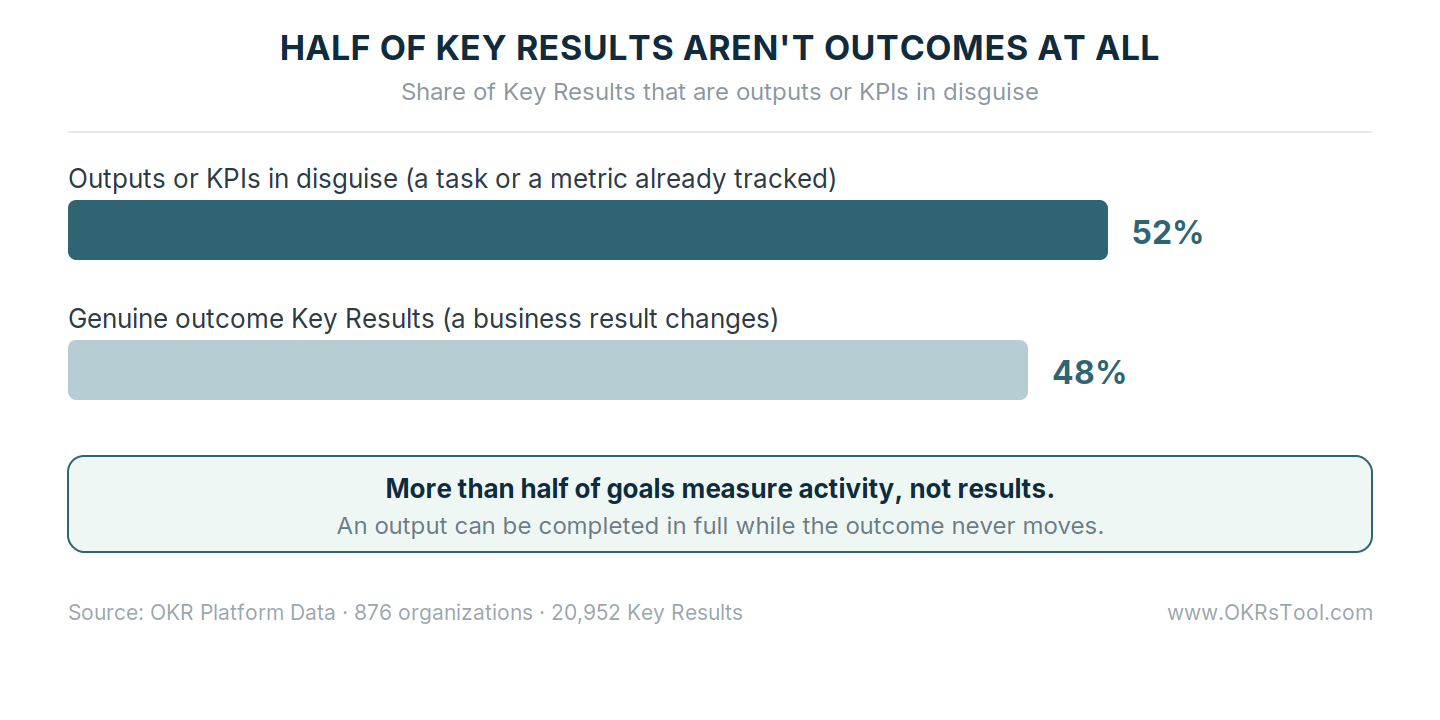
Across 20,952 Key Results, 52% were outputs or KPIs in disguise — tasks to complete, or metrics the team already monitored, rather than a deliberate result to change this cycle.
More than half of all goals measured activity or ongoing health instead of the specific change they were supposed to drive. It's the same root cause behind weak OKR alignment: a goal that measures activity can't tell a team whether its work is laddering up to anything.
An output goal can be finished without producing anything, so it gives no feedback on whether the strategy behind it was right. A team that sets only output goals learns its theory was wrong far too late, because every output came in green.
Outcome goals expose that gap while there's still time to act: the work shipped, the number didn't move, and now there's a real signal instead of a checked box.
The Two-Second Test
You don't need a rubric to catch an output goal. You need one question and a look at the verb.
The question: can this be marked complete without any business metric changing? If yes, it's an output. "Launch the onboarding flow" passes — you can launch it and nothing else has to happen. "Raise activation to 55%" fails, in the right way: it can't be complete unless the number moved.
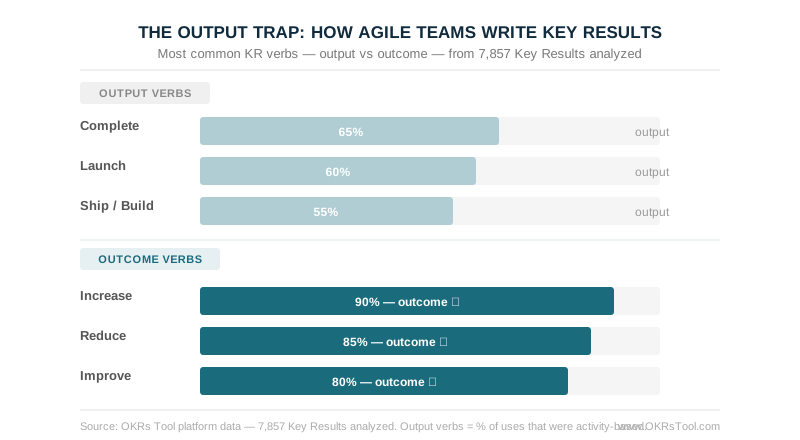
The verb is faster. Output goals open with an activity word — complete, launch, conduct, maintain, track. Outcome goals open with a change word — increase, reduce, improve, grow, cut. The most common verb across the Key Results we analyzed was "complete," which describes a task and proves nothing about impact.
A Key Result that opens with an activity verb is probably an output, and probably needs rewriting before the cycle starts.
Rewrite It Into the Baseline-to-Target Format
The rewrite is one fixed shape: move a specific metric from a baseline to a target by a date. "Raise Day 7 activation from 34% to 55% by end of Q2."
An output can't be written this way — it has no baseline and no metric to move, so the format rejects it automatically. That's what makes it useful: force every Key Result into the shape, and the disguised outputs fall out on their own.
It's the same line that separates a Key Result from a restated KPI — a number you already watch, dropped into the goal column with no target attached. A goal in this shape names the current state, the destination, and the deadline. If it's missing any of the three, it isn't an outcome yet — just an OKR waiting to be fixed.

Outputs Still Matter — One Level Down
Outputs aren't the enemy. They're how outcomes get produced — you can't raise activation without shipping something. The mistake is putting them at the same level as the result, not having both.
In an OKR cycle, the outcome is the Key Result and the outputs are the initiatives beneath it — the bets a team makes to move the number. "Raise activation to 55%" is the Key Result; "ship the new onboarding flow" and "add the day-3 nudge email" are the outputs meant to get there.
Keeping them separate lets a team track progress honestly: if every output ships and the outcome stays flat, the bets were wrong and it's time to change them, without pretending the goal was met.
An outcome needs a weekly check-in more than an output does. An output either shipped or it didn't. An outcome moves gradually, and the only way to know whether the outputs are working is to watch the metric across the cycle, early enough to change course.
Teams that check in weekly complete 43% more of their goals — but that only holds when the goals are outcomes worth checking in the first place. Watching an outcome and its underlying initiatives in one place is what makes the weekly read possible without rebuilding a spreadsheet each Monday.
Write the Goal as the Result, Not the Work
An output is the work you finished. An outcome is what changed because you did it. A goal is worth setting only when it's written as the second — and output goals are easier to write, easier to control, and easier to mark done, so every incentive points at them. That's how 52% of real Key Results end up as outputs.
The cost arrives a quarter later, when the work is finished and the number never moved. Run each goal through the one question before the cycle starts: can this be complete while every business metric stays exactly the same?
If it can, it's an output, and there's still time to rewrite it as the outcome you wanted. That rewrite, from motion to impact, turns a quarter of effort into a quarter of progress.
Data: OKR Platform Data (876 organizations, 7,419 objectives, 20,952 Key Results — first-party behavioral). The 2026 OKR Benchmark Report (200 organizations). Explore all reports on the research hub.