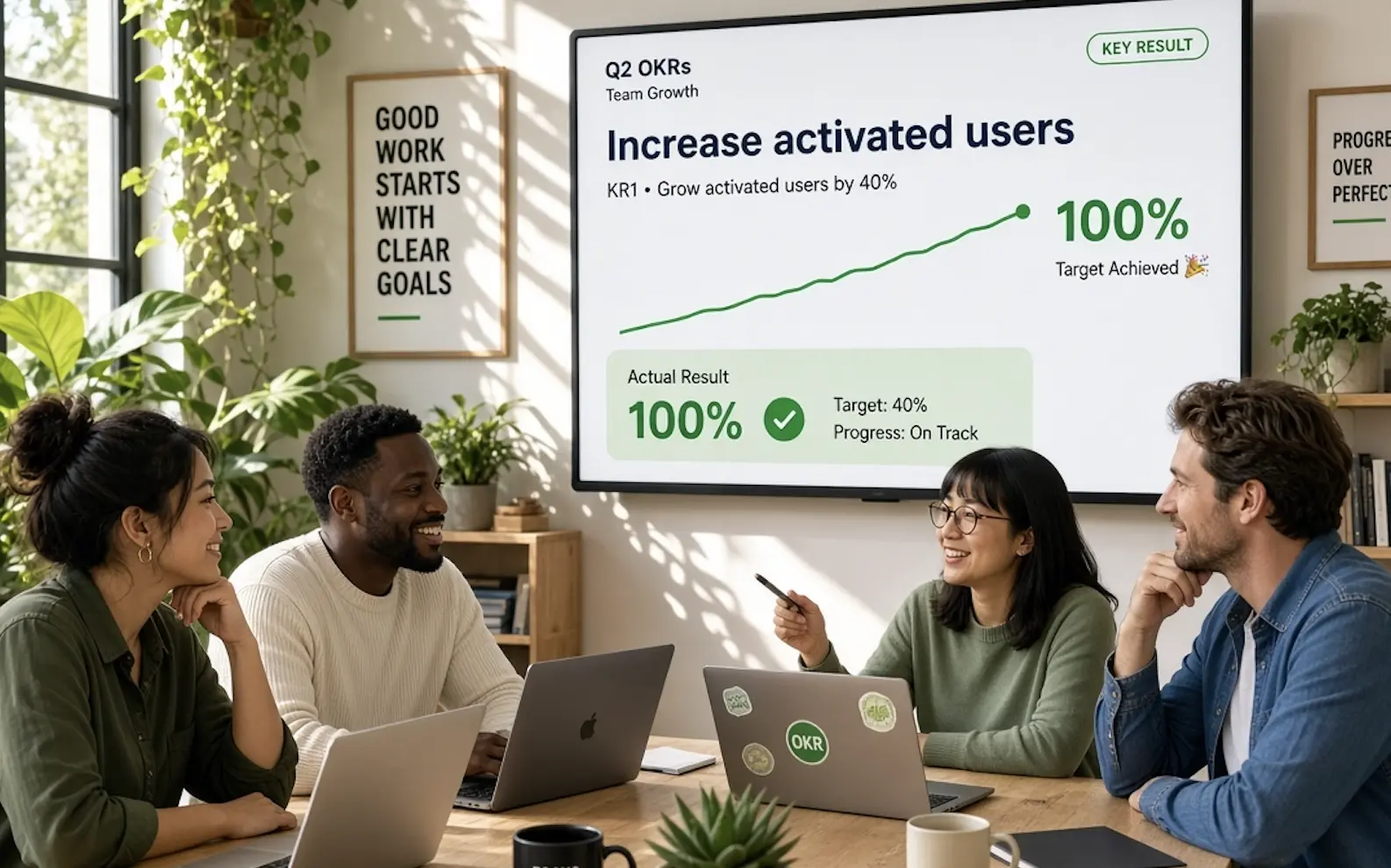
The benchmark sweet spot for stretch goals is 70–80% completion, not 100%. The 2026 OKR Benchmark Report (200 organizations) identifies that band as the rate that signals genuinely ambitious, well-owned goals — far enough beyond current capability to require real change, close enough to realistic that the team commits to the work. That calibration is what separates a stretch goal from an aspirational statement that fades out by week four.
Teams that try stretch goals usually fail on the structural habits rather than the ambition of the targets: named ownership per Key Result, a weekly check-in that keeps progress visible, and an honest score at cycle end that feeds the next quarter's planning.
The newest research backs this directly — the Goal-Setting Benchmark found a goal tracked closely hits 51% of the time against 29% for one set well but left to drift, and teams running three or four core habits hit their goals 2.9x more consistently than teams running none.
Without those habits, a stretch goal becomes stretch theatre — an ambitious-sounding target nobody is actively working to close. It's the same pattern that runs through goal setting generally: the system around the goal decides more than the goal itself.
What a Stretch Goal Actually Is
A stretch goal is an Objective set at the level where achieving 70–80% of the Key Results underneath it represents genuine progress — not a safe target hit on the last day of the quarter.
Andy Grove introduced this logic at Intel when he built the OKR framework in the 1970s. The goal is ambitious enough that a 0.7 score is a success, and honest enough that a 1.0 score prompts a question: was this actually ambitious enough? A team that hits 100% of every Key Result every cycle is almost certainly sandbagging. The State of Goal Management found 89% of employees admit sandbagging, and the rate rises to 96% when goal scores affect performance ratings. Stretch goals only work when scores are decoupled from compensation and the failure to reach 100% is treated as calibration, not underperformance.
The practical test: if every member of the team could have told you in week one exactly how the OKR would end, it was a safe target with a bold-sounding Objective written above it — not a stretch goal.
The Completion Rate Diagnostic
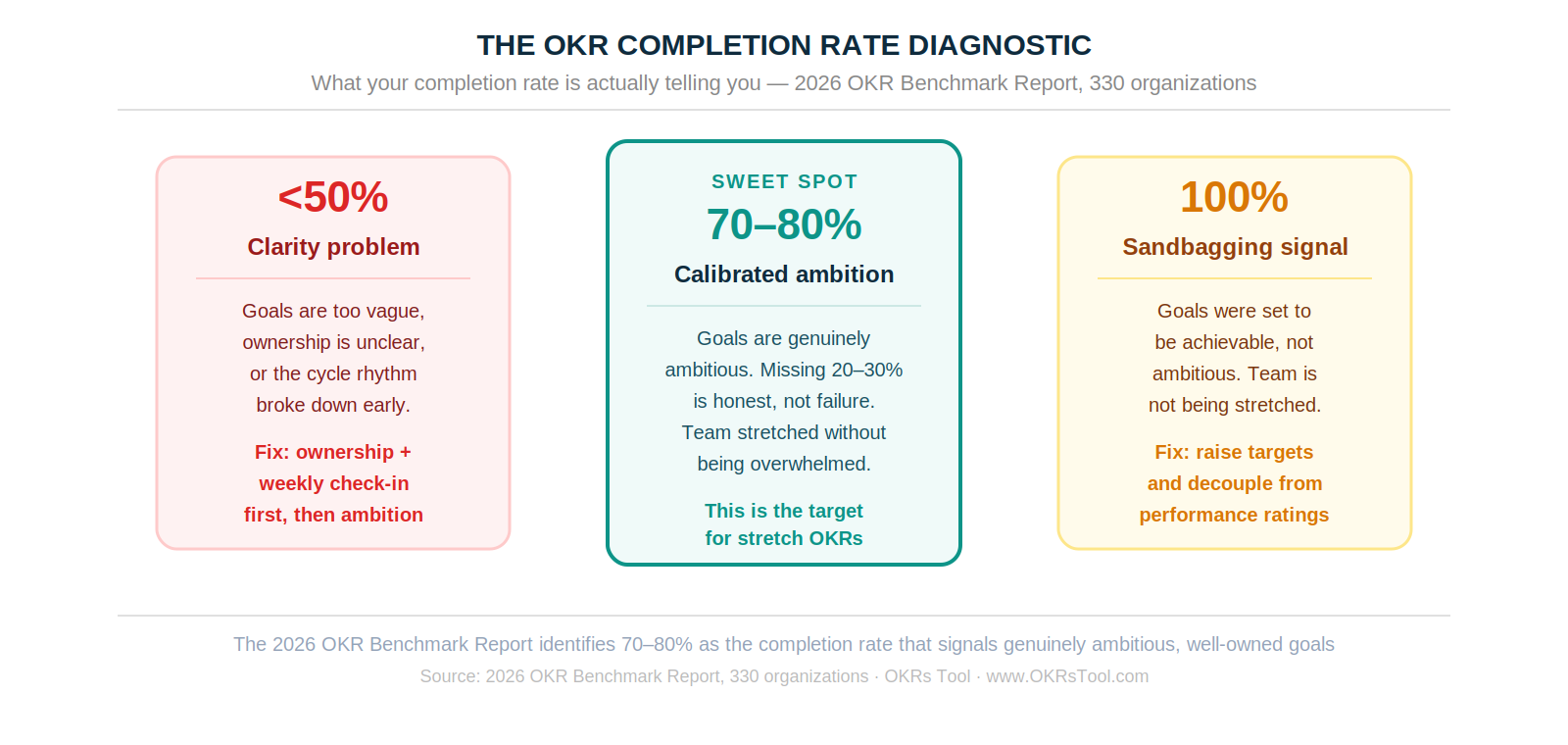
Under 50% completion points to a structural problem, not a stretch problem: goals are too vague, ownership is unclear, or the weekly check-in habit broke down early. Raising the ambition of the targets before fixing those habits makes everything worse.
Consistently hitting 100% signals the opposite problem: targets that don't require genuine effort to hit. The benchmark data is direct — teams in this zone are leaving performance and growth on the table by optimizing for certainty rather than progress. The right response is to raise the target until the team is genuinely uncertain whether they can get to 0.7 by cycle end.
The 70–80% zone is where stretch goals live: ambitious enough that missing 20–30% of the target is expected and honest, structured enough that the named owner of each Key Result is working toward it every week, and transparent enough that drift is caught in week three rather than discovered at the end-of-cycle review.
How to Write Stretch Goals as OKRs
The format that produces genuine stretch is the baseline-to-target structure: Improve [outcome] from [current state] to [ambitious target] by [end of quarter]. The baseline forces a diagnostic before the target is set — you can't write a stretch goal without knowing where you're starting from. The ambitious target defines what 0.7 looks like. The date boundary is what makes it a quarterly OKR rather than an aspiration.
Two to three Key Results per Objective — each measuring a different dimension of the change the Objective is trying to create. More than three dilutes focus and makes it easier to declare partial success without genuine progress. One named owner per Key Result, assigned before the cycle starts.
Notice what both examples share: a current baseline, a specific ambitious target, and a clear outcome measure — not a task. That structure is what makes them trackable weekly rather than reviewed once at cycle end. "Launch an enterprise sales programme" is a task. "Close 8 enterprise deals with ACV above $25K" is a Key Result. The second one has a named success condition, a baseline to improve from, and a number the team either hits or doesn't.
The Cadence That Makes Stretch Goals Survivable
The weekly check-in is the mechanism that converts an ambitious stretch goal from a planning artifact into a live execution commitment. Teams that check in weekly complete 43% more OKRs than those reviewing monthly or ad hoc — a gap that is significantly larger for stretch goals, where drift compounds faster and mid-cycle course correction is more often required.
The check-in cadence for stretch OKRs should include three things: a current score (0.0–1.0) for each Key Result, a specific blocker if the Key Result is below trajectory, and a decision about what changes this week to close the gap. Without the blocker and the decision, the check-in becomes a status update that tells leadership what already happened rather than a mechanism for adjusting what happens next.
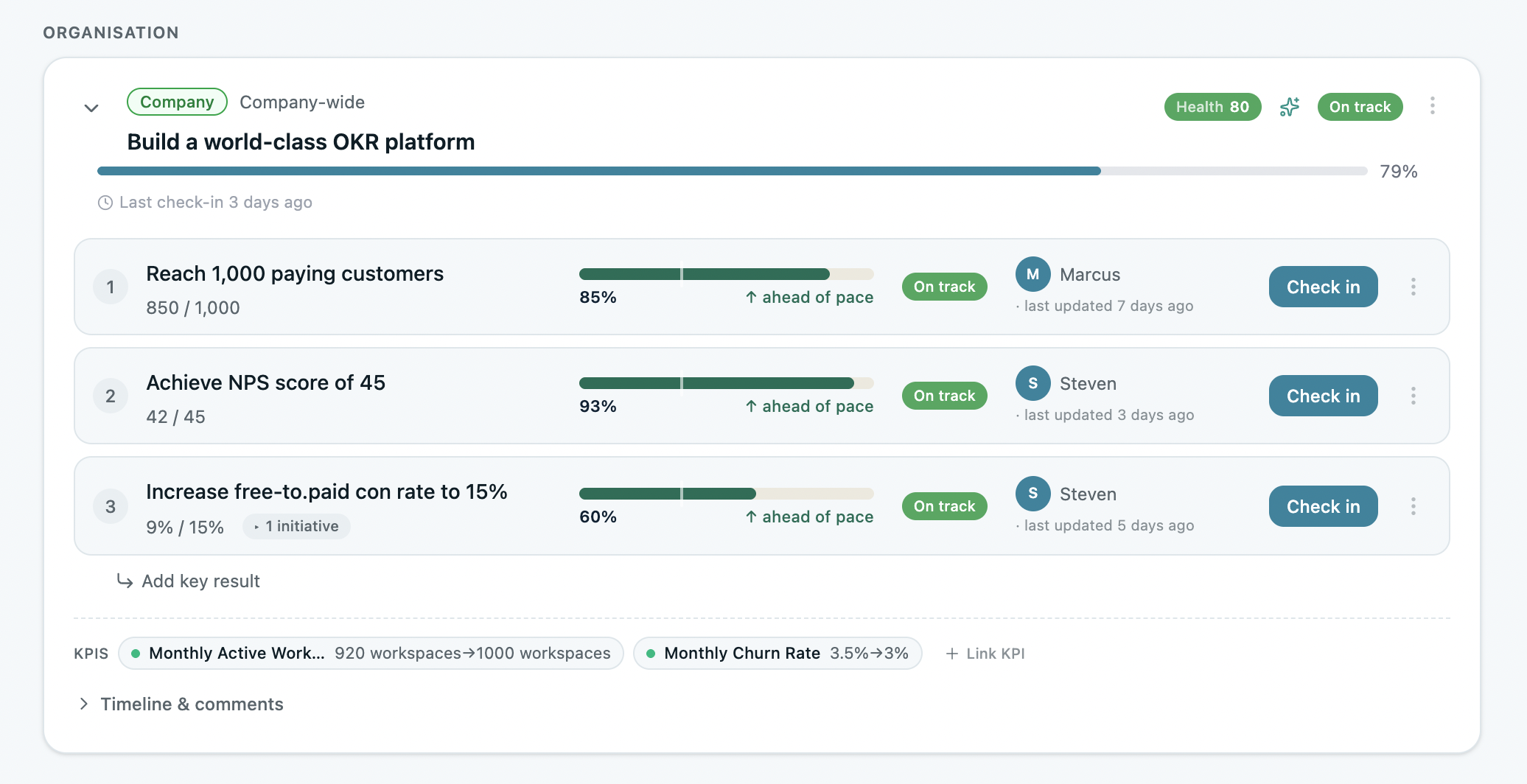
At the mid-cycle review in week six, stretch goals require a specific decision: is this Key Result still achievable at 0.7+, or has something changed that makes the target structurally unrealistic? The answer determines whether the Key Result gets revised, escalated, or formally closed. Leaving an unreachable Key Result on the board and hoping for a miracle guarantees a 0.0 score and demoralizes the team — it's the opposite of a stretch goal strategy.
Stretch Goals Compound When Cycles Close Honestly
The end-of-cycle retrospective is where stretch goals produce their compounding value. Teams that run consistent retrospectives complete 30–45% more goals the following quarter — because the retrospective converts the gap between 0.7 and 1.0 into diagnostic data for the next cycle rather than leaving it as an unexplored miss.
A stretch goal scored 0.65 with an honest retrospective is more valuable than a safe goal scored 1.0 without one. The 0.65 tells you exactly which Key Result stalled, who owned it, when the drift started, and what would need to be different next cycle to close the gap.
The 1.0 on a safe target tells you the target was wrong. The OKR maturity curve compounds from 51% completion in cycles 1–2 to 79% by cycle five precisely because each retrospective feeds the next cycle's planning session with the specific learning that makes the next stretch more calibrated than the last.
See how OKRs Tool runs the full stretch goal cycle — from calibrated target-setting to automated weekly check-ins to AI at-risk detection and honest end-of-cycle scoring — free for up to 5 users.
Data: the 2026 OKR Benchmark Report (200 organizations), the Goal-Setting Benchmark (280 operations and strategy leaders), and the State of Goal Management (210 employees).