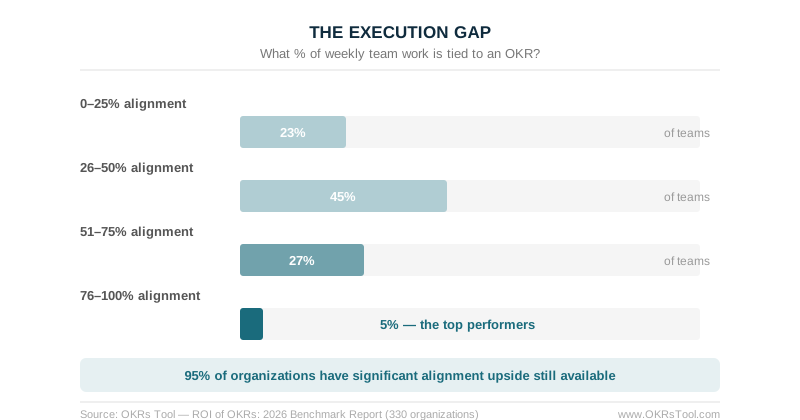
Only 5% of teams have more than three-quarters of their weekly work tied to a strategic goal, and 65% say their goals aren't linked to strategy at all. Cascading OKRs are the fix — but growing teams break them by adding layers. Three levels, weekly, is what works.
Cascading OKRs promise a straight line from company strategy to a team's weekly work. Set the company objective, break it into department goals, break those into team Key Results, and every employee can see how their work connects to the strategy. Alignment, in theory, takes care of itself.
In practice, growing teams over-build it. Extra layers turn a simple line of sight into a bureaucratic exercise, and the alignment document gets filed after kickoff and never opened again. The 2026 OKR Benchmark Report shows where that leads: only 5% of teams have more than 75% of their weekly work tied to a strategic goal, 65% admit their goals aren't linked to company strategy at all, and just 49% of leaders review OKRs weekly.
The cascade concept is sound. What breaks it is the over-engineering — five layers where three would do, vertical alignment with no horizontal check, and goals reviewed once a quarter instead of once a week. This guide covers how cascading OKRs actually work in a 50–200 person company: what to include, what to skip, and how to build a structure that drives weekly execution instead of quarterly paperwork.
What Are Cascading OKRs?
Cascading OKRs are a goal-setting approach where an organization's high-level objectives are translated into more specific, team-level goals — creating a connected hierarchy from company strategy to individual execution.
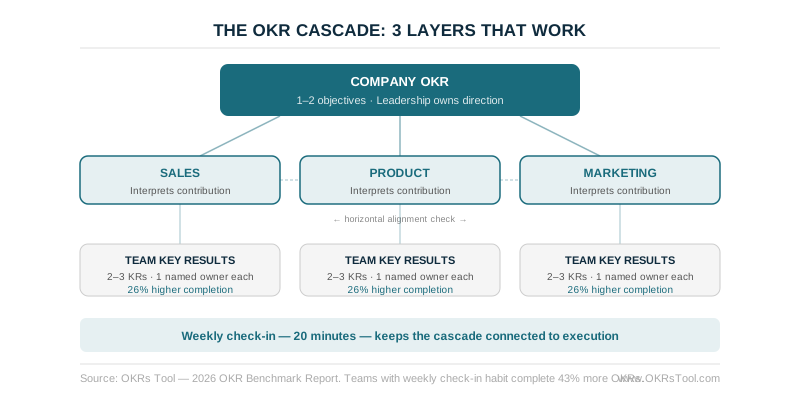
The structure works in three layers:
- Company OKRs — the 1–2 most important outcomes the organization is trying to achieve this quarter
- Department OKRs — how each function (product, sales, marketing, engineering) contributes to those company outcomes
- Team OKRs — the specific, measurable outcomes each team commits to delivering
Done well, every employee can draw a direct line from their weekly work to the company's most important strategic priority. The 1:25 return on investment that OKRs generate is largely driven by this connection — when teams can see how their work connects to outcomes that matter, focus and accountability increase.
Done poorly, the cascade becomes a bureaucratic exercise: goals that look aligned on paper but have no connection to what teams actually work on Monday morning.
Why Cascading OKRs Fail in Practice
The cascade concept is sound. The failure modes are consistent.
1. Too Many Layers
The most common mistake: cascading company → division → department → team → individual. Five layers in a 100-person company means every goal change requires re-alignment across four levels. By the time the cascade is complete, the quarter is already three weeks in.
For most growing organizations, three layers is enough: company → department → team. Individual OKRs on top of team OKRs create overhead that exceeds the alignment benefit for any organization under 200 people.
2. Rigid Vertical Alignment, No Horizontal Check
Most cascade processes focus on top-down alignment — company goals feeding into department goals feeding into team goals. They miss the most expensive misalignments: lateral ones.
Sales optimizing for deal count while customer success is measured on retention. Product shipping features while marketing is still selling the old positioning. Two teams working toward metrics that pull in opposite directions, neither aware of the conflict.
A cascade without a horizontal alignment check produces the appearance of alignment while the real misalignment stays invisible.
3. Goals That Mirror Rather Than Interpret
The cascade becomes cosmetic when teams copy company goals rather than interpret their contribution to them.
A company goal of "Become the leading platform in our category" doesn't cascade to a marketing team goal of "Become the leading platform in our category through marketing." It cascades to "Achieve top-3 organic ranking for 5 high-intent category keywords" — a specific, owned outcome that the marketing team is uniquely positioned to move.
The difference between mirroring and interpreting is the difference between a cascade that creates accountability and one that creates paper alignment.
4. Set Once, Never Reviewed
The most common cascade failure: goals documented in week one, never opened again until the quarterly review.
The benchmark data on this is precise. Teams with a weekly check-in habit complete 43% more OKRs than those reviewing monthly or ad hoc. Teams that skip the weekly rhythm are 3x more likely to abandon their goals entirely. A cascade that produces a document rather than a weekly rhythm produces no return.
How Cascading OKRs Work in Growing Organizations
The cascade structure that consistently works in 50–200 person organizations is simpler than most implementation guides suggest.
Step 1: Set 1–2 Company-Level OKRs
Leadership sets the company's most important outcomes for the quarter — not a list of strategic priorities, not an annual plan broken into quarters. One or two outcomes that, if achieved, would make the quarter a clear success.
Teams running 1–2 company OKRs per quarter are twice as likely to achieve them as those running three or more. The constraint is the point.
Step 2: Each Department Interprets Their Contribution
Each department head asks one question: "Given the company's priorities this quarter, what is our team uniquely positioned to move?"
That question produces department OKRs that genuinely contribute to company goals rather than mirror them. Sales, marketing, product, and engineering each have a specific, owned outcome that connects to the company objective — without all four saying the same thing in different words.
Step 3: Teams Define Specific Key Results
Each team translates their department objective into 2–3 measurable Key Results — specific, time-bound, outcome-based. One named owner per Key Result. No shared ownership.
Teams with clear single ownership per Key Result see 26% higher completion rates than those with shared or vague accountability. The named owner is the mechanism that makes the cascade real rather than theoretical.
Step 4: Make the Alignment Visible
The cascade only drives behavior if it's visible. An alignment map — showing how every team's Key Results connect to company priorities — is the infrastructure that replaces the quarterly alignment meeting.
Step 5: Review Weekly, Not Quarterly
The cascade is a living system, not a planning artifact. A 20-minute weekly check-in — same time every week, focused on what moved, what's at risk, and what needs a decision — is what keeps the alignment structure connected to daily execution.
Without the weekly rhythm, the cascade produces a document. With it, the cascade produces a 1:25 return on investment.
Simple vs Over-Engineered Cascades: The Comparison
The difference isn't philosophy. It's operational. The simpler cascade — fewer layers, weekly rhythm, named ownership — is what produces the returns. The over-engineered version produces the appearance of alignment while the actual work disconnects from strategy within three weeks.
What Good Cascading Looks Like in Practice
Company OKR:Objective: Build the enterprise pipeline that funds next year's growth
- KR1: Grow enterprise pipeline to $3.2M by end of Q3
- KR2: Close 8 new enterprise accounts with ACV above $40K
- KR3: Reduce average sales cycle for enterprise from 90 days to 65
Sales team OKR (interprets contribution):Objective: Convert our best-fit enterprise accounts faster
- KR1: Run 40 enterprise discovery calls with qualified accounts — Owner: AE Lead
- KR2: Achieve demo-to-proposal rate of 70%+ — Owner: Sales Manager
- KR3: Shorten proposal-to-signature cycle from 14 days to 8 — Owner: VP Sales
Marketing team OKR (interprets contribution):Objective: Make enterprise demand generation predictable
- KR1: Generate 80 enterprise MQLs from targeted content — Owner: Content Lead
- KR2: Achieve 35%+ MQL-to-SQL conversion from enterprise segment — Owner: Demand Gen
- KR3: Launch 3 enterprise case studies driving 500+ downloads — Owner: PMM
Each team is working from the same company objective but owning a different, specific piece of it. Nobody is doing the same thing. The alignment map makes all of it visible in one view.
Three Layers, Named Owners, a Weekly Rhythm
Cascading OKRs are not an enterprise feature — they're how growing companies stay aligned as they scale past the point where alignment can happen through proximity and conversation.
The version that fails is the one with too many layers, no weekly rhythm, and goals that mirror company priorities rather than interpret them. The version that works is three layers, named ownership, a horizontal alignment check, and a 20-minute weekly check-in that keeps the cascade connected to execution.
The 2026 OKR Benchmark Report is clear: 65% of teams are currently operating with goals that aren't linked to company strategy. The cascade is the fix. The key is not over-engineering it.
Start with one company objective. Let each team interpret their contribution. Name one owner per Key Result. Check in weekly. The alignment that most organizations spend months trying to achieve becomes visible in an afternoon.
Data: The 2026 OKR Benchmark Report (330 organizations) and The ROI of OKRs: 2026 Benchmark Report (330 organizations).