
A performance goal has a second job most goals don't: it has to stand up in a review months later. Yet only 27% of people leaders say a manager could defend every rating with the goal evidence to back it, while 66% still trust those ratings. That gap is what separates a performance goal that holds up from one that's forgotten — and it comes down to how the goal is written and whether its progress was tracked all period, not how it sounded at the planning meeting.
Performance goal setting is the practice of writing individual goals that both drive the work and document it — so that when the review arrives, the rating rests on evidence rather than the manager's memory of the last few weeks. Done well, a performance goal points someone at a real outcome and leaves a trail of progress behind it. Done the usual way, it's a sentence written once, filed, and reconstructed from memory the night before the review.
This guide gives performance goal examples by type — outcome, behavioural, and development — each written to be measurable and trackable. The examples sit inside the wider practice of goal setting, and they connect directly to how those goals later inform a performance review.
What Makes a Performance Goal Hold Up
The Performance Rating Benchmark Report surveyed 230 people and HR leaders and found a problem at the centre of most review cycles: ratings are trusted but not provable.
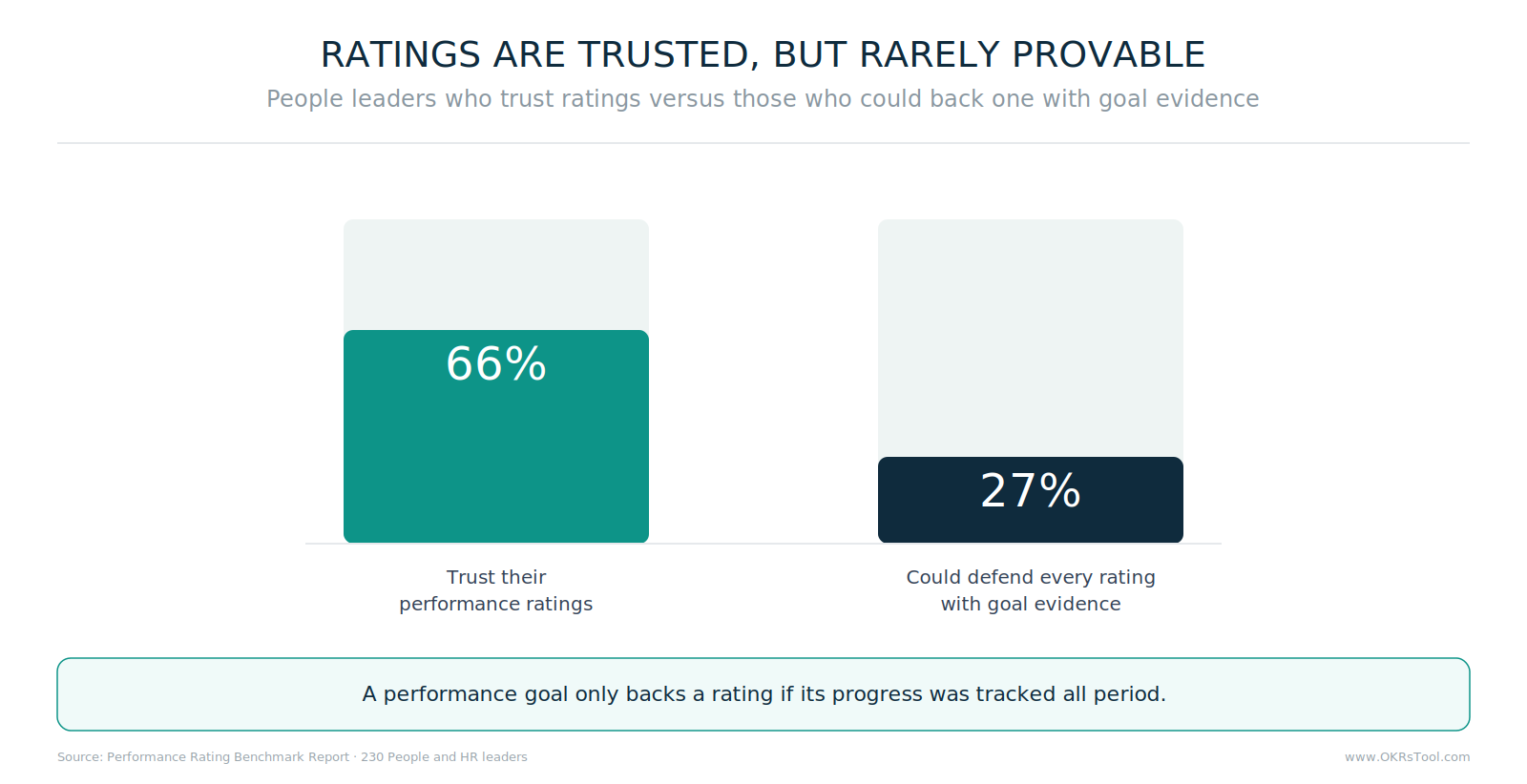
Two-thirds of leaders trust their ratings, yet barely a quarter say a manager could back every one with the goal record to support it. The gap comes down to documentation more than trust: 65% have seen a rating the goal evidence didn't support, and 35% have to reconstruct an employee's goals from memory at review time. A performance goal only closes that gap if it was written to be measured and then actually tracked. The three types below are all built that way.
Outcome Goals: Move a Number
An outcome performance goal names a result the person is accountable for and a number that proves it moved. These are the goals that carry the most weight at review time because they can't be argued — the key result moved or it didn't.
Each names a baseline and a target, so progress is visible all period and the review reads from a record rather than a recollection. In a scan of 20,952 key results, 52% turned out to be activity dressed as a goal — the outcome framing is what stops a performance goal collapsing into a to-do list.
Behavioural Goals: Change How the Work Happens
Not every performance goal is a metric. Behavioural goals capture how someone works — collaboration, communication, reliability — and the trick is to make them observable rather than vague. "Be a better communicator" can't be scored; a behavioural goal with a concrete signal can.
Development Goals: Grow the Person
Development goals build capability for the next role rather than hitting this quarter's number. They're the easiest to let slide because nothing breaks if they slip, which is exactly why they need a deadline and a visible marker of progress.
Tie development goals to a cadence the same way you would an outcome goal. A development goal reviewed weekly gets the same completion lift as any other; one filed and revisited only at year-end is the one that never happens.
Why Tracking Decides More Than Wording
However well any of these examples is written, the Goal-Setting Benchmark shows the wording is the smaller half of the result.
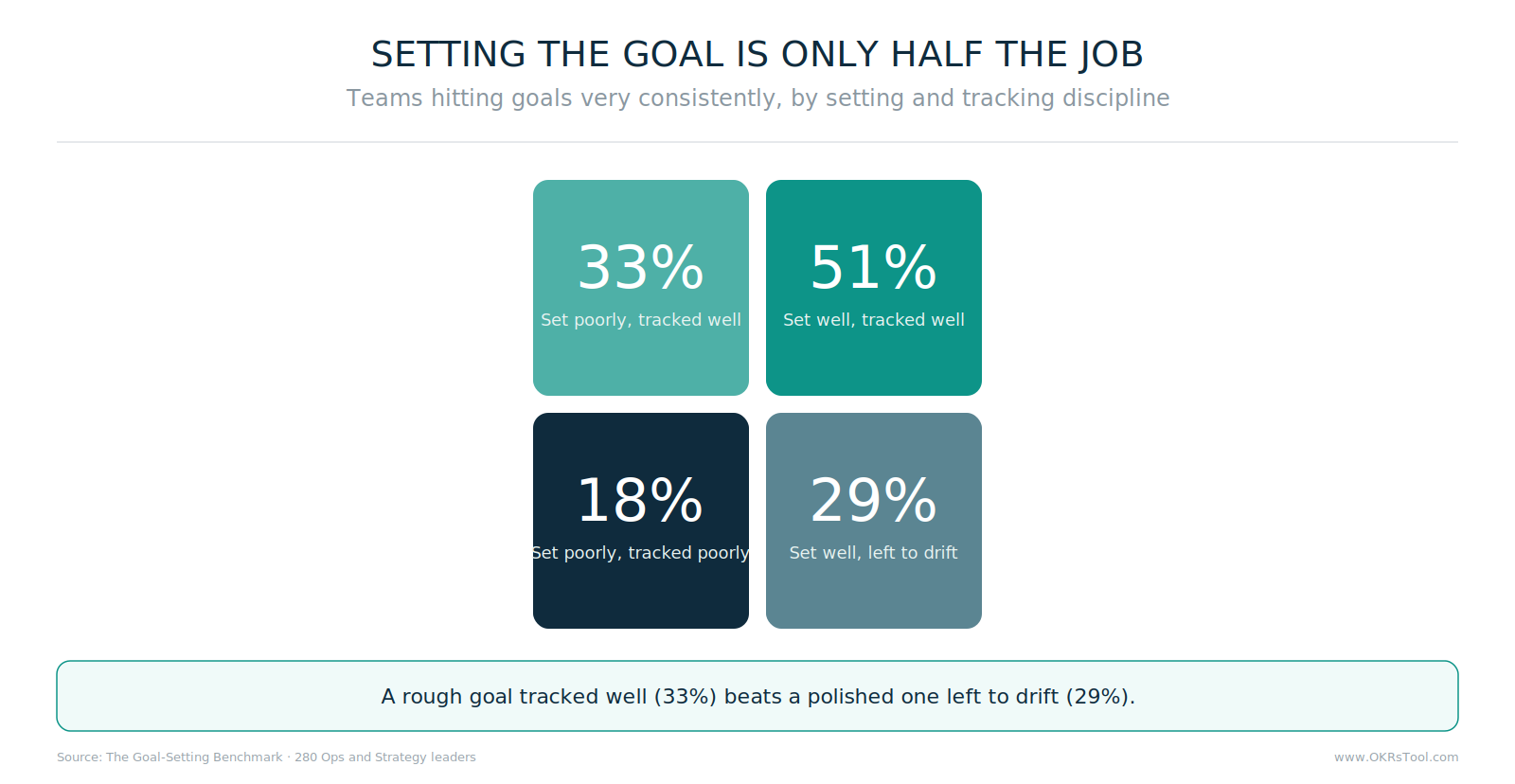
A performance goal set well but left to drift lands at 29% — barely ahead of one set badly. Tracked closely, a goal reaches 51%. For performance goals the stakes are higher than completion alone: an untracked goal doesn't just miss, it leaves the review with nothing to stand on.
That's how a rating ends up trusted but unprovable. The fix is the same for all three types — one owner, a weekly check, and progress kept somewhere visible on one platform rather than reconstructed at review time.
Keep Goals and Ratings on Speaking Terms — Not Fused
One caution the data is firm on: writing sharp performance goals doesn't mean welding them directly to the rating. When a goal's score is the rating, people set targets they've already cleared.
Use goal evidence as the backbone of a fair review — the record 65% of leaders wish they had — while leaving room for judgement, so the goal stays a real stretch rather than a negotiated floor. Score on a 0.0–1.0 scale where a 0.7 is strong, and let the tracked history inform the rating rather than dictate it.
Put the Examples to Work
Pick two or three performance goals per person — a mix of an outcome goal and one behavioural or development goal usually fits a review cycle well. Write each with a baseline and target, give it one owner, and set the weekly check-in before the cycle starts.
Do that and the review months later has a record behind it instead of a memory. The examples are only the starting point; the goal setting habits underneath them are what make a performance goal hold up when it matters.
Data: the Performance Rating Benchmark Report (230 People and HR leaders), the Goal-Setting Benchmark (280 operations and strategy leaders), and OKRs Tool platform data (876 organizations, 20,952 key results).