
A goal written down and left alone lands 29% of the time. The same goal, tracked weekly, hits 51%. This free worksheet builds the gap between those two numbers directly into the page — a clear outcome, a named owner, a weekly check, and an honest score — so what you fill in points at the four habits the data ties to hitting goals, not just the wording that makes a goal look finished.
Filling in a worksheet feels like progress, and up to a point it is: a written goal with a baseline and a target beats a vague intention every time. The research is equally clear that the writing is where the smaller share of the result is decided. Across an independent survey of 280 operations and strategy leaders, how a goal was tracked between planning and deadline predicted success far more reliably than how carefully it was worded.
That is the difference this worksheet is designed to close. It captures the goal the way any good template does, then keeps going into the fields most worksheets omit — the owner who is accountable for it, the weekly check that catches drift early, and the end-of-cycle score that keeps the next goal honest. Download it, fill it in for your two or three priorities this quarter, and use it to build the habits rather than just record the intentions.
What's on the Worksheet
The worksheet is one page with seven fields, and each maps to something the Goal-Setting Benchmark found separates goals that get hit from goals that stall. Two of those fields — the owner and the weekly check — are the ones most templates leave out, and they carry more of the result than the wording does.
The Two Fields That Do the Work
Writing a sharp objective matters, but the fields that decide whether the goal survives the quarter are the owner and the weekly check-in.
A goal needs one name against it, not a team. Half of all goals across growing organizations have no named owner, and when accountability is split, each person assumes the other has it. A single owner lifts completion by 26%. The worksheet gives every goal one owner line for exactly this reason.
The weekly check is the field that turns a written goal into a tracked one, and the gap it closes is large.
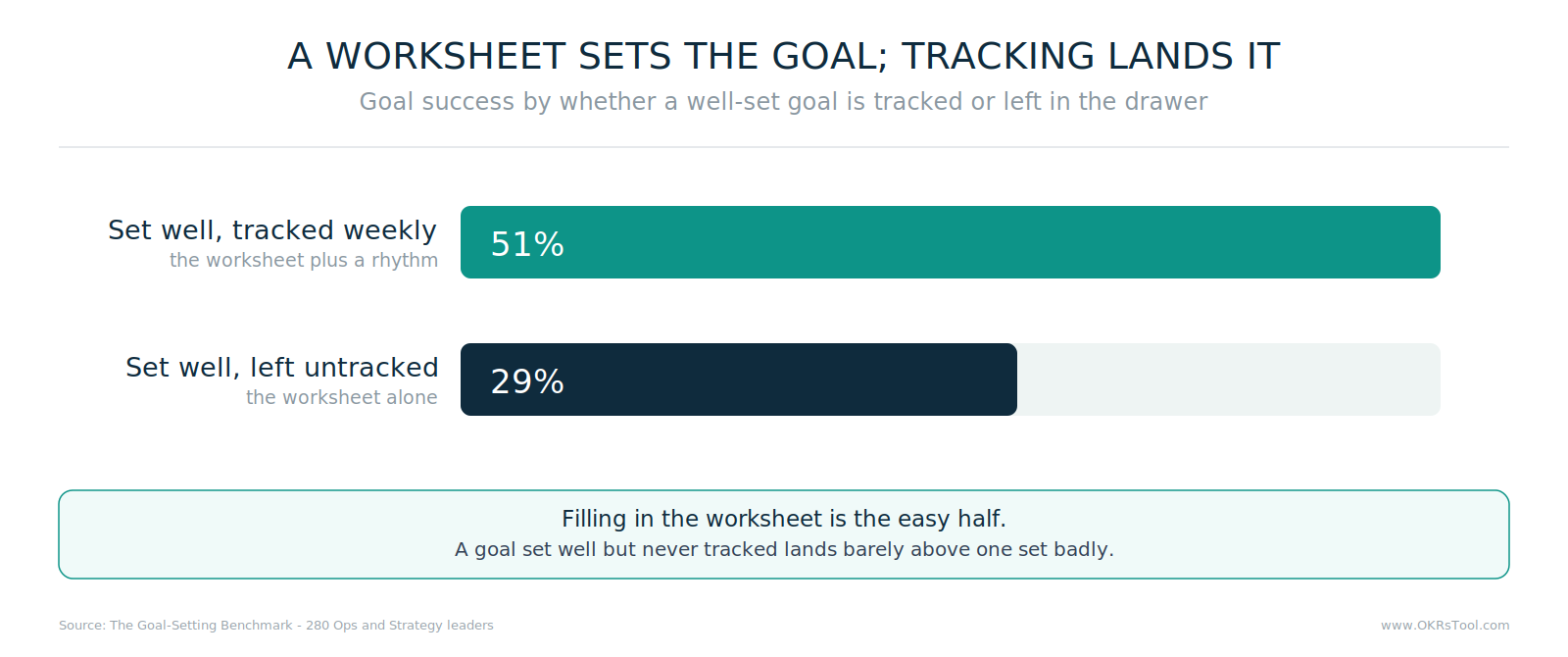
A goal set well but never revisited lands at 29% — barely ahead of a goal set badly. Tracked with a short weekly check-in, the same goal reaches 51%. The worksheet's weekly-check row exists to make that review a habit: a few minutes in a check-in on what moved, what's blocked, and what's next, every week, rather than a scramble to reconstruct progress before a deadline.
How to Fill It In
The worksheet takes about ten minutes to fill in for one goal, and the order matters — each field sets up the next. Work top to bottom, and treat the weekly check as the field you commit to before you file the sheet, not an afterthought.
- Write the objective as an outcome. "Launch the onboarding flow" is a task that can be marked done while nothing improves; "raise Day-7 activation from 34% to 52%" is a result. Across 20,952 real key results, 52% were tasks in disguise, and goals written as outcomes got hit 30% more often.
- Attach a baseline and a target. Without a starting number there's no honest way to score the result at the end. "34% → 52%" beats "improve activation" every time.
- Put one name in the owner box. Not a team, not "leadership" — one person accountable for the weekly update. Single-owner goals are completed 26% more often.
- Set the deadline to your cycle end, and book the weekly check before you file the sheet. This is the step that matters most: the weekly review is what carries the goal from the page into the quarter.
- Score honestly at cycle close on the 0.0–1.0 scale. A 0.7 is a strong result, and consistent 1.0s mean the target was set too low to learn anything from.
Keep the count low: two or three goals filled in well beat ten filled in and forgotten.
When a Worksheet Isn't Enough
A worksheet is the right tool for one person running a few goals for one cycle. It reaches its limit the moment a goal needs to connect to a company priority, or a manager needs progress across a team without chasing a folder of separate files. A static sheet can't cascade a company objective down to team goals, can't send the weekly reminder, and can't flag a goal slipping off pace before the deadline — a common reason goals fail.
That's the line between a worksheet and a system. Teams that run the same seven fields as a live process rather than a filed document climb from 51% completion in early cycles to 79% by cycle five along the maturity curve, because the tracking and closing happen automatically instead of depending on someone reopening the file.
The worksheet is a fine place to start and a natural thing to outgrow — and the point where it starts feeling like overhead is the point to move the same fields onto a platform built to run them that runs them for you.
The worksheet gets your goals written the way the wider practice of goal setting rewards. The four habits behind it — outcome, owner, weekly check, honest score — are what turn a filled-in page into goals that actually land.
Data: the Goal-Setting Benchmark (280 operations and strategy leaders), the 2026 OKR Benchmark Report (200 organizations), and OKRs Tool platform data (876 organizations, 20,952 key results).