The OKR Intelligence Report 2026 goes further than any benchmark before it — past check-in frequency and goal count into the variables nobody has measured until now. AI adoption, cascade speed, mid-cycle behavior, scoring culture, and cross-functional ownership. This is what 220 organizations across the technology sector actually told us.
The ROI OKR Benchmark Report documented the return on investment from OKRs — 1:25, across 330 organizations. The OKR Execution Benchmark Report documented the execution habits behind those returns — check-in frequency, ownership patterns, cycle completion rates.
The OKR Intelligence Report goes somewhere neither of those went: into the variables nobody has measured until now. How do organizations actually set goals? What happens when a Key Result goes off track? When does AI help and when does it hollow out team ownership? How long before new hires touch an OKR?
222 respondents. All in technology sector companies with 51–200 employees. All confirmed active OKR implementation. No OKRs Tool customers in the sample.
Here are the findings.
Finding 1: 83% Are Using AI in Their OKR Process — But Only 13% Trust It
83% of organizations are actively using AI in their OKR process right now. Not piloting it, not planning to — using it this quarter.
But high adoption doesn't mean high trust.
- 47% treat AI as a strong starting point that always needs human refinement
- 20% use it for inspiration only — rewriting substantially
- 13% use AI suggestions as-is
- 11% review AI output skeptically and rarely adopt it
The 13% using AI as-is represent a risk pattern, not a best practice. 31% of that group cite generic goals as their biggest concern — they're accepting shallow output because refining feels like more work than it's worth.
The most important finding in this section: the biggest concern about AI in OKRs isn't output quality. It's data privacy and security — cited by 25% of respondents. Strategic data entering an external AI system is the concern that's shaping the next phase of AI adoption.
And the most valuable AI usage isn't goal-writing. It's goal analysis. Among 178 active AI users:
- Writing better-quality Key Results: 51%
- Identifying team/company misalignment: 49%
Two percentage points apart. AI is already operating as a strategic lens, not just a drafting assistant.

Finding 2: How Goals Get Set Predicts What Happens When They're Missed
65% of organizations set OKRs primarily top-down. 30% operate collaboratively — the emerging benchmark.
This structural choice has consequences that show up months later — when a goal is missed.
Top-down structures turn misses into performance events. Collaborative structures turn them into learning events. That difference compounds quarter after quarter.

The cascade gap adds a second layer of cost. Only 16% complete the cascade — from company OKRs finalized to all team OKRs set — within the same week. 26% take 3–4 weeks. For teams taking a month, the quarter is already a third over before everyone is aligned.
Finding 3: 93% Adapt Mid-Cycle — The Risk Is the 7% Who Go Silent
93% of organizations modify OKRs at least occasionally after the cycle starts. The data challenges the idea that mid-cycle adjustment signals weak planning — most organizations are simply paying attention.
The real risk is the 7% who informally stop tracking off-track Key Results entirely. This report calls them Invisible OKRs — goals that technically exist on a dashboard, still listed as active, but with no one watching them, no consequence attached to their failure, and no process triggered by their disappearance.
When a Key Result is clearly off track, what do teams actually do?
- Formally revise the KR target: 41%
- Escalate and reallocate resources: 28%
- Keep original target, accept a low score: 20%
- Informally stop tracking it: 7%
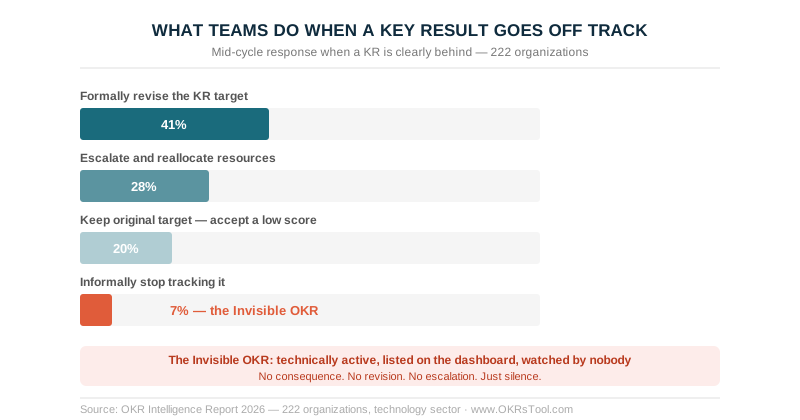
The Invisible OKR pattern is the clearest failure cluster in this dataset. It isn't a planning problem. It's a governance problem.
Finding 4: 75% Have Formally Linked OKRs to Performance Reviews
The debate about whether OKRs should influence performance reviews is, in practice, largely settled.
75% have made the connection formally:
- 47% — OKRs as one factor among several
- 28% — OKR results directly influence ratings
- 18% — deliberately kept separate
- 7% — no individual OKRs tracked at all
Most organizations are threading the needle: OKRs as informed context for performance conversations — not a binary pass/fail verdict. The scoring method predicts the consequence culture that follows.
Organizations using traffic light / RAG status are most likely to analyze misses in retrospectives (57%). Organizations using percentage completion are most likely to trigger formal accountability conversations (40%). Organizations with no formal scoring have no consistent consequence process 43% of the time.
The measurement method shapes the conversation that follows, which shapes the behavior that precedes it, which shapes whether people set ambitious goals or safe ones.
Finding 5: Only 15% Bring New Hires Into OKR Ownership Within Their First Week
The onboarding window is where OKR culture gets set — and most organizations are missing it.
- Within first week: 15%
- Within 2–4 weeks: 36%
- Within first full quarter: 34%
- No standard process: 12%
More than half of all new employees spend at least one full quarter outside the goal system. Organizations delaying aren't protecting new hires — they're excluding them from the operating discipline entirely.
The correlation between onboarding speed and OKR-performance integration is one of the sharpest in the dataset. 59% of organizations onboarding in week one have OKRs directly influencing performance ratings. Only 19% of organizations waiting a full quarter keep OKRs deliberately separate from performance.
Finding 6: Cross-Functional OKRs Are Universal and Almost Entirely Shallow
91% of organizations have at least some OKRs spanning more than one team. But depth tells a very different story from breadth.
- 9% — all OKRs single-team owned
- 52% — 1–25% cross-functional
- 34% — 26–50% cross-functional
- 6% — more than 50% cross-functional
Present nearly everywhere. Governing very little.
The hybrid compounding problem makes this worse. Hybrid teams have the deepest cross-functional OKR exposure and the least consistent check-in cadence. The teams most in need of coordination infrastructure are running with the least of it.
The 14 organizations running 50%+ of their OKRs cross-functionally are 71% fully in-office. Cross-functional ownership at scale has been cracked by the teams who built coordination systems around it — not by teams that relied on proximity or assumed shared accountability would sort itself.
What Best Looks Like
The organizations generating the best OKR results in 2026 share one characteristic — and it isn't the quality of their goals. It's the quality of their systems around those goals.
The gap between this profile and where most organizations sit isn't a capability gap. It's a systems gap — and systems can be fixed.
Score Your Own Program
The full report includes a self-assessment scorecard across all seven dimensions — with scoring thresholds that place your organization at High Performance (28–35), Developing (18–27), or Early Stage (below 18).
Data: OKR Intelligence Report 2026 — 222 respondents, technology sector, 51–200 employees, all confirmed active OKR implementation. Independent research — no OKRs Tool customers included.