
A manager can write a flawless employee goal and still watch it stall. Half of all goals carry no named owner, and 96% of employees sandbag their targets the moment those targets feed a performance rating. Setting employee goals that get hit is less about the wording and more about four moves a manager controls: write an outcome, name the owner, keep the goal off the rating, and review it weekly.
Goal setting for employees is the manager's job of turning a team priority into individual team goals that people own, track, and actually reach. Done well, each person knows what they're accountable for and can see whether they're on pace. Done the way it often goes — goals set in a review meeting, filed, and revisited at the next review — it produces targets that look fine on paper and change nothing in between.
The gap between those two outcomes has been measured. Across the State of Goal Management and the 2026 2O26 OKR Benchmark, the same pattern holds: what a manager does structurally around an employee goal predicts whether it's hit far better than how the goal is phrased. This guide walks the four moves in order, and they sit inside the wider practice of goal setting that separates teams who hit their goals from teams who miss.
Move 1: Write the Goal as an Outcome
The most common mistake in employee goals is writing the task instead of the result. "Run four onboarding webinars this quarter" is something an employee can complete while nothing about the business changes. "Lift new-hire 30-day activation from 60% to 80%" is a goal that either happened or didn't. The second version can't be marked done by staying busy.
The evidence for the swap is large. A scan of 20,952 key results in the platform data found more than half — 52% — were really tasks or KPIs wearing a goal label, while goals written as outcomes instead of activities landed 30% more often. For a manager, the test on any employee goal is quick: can the person mark it complete without a number moving? If yes, rewrite it as the number the task was meant to move, with a starting point and a target attached, the way a strong key result is built.
Move 2: Name One Owner Before Work Starts
An employee goal with no clear owner is a goal that belongs to everyone and no one. Half of all goals across growing organizations have no named owner, and goals with a single accountable person get completed 26% more often than goals with shared or vague accountability.
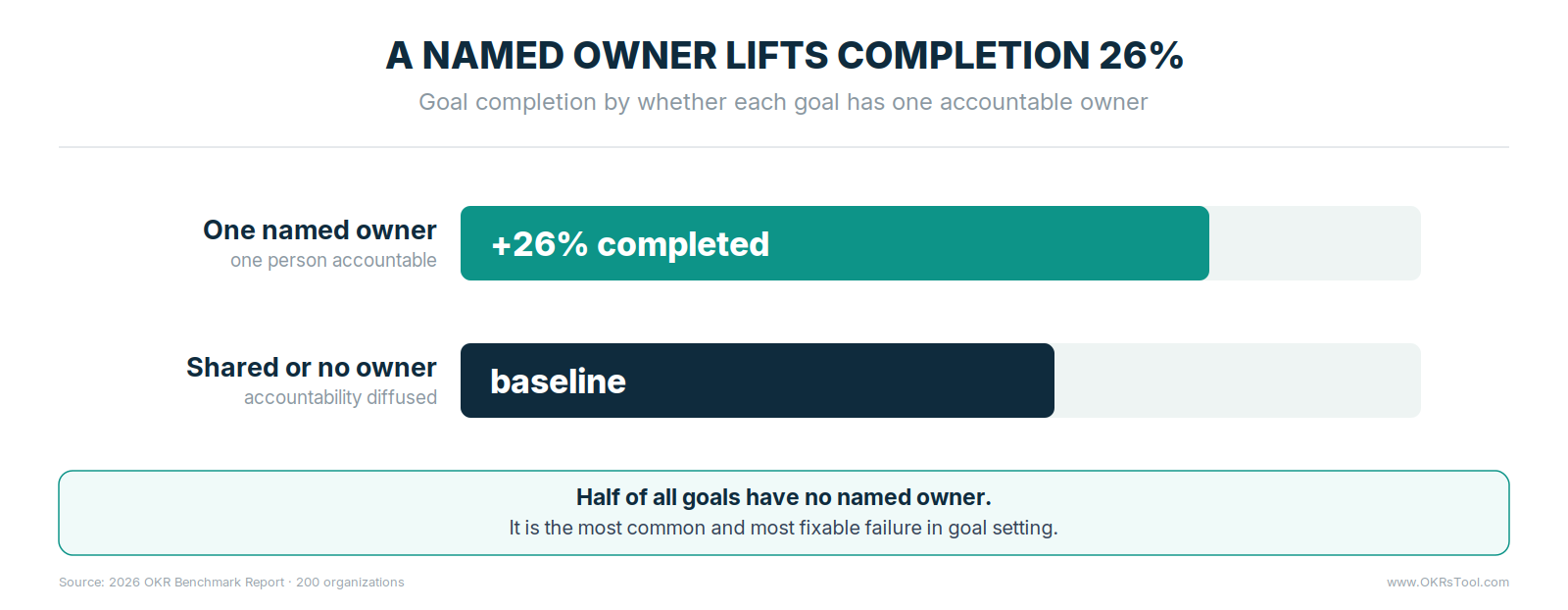
For a manager this is the most fixable failure on the list. Split a goal across two people and each quietly assumes the other has it; assign it to "the team" and no one feels the weight of it. Every employee goal needs one name beside it — the person whose progress shows up in the weekly check-in, who's expected to raise a hand when it's blocked. Keep the load realistic, too: past a handful of goals per person, ownership and focus dilute.
Move 3: Keep the Goal Off the Performance Rating
This is the move managers get wrong most often, and the data on it is stark. When an employee's goal directly feeds their performance rating, 96% sandbag the target — setting a bar they've mostly already cleared — against 81% when goals are kept separate from the rating.
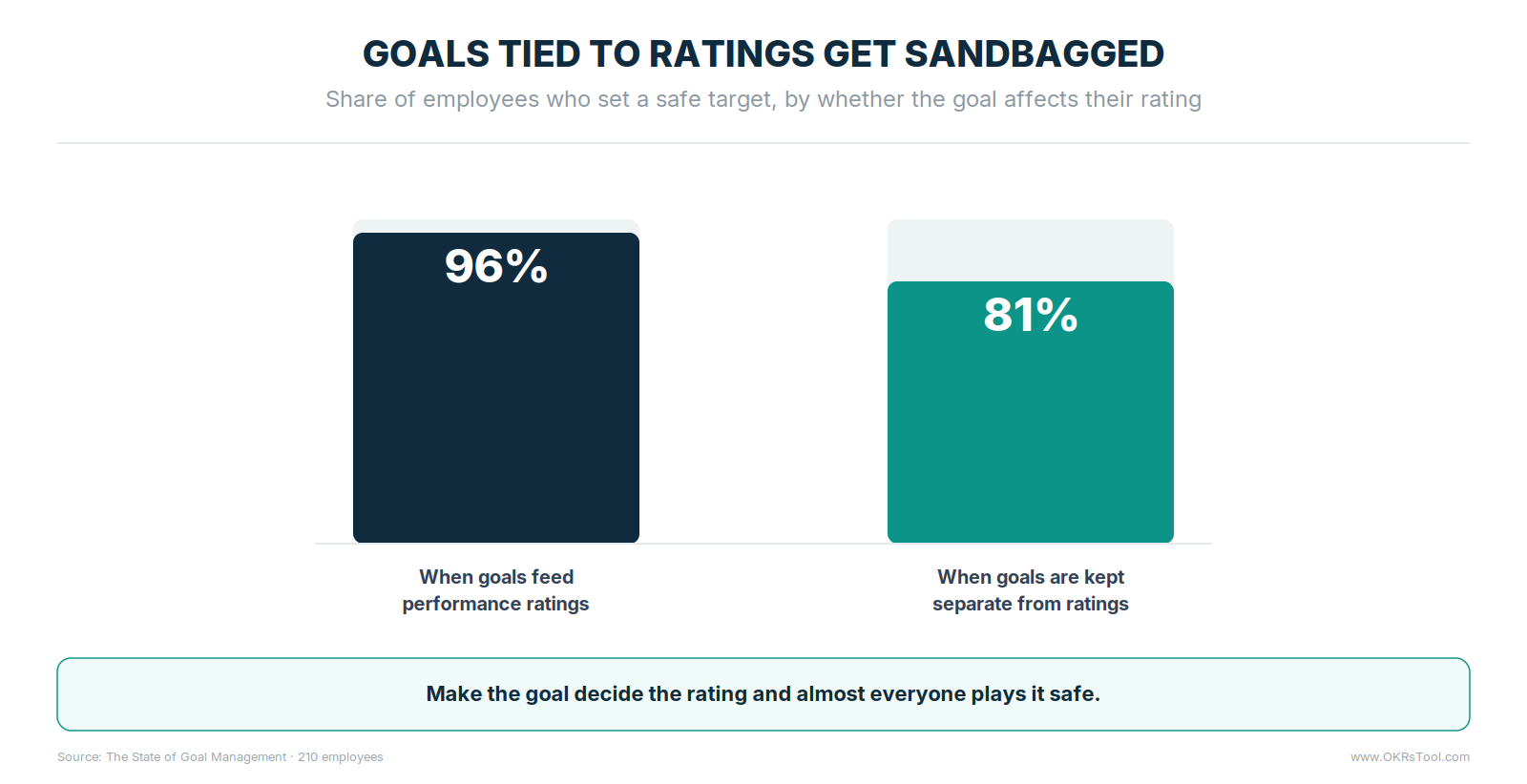
The mechanism is rational from the employee's side: if missing a goal costs you at review time, the smart play is to promise less. Tie goals tightly to ratings and you train the whole team to lowball. The fix is to keep ambition safe — score goals on a 0.0–1.0 scale where a 0.7 is a strong result, use goal data as one input to a performance review rather than the verdict, and make it clear that a stretch goal missed by a little beats a safe goal hit exactly. Employees set braver targets when a miss isn't punished as a failure.
Move 4: Review Every Week
The habit that ties the first three together is a short weekly review. This is where the Goal-Setting Benchmark, an independent survey of 280 operations and strategy leaders, is blunt: a goal set well but tracked loosely lands at 29%, while a goal set well and tracked closely hits 51% — a manager can write the perfect employee goal and still lose most of its value by not watching it.
Employees whose goals get a weekly check-in complete 43% more of them than those reviewed monthly or only at cycle end. It doesn't need a meeting — a few minutes per person in a lightweight check-in on what moved, what's blocked, and what's next.
The value is in catching a stalled goal early. A goal drifting in week four can still be recovered; the same goal surfaced at a quarter-end review is a post-mortem.
A standing weekly cadence also keeps the goal visible, which matters more than it sounds — an employee who can't see their goal between reviews has effectively been handed a target and told to forget it until judged on it. Keep goals somewhere the person opens daily on one platform, not in a document filed after the planning meeting.
Employee Goals That Get Hit, in One View
The four moves work as a set. An outcome goal only produces an honest signal if someone owns it; ownership only produces effort if the goal is reviewed weekly; and honest effort only shows up if the target isn't rigged safe by tying it to a rating. Miss any one and the goal drifts back toward the pile that changes nothing.
For a manager, that turns goal setting from an annual writing exercise into a weekly management habit. Write the outcome, put one name on it, keep it off the rating so the target stays honest, and look at it every week. The employee goals that get hit are the ones a manager actually carried through the quarter, which has little to do with how well they were worded.
Data: the 2026 OKR Benchmark Report (200 organizations), the Goal-Setting Benchmark (280 operations and strategy leaders), the State of Goal Management (210 employees), and OKRs Tool platform data (876 organizations, 20,952 key results).