
A goal set in January and reviewed in March is being reported — tracking is the work in between. Teams that write goals well and track them closely hit their targets 51% of the time; a sharp goal nobody watches slips to 29%. Weekly tracking completes 43% more goals and abandons 3x fewer. Goal tracking is everything between the planning session and the result, and it decides more of the outcome than the wording does.
Goal tracking is the mechanics of keeping goals visible, owned, and honestly updated between planning sessions. It sits between goal setting — knowing what you want to achieve — and goal management, the full system from setting through closing. Tracking is the in-cycle discipline specifically: who updates what, how often, what triggers intervention, and how a team knows a goal is drifting before it becomes a miss.
The newest research puts tracking at the centre of the outcome. The Goal-Setting Benchmark, an independent survey of 280 operations and strategy leaders, sorted teams on two axes — the care they put into setting a goal and the discipline they put into tracking it. Strong on both, and 51% hit their goals very consistently; a roughly set goal tracked closely still reaches 33%, while a polished goal left to drift falls to 29%, and teams weak at both sit at 18%.
The rough goal somebody actually watches out-performs the elegant one nobody reopens, which is the whole case for treating tracking as the decisive half.
Tracking Decides More Than Setting
The market spends most of its energy on writing better goals. The benchmark says that's the smaller half of the job.
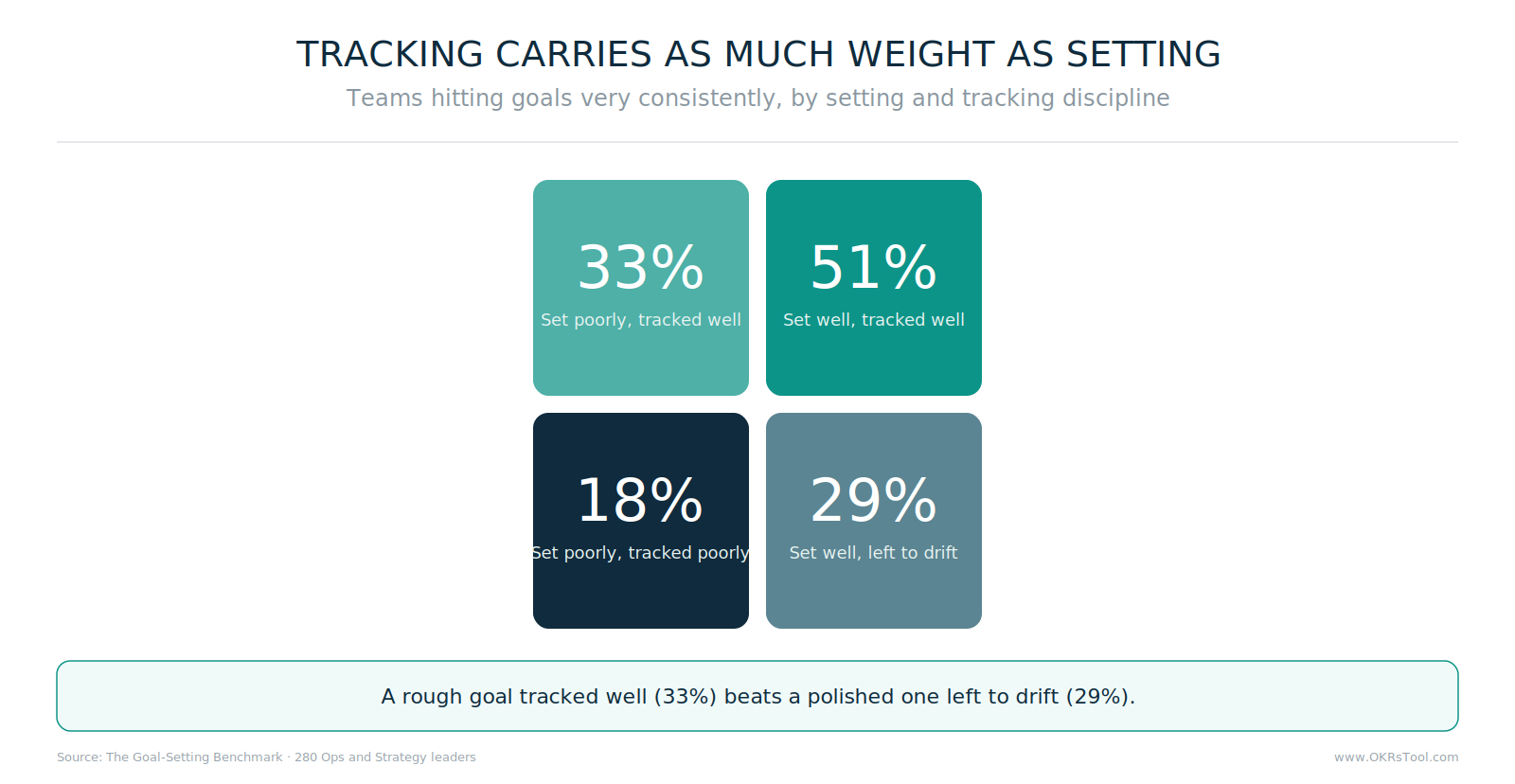
On its own, a goal set with real care but never watched comes in at 29% — only a whisker above the 18% you get when nothing is done well. Flip it, and a scrappy goal kept under weekly watch reaches 33%. For a team deciding where to put its effort, the message is blunt: writing the goal is necessary but returns the least on its own; the tracking is what carries it.
The 2026 OKR Benchmark Report adds the cost of skipping it — 7% of off-track Key Results are simply abandoned mid-cycle, informally stopped with no revision, no escalation, and no consequence. Those are the Invisible OKRs: goals that exist on the dashboard, get updated occasionally, and influence nothing by cycle end.
The Frequency Question
How often goals get tracked is a structural variable with measurable consequences, not a preference. Teams that check in weekly complete 43% more OKRs than those reviewing monthly, and teams running no fixed cadence walk away from their goals mid-cycle about three times as often.
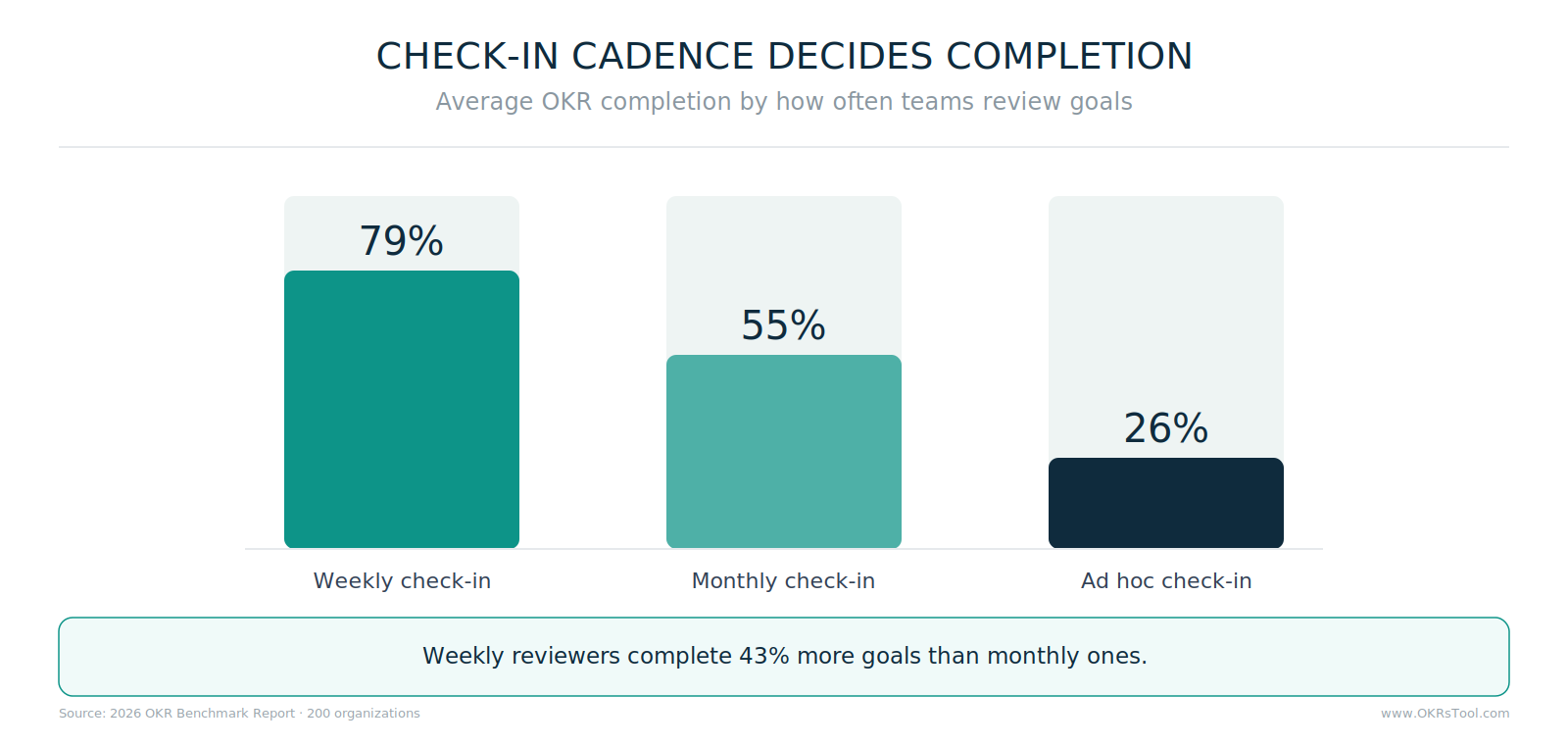
The edge comes from timing, not from better information in any single session. Catch a goal sliding in week four and you can still save it; find the same slide in week eleven and all you can do is write it up. A monthly rhythm leaves you doing autopsies; a weekly cadence lets you steer.
And most teams overrate how well they do this — the benchmark asked teams who say they run a framework consistently what they actually do, and only 36% review weekly with just 41% on real software. The weekly check-in is the habit teams most often claim and least often keep.
The Three Mechanics of Effective Goal Tracking
Named ownership per goal. Half of all Key Results across growing organizations have no named owner, and a goal without an accountable person is tracked by nobody. Teams with required single ownership per Key Result see 26% higher completion. Ownership creates one person whose name is attached to the honest progress score every week, which changes how goals get updated more than any reporting format does.
Honest status, not narrative. The tracking failure that hurts most is watermelon reporting: a goal shown green while the underlying reality is red. The State of Goal Management found 70% of employees have reported a goal as healthier than they knew it to be. The fix is structural — scoring on a 0.0–1.0 scale where the honest number is visible to the whole team continuously, rather than assembled into a narrative before the review. When the score is always visible, inflating it becomes obvious immediately.
At-risk flagging before the cycle ends. Effective tracking includes a mid-cycle intervention point — typically week six of a twelve-week quarter. Every Key Result below 50% at week six should leave the mid-cycle review with one of three outcomes: revised target, escalated blocker, or formally closed. A goal that stays at-risk with no explicit decision becomes one of the 7% Invisible OKRs, dropped without anyone deciding to drop it.
What Goal Tracking Software Should Do
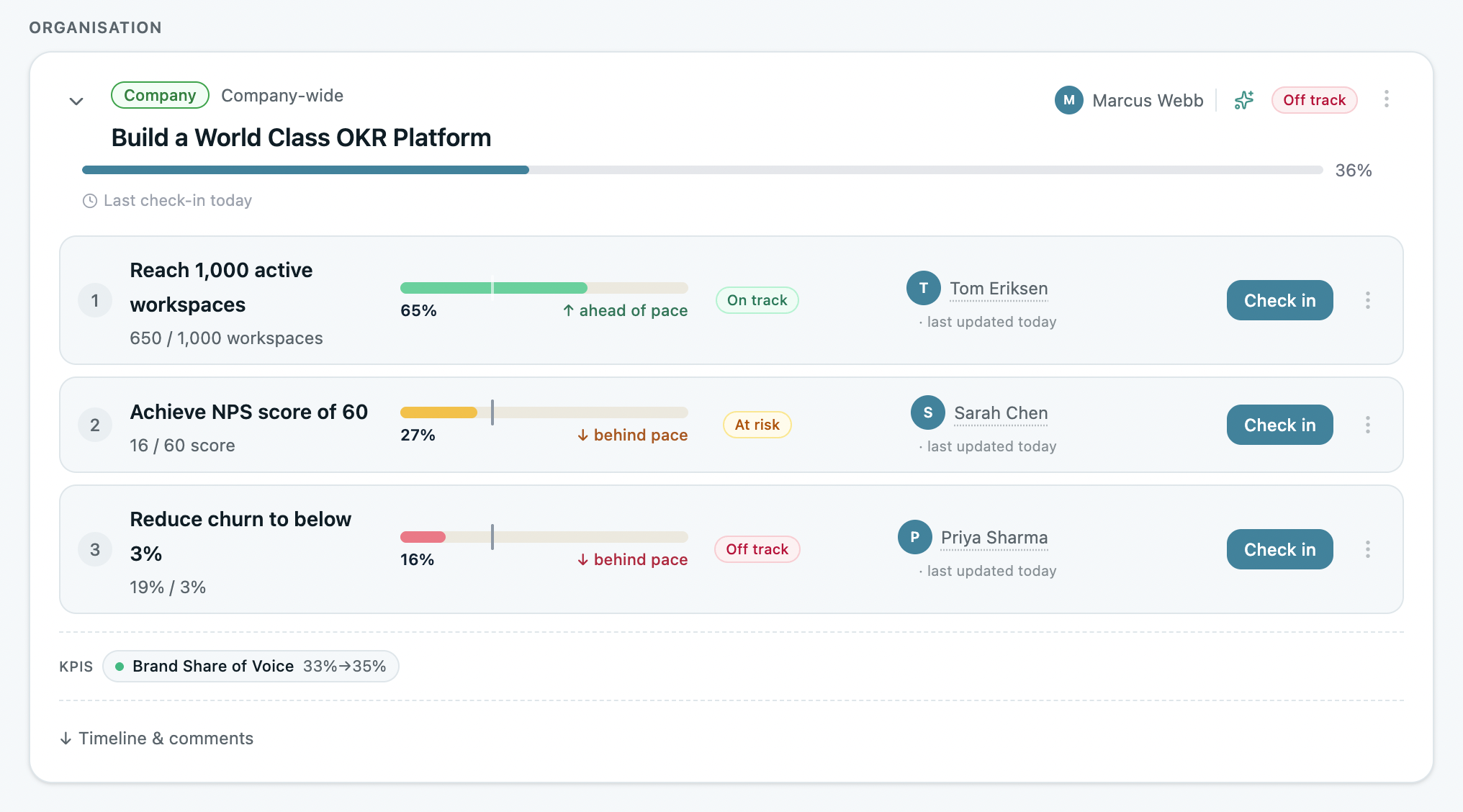
Goal management software enforces those mechanics structurally instead of leaving them to willpower.
Automated weekly nudges replace scheduled meetings as the check-in mechanism — a Slack or MS Teams message fires at the same time each week, prompts the update, and surfaces the result in the dashboard without anyone scheduling it. That structural cadence is what produces the 43% completion lift. Required ownership before goals go live closes the 50% no-owner problem at the source: the planning session can't finish until every Key Result has a named owner.
And live visibility across the cascade lets every team member see how their Key Result connects to the company objective above it, and leadership see the whole portfolio, without a status meeting — the fix for the finding that only 30% of employees can name their company's top goals without looking them up.
The return follows the same line the benchmark draws. Take the teams already doing the hard part — weekly reviews, continuous tracking — and the tool still splits them: 74% hit their goals very consistently on purpose-built software versus 33% on spreadsheets, the same habits producing less than half the result once the sheet stopped keeping up.
Over a full year that shows up as ROI: OKR software returns 1:88 against 1:25 on spreadsheets, and the gap traces to the tracking infrastructure a spreadsheet can't provide — automated cadence, required ownership, live visibility, and at-risk flagging before misses compound.
Goal Tracking vs Goal Setting vs Goal Management
These three terms describe different parts of one system, and it helps to keep them straight.
Plenty of organizations invest in goal-setting frameworks and skip the tracking. The benchmark data shows the price: teams that close the tracking gap — weekly cadence, named ownership, honest status — complete 43% more goals, see 26% higher completion, and compound from 51% completion in early cycles to 79% by cycle five.
Track the Goal, Not Just Set It
Setting the goal is where most teams stop and where the return is smallest. What decides the outcome is everything after: a weekly cadence that catches drift early, one named owner on each goal, an honest score that can't hide a miss, and a mid-cycle point where a failing goal gets revised, escalated, or closed. Run those and a goal set in January is still moving in March, with a record behind it instead of a story assembled before the review.
Reporting looks back at what already happened; tracking catches it while you can still act — and in the data that separates a goal system 34% of employees wouldn't miss from one that compounds cycle after cycle. Start with the weakest link in your own tracking, run it for a full cycle, and add the next.
Data: the Goal-Setting Benchmark (280 operations and strategy leaders), the 2026 OKR Benchmark Report (200 organizations), OKRs Tool platform data (876 organizations, 20,952 key results), and the State of Goal Management (210 employees).