
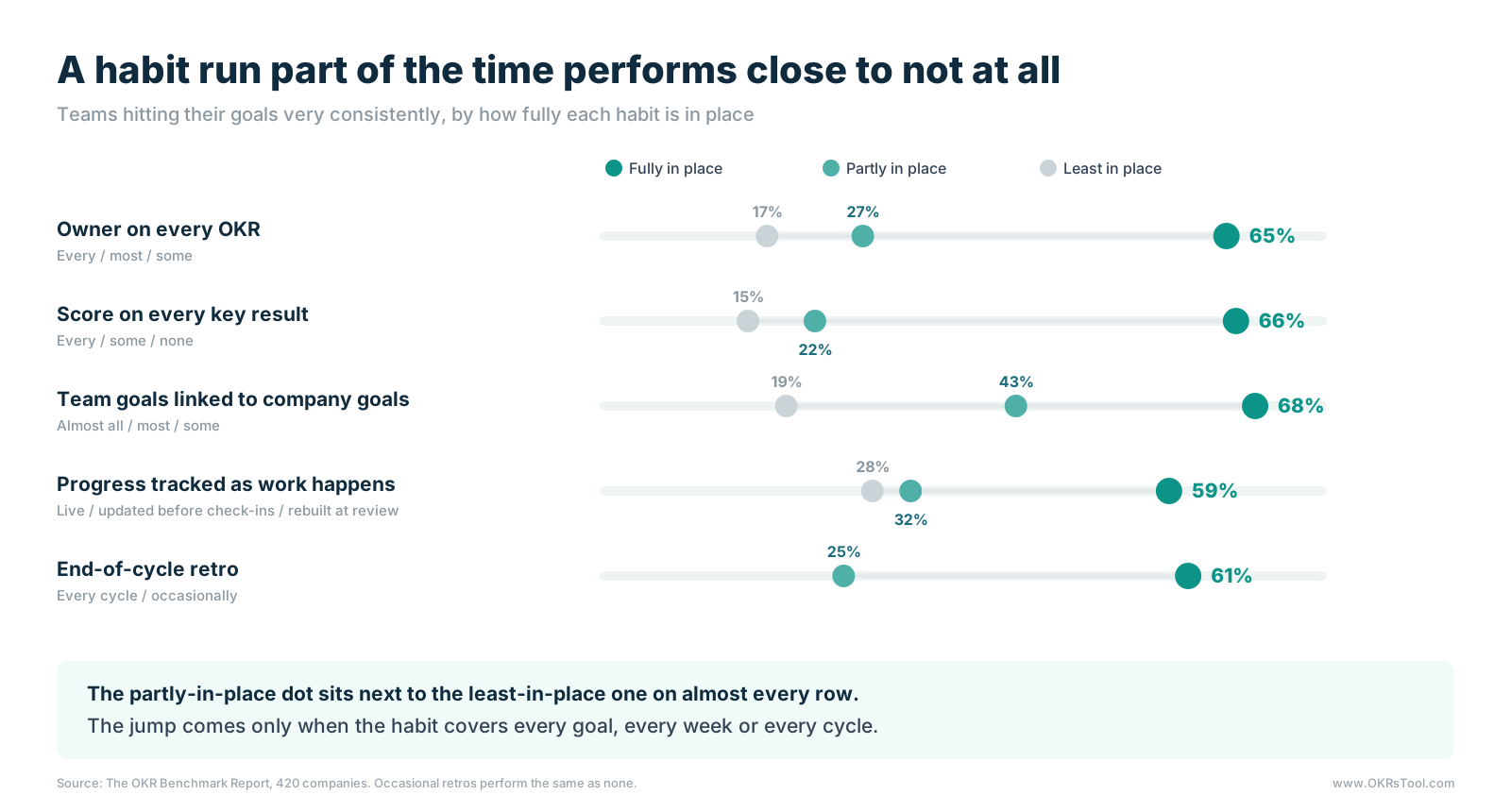
Teams that put a confidence score on every key result hit their goals very consistently 66% of the time. Teams that score only some hit 22%, barely ahead of the 15% that score none. The same pattern runs through ownership, progress tracking and retros in our survey of 420 companies: a habit pays off when it covers every goal, and running it most of the time gets close to nothing.
Giving most OKRs an owner sounds close enough to giving every OKR one. In our new benchmark, the difference between the two is the widest gap in the study: teams with an owner on every OKR hit their goals very consistently 65% of the time, and teams where most OKRs are owned hit 27%, much closer to the 17% for teams where only some are.
That gap repeats across almost every habit we measured for the OKR Benchmark Report, a survey of 420 operations and strategy leaders at technology companies of 50–200 people. Partial scoring, manual progress updates and occasional retros all perform about as well as doing nothing, which changes what an OKR program should aim for. Adding more habits matters less than finishing the ones already started, so that each covers every goal, every week and every cycle.
The Same Pattern in Every Habit
The benchmark asked how fully each habit is in place, and the results fall into the same shape for each one.
On four of the five rows, the partial version of the habit sits next to the weakest version, a long way from the full one. Linking team goals to company goals is the exception, where "most linked" lands halfway at 43%, and the reasons for that are covered below. Everywhere else, the result only jumps once the habit covers everything.
Why Partial Habits Fall Short
Each habit has its own reason for behaving this way, and in every case the goals left out are the ones the habit exists to catch.
1. Ownership: The Unowned Goal Is the One Nobody Raises
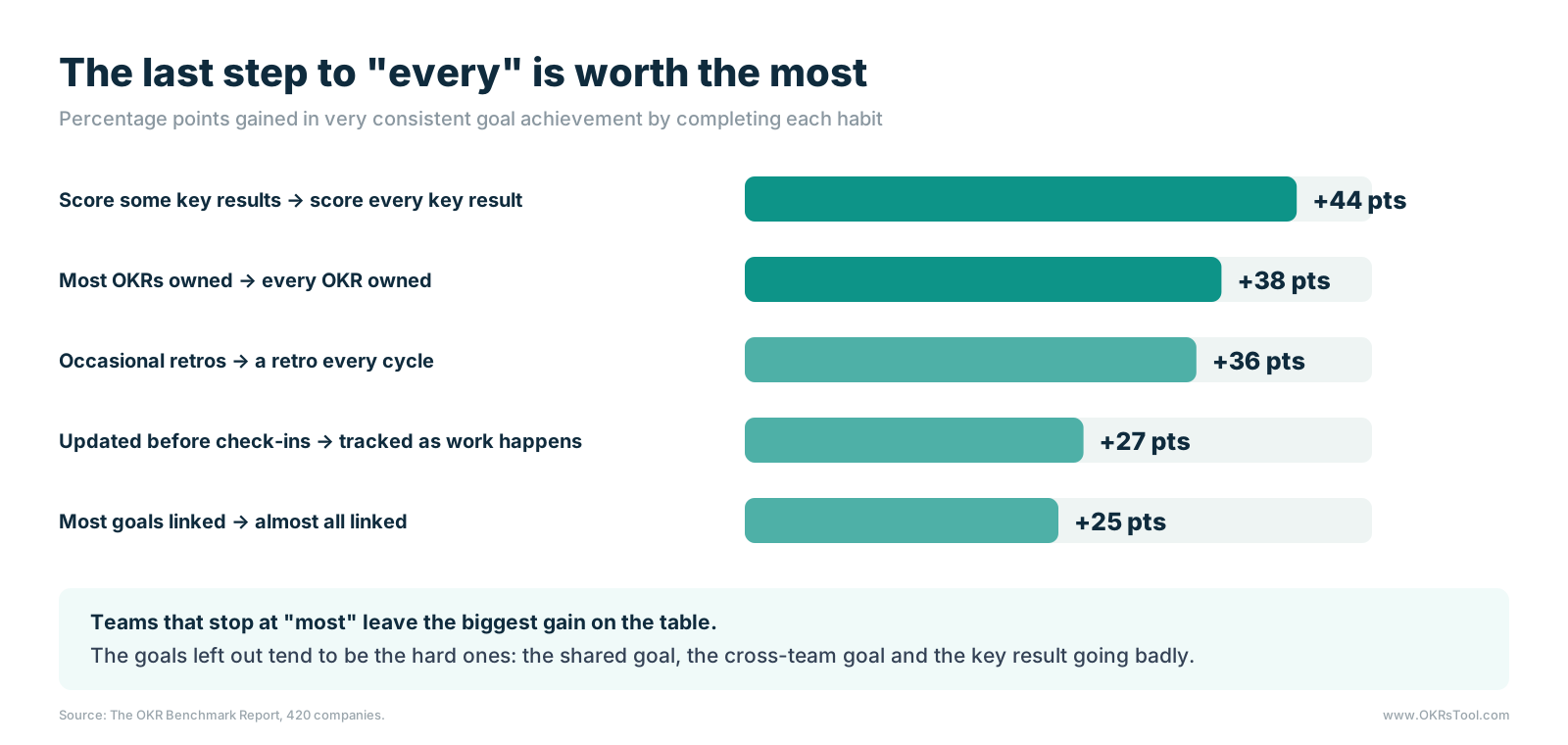
Teams with every OKR owned hit their goals very consistently 65% of the time, against 27% where most are owned and 17% where some are. The 38-point step from most to every is the widest gap in the study, and half of companies (51%) have closed it.
The OKRs that go without an owner tend to be the hard ones: the cross-team goals, the ones handed to "the product team" or to a pair, and the ones nobody wanted. When one of those stalls, nobody knows whose call it is to raise it, so it drifts until the review. A team with most OKRs owned still has its most fragile goals unwatched, which is why its results look so much like a team with almost none owned.
2. Scoring: The Unscored Key Result Is the One in Trouble
Teams scoring every key result hit their goals very consistently 66% of the time, against 22% for teams scoring some and 15% for teams scoring none. 55% of companies score every key result, and the 41% that score only some get almost none of the benefit.
Teams that score selectively tend to score the key results going well. A confidence score on a healthy goal tells the team what it already knows, and the unscored key results are usually the ones in trouble, which are exactly what a check-in exists to catch. Partial scoring gives a dashboard full of green and leaves the red off it, the same blind spot that produces a watermelon OKR.
3. Progress: A Manual Update Is Still a Look Backwards
Teams tracking progress as work happens hit their goals very consistently 59% of the time, against 32% when progress is updated by hand before each check-in and 28% when it's rebuilt at review time. 51% of companies track progress live, and the 38% that update before each check-in perform almost as poorly as the 10% that rebuild everything at the end.
Adding a manual update step feels like tracking, and it does put a number on the screen each week. The number is already out of date by the time anyone looks at it, though, because it captures progress after the fact, and the owner filling it in the night before is reconstructing the week from memory. The check-in loses its value when the figures it reviews are stale, which is the hidden cost of manual OKR reporting.
4. Retros: An Occasional Retro Performs Like No Retro
Teams running a retro every cycle hit their goals very consistently 61% of the time, against 25% with occasional retros, the same as running none. 57% of companies hold one at the end of every cycle.
A retrospective works because it forces a decision on every OKR at the end of each cycle: continue, change or stop. Skip it in a busy quarter and the goals from that quarter end without one, which is how OKR programs die one team at a time.
The Death of OKRs found what that costs: where retros happen only occasionally, 64% of leaders describe OKRs being dropped or left unused with nobody deciding, against 41% where a retro runs every cycle. A retro that happens two quarters out of three leaves a third of the program's endings to chance.
5. Linking and Check-Ins: Where "Most" Still Counts
Two habits break the pattern, and they show why the others don't. Team goals linked to company goals score 68% when almost all are linked, 43% when most are and 19% when only some are. Weekly team check-ins score 60%, bi-weekly 43% and monthly 30%.
Both are gradients, with each step worth something. A team goal that's linked helps the team whether or not its neighbors are, and a check-in every two weeks catches problems a monthly one misses.
Ownership, scoring, live progress and retros work differently, because each one exists to catch the exception: the goal nobody owns, the key result going badly, the week nobody updated, the quarter nobody closed. A habit that misses the exceptions misses its purpose, so its value only arrives once the coverage is complete.
The Last Step Is Worth the Most
Measured as the gain from completing each habit, the final step from "most" or "some" to "every" is where nearly all the value sits.
That's also why the full set of five habits climbs so steeply. Teams running none of the benchmark's five core habits (an owner on every OKR, a weekly check-in, live progress, a score on every key result and team goals linked to company goals) hit their goals very consistently 4% of the time.
With one habit, the figure is 23%, then 46% with two, 60% with three and 82% with four or five. Each step on that staircase counts a habit only when it's fully in place, so a team running five habits at "most" sits much lower on the staircase than its effort suggests. 16% of companies run none of the five, and only 9% run all of them.
Why Teams Stop at "Most"
The last 10–20% of any habit is the hardest part to cover, because it's made of exceptions. The goal shared between two departments, the key result that's going badly and its owner would rather not score, the team that joined mid-quarter and the busy week when the update slips are all harder to reach than the routine cases, and they stay uncovered when the habit depends on someone remembering.
That makes it a structural problem, and the benchmark points to the same conclusion from the tooling side. Companies running OKRs on dedicated OKR software hit their goals very consistently 55% of the time, against 32% without it, while spreadsheets alone post the lowest result of any setup at 29%, since every update and reminder depends on one person.
When a goal can't go live without an owner, when every key result is prompted for a score each week and when progress flows in from the systems the work happens in, the exceptions get covered by default, which is what turns "most" into "every".
Every Goal, Every Week, Every Cycle
The finding changes how to judge an OKR program. Counting habits gives a flattering picture, because a team can say it does ownership, scoring, live updates and retros while running each at "most" and getting results close to a team doing none of them. The question that predicts results is coverage: whether every OKR has an owner, every key result has a score, progress is current every week and every cycle ends with a decision.
For the person running OKRs at a growing company, that means finishing a habit before starting the next one, starting with ownership and scoring, where the last step is worth the most. A platform that makes an owner a requirement before any goal goes live, prompts every owner for a score each week and keeps progress current without anyone chasing it covers the exceptions that manual habits miss, and the weekly check-in then has a complete picture to work from.
Data: The OKR Benchmark Report and The Death of OKRs (and How to Revive Them).