
In 49% of objectives on OKRs Tool, every key result finishes within 20 points of the others, and the median gap between an objective's best and worst key result is 21 points. Key results rise and fall together, so when one stalls, the problem usually sits with the objective it belongs to, and that's where the rescue has to happen.
Mid-quarter reviews usually treat key results one at a time. The one at zero gets a new first step, the one slipping gets a nudge, and the meeting moves on, with each key result handled as if it had stalled on its own.
Our platform data shows goals behaving differently. Across 29,987 key results from 3,527 organizations, key results in the same objective tend to finish close together, success and failure cluster inside teams, and whole organizations split into those that move almost everything and those that leave half their goals at zero. A stalled key result is usually the first visible sign that its objective has lost attention, which changes both the diagnosis and the fix.
Key Results Rise and Fall Together
We measured how far apart the key results inside each objective finished, and how outcomes cluster across whole organizations.
Across 1,463 objectives with actively tended key results, 49% had every key result finish within 20 points of the others, and the median gap between an objective's best and worst key result was 21 points.
The clustering continues at the team level, where outcomes pile up at the extremes: 22% of teams hit none of their goals, while 2% hit all of them. At the organization level, top-quartile organizations moved a median of 92% of their key results off zero during the cycle, against 44% for bottom-quartile organizations, the gap behind why OKRs fail at so many companies.
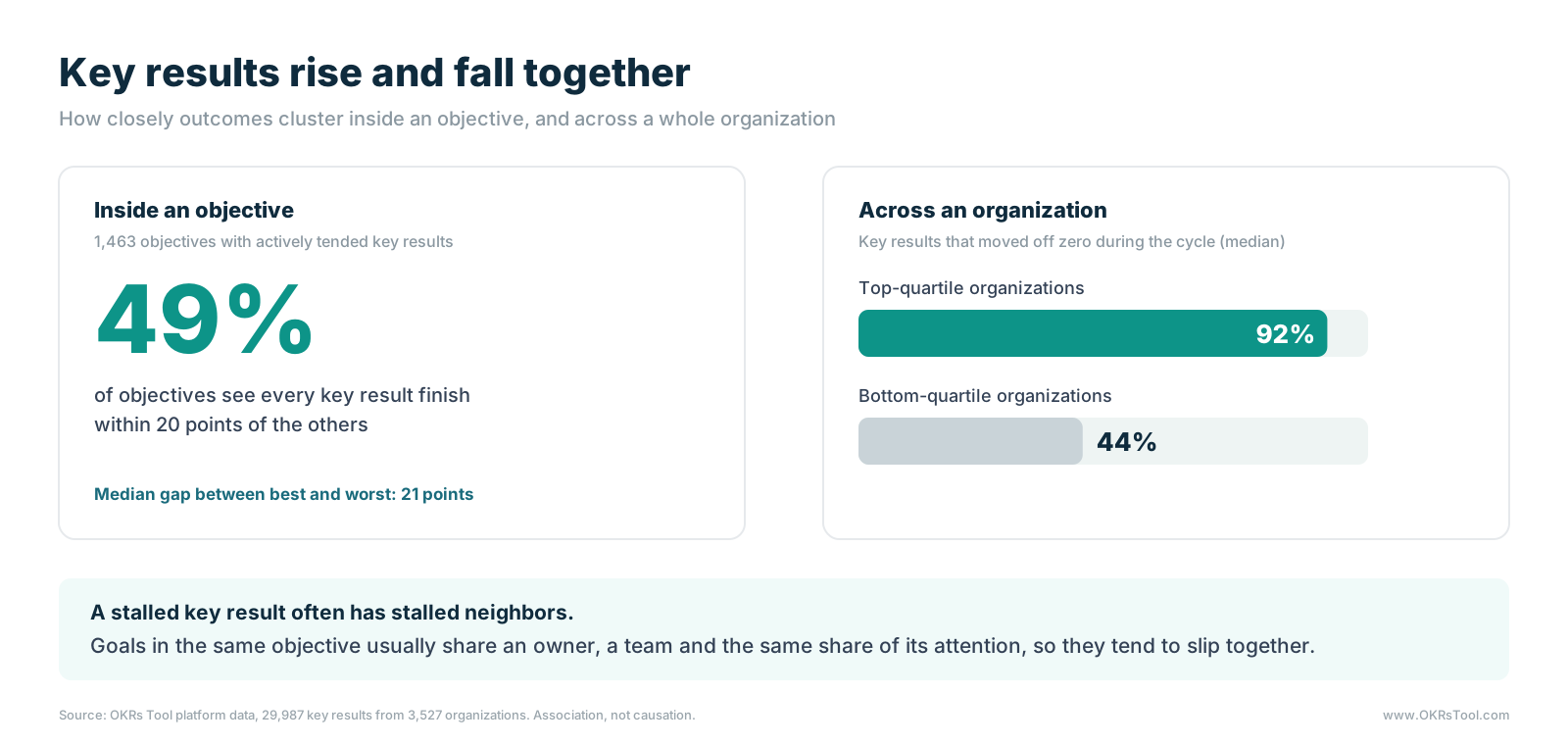
Key results inside one objective usually share an owner, a team, a slice of the quarter and the same share of attention. When any of those runs short, every key result that depends on it slows down together, which is why fixing one in isolation tends to leave the cause in place.
What a Stalled Key Result Usually Means
When one key result in an objective stalls and its neighbors are slipping too, the cause usually comes from one of three places, and each one sits above the key result.
The owner's attention has gone elsewhere. An owner carrying an objective with three or four key results on top of a full job will protect the one they care about most and let the rest drift. The OKR Benchmark Report shows how much ownership matters: teams with an owner on every OKR hit their goals very consistently 65% of the time, against 17% for teams where only some OKRs are owned, and an owner stretched across too much behaves a lot like no owner at all.
The objective depends on something that stopped. Key results often share a dependency, such as a product release, a hire or a budget decision. When it slips, every key result waiting on it stalls in the same week, and no amount of work on any single key result will move it.
The objective no longer fits the quarter. Priorities move, and an objective set in planning week can lose its place by week five without anyone saying so. In the Goal-Setting Benchmark, "priorities shifted" was the most common reason goals were missed, named by 46% of leaders.
Each of those calls for an objective-level decision, and treating the key results one by one delays it.
Diagnose the Objective First
The first question for any stalled key result is whether it's stalling alone.
A key result stalling while its neighbors move usually has a local cause, such as a missing first step, a target set before the facts were in or an initiative waiting on one person. Those get fixed at the key result: a first milestone small enough to hit before the next check-in, a named owner and a date, or a documented change to the target.
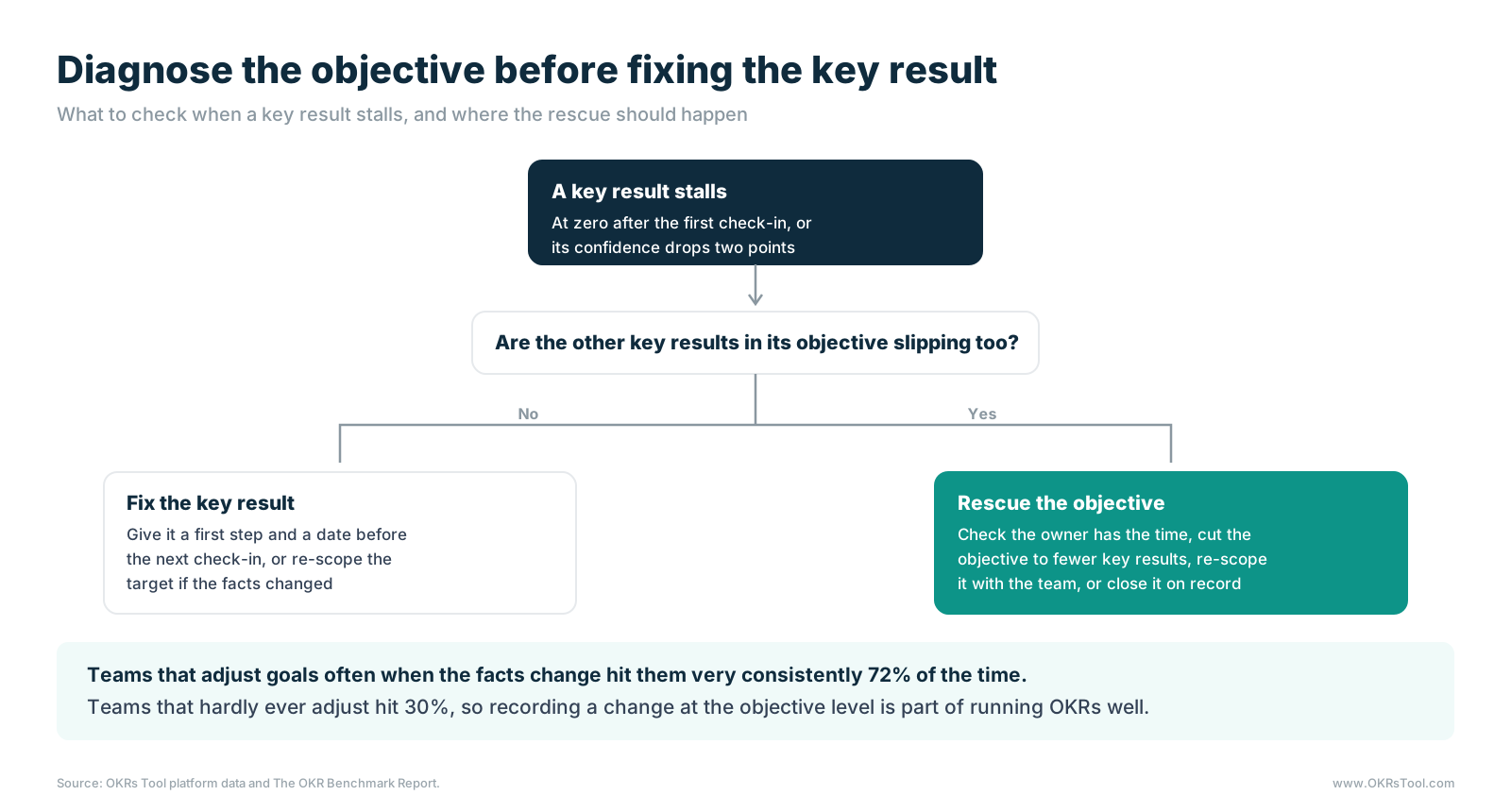
When the neighbors are slipping too, the rescue moves up a level. The useful signal is in the confidence scores: two or more key results in one objective dropping at the same time points to a shared cause, the kind a row of green watermelon OKRs can hide, and teams scoring every key result hit their goals very consistently 66% of the time, against 22% for teams scoring only some, largely because complete scores make this kind of pattern visible.
How to Rescue an Objective
An objective-level rescue has four moves, and the right one depends on which of the three causes is at work.
1. Free Up the Owner
If the owner's attention is the problem, the fix is capacity: take something else off their plate for the rest of the quarter, or hand the objective to someone who can give it the time. A new owner with a clean slate often moves an objective that the original owner had let slide, and the playbook for key results with no owner applies just as well to an objective whose owner has stopped looking at it.
2. Cut the Objective to Fewer Key Results
An objective with four key results and half the attention it needs can often be saved by closing one or two of them on record and putting the effort into the ones that matter most. Teams running one or two objectives per quarter are twice as likely to achieve them as teams running three or more, and the same logic applies inside an objective: focus helps the key results that remain.
3. Re-Scope It With the Team
If a shared dependency has slipped or the facts have changed, the objective's targets should change with them. Teams that adjust goals often when the facts change hit them very consistently 72% of the time, against 30% for teams that hardly ever adjust, as long as each change is agreed and recorded. A clear process for adjusting OKRs when priorities change keeps a re-scope from looking like a quiet retreat.
4. Close It With a Reason
If the objective no longer fits the quarter, closing it is a legitimate result. The Death of OKRs found that half of all OKR endings happen with nobody deciding, as goals are dropped or left in place unused. An objective closed in the review, with a written reason and its owner's time moved to something that matters, protects the rest of the OKR program from that pattern, and it's the decision an underperforming OKR workflow exists to force.
When to Step In
Timing decides how much a rescue can achieve. On the platform, key results already moving at their first check-in hit their target 62% of the time, against 27% for those still at zero. Among key results that were flat at their first check-in and still being worked on, 66% recovered to 70% or more of target when they started moving before the midpoint of the quarter, against 47% when they started later.
That puts the window for an objective-level rescue in the first half of the quarter, with the mid-quarter review as the last scheduled chance to act. The OKR Pacing Benchmark gives a reference point for reading progress before then: key results that hit their target were typically at 50% by week four and 74% by week eight. An objective whose key results are all well short of that pace by week four is a candidate for rescue, even if none of them has hit zero.
Treat the Objective as the Unit of Rescue
Key results tend to fail together. Goals inside an objective share an owner, a team and a slice of the quarter's attention, and the platform data shows them finishing close together far more often than they diverge. When one stalls, the most useful question is what's happening to the objective around it, and the most useful decisions are the ones only an objective-level review can make: freeing the owner, cutting to fewer key results, re-scoping with the team or closing it on record.
Spotting that pattern early depends on seeing every key result's progress and confidence side by side each week. A platform that groups key results under their objective on a live OKR dashboard, with a score on every one and an owner for each objective, shows when several key results slip together while there's still half a quarter left to act.
Data: OKRs Tool platform data, The OKR Benchmark Report, The Goal-Setting Benchmark, The Death of OKRs (and How to Revive Them) and the OKR Pacing Benchmark.