
Teams whose leaders review OKRs every week hit their goals very consistently 65% of the time, against 33% where leaders review them quarterly. Only 26% of companies have leaders looking at OKRs weekly, and the review can be short: with progress already current, ten minutes covers what moved, what's at risk and what leaders need to decide.
"If we had a single place to track them and managers reviewed them weekly, they'd stick a lot better." That answer came from one of the 420 operations and strategy leaders we surveyed for the new OKR Benchmark Report, and it describes one of the clearest gaps in the data. When leaders look at OKRs every week, their teams hit goals very consistently twice as often as teams whose leaders look once a quarter.
The usual objection is time. Leadership calendars are full, and a weekly goal review sounds like one more status meeting. In the teams doing it well, the review is short, runs on numbers that are already up to date and spends its minutes on decisions, and a ten-minute agenda is enough for any leadership team to start next week.
What a Weekly Leadership Review Is Worth
The benchmark measured how often leaders review OKRs alongside how often teams check in and how consistently key results are scored. The weekly version of each goes with roughly double the rate of very consistent goal achievement.
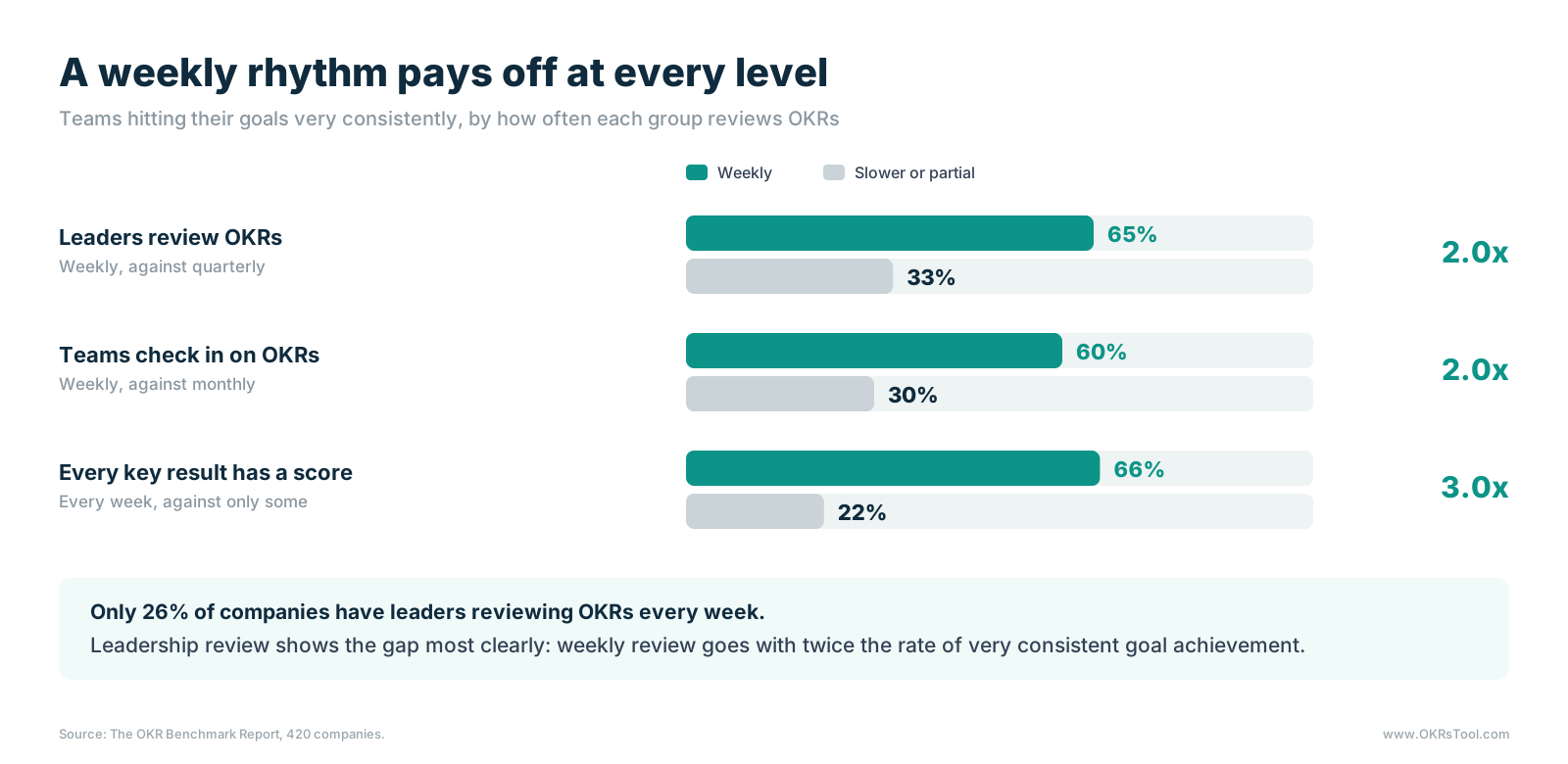
Weekly leadership review stands out because it's rare. Only 26% of companies have leaders reviewing OKRs every week, and bi-weekly is the most common review rhythm at 30%. Our earlier research shows what the gap looks like from the other side. In The Death of OKRs, 57% of leaders who review OKRs weekly said their programs end goals with a clear decision, against 45% where leaders review monthly, and lack of leadership buy-in was the cause that rose most among companies whose OKRs had already stalled.
The weekly look matters for a simple reason. A team watches what leaders watch, and a goal that leadership asks about every week stays important for the whole quarter, while one that only comes up at the quarterly review can drift for weeks before anyone notices. "Weekly reminders from company leadership to use them" was one respondent's answer to what would most improve how their company runs OKRs.
Why So Few Leadership Teams Do It
When a weekly review feels expensive, the cost usually sits in preparation. If progress lives in spreadsheets that owners update the night before, every review starts with someone rebuilding the picture, the hidden cost of manual OKR reporting, and the meeting fills up with reading numbers aloud and arguing about whether they're right.
The benchmark shows how much that preparation drags results down. Teams tracking progress as work happens hit their goals very consistently 59% of the time, against 28% when progress is rebuilt at review time, and manual updates before each check-in did barely better, at 32%. The Strategy Execution Benchmark found the leadership side of the same problem: 47% of leaders first learn a priority is off track at a scheduled review, and only 17% get an automatic signal when something drifts.
A ten-minute review depends on two things being true before anyone walks in. Every owner has updated their key results that week, and every key result carries a confidence score, so leaders can see at a glance which ones need help. Teams scoring every key result hit their goals very consistently 66% of the time, against 22% for teams scoring only some, and the scores are what let the review skip straight to the problems.
The 10-Minute Agenda
The agenda below assumes progress is current and every key result has a score from 1 (off track) to 5 (certain).

Minutes 0–2: Scan What Moved
Open the OKR dashboard and look at the week's changes: which key results moved, which didn't, and which scores dropped, without anyone presenting, so the team arrives at the next block knowing where the attention should go.
Minutes 2–6: Go Straight to What's at Risk
Spend the longest block on every key result scored 1 or 2, and on any score that dropped two points in a week. The owner's written update leads, so leaders hear what the person closest to the work thinks before anyone else weighs in. Key results on track get no airtime, which is what keeps the meeting short.
Minutes 6–9: Make the Decisions Only Leaders Can Make
Each at-risk key result leaves with one decision: unblock it, re-scope it, reassign it or close it, with a name and a date attached. This is where leadership time is worth most, because owners can update numbers on their own but can't move budget, people or priorities.
Teams that adjust goals often when the facts change hit them very consistently 72% of the time, against 30% for teams that rarely adjust, as long as each change is recorded as a decision, so a clear process for adjusting OKRs when priorities change belongs in this block.
Minute 9–10: Send One Signal Back
Agree one line that goes back to the teams: a key result that moved, a blocker removed or a goal that's now the priority. It takes a minute and it's the part teams see, which turns a private leadership habit into a visible one.
A Ten-Minute Review in Practice
This is how one week's review runs at an example 120-person software company with three company objectives and eleven key results, every owner updating before Monday's leadership meeting.
Scan (two minutes). The dashboard shows seven key results moved since last week, two stayed flat and two dropped in confidence. The CEO notes the two drops and the leadership team moves on without discussing the seven that moved.
At risk (four minutes). Two key results get the time. "Raise self-serve activation from 40% to 65%" sits at a score of 2, and the Head of Customer Success's update explains why: the onboarding change it depends on has slipped a sprint. "Expand seats in the top 50 accounts from 12 to 30" dropped from 4 to 2 after two renewals stalled in procurement, and the VP of Sales has written up both deals. While scanning, the COO also spots a marketing key result that doesn't name the company objective it supports.
Decide (three minutes). The CTO moves one engineer onto the onboarding change for two weeks, starting Tuesday. The CFO approves a 60-day payment term the VP of Sales can offer both stalled accounts this week. The Head of Marketing will link the unconnected key result to a company objective or close it by Friday. Each decision goes into the log with a name and a date.
Signal (one minute). The CEO posts one line to the company channel: activation is the biggest risk this quarter, and product is adding an engineer to fix onboarding for the next two weeks.
Every minute in that meeting went on the two goals in trouble and the one that had lost its link. The scores told leaders where to look, the written updates replaced presentations, and the alignment check caught a team goal drifting away from strategy.
That check is worth building in, because only 30% of companies link almost all team goals to company goals, and those that do hit their goals very consistently 68% of the time, against 19% for companies that link only some, which makes OKR alignment the habit with the most room to grow.
Build the Habit in 90 Days
The benchmark's 90-day plan for installing its five core habits doubles as a plan for getting a leadership review running, because the review depends on the habits underneath it.
By day 90, the aim is four or five of the habits in place. Teams running four or five hit their goals very consistently 82% of the time, against 4% for teams running none, and only 9% of companies run all five. The decision log from each weekly review then feeds the quarterly review, so the end-of-quarter meeting starts from a record of what leaders decided and why.
The first weeks carry the most weight. In the OKRs Tool platform data, organizations whose first key result was seen through went on to hit 53% of their later key results, against 24% when it fell short, and the first goals a company sets are usually leadership's. A weekly review from the first week of the first cycle gives those goals the best chance of landing, and it's the most visible form of leadership accountability a team will see.
Ten Minutes, Every Week
A weekly leadership review goes with twice the rate of very consistent goal achievement, and only a quarter of companies run one. The reason it's rare is the assumption that it takes an hour of preparation and another hour of meeting. With owners updating as the work happens and a score on every key result, the review takes ten minutes and spends almost all of them on decisions only leaders can make.
That depends on the numbers being current without anyone chasing them. A platform that collects weekly updates from every owner, keeps a confidence score on every key result and shows company and team goals in one live view gives leadership what it needs for those ten minutes, which is the setup behind leadership visibility without status meetings.
Data: The OKR Benchmark Report, The Death of OKRs (and How to Revive Them), The Strategy Execution Benchmark and OKRs Tool platform data.