66% of People and HR leaders say their performance ratings are highly trusted, but only 27% say nearly all their managers could defend every rating with goal evidence. That gap, from our survey of 230 HR leaders at companies of 50–200 people, shapes how to run a performance review: build the goal record across the period, so the rating has something to stand on.
Review week at a 140-person company tends to look the same. Managers open a blank form, try to remember what each person did since the last review, scroll back through Slack for anything that stands out and write a rating that feels about right. The employee reads it, recognizes the last two months of their work and wonders where the first four went.
To find out how common that pattern is, we surveyed 230 People and HR leaders, from Heads of People to HR business partners, at technology companies of 50–200 employees for the Performance Rating Benchmark Report. Ratings came out as widely trusted and hard to prove, mostly because the goal record and the review live on separate calendars. The data below covers what a performance review is for, where it breaks down and a five-step way to run one that holds up when an employee asks why they got the score they did.
What a Performance Review Is For
A performance review is the scheduled conversation where a manager and an employee look back over a period of work, agree how it went and decide what happens next. At most growing companies it does three jobs at once: it produces a rating, it feeds decisions on pay and promotion, and it sets the direction for the employee's development over the next period.
Goals sit at the center of all three. 87% of HR leaders in the benchmark said goal achievement is an input to the rating, and 60% said goal delivery should be the factor that most influences it. In practice, 55% said it does, and the gap between the two numbers is where most of the trouble in a review starts. A review is only as fair as the evidence behind it, and in a performance management process that evidence usually comes from the goals set at the start of the period.
Why Ratings Are Trusted but Hard to Defend
The headline finding in the benchmark is a confidence gap. 66% of HR leaders said their ratings are highly trusted, yet only 27% said nearly all their managers could defend every rating with goal evidence. 65% have personally seen a rating the goal evidence didn't support, and 39% have seen it more than once.
The cause is memory. Only 52% of HR leaders said manager recall covers the full review period evenly, and 68% have seen strong early work forgotten by the time the review came round. When leaders were asked what should most influence a rating against what does, the most recent work showed the biggest gap of any factor, rising from 20% to 28%. 45% admitted something other than goal delivery moves the number.
Recency bias also falls unevenly. 62% of HR leaders said remote or hybrid staff are at least somewhat disadvantaged in reviews, and 26% said meaningfully so. People who are seen less get remembered less, and a review built on recall carries that into the rating. The performance management statistics from the wider research point the same way.
Where Performance Reviews Run Today
Part of the problem is where the review happens. The benchmark asked HR leaders where they run performance reviews.
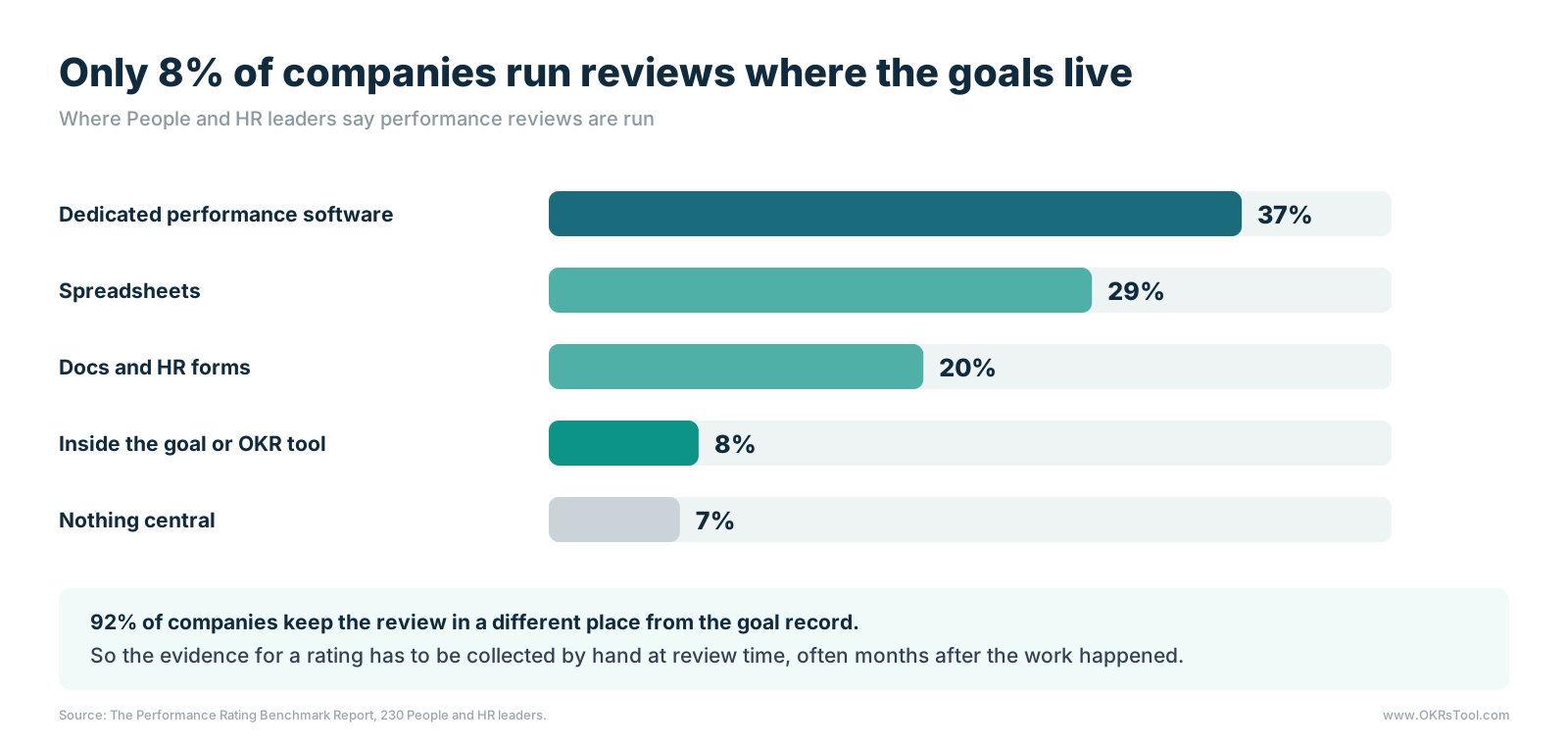
Only 8% run performance inside the same tool that holds their goals, even though 37% already use dedicated performance management software. The other 92% keep the review somewhere else, so the evidence for a rating has to be gathered by hand at review time.
That's harder when reviews are infrequent: 49% of companies review performance twice a year or less, which leaves six months or more of work for a manager to reconstruct, and 35% of HR leaders said their managers have to rebuild the goal picture at review time. A mid-year review shortens that window, but it doesn't fix the missing record on its own.
Connect Reviews to the Goal Record
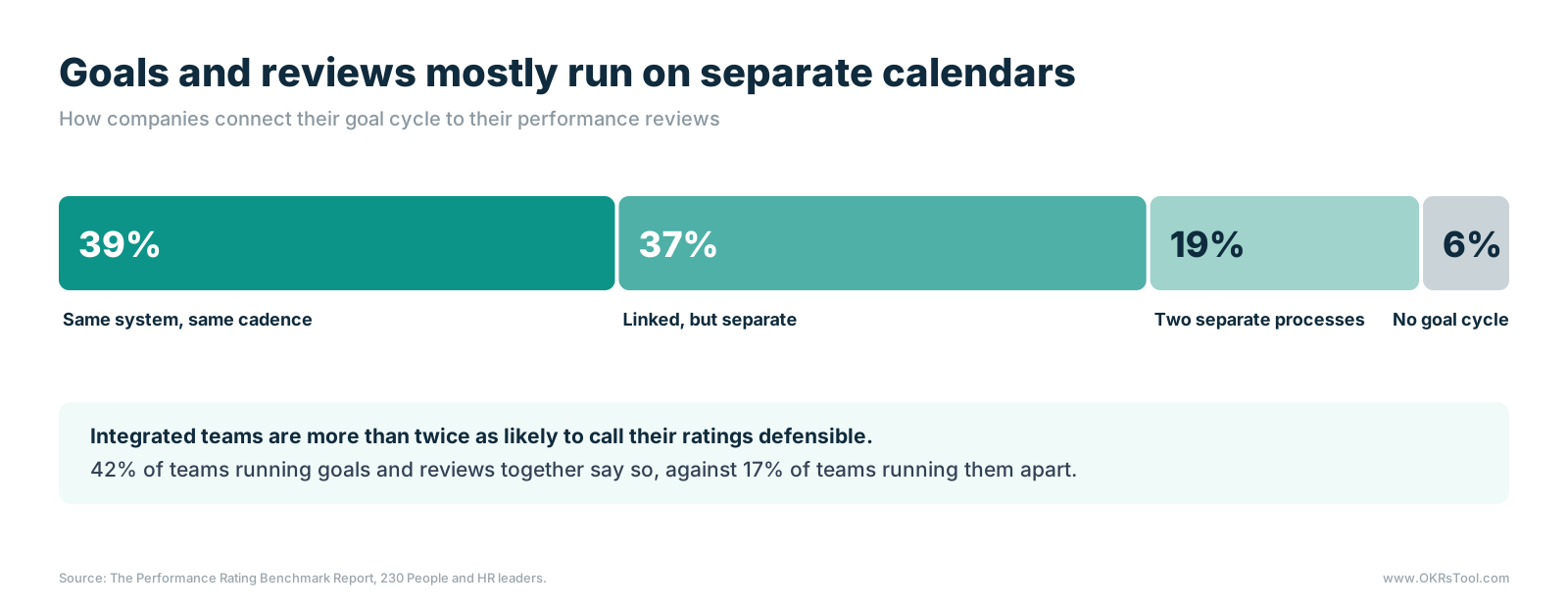
The strongest single predictor of a defensible rating in the benchmark was whether goals and reviews run together.
39% of companies run goals and reviews in the same system on the same cadence. The other 61% run them separately or with no formal goal cycle at all. Integrated teams were more than twice as likely to say their ratings are defensible, 42% against 17%, and less likely to have seen a rating the evidence didn't support, 53% against 74%.
With integration, the manager writing the review can see every goal the employee owned, how it moved week by week and what got in the way, without having to ask anyone, while the rating still weighs how the work was done. That's the idea behind continuous performance management: the record builds as the work happens, so the review reads it.
How to Run a Performance Review in Five Steps
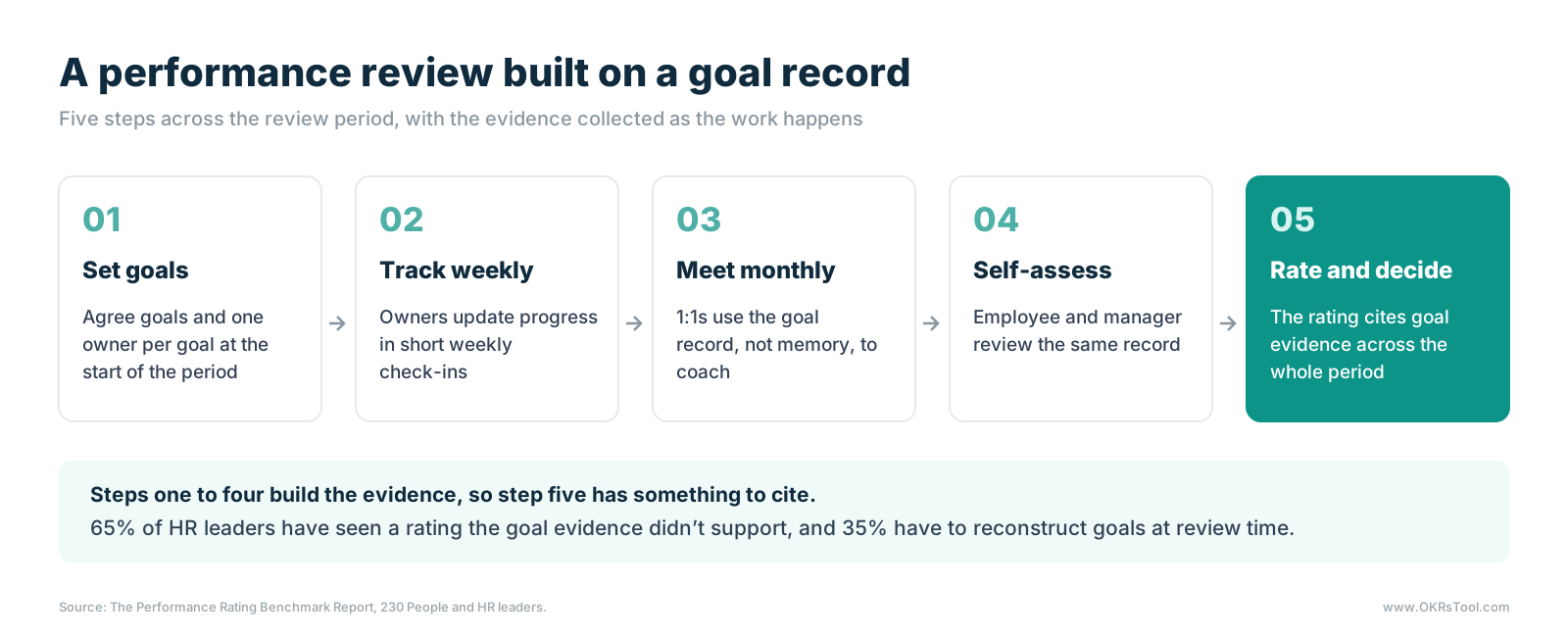
The five steps below spread the work of a review across the whole period, with the rating as the last step.
1. Set Goals With One Owner at the Start of the Period
Every review should begin months earlier, when the employee's goals are agreed. Each goal needs a measurable outcome, a target and a date, plus one named owner, so there's no question later about whose result it was. Examples of performance goals by role help managers set targets that are specific enough to review, and the principles of goal setting for employees keep them connected to team and company goals.
2. Track Progress Weekly
A short weekly check-in, where each owner updates progress and flags blockers, is the goal tracking that builds the record. It takes a few minutes a week, and by review time it holds a dated history of every goal with no reconstruction needed.
3. Hold Monthly 1:1s on the Goal Record
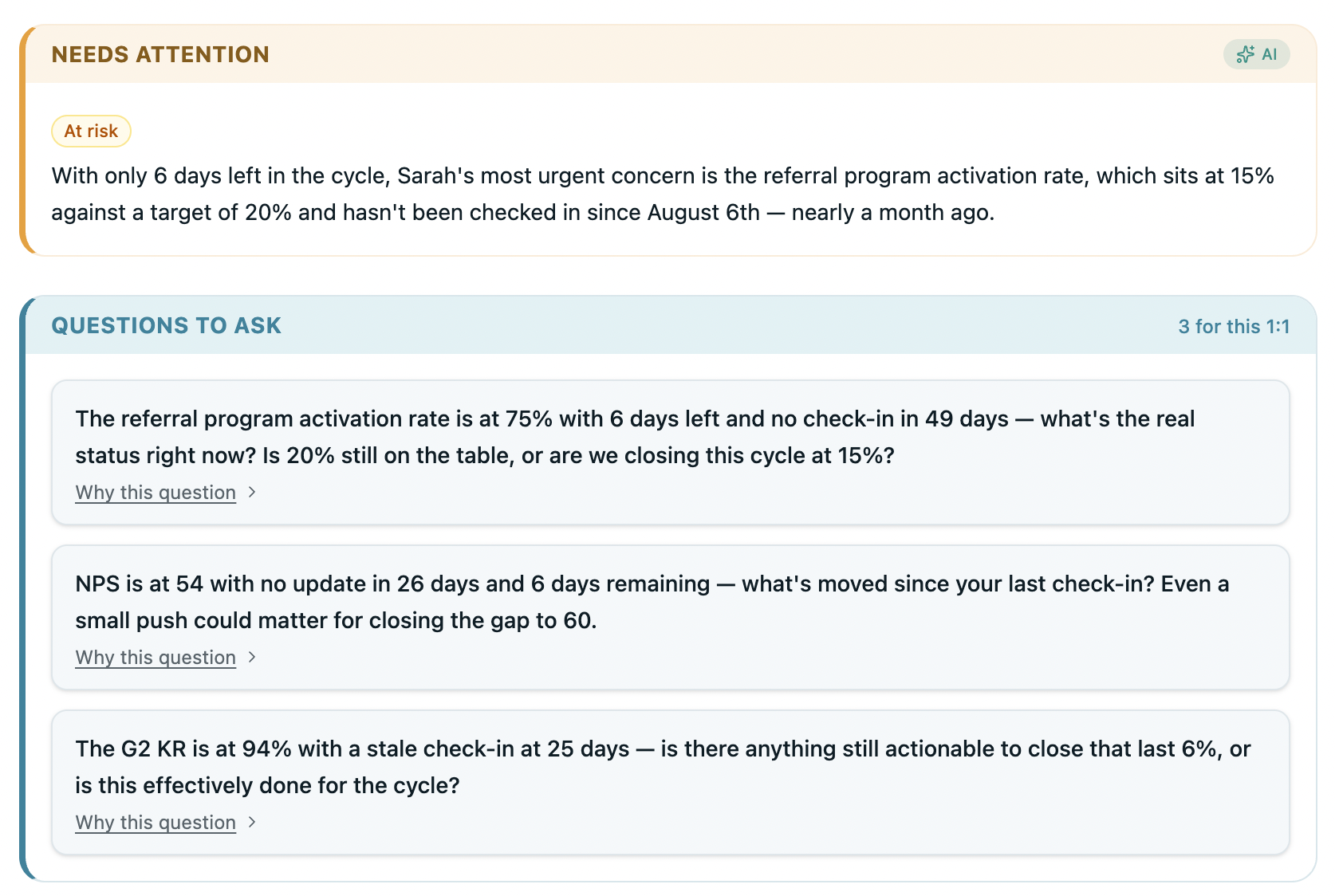
Monthly one-to-ones are where coaching happens. Opening them on the goal record keeps the conversation anchored to what moved, and gives the manager notes from every month of the period. Good check-in questions shift the focus from status to what the employee needs to succeed.
4. Ask for a Self-Assessment Against the Same Record
Before the review meeting, the employee writes a short self-assessment covering what they delivered, what they learned and where they'd like to grow. When both the employee and the manager work from the same goal history, the meeting starts from shared facts, and disagreements are about interpretation.
5. Rate, Calibrate and Decide
The manager writes the rating with evidence from the whole period, citing specific goals and results the way strong performance evaluations do, then a calibration session compares ratings across managers to catch inconsistent standards.
Calibration works best when every rating cites goal evidence, because the discussion can turn to the record when two managers disagree. Input from peers through 360 feedback adds the view a single manager can miss. The meeting itself should hold no surprises: anything in the rating should already have come up in a 1:1.
Types of Performance Reviews
Companies mix several formats, and the right one depends on how fast goals change and how much evidence each review needs.
Whatever the mix, the performance management process works best when every format draws on the same goal record.
Using AI in Performance Reviews
AI is already part of the review at most companies in the benchmark. 54% of HR leaders said they use it in some part of the process.
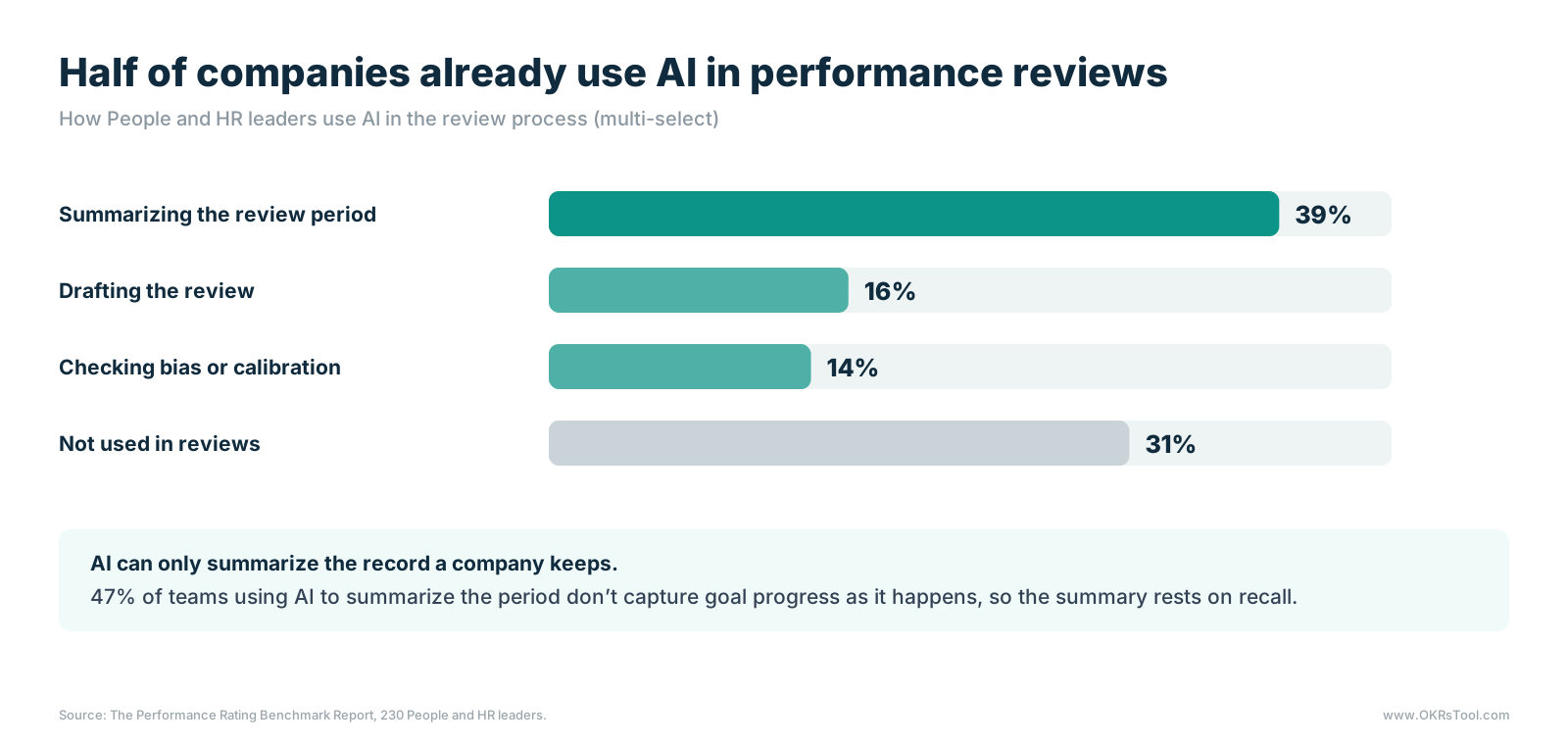
Summarizing the review period is the most common use, at 39%. The catch is what's being summarized. Among teams using AI that way, 47% don't capture goal progress continuously, and only 10% run performance inside a goal tool, so the AI is often working from the same patchy notes and recollections a manager would.
HR leaders named data privacy as their top AI concern (37%), while only 11% named the missing record. AI can speed up a review that already has evidence behind it, and it works best as a drafting aid on top of a goal history, with the manager owning the rating.
Common Performance Review Mistakes
Rating from memory. With only 52% of HR leaders confident manager recall covers the full period, any rating written without a record leans toward the last few months.
Delivering surprises. A rating the employee hasn't heard about before review day damages trust in the whole process. Anything that will affect the score should come up in a 1:1 first.
Tying every goal miss to the rating. The State of Goal Management found that when a missed goal feeds a performance rating, 96% of employees sandbag their targets, against 81% when goals are kept separate. Goal delivery should inform the rating, alongside how the work was done, and stretch goals need room to miss. The guide to OKR performance reviews covers how to weigh the two.
Reviewing too rarely. Half of companies review twice a year or less, which makes the reconstruction problem worse each time.
Overlooking remote staff. 62% of HR leaders see remote or hybrid employees at a disadvantage. A written goal record evens that out, because it shows the work regardless of who was in the office.
Running goals and reviews in different places. With 92% of companies keeping the review apart from the goal tool, the evidence has to travel between systems by hand, and some of it gets lost on the way.
Build the Record Before Review Week
Performance reviews struggle for a practical reason: the evidence a fair rating needs is spread across memory, spreadsheets and old messages, and gathered in a rush once or twice a year. The teams with defensible ratings collect it as the work happens, with goals set and owned at the start, progress updated every week and 1:1s that work from the same record.
For the person running reviews at a growing company, the change starts before review week. Agree goals with one owner, put a weekly check-in in place and make sure the review form can see the goal history. Performance reviews in OKRs Tool sit on the same platform as the goals, so every rating draws on a record of the whole period, and the review becomes a conversation about what the evidence shows.
Data: The Performance Rating Benchmark Report and The State of Goal Management.