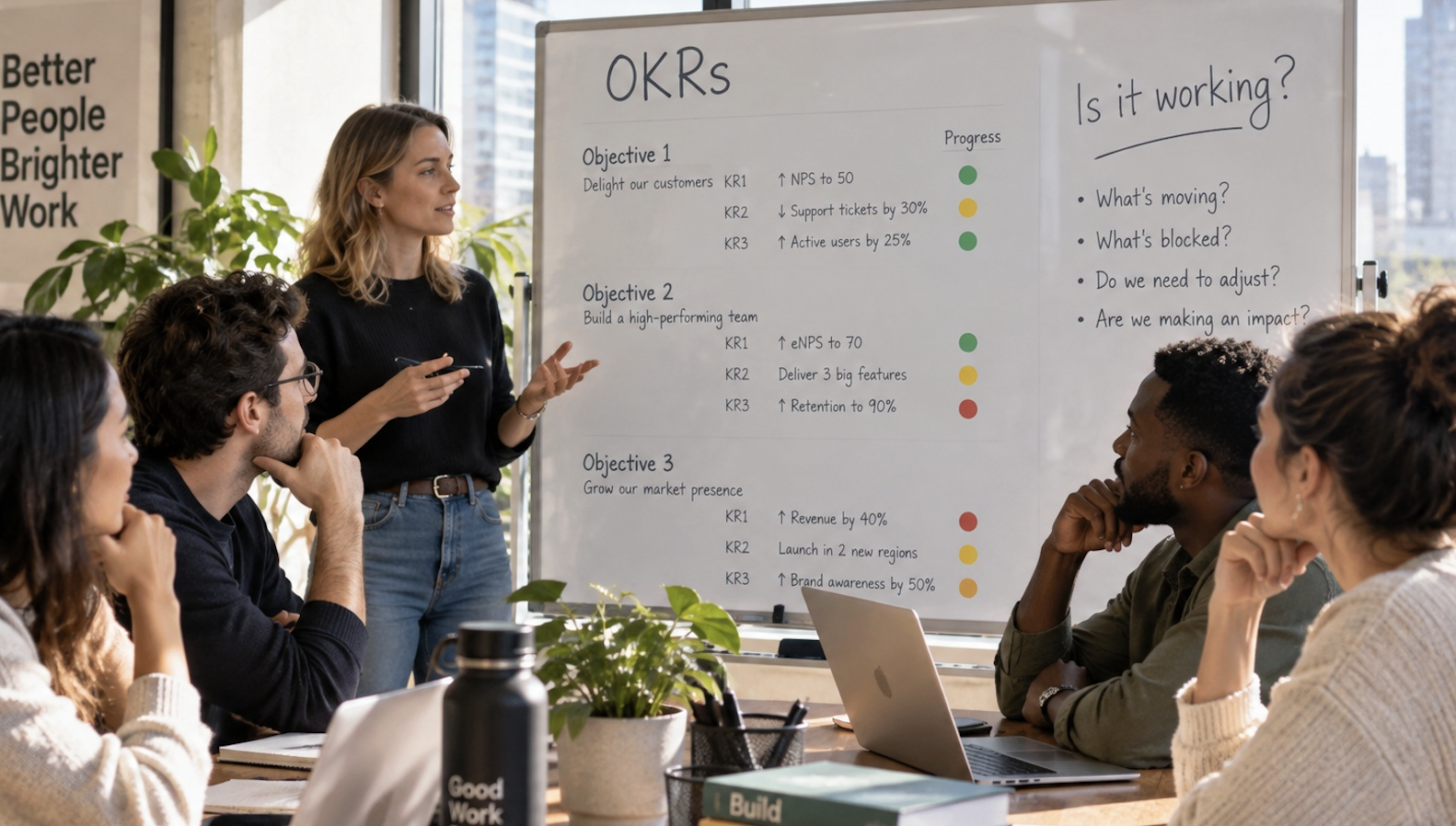
93% of organizations change their goals mid-cycle, yet the meeting built to steer that change — the mid-year review — usually ends in "stay the course." This guide covers what a decision-producing mid-year review looks like: the agenda, the OKR data that feeds it, and the H2 calls it has to leave the room with.
The mid-year review is the most underused lever in the annual planning cycle.
Organizations invest significant time in Q1 planning — strategy sessions, OKR writing workshops, cascade alignment. Then they run two quarters and meet again in December to discuss what happened. The mid-year review sits between those two events and is treated, in most organizations, as an optional check-in rather than a structural intervention.
The OKR Intelligence Report 2026 — 222 organizations — found that 93% of organizations modify their goals at least occasionally after the cycle starts. Mid-cycle adaptation isn't a sign of poor planning. It's a sign of paying attention. The question isn't whether your mid-year review should surface changes — it's whether it's structured to produce the right ones.
What Is a Mid-Year Review?
A mid-year review is a structured leadership session — typically held in June or July — that assesses H1 performance against strategic goals and makes explicit decisions about H2 priorities, resource allocation, and goal adjustments.
It is not a progress update. It is not a forecasting exercise. It is a decision session — the output is a revised or reaffirmed set of H2 priorities that the organization will actually execute.
The distinction matters because the format follows the purpose. A progress update produces a slide deck. A decision session produces a list of changed priorities, revised Key Results, and reallocated resources.
Why Mid-Year Reviews Fail
The most common failure mode: the mid-year review surfaces problems that everyone already knew about, produces no decisions, and ends with a commitment to "stay the course" that nobody believes.
Three structural reasons this happens:
No OKR data as input. Reviews that rely on qualitative updates — "sales is behind," "product is on track" — produce qualitative decisions. Reviews that start from OKR scores and Key Result completion rates produce specific ones.
The 2026 OKR Benchmark Report across 330 organizations found that only 49% of leaders consistently review OKRs on a weekly basis. If leadership isn't reviewing OKR data weekly, the mid-year review will be the first time they see it — which means the first hour is spent understanding the data rather than making decisions.
No strategic assumption audit. H1 plans were written in January based on assumptions about the market, the product, and the team. By July, some of those assumptions are wrong. A mid-year review that doesn't explicitly ask "which assumptions from Q1 planning are no longer valid?" will produce decisions based on outdated thinking.
No named decisions. The most common mid-year review output is a set of observations: "we need to accelerate enterprise pipeline," "the product roadmap needs to be reprioritized." Observations are not decisions. A decision is: "We are moving two engineers from the consumer roadmap to the enterprise integration — effective immediately. OKR Owner: James. Reviewed at Q3 weekly check-in week 2."

The Mid-Year Review Agenda
A 90-minute session, structured in four blocks:
Block 1: H1 OKR Scorecard (20 minutes)
Start with the data. Score every company-level Key Result on a 0.0–1.0 scale — not as a performance judgment, but as a factual input to the decisions that follow.
The OKR scoring guide covers the scale in detail. For the mid-year review, the relevant question per KR is not "why did we miss this?" — it's "does this KR still represent the right outcome to pursue in H2, and if so, is the target still the right target?"
A KR scored 0.3 at mid-year with a realistic path to 0.7 by year-end is a different conversation from a KR scored 0.3 at mid-year where the underlying strategic assumption has changed.
Block 2: Strategic Assumption Audit (25 minutes)
Three questions for each company-level objective:
- What did we assume about the market / product / team when we set this objective in January?
- Which of those assumptions are still valid?
- For the assumptions that have changed — what does that mean for H2 priorities?
This is the most important block in the session. It's also the one most mid-year reviews skip. The result: organizations spend H2 executing on a strategy built for a version of the world that no longer exists.
The OKR Intelligence Report 2026 finding supports this structurally: 93% of organizations modify goals mid-cycle. The organizations doing this well are treating modification as a deliberate decision — not a quiet drift. The strategic assumption audit is what makes the modification deliberate.
Block 3: H2 Priority Decisions (30 minutes)
Based on the scorecard and the assumption audit, the leadership team makes three to five explicit H2 decisions:
- Which OKRs from H1 carry forward unchanged into H2?
- Which need revised targets?
- Which should be formally closed — because the strategic context that made them relevant has changed?
- Which new priorities, not on the original H1 plan, should be added for H2?
Each decision gets a named owner and a date for first check-in.
Block 4: Resource and Ownership Alignment (15 minutes)
H2 priorities without resource alignment are aspirations. The final block addresses two questions:
- Are the right people working on the highest-priority H2 goals?
- Does anything need to move — headcount, budget, external support — to give the H2 priorities a realistic chance?
Teams with clear single ownership per Key Result see 26% higher completion rates. The mid-year review is the structural moment to fix ownership gaps before H2 starts.
How OKR Data Makes the Mid-Year Review Specific
The mid-year review is only as specific as the data going into it. OKR software that surfaces live KR completion rates, check-in history, and alignment map status gives the leadership team a factual foundation for every decision in the session.

The specific inputs that make the mid-year review productive:
The Mid-Year Review vs the Quarterly Business Review
The mid-year review and the quarterly business review are related but serve different purposes.
The QBR is a cycle-end event — scoring the quarter, running the retrospective, and feeding learnings into the next cycle's planning. It happens four times a year.
The mid-year review is a strategic recalibration event — it happens once a year and its scope is the full annual strategy, not a single quarter. It asks whether the annual priorities set in January still make sense, given six months of new information.
In a well-structured OKR programme, the rhythm looks like this:
OKRs Tool now supports all five review layers natively — from the automated weekly check-in nudge through to the structured MBR and QBR formats.
Mid-Year Review Template: The 90-Minute Agenda
Pre-work (sent 3 days before):
- Each team lead scores their H1 Key Results and submits a one-paragraph assumption audit for each objective
- Finance provides H1 actuals vs plan
- OKR dashboard exported or shared live
In-session agenda:
00:00 — 00:20: H1 OKR ScorecardWalk through company-level KR scores. No debate on causes — just facts. Flag anything below 0.5 as requiring a decision in Block 3.
00:20 — 00:45: Strategic Assumption AuditFor each company objective: what did we assume in January? What's changed? What does that mean?
00:45 — 01:15: H2 Priority DecisionsFor each decision identified in Blocks 1 and 2: carry forward, revise, close, or add. Named owner and first check-in date for each.
01:15 — 01:30: Resource and Ownership AlignmentDoes H2 have the right people on the right priorities? What needs to move?
Post-session (within 48 hours):
- Revised H2 OKRs published with updated owners
- Decision log distributed to all team leads
- Cascading goals updated to reflect H2 priorities
The 90 Minutes That Decide H2
A mid-year review is 90 minutes against six months of execution — the highest-leverage meeting in the annual calendar, and the one most consistently run as a status update instead of a decision session.
The teams that get it right walk out with OKR scores read as facts, the January assumptions that no longer hold named out loud, and three to five H2 calls each with an owner and a first check-in date. The teams that skip it carry H1's momentum into H2 in a direction the last six months may have already invalidated.
The OKR maturity curve shows what happens when that discipline repeats: teams in their first two cycles finish 51% of goals, teams at cycle five and beyond finish 79%. That climb is built at the mid-point — reviewing honestly, deciding explicitly instead of drifting, and starting each half with a plan that matches the world as it actually is, then repeating it the next cycle and the one after that.
Data: the OKR Intelligence Report 2026 (222 organizations, technology sector), the ROI of OKRs: 2026 Benchmark Report (330 respondents), and the 2026 OKR Benchmark Report (200 organizations).