A sharp check-in question surfaces a stalling goal early — but only if its answer gets recorded and reaches someone who can act. Teams that check in weekly complete 43% more of their goals than teams checking in monthly.
Search "check-in questions" and the results run together: long ranked lists of prompts to ask your team. "What are you proud of this week?" "What's one thing slowing you down?" You could work through every one of them and still watch the same goals stall out by week six. The questions were never the variable.
What moves the number is what happens to the answer after someone says it. A team where "this key result hasn't budged" reaches the person who can act on it hits its goals. A team where the same sentence gets said in a Monday meeting and forgotten by Thursday doesn't. Same question, opposite outcome — decided entirely by whether the answer went anywhere. That gap is what separates a working set of OKRs from a dashboard nobody trusts.
The behavioral data backs this up hard, and it points at cadence and follow-through rather than phrasing. So this covers four check-in questions that produce something you can act on, one question worth dropping, and the part every list leaves out — where the answers have to land for any of it to count.
Cadence Predicts Completion More Than Wording Does
The 2026 OKR Benchmark Report looked across 200 organizations for what separates teams that complete their goals from teams that don't. The strongest single predictor was check-in frequency — not goal wording, ambition, or framework. Teams running a weekly check-in completed far more of their OKRs than teams checking in monthly or ad hoc.
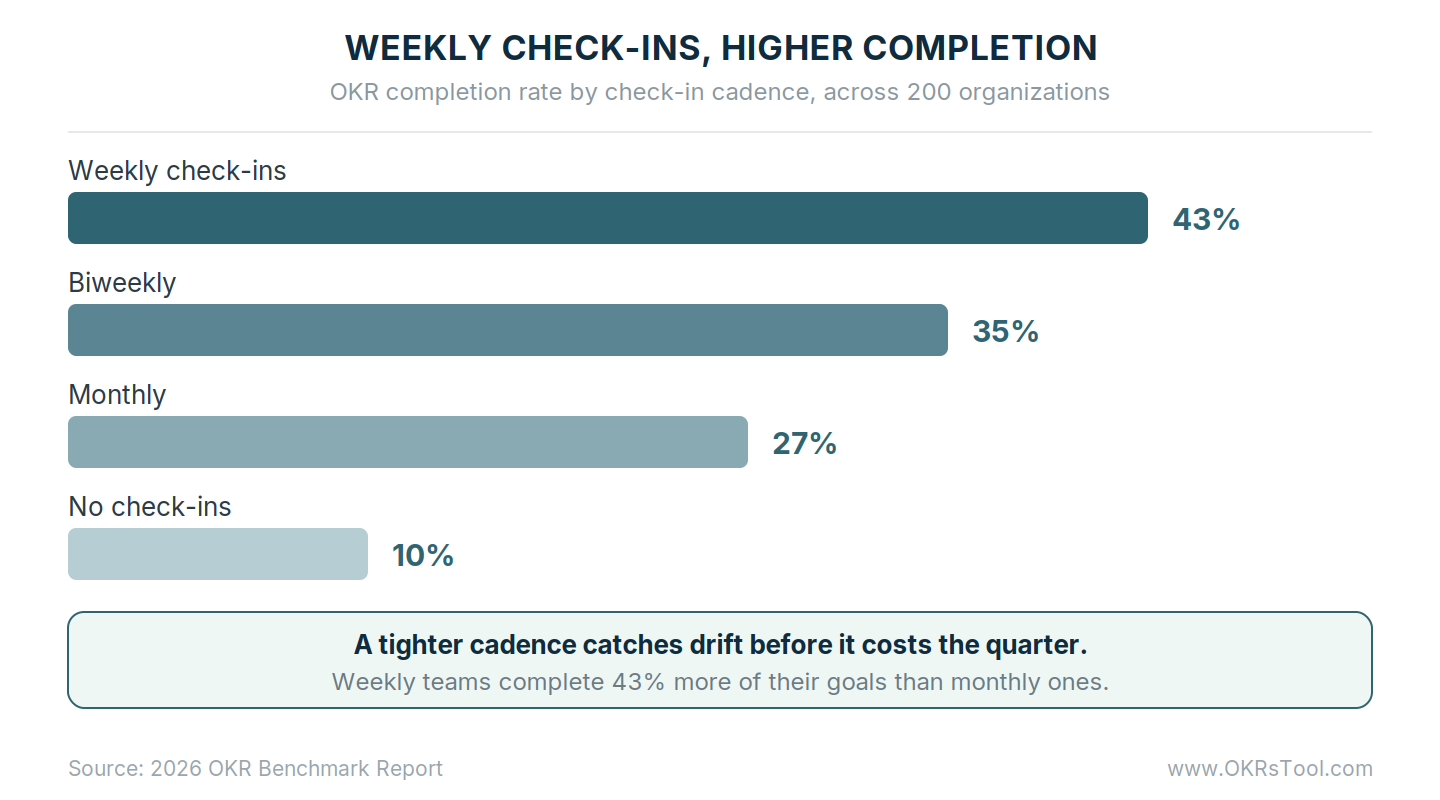
The 43% figure is a lift over monthly or ad-hoc reviews. It doesn't mean weekly teams write better goals — it means they touch their goals more often, which keeps a drifting priority from sliding silently for eleven weeks before anyone reacts. The cadence beats the wording here.
Which means the job of a check-in question is narrow and specific. It isn't to inspire reflection. It's to surface, in the smallest possible number of words, whether a goal is moving and whether anyone needs to do something about it. Judge every candidate question against that job and few of the standard prompts survive it.
The Four Questions Worth Asking
A good check-in meeting runs in fifteen to twenty minutes for a whole team, which means roughly two minutes per person. You cannot spend that budget on open-ended reflection. These four questions fit inside it and each one produces something actionable.
1. What Moved This Week?
Not "what did you work on" — that invites a to-do list. "What moved" forces the answer back to the key result itself: the number, the metric, the baseline-to-target movement. If the honest answer is "nothing moved," that's the most useful thing anyone will say all week, because it's the earliest possible sign of a stall. A goal frozen at zero progress is the clearest predictor of a miss, and this question is how you catch it in week three instead of week eleven. If you're not sure how to phrase a KR update, our check-in generator drafts one in seconds.
2. What's Off Track, and Why?
This is the question that makes watermelon reporting — green on the outside, red on the inside — harder to sustain. Asking "why" alongside "what" separates the people who know exactly why their KR slipped from the ones reporting healthy because it's easier. You're not looking to assign blame. You're looking for the specific cause, because a scope problem, an ownership problem, and a blocker are three different fixes.
3. Where Do You Need Help?
A stall usually comes from an unresolved dependency rather than a lack of effort. The day-3 email that's blocked on someone else's copy review. The sign-off that hasn't come. This question exists to convert a private blocker into a shared one before it costs a fortnight. It's also the question that makes the check-in feel like support rather than surveillance, which is what keeps people honest in the other three.
4. How Confident Are You Now — On a Scale of 1 to 5?
The confidence score is the most underused signal in OKR practice and the most valuable. A single number, tracked week over week, turns a fuzzy sense of "how's it going" into a trend line.
A KR that drops from 4 to 3 to 2 over three weeks is telling you something a percentage-complete figure can hide: the owner has lost belief in the target while the number technically still looks fine. That divergence — flat progress, falling confidence — is the truest early warning you have.
Four questions, two minutes, one signal per person. The check-in isn't a status meeting. It's a weekly instrument reading, and confidence is the gauge that moves first.
The One Question to Stop Asking
"Are we still on track to hit this?"
It sounds responsible. In practice it invites the exact behavior you're trying to prevent. Ask a binary on-track/off-track question in a room where goals are tied to performance reviews, and you've handed everyone a reason to say "yes, on track" and manage the gap privately.
The State of Goal Management Report found that when goals directly affect ratings, 96% of employees admit to sandbagging and 70% to reporting a goal as healthier than it was. A yes/no on-track question doesn't get you truth. It gets you a better-looking version of whatever the person already decided to tell you.
The confidence score replaces it precisely because a 3-out-of-5 isn't a confession. It's a reading. It's safe to give, which is exactly why it's more honest than the binary it replaces — and why it gives a mid-quarter review something real to work with instead of a wall of green.
The Answer Has to Land Where Someone Can See It
You can ask all four questions perfectly and still get nothing from them, if the answers evaporate the moment the meeting ends. What separates a check-in that works from a ritual that decays is where the answer goes next.

Across 876 organizations and 20,952 key results in our first-party platform data, teams that kept their key results updated completed goals at 68% versus 35% for teams that didn't — nearly double. A check-in question is worth exactly as much as the update it produces. An answer that gets spoken in a meeting and never recorded changes nothing; the same answer typed into a KR the whole team can see changes the trajectory.
This is the difference between visibility that's pull versus push. In a pull system, the check-in answer sits in a doc or a Slack thread, and a leader only learns a goal is stalling if they remember to go looking. In a push system, the answer to "what's off track" and a falling confidence score combine into a signal that surfaces itself — reaching the person accountable without anyone having to notice.
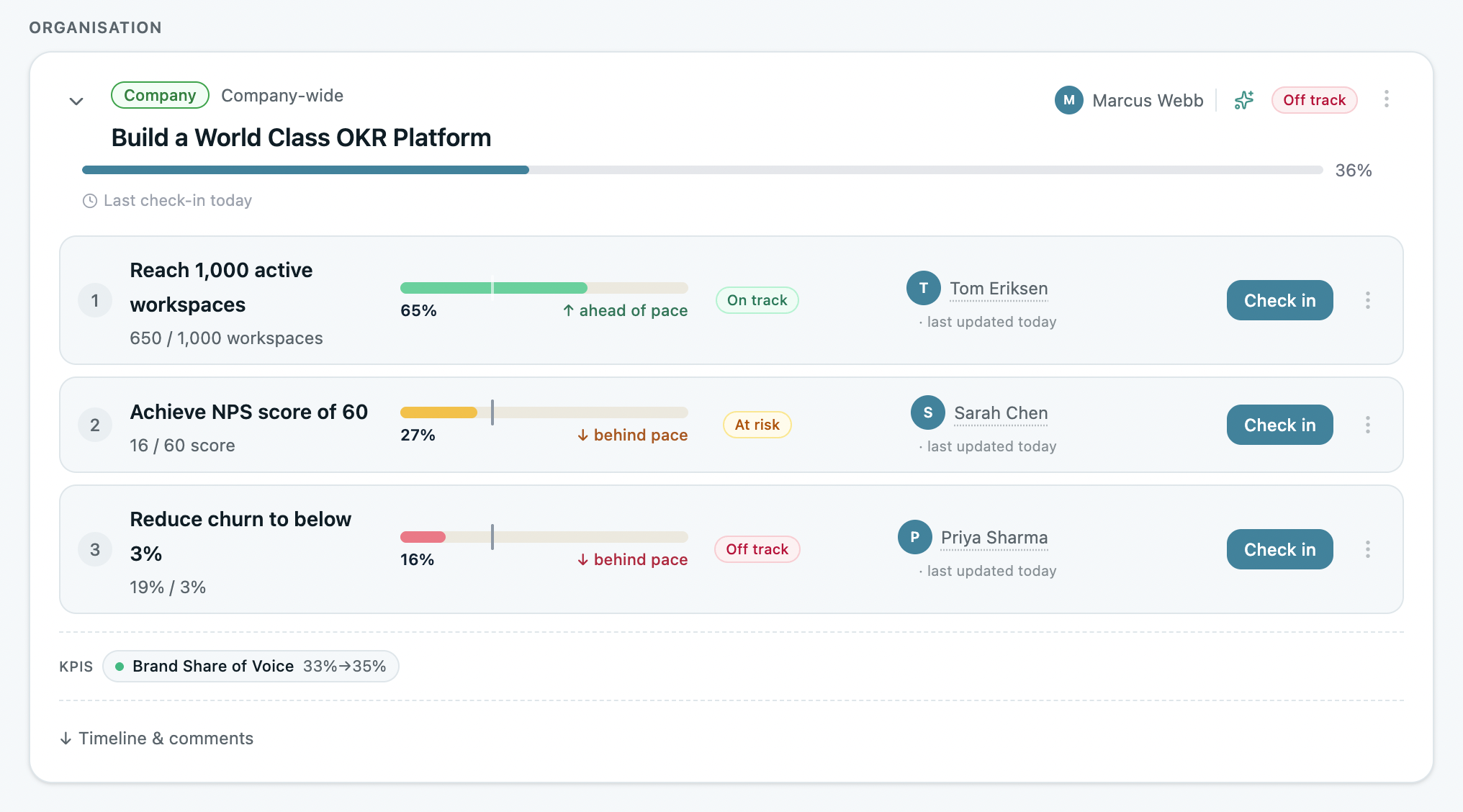
Asking the questions inside a system rather than a meeting is what makes this work. A recorded answer surfaces on its own; a spoken one gets filed and forgotten. When the confidence score drops two weeks running while progress stalls below pace, the owner's lead hears about it — automatically. Nobody had to be the person watching.
The Real Job: Getting Off the Hook Yourself
There's a specific failure mode this is built to prevent. You introduced goals, and for a while you personally held the whole thing together — chasing updates on Monday, reminding people their KRs hadn't moved, assembling the picture yourself before every review. It worked because you were the mechanism. Every new hire made it heavier.
Better check-in questions don't fix that. A better system for the questions does. When the check-in nudges the owner, captures the four answers, and flags a stalling goal on its own, keeping OKRs alive stops depending on you.
A goal program that runs on one person quietly dies the first busy quarter; one that runs on a system survives past the first cycle. Flat pricing on Scale lets the whole org check in, not just the teams with a spare seat, and every answer rolls up into one view leadership can read without asking for it.
Ask the four questions. Drop the on-track one. But put them somewhere the answers get recorded, surface on their own when a goal slips, and reach the person who can act — not a meeting the team forgets by Thursday. Questions asked inside that kind of system are what keep a strategy moving through the quarter instead of stalling in silence.
Data: 2026 OKR Benchmark Report (200 organizations) OKR Platform Data (876 organizations, 7,419 objectives, 20,952 key results); and the State of Goal Management Report (210 employees, anonymous survey). Explore all six on the research hub.