
Performance management measures what people deliver; engagement measures how they feel about delivering it. Run apart — a review on one calendar, a survey on another — a retention problem stays buried until someone resigns. And the performance half is shaky alone: 66% of HR leaders trust their ratings, but only 27% can prove one with evidence. Connected on a shared goal record, a dip shows up while there's still time to act.
Performance and engagement are usually owned by the same people and run as if they were unrelated. The review cycle produces ratings; the engagement survey produces a sentiment score; the two get discussed in different meetings and rarely cross-referenced.
That separation is expensive, because the questions each answers only make sense together: a high performer whose engagement is sliding is a flight risk the performance review alone won't catch the review alone won't catch, and a disengaged team hitting its numbers is running on borrowed time.
The reason the two drift apart is structural, and it's the same reason ratings themselves are hard to trust. In a survey of 230 People and HR leaders, the Performance Rating Benchmark Report found 66% trusted their ratings while only 27% could defend one with goal evidence — because performance and the goal record live on separate systems.
Engagement is one more disconnected layer on top of that. This guide covers how performance and engagement actually connect, why running them apart fails, and how a single system built on the goal record ties them together — including the performance and engagement features that do it in practice.
How Performance and Engagement Connect
The link between the two runs through the goal. Someone's performance is what their work delivered; their engagement is whether they still believe the work matters and that their effort is seen fairly. Both are read off the same daily reality — the goals they own, the progress they make, the feedback they get, the recognition they receive or don't.
That shared root is why they move together. Engagement drops when effort feels invisible or a rating feels arbitrary, and both of those are goal-record problems: work that wasn't tracked can't be recognised, and a rating with no evidence behind it reads as unfair.
It rises when the connection is visible — when someone can see their work laddering up through a clear alignment map, gets feedback tied to it, and trusts that the review will reflect what they actually did. Performance data tells you what happened; engagement data tells you whether it's sustainable. Neither is complete without the other.
Why Running Them Apart Fails
Kept on separate systems, each loses most of its value. The review becomes a backward-looking verdict with no read on whether the person is still bought in; the engagement survey becomes a sentiment number with no link to the work that produced the feeling.
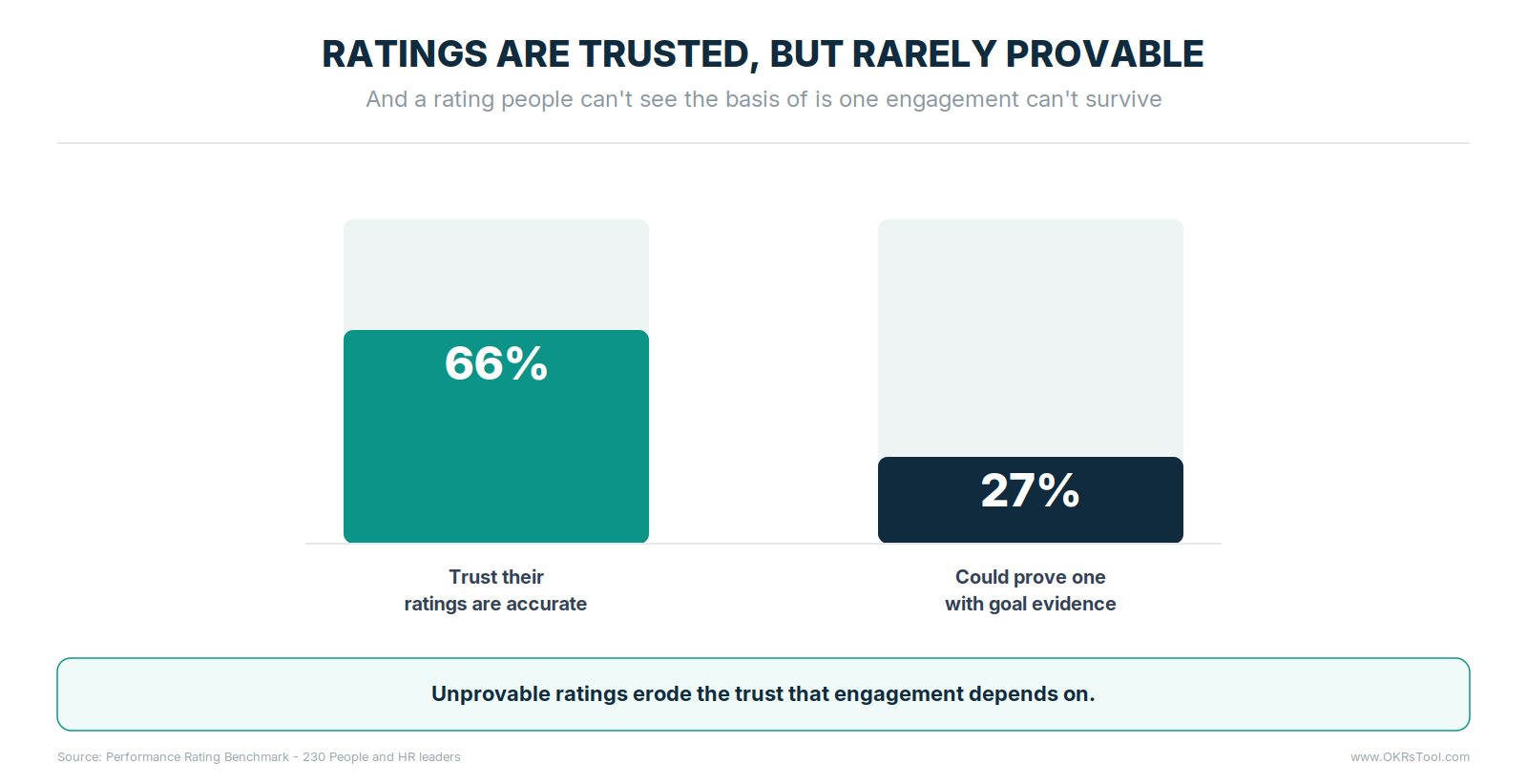
The performance side is already fragile on its own: two-thirds of leaders trust their ratings, but barely a quarter could defend one with evidence, and 68% have watched a strong performer marked down because their best work faded from memory — a recency mistake by review time. A rating people can't see the basis of is one engagement can't survive — unfairness perceived once feeds goal-gaming and colours every survey that follows.
Meanwhile the annual engagement survey arrives too late to act on: by the time a dip shows up in a once-a-year score, the disengaged high performer is often already interviewing elsewhere. Two lagging indicators, each blind to the other, is the worst possible setup for catching a problem early.
Separate Systems vs. One Connected System
What separates them is whether the two data sets can see each other at all.
The Features That Connect Them
A connected system needs both halves running on the same goal record. In OKRs Tool, the Performance Reviews experience and the engagement layer are built to do exactly that.
Performance Reviews bring structured, OKR-aligned reviews into one flow — run cycles, collect self and manager input, reference the OKRs directly, and set next-cycle focus, so performance reflection connects to business outcomes rather than floating free of them.
The 9-Box Grid places every team member by performance and potential on one grid, with OKR progress seeding the performance axis while you make the final call. It turns talent decisions — who to stretch, who to coach — into calls backed by delivery data instead of gut feel.
360 Reviews collect input from peers, managers, and self-assessments in one place, with competency scoring and AI-generated summaries, so strengths and growth areas surface without chasing feedback across tools.
Continuous Feedback lets anyone give, request, or record feedback at any point in the cycle — public praise to the recognition feed or private notes — keeping development conversations tied to the work rather than saved for the annual review.
Employee Engagement Surveys measure how the team feels, not just how it performs — run alongside the OKR cycle, tracking sentiment over time and surfacing the signals that matter before they become retention problems. Running them on the same platform is what connects people data to goal data, so a leader reads the full picture on one platform.
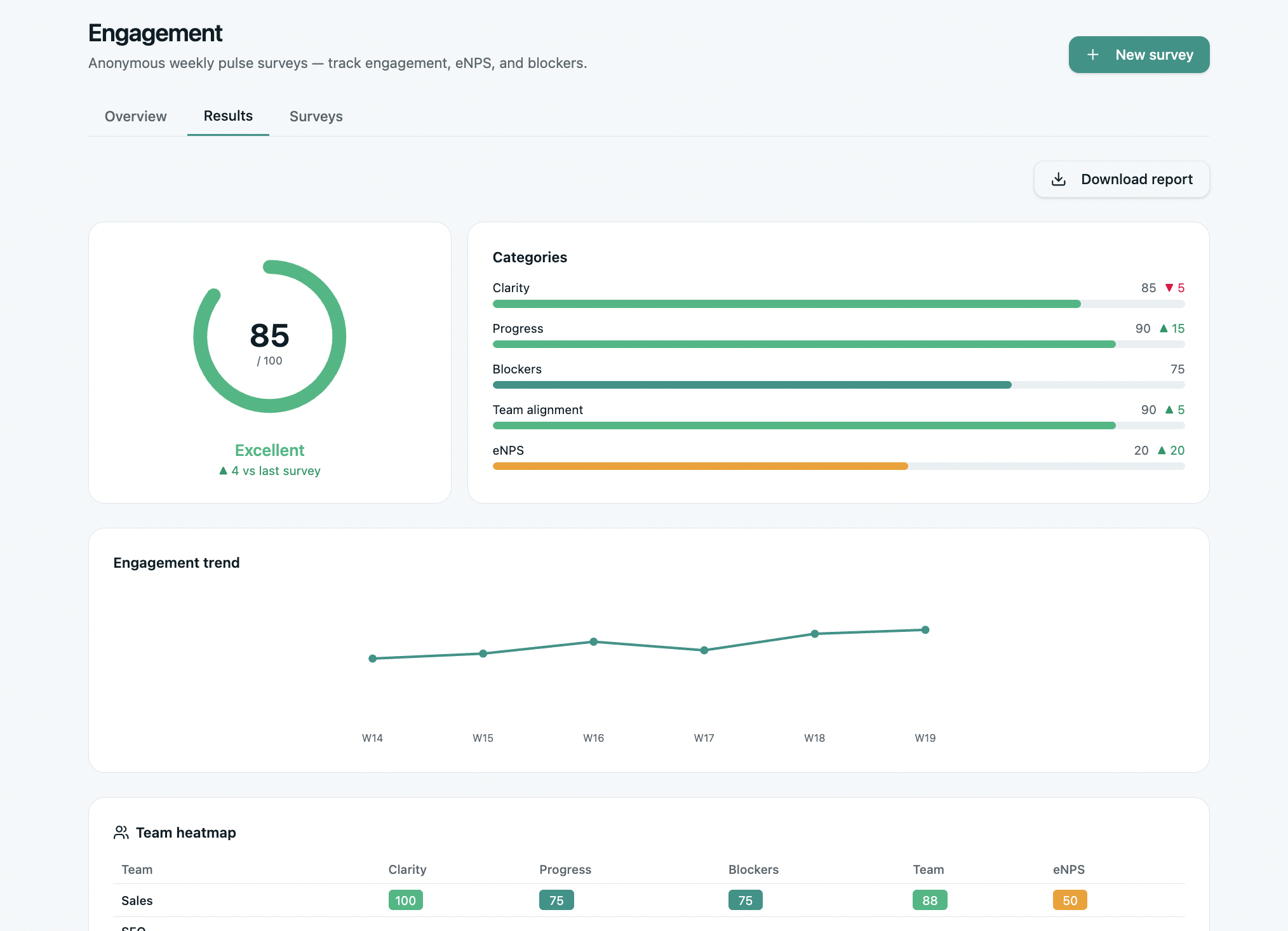
People Data and Goal Data Belong Together
Performance management and employee engagement answer two halves of one question: what did the team deliver, and will they keep delivering it? Run apart, each answer is partial and late.
Run on one performance management system built on the goal record, they check each other — a rating that points to evidence keeps engagement intact, and an engagement dip against strong goal progress flags a retention risk while there's still a conversation to be had.
For a growing company, the move is to stop treating the survey and the review as separate events on separate calendars. Put both on the same cadence as the goals, so the sentiment score and the delivery record sit side by side.
That's when performance management stops being a backward-looking verdict and engagement stops being an annual temperature check — and the two together start telling you what's actually happening on the team, early enough to do something about it.
Data: the Performance Rating Benchmark Report, an independent survey of 230 People and HR leaders at technology companies of 50–200 employees.