
87% of People and HR leaders use goal achievement as an input to performance ratings, yet 65% have seen a rating the goal evidence didn't support. The appraisal method a company picks decides how much evidence a manager has when the form arrives, and the seven methods below differ most on exactly that. For most growing companies, a goal-based method with a short self-appraisal strikes the best balance.
A performance appraisal form asks a manager to sum up six or twelve months of someone's work in a few boxes and a number from one to five. How fair that number turns out to be depends mostly on what the manager has to go on when filling it in, which comes down to the appraisal method behind it.
This guide compares the seven methods companies use most, shows where each one gets its evidence, and ends with a sample appraisal form and example comments managers can adapt. The data comes from our Performance Rating Benchmark Report, a survey of 230 People and HR leaders at technology companies of 50–200 people.
Choose the Method Before the Form
Each appraisal method asks for a different kind of evidence. A rating scale relies on the manager's overall impression at the end of the period, a critical incident log on notes kept as the work happens, and 360 feedback on input from several people. The map below places the seven methods by how much of the period they record and how much effort they take at review time.
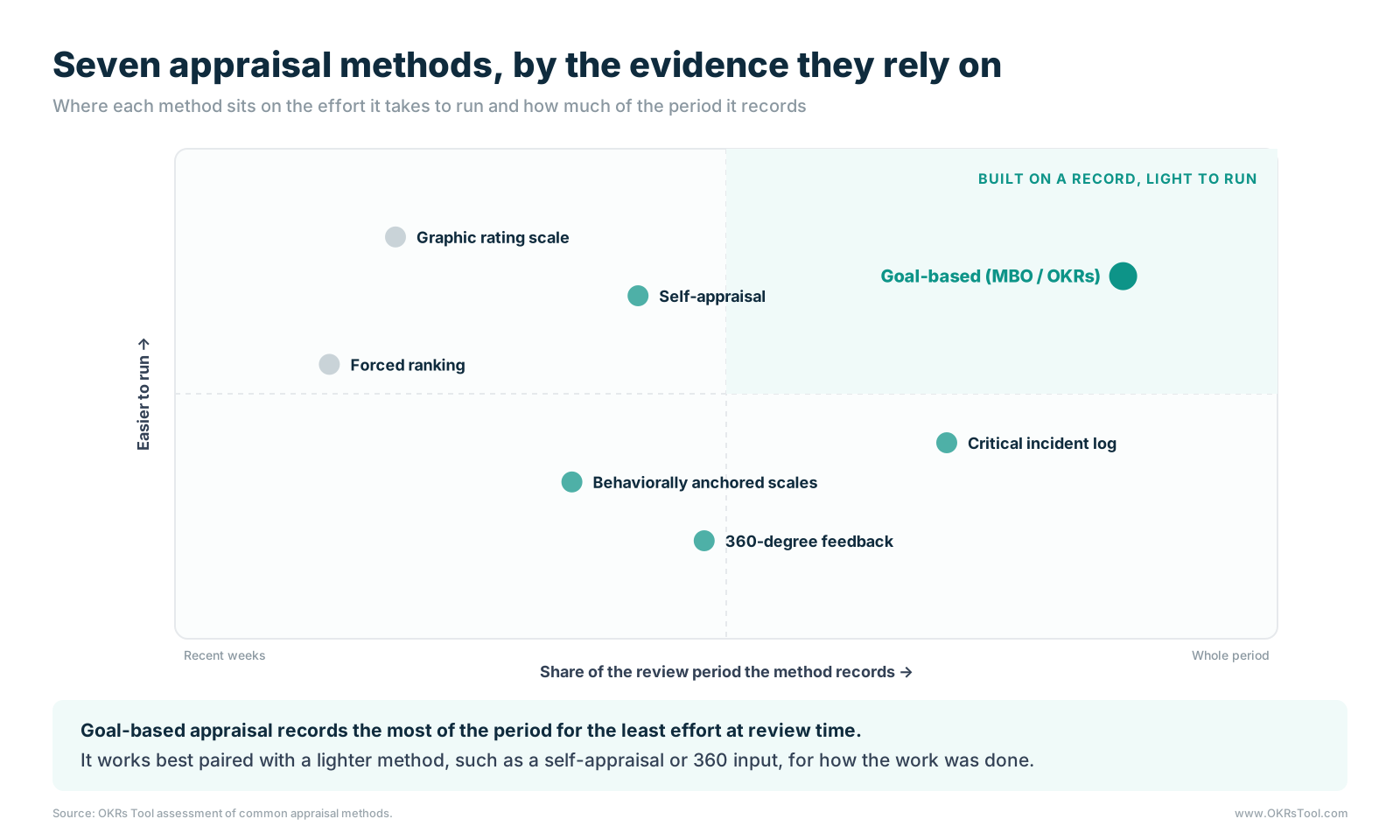
The methods that record the most of the period are the ones that collect evidence as the work happens. Methods that depend on an end-of-period impression are quicker to set up, and they lean on memory, which our benchmark shows is the weakest link in most appraisals: only 52% of HR leaders said manager recall covers the full review period evenly.
The 7 Performance Appraisal Methods
1. Goal-Based Appraisal (MBO and OKRs)
The employee and manager agree goals at the start of the period, and the appraisal measures how far each one was delivered. Management by objectives introduced the idea, and OKR performance reviews apply it with quarterly OKRs and weekly progress updates, so the evidence builds through the period.
It suits roles with measurable outcomes, from sales and marketing to product and operations. The risk is tying every goal miss directly to the rating, which encourages people to set safe targets. The State of Goal Management found 96% of employees sandbag when a missed goal feeds a performance rating, so stretch goals need to be scored as stretch, with OKR scoring that treats 70% as a strong result.
2. Graphic Rating Scale
The classic appraisal form: a list of traits or competencies, such as quality of work, communication and initiative, each rated on a scale from one to five. It's fast, easy to compare across a team and familiar to every manager.
Its weakness is that a rating on "initiative" has no evidence attached unless the manager supplies it. Without a record, the score drifts toward the last few weeks and the manager's general impression of the person.
3. 360-Degree Feedback
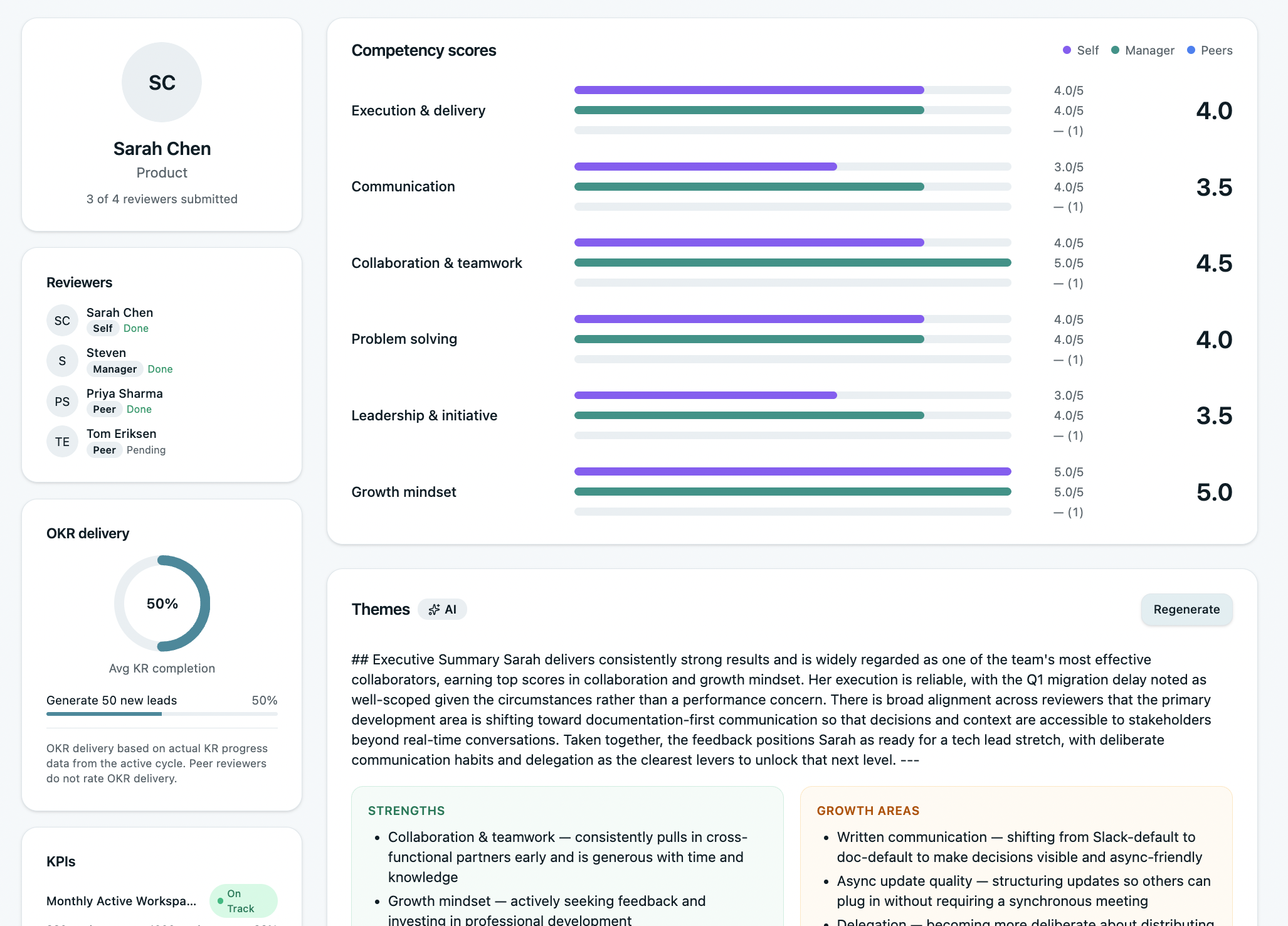
Peers, direct reports and sometimes customers rate the employee alongside the manager. 360 feedback captures collaboration and leadership behaviors a single manager can miss, which makes it useful for managers and senior individual contributors.
It takes the most effort of any method, with several reviewers per employee, and it captures how people experience working with someone, so it works best as one input alongside a goal-based assessment of results.
4. Behaviorally Anchored Rating Scales (BARS)
Each point on the rating scale is tied to a written example of behavior. A "5" for customer communication might read "anticipates customer questions and resolves them before escalation," while a "2" reads "responds to customer questions only when chased." The anchors make ratings more consistent between managers.
The cost is upfront: writing good anchors for every competency and role takes time, and they need revisiting as roles change. They fit well with a competency framework a company already maintains.
5. Self-Appraisal
The employee rates their own performance before the manager does, usually on the same form. It surfaces work the manager didn't see, which matters for remote and hybrid staff: 62% of HR leaders in our benchmark said those employees are at least somewhat disadvantaged in performance reviews.
On its own, a self-appraisal is only as accurate as the employee's memory, so it's strongest when both people complete it from the same goal history and the meeting starts from shared facts.
6. Forced Ranking
Managers rank employees against each other, or sort them into fixed bands such as top 20%, middle 70% and bottom 10%. It forces differentiation where every rating would otherwise cluster at "meets expectations."
It's also the most contested method. In small teams, a forced distribution can label a solid performer as bottom-tier simply because the team is strong, and it discourages the collaboration most growing companies depend on. If used at all, it belongs in calibration discussions across larger groups.
7. Critical Incident Method
The manager keeps a running log of specific moments, good and bad, through the period: a difficult client recovered, a launch delivered early, a deadline missed without warning. The appraisal draws on those dated examples.
It records far more of the period than an end-of-year impression, and it gives the appraisal concrete examples to cite. The catch is discipline, because the log only works if the manager keeps it every week. Weekly goal check-ins do much of the same job with less effort, since the owner records progress and blockers as they happen.
Which Methods Hold Up When a Rating Is Questioned
An appraisal gets tested when an employee asks why they received the score they did. Our benchmark shows how often HR leaders expect their ratings to pass that test.
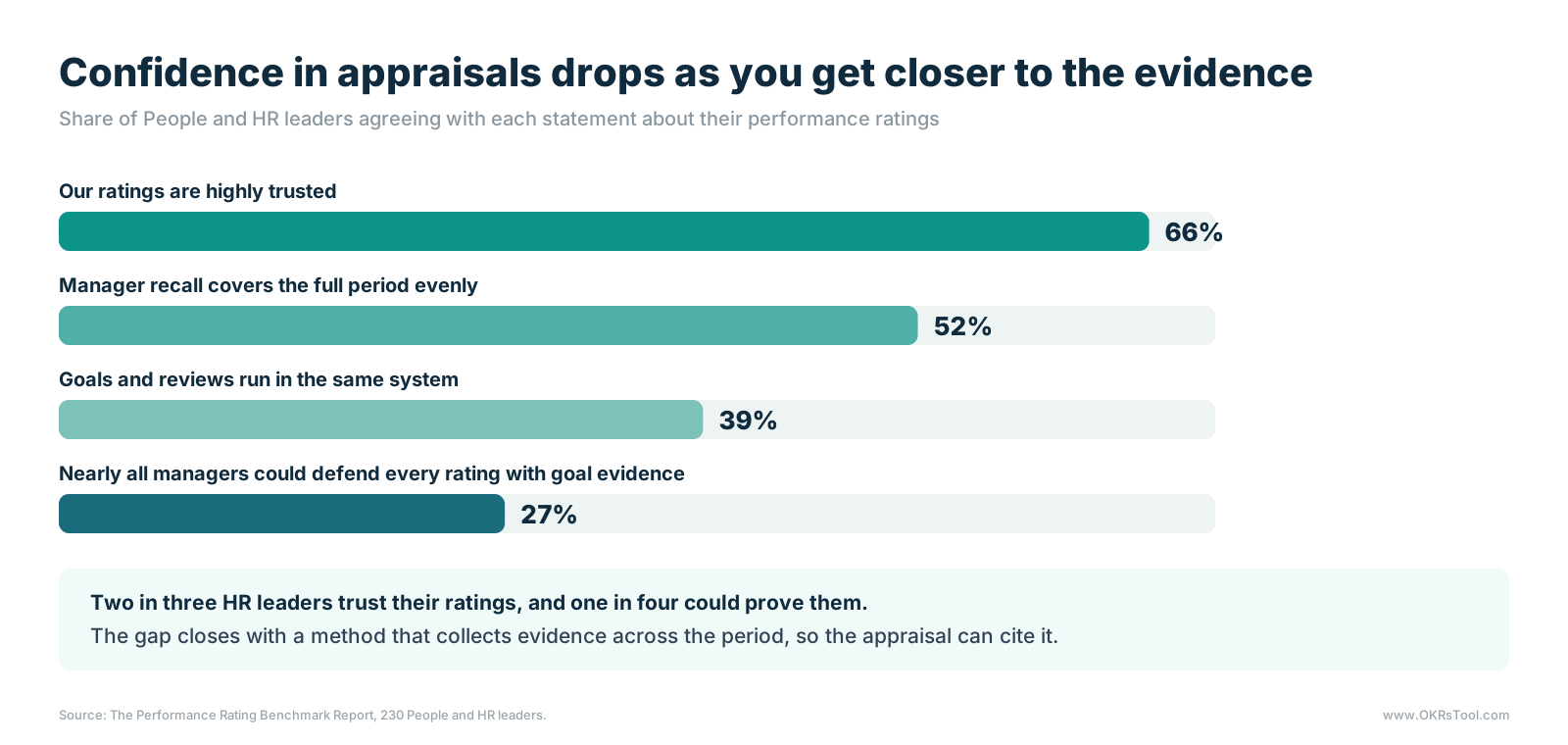
66% of HR leaders said their ratings are highly trusted, while only 27% said nearly all their managers could defend every rating with goal evidence. The setup makes a large difference: teams running goals and reviews together were more than twice as likely to call their ratings defensible, 42% against 17%. Only 8% of companies run performance inside the tool that holds their goals, even though 37% use dedicated performance management software, and 35% of HR leaders said managers have to reconstruct goals at review time.
In practice, that points to a combination. A goal-based appraisal covers what was delivered with evidence from the whole period, and a self-appraisal or 360 input covers how the work was done. Graphic rating scales and forced ranking can still play a part, as long as each rating cites something from the record.
A Sample Performance Appraisal Form
The form below combines a goal-based section with a short competency section and a self-appraisal. Adapt the competencies to the role.
Section 2 is where most forms fall short. When the goal history is linked straight into the appraisal, the manager writes the rating from a record of the full period, and the employee can see the same evidence. For goal ideas to carry into section 6, our performance goal examples cover common roles.
Example Performance Appraisal Comments
Good appraisal comments name a specific result, connect it to its impact and point toward what comes next. The examples below follow that pattern at three rating levels.
Exceeds Expectations
- "Took ownership of the onboarding key result and moved Day-7 activation from 34% to 51% against a target of 45%, which cut early churn and freed the support team for enterprise accounts."
- "Spotted the pipeline gap in week four and rebuilt the outbound sequence without being asked, adding 18 qualified opportunities by quarter end."
- "Consistently updated progress every week, so leadership could see the risk on the migration early and adjust the launch date with a full month's notice."
Meets Expectations
- "Delivered two of three key results in full and reached 70% on the third, a stretch goal, with clear weekly updates throughout the quarter."
- "Handled a heavy support queue reliably and kept CSAT above the 90% threshold for the whole period."
- "Collaborates well with design and engineering; next period, the focus is on presenting results to leadership without needing a manager to step in."
Below Expectations
- "The reporting key result stayed at zero for the first six weeks with no update, and the blocker on data access only surfaced at the mid-quarter review. Next period, we'll agree a first milestone for week two and review it together."
- "Deadlines on two client projects slipped without warning. Raising risks in the weekly check-in, even when the news is bad, is the main development goal for next quarter."
- "Strong technical work, but handovers to the support team lacked documentation, which led to repeat tickets. We'll set a documentation standard and check it at each release."
More worked examples by role and rating are in our collection of performance evaluation examples.
Running the Appraisal Meeting
The form is the record, and the meeting is where it lands. A few habits keep it constructive:
- Share the completed form a day ahead, so the employee arrives having read it and the meeting is spent on discussion.
- Start with the employee's self-appraisal, which shows where the two views agree and where they don't.
- Walk through goals and results with the record open, so any disagreement is about interpretation of shared facts.
- Keep surprises out of it. Anything that affects the rating should already have come up in a one-to-one during the period.
- End on the development plan, with two goals the employee owns and a date for the first check-in.
Between appraisals, short mid-year reviews and continuous performance management keep the gap between appraisals small, so nothing in the next one comes as news.
Make the Evidence Part of the Method
The methods that hold up best collect evidence as the work happens, and the ones that struggle ask a manager to remember six months on the day the form arrives. For most growing companies, a goal-based appraisal with a self-appraisal and a short competency section gives the best balance of fairness and effort, as long as the goal record is kept up to date in a weekly check-in and is visible to both people.
That's the setup behind performance reviews in OKRs Tool, where goals, weekly check-ins and appraisals sit on one platform. Each appraisal links to the goal history for the full period, so the manager writes from the record and the employee sees the same evidence, which is what turns a trusted rating into a defensible one.
Data: The Performance Rating Benchmark Report and The State of Goal Management.