A performance management framework is the model an organization uses to structure evaluation — MBO, OKRs, 360-degree feedback, competency models, or a blend. Teams agonize over which one to adopt, but the benchmark data points somewhere else: 61% run their framework disconnected from the goal record, and that disconnection predicts a weak rating far better than the framework label does.
There's a familiar debate at the start of every performance program: which framework do we use? MBO or OKRs, competency models or 360 feedback, a rating scale or a narrative. The choice feels consequential, and hours go into it. Then the program launches, the framework does its job on paper, and the ratings at the end still can't be defended — because whatever was supposed to feed them was never connected.
Below, each major framework gets a fair hearing — what it measures, where it shines, and where it strains. But the real payoff is the pattern that sits underneath all of them, which the Performance Rating Benchmark Report — a survey of 230 People and HR leaders — makes impossible to ignore: the model on top matters far less than whether it's wired to the goals beneath it. Get that wiring right and any framework works; get it wrong and none of them do, which is the real reason most performance management fails.
The Major Performance Management Frameworks
Each framework is a different answer to one question: what should a rating be based on? They're worth knowing well, because each fits a different kind of organization.
Management by Objectives (MBO) is the oldest of them, dating to Peter Drucker in the 1950s. Managers and reports agree on objectives at the start of a period and measure delivery against them at the end. Its strength is clarity — everyone knows what they're accountable for. Its weakness is cadence: classic MBO runs annually, which leaves a long gap where the record can decay, and it can drift toward rewarding the number over the judgment behind it. Those trade-offs are why many teams now choose OKRs over MBO for anything that moves faster than a year.
OKRs — objectives paired with measurable key results — are MBO's modern descendant, built for a faster cadence. Where MBO sets a target and waits, OKRs assume frequent check-ins and visible progress tracking throughout the period.
That makes them the most natural fit for a performance process that needs a live record, because the framework already produces one: every key result is a tracked number with an owner. For organizations that want the rating to rest on delivery data, OKRs do most of the work up front.
360-degree feedback gathers input from peers, direct reports, and managers rather than a single evaluator. Its value is perspective — it surfaces collaboration and behavior that a manager working from their own vantage point never sees. It works best as one input among several: 360 feedback layered on top of a goal record gives a rounded view, while 360 used alone can turn a rating into a popularity measure.
Competency models evaluate people against defined skills and behaviors — communication, leadership, technical depth — rather than only outcomes. They suit roles where how the work gets done matters as much as what ships, and they're strong for development conversations. The risk is subjectivity: without behavioral evidence attached to each competency, the scores drift toward general impression, which is the same failure mode that undermines any framework run from memory.
The Balanced Scorecard widens the lens beyond individual performance to the organization itself, measuring across four perspectives — financial, customer, internal process, and learning and growth — so that no single dimension (usually financial) dominates the picture.
It's less a personal-rating framework than a strategic one, best suited to leadership teams translating strategy into measurable objectives across the business, and it overlaps with OKRs enough that teams often weigh the two against each other. The same integration principle governs it regardless: a scorecard cut off from the operational record is as unprovable as any other framework.
Rating scales and calibration aren't standalone frameworks so much as the machinery underneath all of them — the numeric scale that turns performance into a comparable score, and the cross-manager meetings that keep those scores consistent across teams. Calibration is only as honest as the evidence managers bring to it; without a record, it becomes a room full of people defending impressions.
The Choice Between Frameworks Is Overrated
Here is the finding that should reframe the whole framework debate.
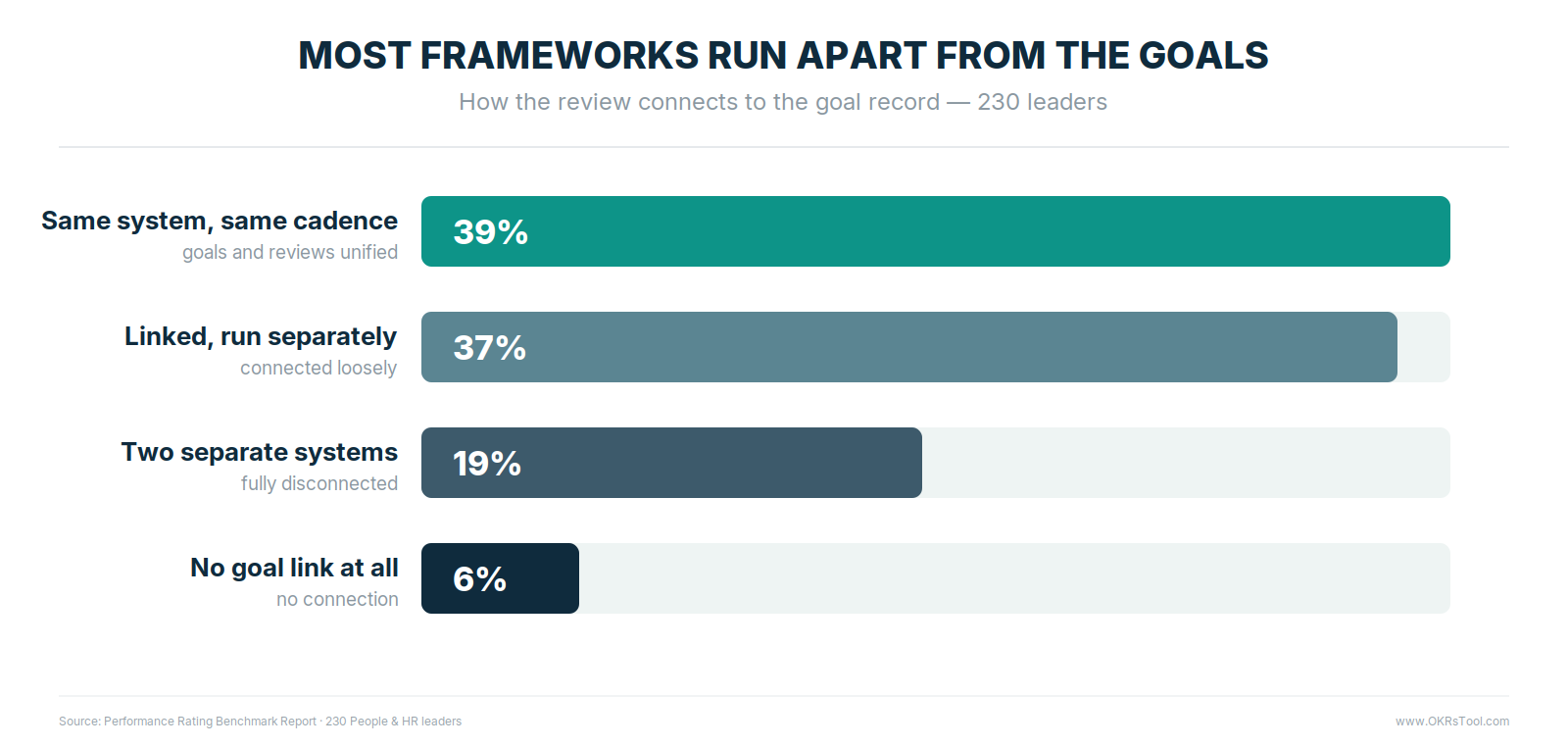
Across 230 organizations, only 39% run their performance framework on the same system and cadence as their goals. The remaining 61% keep the two apart to some degree — 37% link them loosely, 19% run entirely separate systems, and 6% have no connection between goals and reviews at all. Whatever framework these organizations chose, the framework is operating without a live line to the goal record it's supposed to evaluate.
This is why the framework choice matters less than it feels like it should. MBO, OKRs, 360, competency scoring — every one of them rates people on how they performed against expectations, and every one of them needs a record of that performance to do it honestly. A brilliant framework fed by a decayed record produces the same unprovable rating as a mediocre one. What actually moves the outcome is connection to the evidence underneath, not which model sits on top.
What Actually Decides Whether a Framework Works
The deciding factor is integration — whether the framework and the goal record run as one connected system or two disconnected ones.
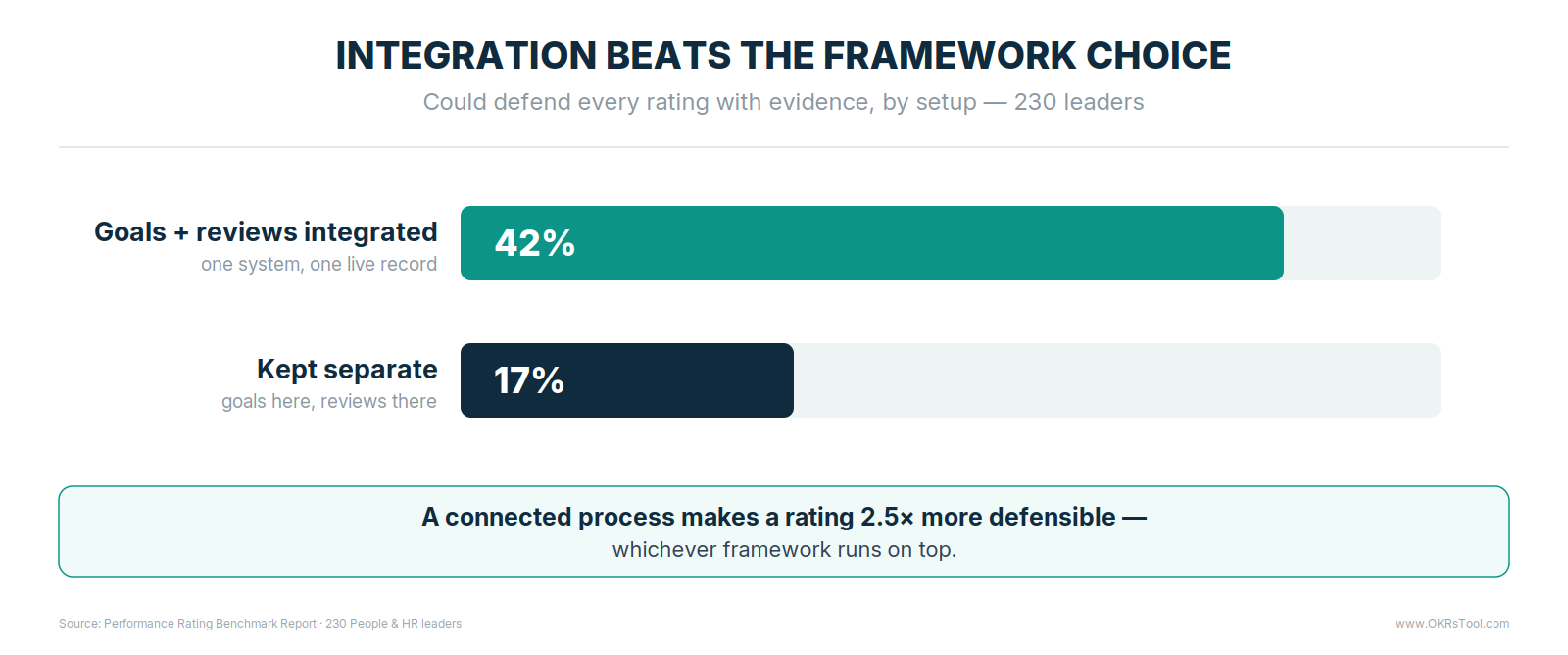
When goals and the review framework are integrated, 42% of leaders say a manager could defend every rating with evidence. When they're kept separate, that figure collapses to 17%. That gap — a rating two and a half times more likely to hold up — comes entirely from integration, not from the framework selected. A team running plain MBO on one connected system will produce more defensible ratings than a team running a sophisticated competency model across two disconnected ones.
The mechanism is the record. A framework is a set of rules for turning evidence into a score; integration is what guarantees the evidence is there when the rules get applied. Run them together and the performance review reads from a record the framework has been feeding all period, turning the review event into a summary rather than an investigation.
Run them apart and the framework shows up at review time to a record that was never kept: 87% of leaders count goal achievement toward the rating, but a third first have to piece those goals back together from recollection before any framework can touch them. No scoring model, however rigorous, can grade evidence that was never captured — which is why goal management and performance management are increasingly run as one system rather than two.
How to Choose — and Connect — a Framework
The practical path is to choose a framework for fit, then make integration non-negotiable regardless of which one you picked.
Match the framework to what you're measuring. If outcomes are what matter, OKRs or MBO fit; if behaviors and skills matter as much as delivery, add a competency layer; if collaboration is central, bring in 360 input. Many mature programs blend two — an outcome framework for the what, a competency or 360 layer for the how. The choice should follow the roles you're evaluating and the kinds of evaluation you need to produce, not the framework that's fashionable.
Then make the record the requirement, not the framework. Whatever you choose, insist on one condition: the goals the framework evaluates must live on the same system and cadence as the reviews that apply it, kept current through regular check-ins. That single requirement does more for rating quality than any refinement to the framework itself — it's what separates the 42% who can defend a rating from the 17% who can't.
Run it where the evidence already accumulates. The 61% who end up disconnected rarely made a bad framework decision; they bought goals and reviews as separate tools that were never joined. Running the whole thing on one platform where the framework and the goal record share a home removes the disconnection at the root, because there's no second system for the record to fall out of. Because the entire process runs in one place, the framework becomes a lens on live data rather than a form to fill from memory.
The Framework Is the Lens, the Record Is the Picture
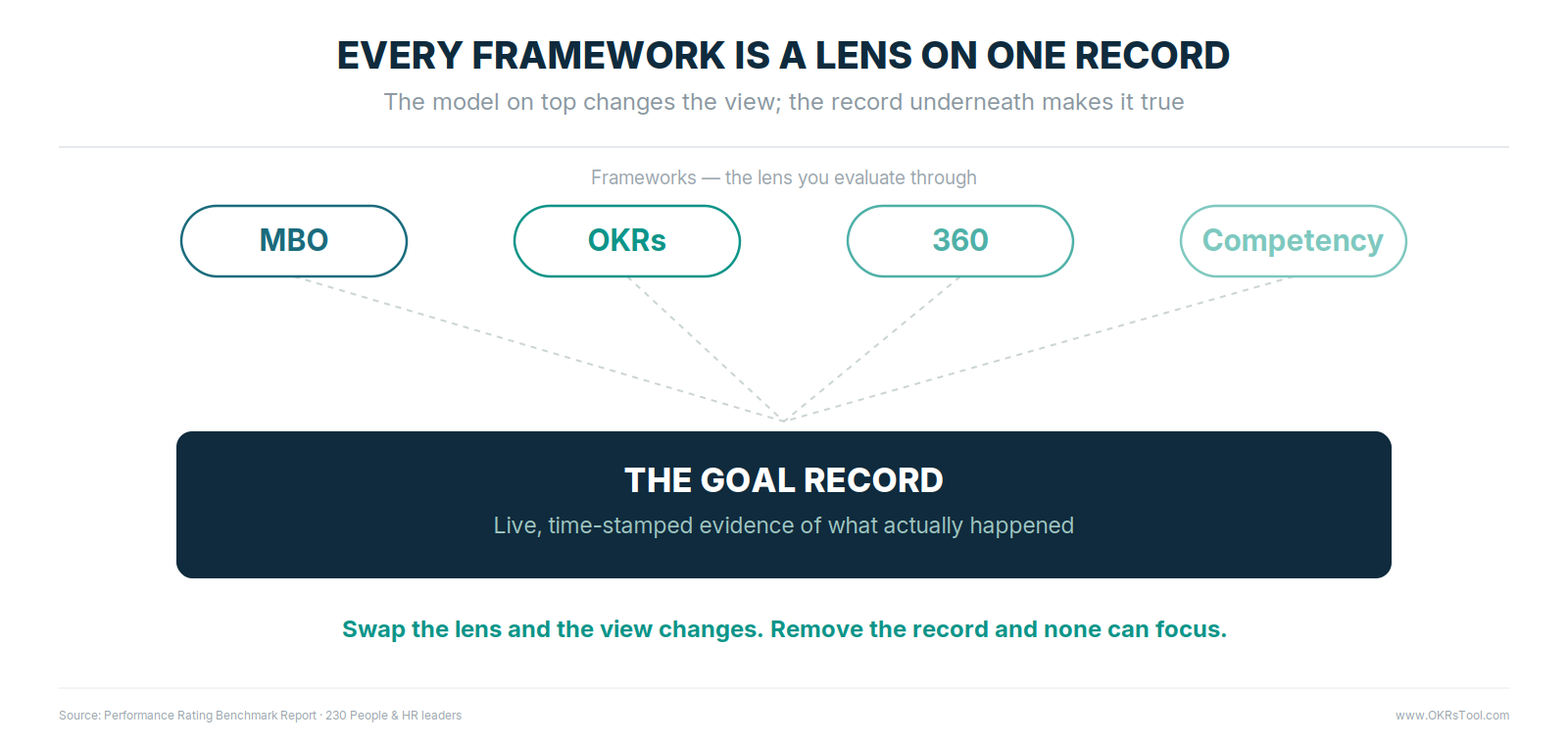
Choosing a performance management framework is worth doing well — the models genuinely differ, and matching one to your organization pays off in how useful the evaluation feels. But the choice sits on top of something more decisive. A framework is a lens: it determines how you look at performance, sharpening the view toward outcomes, or behaviors, or peer perspective. What it can't do is create the picture. That comes from the record — the accumulated evidence of what actually happened over the period.
The 61% who run their framework disconnected from that record have a lens pointed at nothing. They've chosen carefully how they want to evaluate, then cut the evaluation off from the evidence it needs. The 39% who integrated the two have a lens pointed at a full picture, and their ratings hold up because there's something real to look at.
So spend the time to pick a framework that fits — then spend more of it making sure the framework and the goal record are the same system. The model you choose shapes the evaluation; the record you keep is what makes it true.
Data: The Performance Rating Benchmark Report, an independent survey of 230 People and HR leaders at technology companies of 50–200 employees.