
Most growing teams already use a project management tool — Asana, Notion, Linear, Monday. The question isn't which one to replace. It's whether your project management tool is the right place to track strategic goals, or whether that's costing you alignment, accountability, and measurable results.
The most common mistake growing teams make with OKRs isn't writing bad goals. It's tracking them in the wrong tool.
Project management platforms are task systems. They're designed to answer: what needs to happen, by when, and who's doing it? That's a genuinely useful question. It's just not the same question as: are we making progress on the outcomes that matter most this quarter?
Our analysis of 7,857 Key Results found that 52% were tasks or KPIs in disguise — measuring what was done rather than what changed. The most consistent predictor of that problem: teams tracking their OKRs in a project management tool where the default structure is tasks, milestones, and completion percentages rather than outcome baselines and targets.
What Project Management Tools Are Built For
Project management tools — Asana, Notion, Linear, Monday, ClickUp — are task and workflow systems. They answer three questions well:
- What tasks need to happen?
- Who is responsible for each?
- What is the deadline?
They're excellent at breaking down a project into components, tracking completion, managing dependencies, and giving teams visibility into daily work. For execution at the task level, they're the right tool.
Where they fall short is at the outcome level. A project management tool can tell you that the new onboarding flow was launched on schedule. It can't tell you whether activation improved. It tracks the work — not the result of the work.
Show Image
What OKR Software Is Built For
OKR software is a strategic alignment and execution system. It answers three different questions:
- What outcomes are we trying to achieve this quarter?
- How will we measure whether we got there?
- Is every team's work connected to those outcomes?
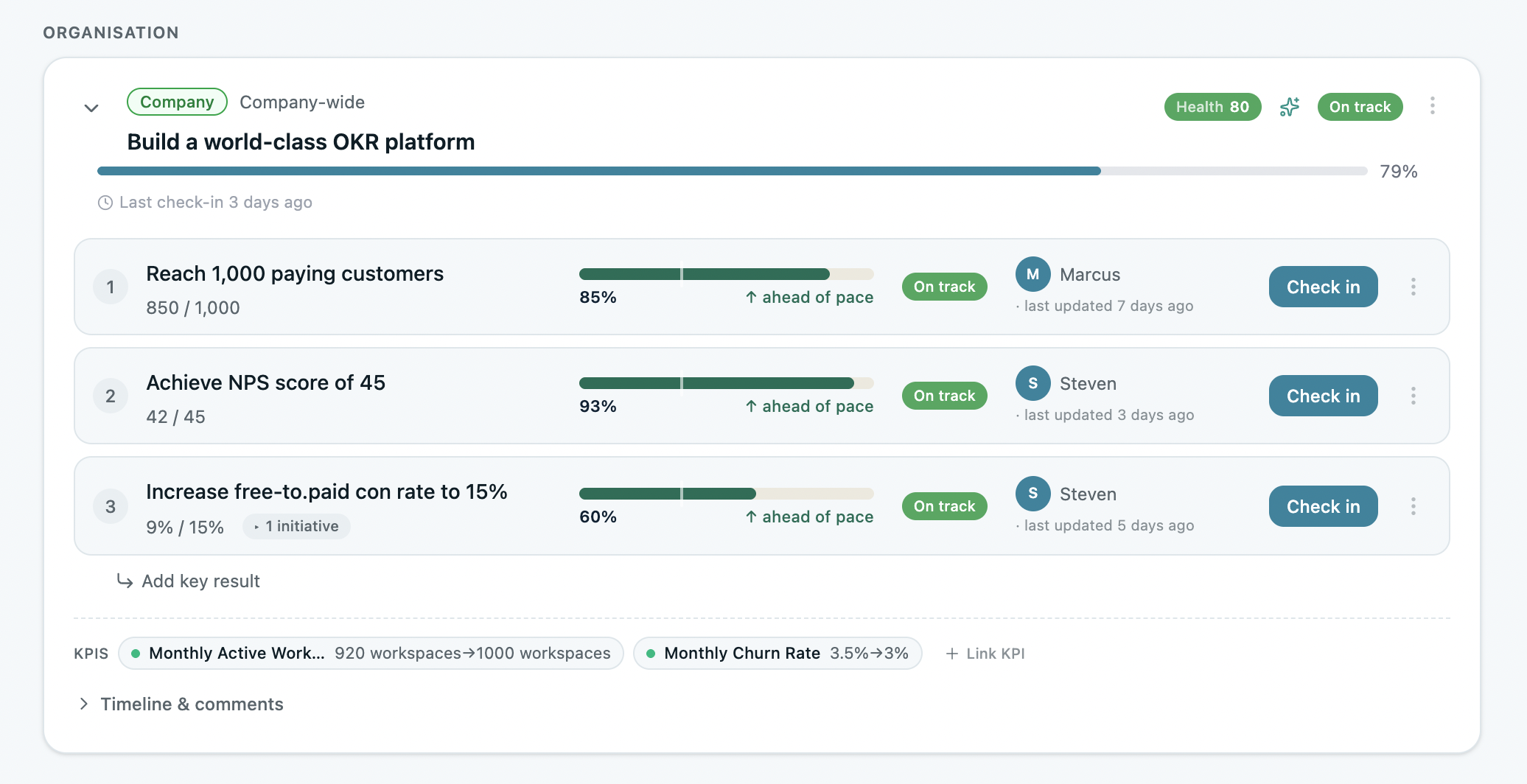
Where a project management tool tracks tasks, OKR software tracks change. The Key Result "Increase Day 7 activation from 34% to 52%" isn't a task — it's a measurable outcome with a baseline and a target. You can't check it off by shipping a feature. You can only score it by measuring what changed.
The structural features that make this work are specific to OKR platforms: a cascade that connects every team's Key Results to company priorities, required ownership per Key Result, automated weekly check-in nudges, and an alignment map that shows leadership what's on track without a status meeting.
Why the Distinction Matters for Results
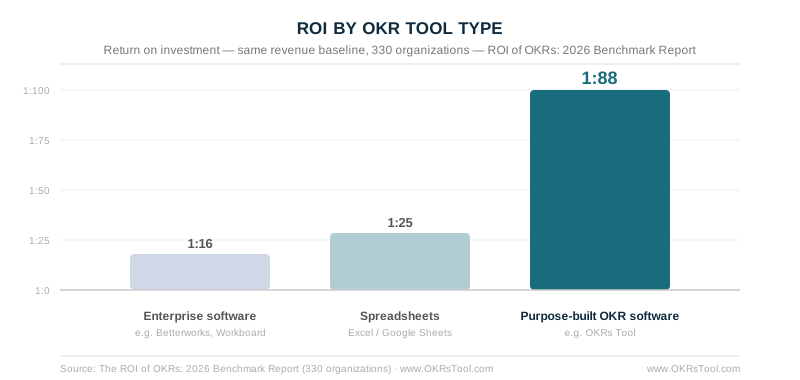
The ROI of OKRs: 2026 Benchmark Report across 330 organizations puts a specific number on the tool choice: organizations using purpose-built OKR software generate a 1:88 return on investment against the same revenue baseline. Organizations using spreadsheets generate 1:25. Enterprise platforms that blend project management with goal-tracking generate 1:16.
The gap isn't the software cost. It's what the tool makes structurally unavoidable.
When OKRs live in a project management tool, they get treated like projects. Updates happen when someone remembers to check the board. Ownership is implicit. Alignment is assumed. And the weekly review — the habit that drives 43% more completions for teams that maintain it — doesn't happen because there's no structural nudge to trigger it.
The Right Tool for Each Layer
The link between the two layers is the initiative — the specific project or campaign that moves a Key Result. In OKR software, you track the outcome: Increase Day 7 activation from 34% to 52%. In your project management tool, you track the work that gets you there: Redesign the onboarding email sequence, ship by week four.
The initiative lives in Asana. The Key Result lives in OKRs Tool. Neither duplicates the other.
Can You Track OKRs in a Project Management Tool?
Technically, yes. Practically, it degrades results.
The problem isn't that Notion or Asana can't store text that says "increase activation to 52%." The problem is what happens around that text. No automated nudge sends you a reminder to update it every week. No cascade shows whether it connects to the company's priority. No ownership enforcement stops it going live without a named accountable person. No alignment map shows leadership what's on track without calling a meeting.
67% of organizations start tracking OKRs in spreadsheets or project management tools — the OKR Intelligence Report 2026 found this is almost universal in the first cycle. The teams that hit 79% completion by cycle five aren't the ones that got better at using Notion for goal-setting. They're the ones that moved to a purpose-built OKR platform before the habits eroded.
The OKR adoption data is consistent: teams that switch to purpose-built OKR software before the second cycle outperform those that stay in spreadsheets or project management tools by a measurable margin — across completion rates, alignment visibility, and leadership confidence in the data.
How OKRs Tool and Project Management Tools Work Together
OKRs Tool integrates directly with Asana and Jira — so the work that happens in your project management tool can be linked to the Key Results it's designed to move. You don't have to choose between them.
The workflow is simple: set your OKRs in OKRs Tool, cascade them to teams, assign one named owner per Key Result. Attach the initiatives — the projects and campaigns that will move each Key Result — as links to Asana boards or Jira tickets. Update your Key Result progress in OKRs Tool every week. Keep task management where it belongs.
The result: leadership sees OKR status in one view, team members update progress in under five minutes, and the weekly check-in nudge runs automatically without anyone scheduling it.
Final Thoughts
Project management tools are essential. So is OKR software. The organizations generating the highest returns from their goal programmes aren't choosing one over the other — they're using each tool for what it does best.
Tasks belong in your project management tool. Outcomes belong in OKR software. The moment you start tracking strategic goals in Asana or Notion, the tool's default structure — tasks, completion percentages, project timelines — shapes how those goals get treated. And 52% of them become tasks in disguise.
The right architecture is simple: OKR software for strategy, alignment, and accountability. Project management tools for execution. A link between the two that makes the connection explicit without duplicating effort.
Data: The ROI of OKRs: 2026 Benchmark Report (330 respondents), OKR Intelligence Report 2026 (222 organizations), OKRs Tool platform data (7,857 Key Results analyzed).