
Mooncamp has earned its place near the top of the market — clean UI, strong strategy map, flexible workflows, and the most direct migration path for teams displaced by Microsoft's Viva Goals shutdown. The teams that look for alternatives aren't dissatisfied with Mooncamp's quality. They're looking for a different fit: flatter pricing, deeper performance management, an AI layer that's already shipped, or a tool already embedded in their existing stack.
I've spent significant time inside Mooncamp for my OKR software review. The interface is one of the best in the category — modern, fast, visually clean in a way that most competitors aren't. The strategy map is among the clearest cascade visualizations available. And the team's responsiveness to the Viva Goals migration audience has been smart, well-executed, and directly useful for thousands of displaced teams.
The benchmark data across 330 organizations identifies three structural habits that predict OKR results: automated weekly check-ins (43% more completions), required ownership per Key Result (26% higher completion), and fast setup (50% higher completion for teams live in under a week). Mooncamp supports all three. The teams that switch do so because of pricing at scale, the absence of an AI layer, or the need for deeper performance management — not because Mooncamp doesn't work.
Why Teams Look for Mooncamp Alternatives
Mooncamp's limitations are narrow and specific — which is actually a sign of a well-positioned product. The teams that leave fall into four clear categories.
Per-user pricing at scale. Mooncamp starts at €6/user/month. A 50-person team pays €300/month. A 100-person team pays €600/month. For organizations on flat-rate alternatives like OKRs Tool ($49/month regardless of team size), that's a 10x pricing difference at scale. For teams where headcount is growing faster than budget, the per-user model becomes a recurring budget conversation.
No AI yet. Mooncamp's AI strategy is in development — publicly they've committed to shipping it only when it genuinely improves workflows, not as a feature for its own sake. A principled position. But with 83% of organizations now using AI in their OKR process, teams that need AI goal drafting and at-risk flagging today will need to look elsewhere.
Performance management depth. Mooncamp is an OKR and strategy platform. It doesn't offer performance reviews, 360 feedback, or 1:1 management features. For organizations connecting OKR delivery to performance decisions — 75% of organizations now do this per the OKR Intelligence Report 2026 — a separate platform is required.
The 11 Best Mooncamp Alternatives (2026)
1. OKRs Tool
Best for: Growing teams (50–200 people) that need flat pricing and required ownership enforcement
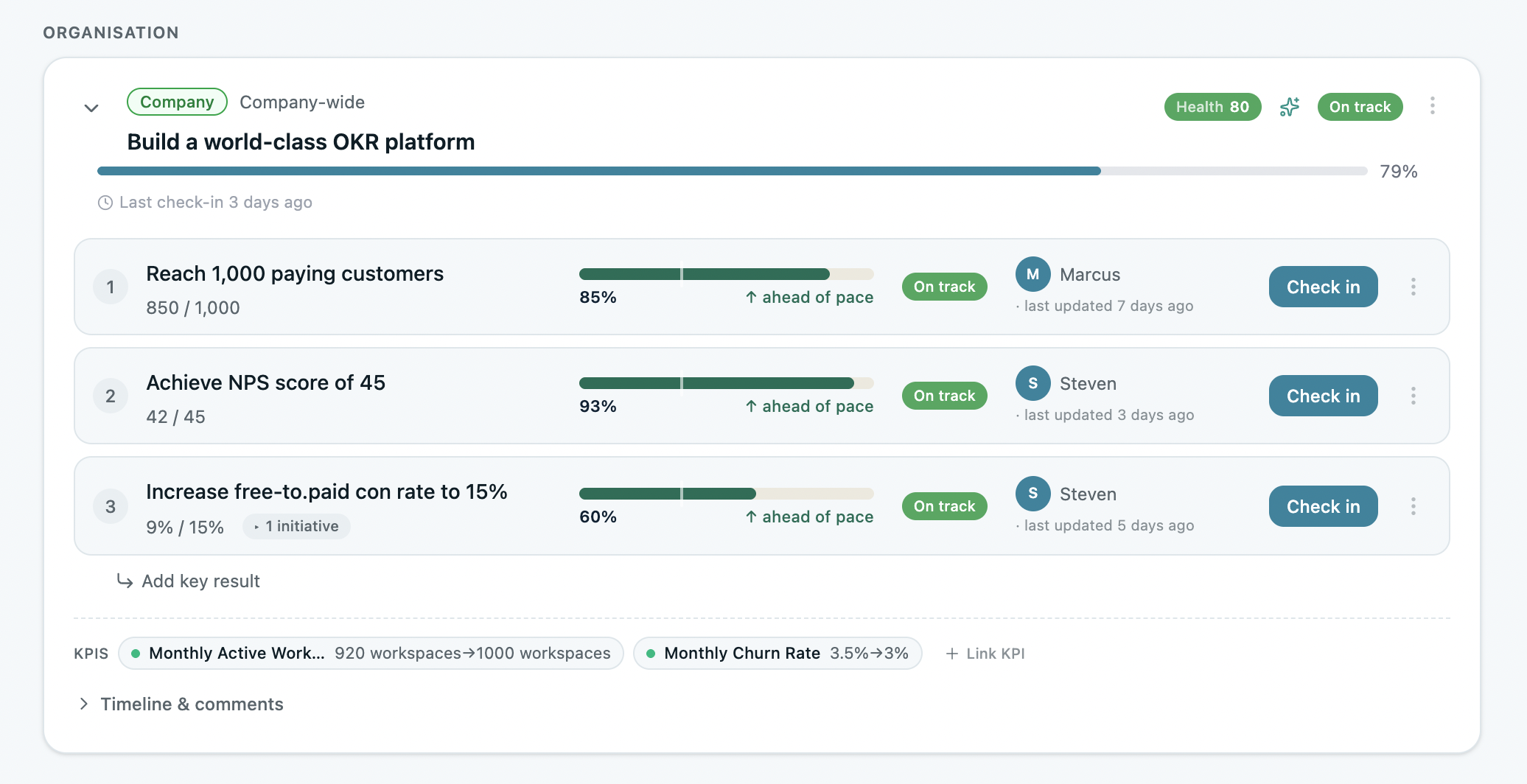
OKRs Tool is the most direct Mooncamp alternative for teams where per-user pricing is the primary constraint. At $49/month flat for up to 50 users, a 50-person team pays 85% less than the equivalent Mooncamp plan — and the price doesn't change as headcount grows within the tier.
The feature set is comparable to Mooncamp — AI-generated OKRs, live alignment map, automated Slack and MS Teams nudges, KPI tracking, 360 reviews, and performance reviews connected to OKR delivery scores — with one structural difference: ownership is a hard gate. A Key Result can't go live without a named owner.
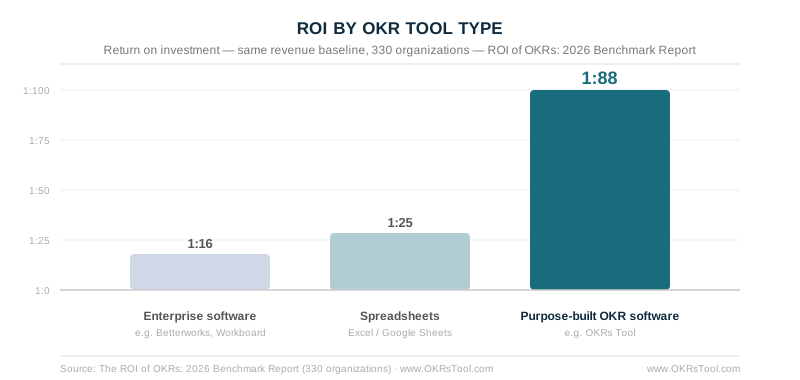
Where Mooncamp wins on interface beauty and strategy map depth, OKRs Tool wins on pricing predictability and execution infrastructure. The ROI data confirms the execution edge: organizations using purpose-built tools at this stage generate a 1:88 return against the same revenue baseline.
Pricing: Free for up to 5 users. $49/month flat for 6–50. $129/month for 51+. Free trial: Yes — free tier, no credit card required.
2. Perdoo
Best for: Organizations that want OKRs and KPIs tracked in one visual strategic framework

Perdoo is the closest structural equivalent to Mooncamp — both platforms sit at the intersection of OKRs, KPIs, and strategic planning. Perdoo adds initiative tracking and a strategy roadmap layer that Mooncamp doesn't offer, making it more suitable where the link between quarterly execution and multi-year strategy needs to be explicit.
The trade-off is a UI that feels older than Mooncamp's — functional but less polished — and a 10-seat minimum on paid plans that creates an awkward entry point for smaller teams.
For organizations that found Mooncamp's strategy map compelling but need more KPI depth and initiative tracking alongside it, Perdoo is a direct upgrade on those specific dimensions.
Pricing: Free for up to 5 users. From €8/user/month (10-seat minimum). Free trial: Yes — free tier.
3. Teamflect
Best for: Microsoft 365 organizations that want OKRs embedded natively in Teams
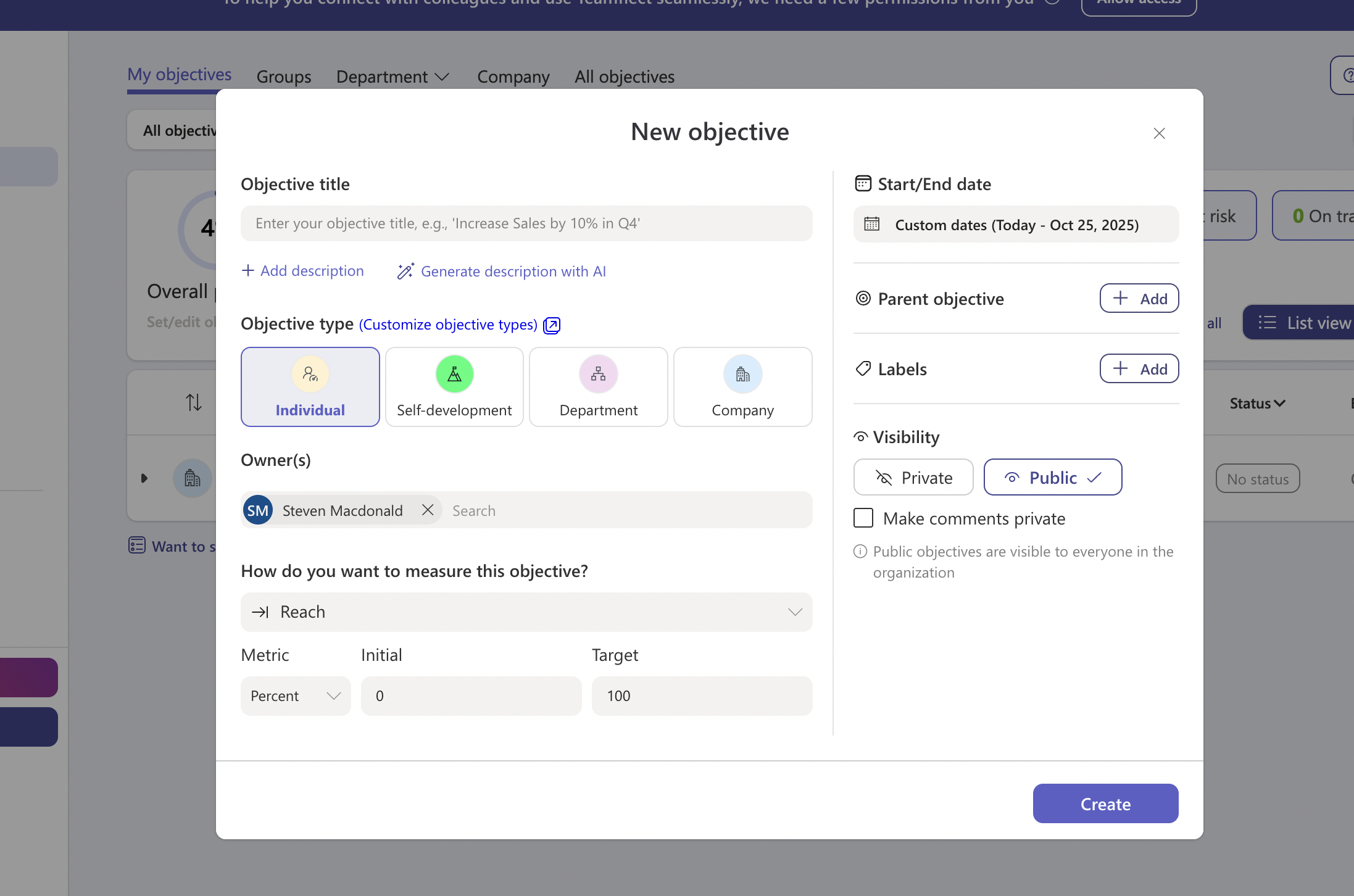
Where Mooncamp integrates with Microsoft Teams, Teamflect is built inside it. Goals, performance reviews, 1:1s, and feedback all live within the Teams interface — no separate browser tab, no separate login, no migration between tools.
The product is particularly strong for Viva Goals refugees: the Teams-native experience replicates what Viva Goals provided, with a more modern goal-setting framework and better check-in infrastructure.
The limitation is the Microsoft dependency. Teams not on Microsoft 365 have no reason to consider it — but for organizations where the stack is non-negotiable, Teamflect removes every adoption friction point.
Pricing: Free for up to 10 users. From $3/user/month after that. Free trial: Yes — free tier, no credit card required.
4. Tability
Best for: Async and distributed teams focused on building a consistent weekly check-in habit

Tability is lighter than Mooncamp in almost every dimension — fewer features, simpler interface, narrower scope — and that's exactly why some teams prefer it. The entire platform is built around one outcome: getting teams to update their OKRs every week without adding meeting overhead.
Automated Slack and email nudges, a fast async update flow, and habit-forming check-in design address the most common adoption failure at this stage. Where Mooncamp offers strategy maps and flexible OKR structures, Tability offers something simpler: a reason to open the tool on Monday morning.
Teams with fewer than 30 people focused purely on execution rhythm will find Tability faster to adopt and easier to maintain than Mooncamp. The trade-off is feature depth — no strategy maps, no performance layer, no KPI tracking.
Pricing: From $6/user/month. 14-day free trial. Free trial: Yes — 14 days.
5. Weekdone
Best for: Small teams wanting weekly planning and OKR tracking in the same view

Weekdone has been running OKR programmes longer than almost any other platform on this list. The weekly planning layer — where team members plan priorities and update OKR progress in the same dashboard — is a genuine structural differentiator from Mooncamp, which keeps goal tracking and weekly work planning as separate concerns.
The trade-off: the interface is noticeably older than Mooncamp's and the per-user cost at $10/month adds up quickly past 20 people.
For small teams that value the weekly planning connection and don't need Mooncamp's visual sophistication, Weekdone provides solid fundamentals at the cost of a dated UX.
Pricing: Free for up to 3 users. $10/user/month after that. Free trial: Yes — free tier up to 3 users.
6. Betterworks
Best for: Large enterprises where OKRs need to sit inside a full performance enablement platform
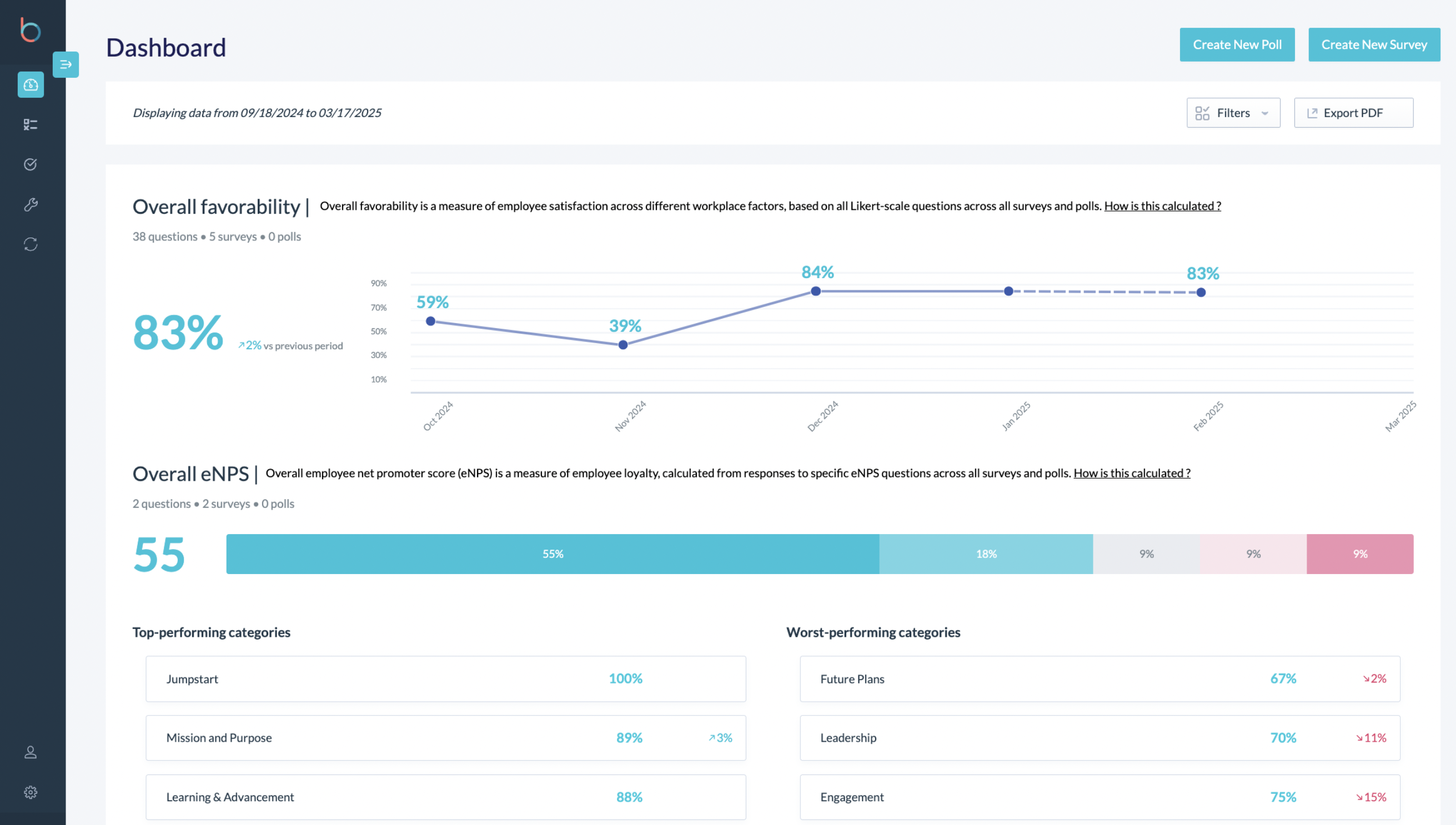
Betterworks is enterprise-grade where Mooncamp is growth-stage. The platform connects OKRs, continuous feedback, structured check-ins, and performance calibration in one system — with AI-powered execution risk detection that flags at-risk goals before the miss happens.
The Manager Command Centre gives leadership consolidated visibility across all teams without a dedicated reporting cycle. For organizations at 500+ people where Mooncamp's per-user costs become significant, Betterworks is the natural next step.
The entry barrier is high: no self-serve, sales demo required, enterprise pricing only. Not the right tool for any organization under 500 people.
Pricing: Custom quote. Suited to 500+ employee organizations. Free trial: No.
7. Workboard
Best for: Enterprise teams that need strategy execution connected to live business data

Workboard acquired Quantive (formerly Gtmhub) in May 2025. The combined platform now includes Quantive's 160+ data source integrations alongside Workboard's strategy execution and executive accountability features.
For organizations where Mooncamp's manual update requirement becomes a friction point — and where OKR progress should update automatically from CRMs, databases, and BI tools — Workboard eliminates that overhead entirely.
The trade-off is scale: this is a 200+ person platform with enterprise pricing and implementation complexity to match. Not suitable for growing teams at the 50–200 person stage.
Pricing: Custom quote. Enterprise-focused. Free trial: No.
8. Profit.co
Best for: HR-led organizations connecting OKRs to performance reviews and task management
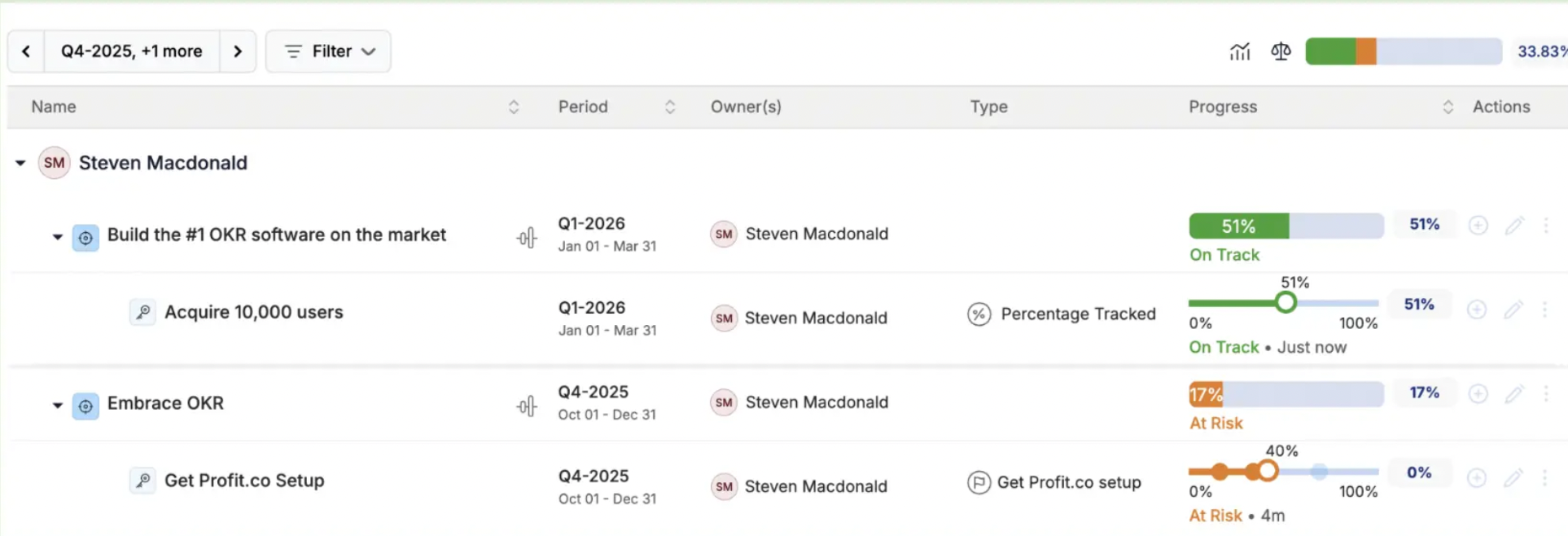
Profit.co goes significantly deeper than Mooncamp on the performance management side — OKRs, KPIs, task management, performance reviews, and 1:1s in one platform. For organizations that find Mooncamp's lack of a performance layer a genuine gap, Profit.co is one of the most complete mid-market alternatives.
The cost of that depth is implementation overhead. Profit.co typically requires 4–6 weeks of configuration before a first cycle runs, compared to Mooncamp's fast-start design.
Custom pricing with no public rates also adds friction for teams evaluating on budget. If you need both OKR execution and a performance management layer, and you're willing to invest the setup time, Profit.co delivers.
Pricing: Custom quote. No free tier. Free trial: No.
9. Lattice
Best for: Organizations that want OKRs embedded in a full people platform

Lattice is one of the strongest full-platform alternatives to Mooncamp for organizations that need OKRs connected to performance reviews, engagement surveys, and compensation workflows.
The interface is significantly cleaner than Profit.co and the connection between OKR delivery data and performance review scores is more structural — OKR completion rates surface automatically in review cycles rather than requiring manual compilation.
The limitation: no public pricing, no free tier, and a sales conversation required to evaluate. For teams ready for a people platform investment alongside Mooncamp-depth OKRs, Lattice is the most polished option.
Pricing: Custom quote. No free tier. Free trial: No.
10. Futureworks
Best for: Nordic enterprises and public sector organizations connecting strategy to weekly execution
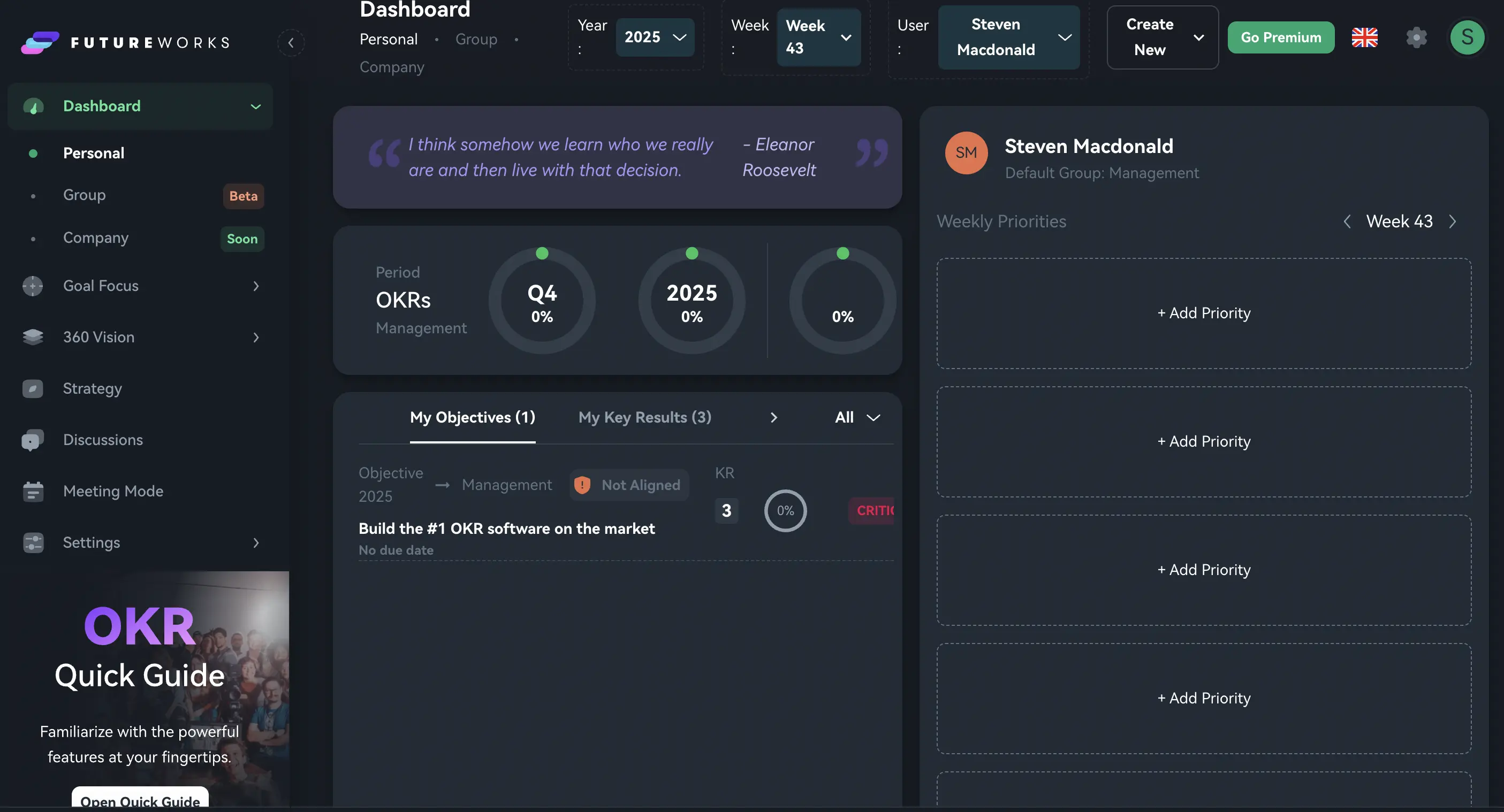
Futureworks connects strategy, OKRs, priorities, and meetings in one shared workspace — with a Strategy Map, Meeting Mode, and an AI Context Engine that translates uploaded strategy documents into actionable OKRs in seconds.
The Meeting Mode is a standout differentiator from Mooncamp: structured agendas with timed points and follow-ups delivered through Slack and Teams, turning the weekly check-in into a meeting format rather than a solo update flow.
Built specifically for Nordic and European organizations, it carries a stronger data sovereignty story than most US-headquartered alternatives. For teams where the weekly check-in needs to happen in a structured meeting, Futureworks offers something Mooncamp doesn't.
Pricing: Free for up to 5 users. From €13/user/month on paid plans. Free trial: Yes — free tier.
11. SimpleOKR
Best for: Teams that want minimal OKR tracking at a predictable flat rate

SimpleOKR sits at the opposite end of the sophistication spectrum from Mooncamp — no strategy maps, no AI features, no performance layer, no visual cascade. What it offers instead is a flat $49.99/month rate for unlimited users, zero configuration overhead, and an interface that any team lead can navigate without onboarding.
For teams that find Mooncamp's breadth more than they need and want the simplest possible OKR tracking at a predictable cost, SimpleOKR removes every variable. It's not a tool to grow into. It's a tool that does one thing cleanly.
Pricing: $49.99/month flat (unlimited users). No free tier. Free trial: No.
How to Choose the Right Mooncamp Alternative
Mooncamp is a genuinely strong product — the strategy map, the UX, and the Viva Goals migration support are all class-leading. If the platform fits your stage, pricing model, and feature requirements, there's no compelling reason to look elsewhere.
The teams that should look at alternatives are specific:
For teams where per-user pricing is the primary constraint at 50–200 people, OKRs Tool and SimpleOKR both offer flat-rate models — with OKRs Tool adding the execution infrastructure (required ownership, automated check-ins, performance reviews) that SimpleOKR doesn't.
For teams embedded in Microsoft 365 who need a Teams-native experience deeper than Mooncamp's integration, Teamflect is the most direct path.
For organizations that need OKRs connected to the full performance management cycle — reviews, feedback, compensation — Lattice or Profit.co extend beyond what Mooncamp was designed to do.
For enterprise teams at 200+ where manual updates are the operational failure mode, Workboard's data integration depth is the structural fix.
For small teams that just need the weekly check-in habit without strategic planning depth, Tability removes every barrier to getting started.
At a Glance: Mooncamp vs the 11 Alternatives
Final Thoughts
Mooncamp is one of the most thoughtfully designed OKR platforms in the market — the strategy map, the UX, and the Viva Goals migration support all reflect a team that understands its audience. If it fits your pricing model and feature requirements, it deserves serious consideration.
The eleven alternatives above each solve a specific gap that Mooncamp leaves open. The right choice depends on which of those gaps is the most expensive one in your current setup — per-user pricing at scale, performance management depth, Microsoft-native experience, or execution infrastructure that enforces the habits the benchmark data shows generate results.
Data: The ROI of OKRs: 2026 Benchmark Report (200 respondents), The 2026 OKR Benchmark Report (200+ organizations), OKR Intelligence Report 2026 (222 organizations).