
An OKR programme lives or dies at the structural level: the goals can be well written and still fail if the layers don't connect. Only 16% of organizations finish cascading company priorities down to team goals within a week — for the rest, the structure exists on paper while the alignment never quite exists in practice. This guide covers the full OKR structure: what belongs at each level, how the cascade works, and the data on what each layer delivers when it's built right
Put every team's OKRs on one wall — company priorities at the top, department goals below, team goals below that — and draw a line from each team goal up to the company priority it serves. In most companies, a third of the lines have nowhere to go. The goal is real, the work is real, but nothing above it explains why it matters this quarter.
That's the difference between a structure that's documented and one that's connected, and it's what OKR structure exists to fix. The OKR Intelligence Report 2026 shows how often it goes wrong: only 16% of organizations finish cascading company priorities down to every team goal within a week of setting them.
For the other 84%, the quarter is often a third over before the goals are even wired together — the structure was on the wall the whole time, but the connections were never drawn.
What Is OKR Structure?
OKR structure is the hierarchy of goals across an organization — from company-level priorities down to team-level Key Results — connected by a cascade that makes alignment explicit rather than assumed.
A fully structured OKR programme has three layers:
Each level translates the level above it. The company goal doesn't become the team's goal — it becomes the context within which the team sets their own specific contribution. This is what separates a genuine OKR alignment structure from a goal list that happens to be organized hierarchically.
Level 1: Company OKRs
Company OKRs are the 1–2 strategic priorities the entire organization is focused on this quarter. They set the direction. Every department and team's goals derive from them.
The number matters. Teams running 1–2 company Objectives are twice as likely to achieve them as those running three or more. Every Objective added past two dilutes focus and reduces completion probability. The OKR best practices guide covers why constraint is a structural advantage — not a limitation.
What a Company Objective Looks Like
Strong: Build the enterprise pipeline that funds next year's growthWeak: Grow revenue by 30%
The strong version is qualitative — inspiring, time-bound, describing a changed state. The weak version is a Key Result masquerading as an Objective. Numbers belong at the KR level, not the Objective level. The how to write OKRs guide covers the full formula.
What Company Key Results Look Like
Each company Objective has 2–3 Key Results — specific, measurable outcomes that prove the Objective was achieved. Our analysis of 20,952 Key Results found that 52% were tasks or KPIs in disguise — measuring what was done rather than what changed.
Strong Key Results use the baseline-to-target formula:
Increase enterprise MQL-to-SQL conversion from 18% to 32% by end of Q3Reduce average sales cycle from 95 days to 65 daysGenerate $400K in new enterprise ARR from accounts closed this quarter
These measure change from a specific baseline to a specific target. They pass the KPI vs OKR test: you can score them at cycle end without ambiguity.
Level 2: Department OKRs
Department OKRs translate company priorities into function-specific contributions. Each department asks one question: "Given what the company needs to achieve this quarter, what is our specific contribution?"
This is where most cascade failures happen. Department heads hear the company priority and write goals that reference it — "support the enterprise pipeline" — without specifying what that means in measurable terms.
A department OKR is connected when it answers: "If we hit this, how specifically does it advance the company objective above it?"
Department OKR Examples
Company Objective: Build the enterprise pipeline that funds next year's growth
Sales Department OKR:Objective: Win the enterprise accounts that prove our segment fitKey Results:
- Increase enterprise MQL-to-SQL from 18% to 32% — Owner: Sales Manager
- Close 8 enterprise accounts at or above $50K ACV — Owner: AE Lead
- Reduce average sales cycle from 95 to 65 days — Owner: VP Sales
Marketing Department OKR:Objective: Make enterprise the primary acquisition channelKey Results:
- Grow enterprise organic MQLs from 90 to 180 per month — Owner: Content Lead
- Increase enterprise trial-to-demo conversion from 12% to 22% — Owner: Growth Lead
- Achieve 40% of total MQLs from enterprise segments — Owner: Head of Marketing
Product Department OKR:Objective: Make the product ready for enterprise scaleKey Results:
- Reduce enterprise onboarding time from 14 days to 5 — Owner: PM Lead
- Achieve SOC 2 Type II certification by end of quarter — Owner: Security Lead
- Reduce enterprise-related support tickets by 60% — Owner: CX Lead
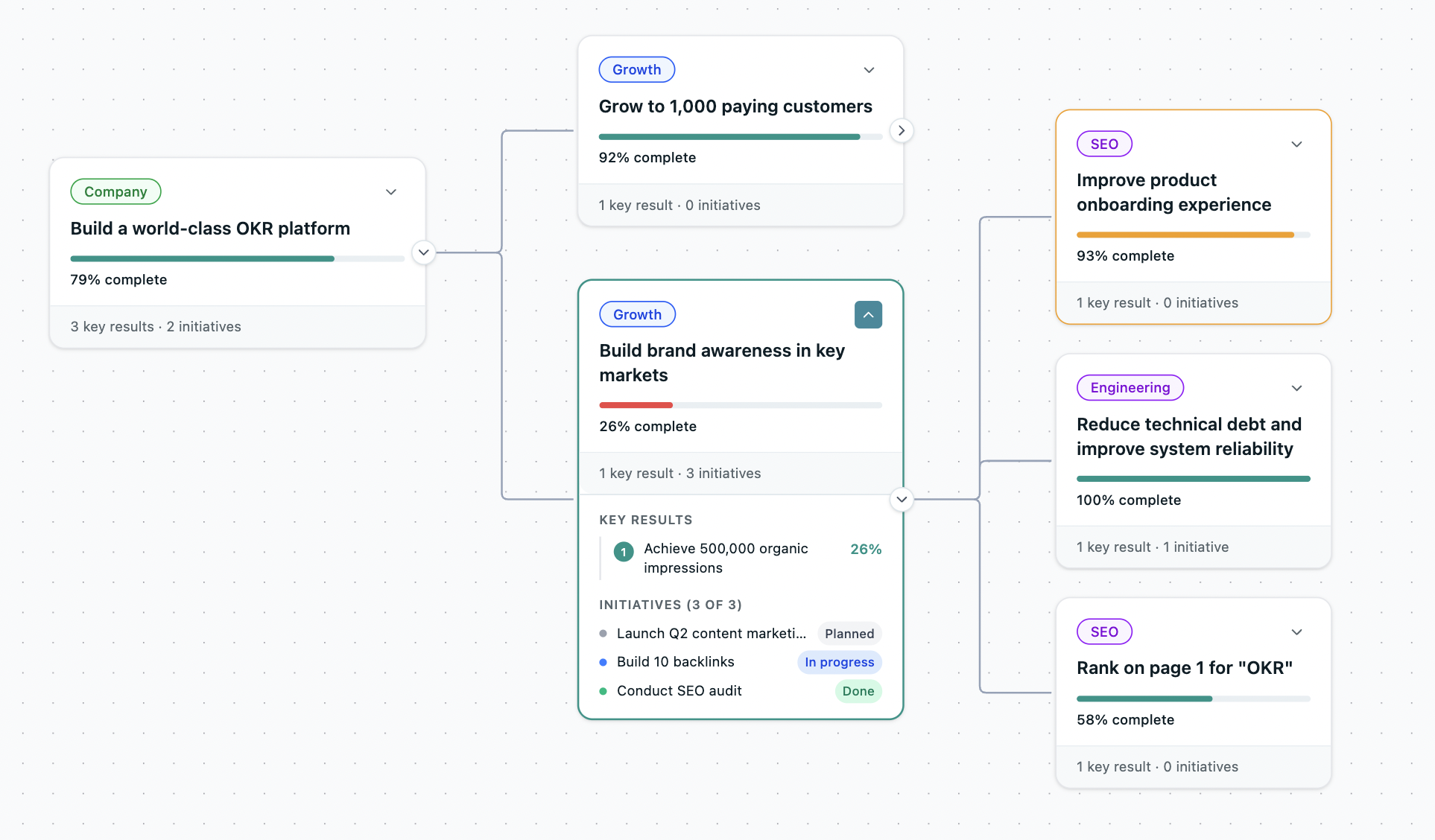
Each department is doing different work — but every Key Result connects explicitly to the same company priority. This is what the alignment map makes visible in OKRs Tool.
Level 3: Team OKRs
Team OKRs are the most specific layer — the measurable outcomes each team will deliver within the quarter. They are the execution layer of the structure.
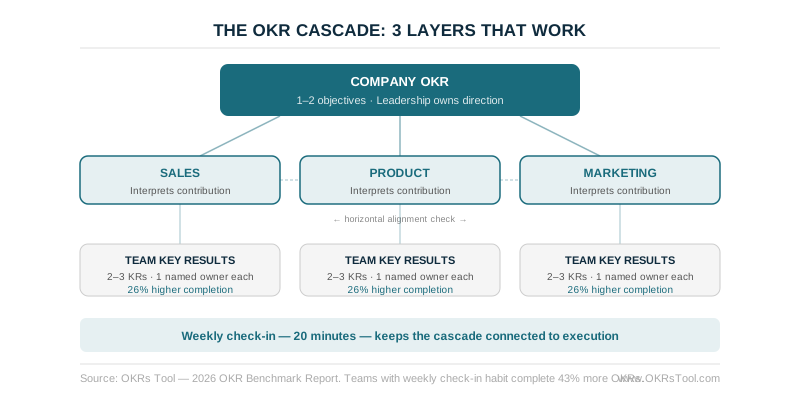
The team level is where ownership becomes critical. Every Key Result requires one named owner — not a team, not "shared." Teams with required single ownership see 26% higher completion rates than those with shared or vague accountability. And 50% of all Key Results across growing organizations have no named owner at all — the single most common and most fixable structural failure.
Team OKR Examples
Content team (under Marketing):Objective: Make organic search a predictable enterprise acquisition channelKey Results:
- Publish 8 enterprise-intent articles with 1,500+ words each — Owner: Content Lead
- Achieve top-3 ranking for 12 target enterprise keywords — Owner: SEO Lead
- Grow enterprise organic sessions from 4,200 to 8,500/month — Owner: Head of Marketing
Sales Development team (under Sales):Objective: Fill the enterprise pipeline with qualified opportunitiesKey Results:
- Book 40 enterprise discovery calls — Owner: SDR Lead
- Achieve 35% show rate on booked calls — Owner: SDR Manager
- Deliver 20 stage-2 qualified opportunities to AEs — Owner: VP Sales
Each Key Result has a named owner, a baseline, a target, and an implicit quarterly cycle deadline. These are ready to go into OKR software on day one.
The OKR Structure and the Cascade
The cascade is what makes the structure operational — the process of translating company OKRs into department OKRs into team Key Results before the cycle starts.
The OKR Intelligence Report 2026 finding on cascade speed: only 16% of organizations complete the full cascade within the same week. 26% take 3–4 weeks. For those teams, the quarter is already a third over before everyone is aligned.
The fix: run company and department goal-setting in parallel in a single half-day session, rather than sequentially. Teams then have 2–3 days to set their Key Results within that context. The cascade compresses from 3–4 weeks to 3–5 days — a structural change that drives the 50% higher completion rates the benchmark data shows for teams that launch in under a week.
How Many OKRs at Each Level?
The original OKR literature recommended 3–5 Key Results per Objective. The benchmark data across 330 organizations consistently shows 2–3 is optimal for growing organizations — enough to triangulate progress without diluting ownership. Beyond three Key Results per Objective, completion rates decline and accountability blurs.
Common OKR Structure Mistakes
Objectives with numbers. "Grow revenue by 30%" is a Key Result, not an Objective. The Objective sets direction qualitatively: "Build the revenue engine that funds next year's growth." The OKR framework keeps numbers at the KR layer by design.
Too many levels. Organizations with more than three levels of OKRs create overhead without adding alignment. Company → Department → Team is the standard. Individual OKRs are optional and work best as contributions to team Key Results — not as a fourth tier requiring a separate cascade.
Team goals without company connection. A team that writes their OKRs without referencing the company level is not cascading — they're operating independently. The structural test: can every team Key Result be connected to a specific company Key Result in one sentence?
Shared ownership. "Sales and Marketing jointly own this KR" means nobody owns it. Every Key Result needs one named person — the one who updates it weekly, escalates when it stalls, and owns the OKR score at cycle end.
Cascade as a waterfall. Setting company OKRs, waiting for department heads to respond, then waiting for teams — this produces the 3–4 week lag. The cascade should be a simultaneous event. The OKR planning guide covers the fast-start format in detail.
OKR Structure and the Weekly Rhythm
Structure is set in the planning session. It's maintained through the weekly check-in.
Teams with a weekly check-in habit complete 43% more OKRs than those reviewing monthly or ad hoc. The structure creates alignment. The weekly rhythm keeps it alive. The end-of-cycle review makes the next structure sharper than the last.
The OKR maturity curve shows what this produces over time: cycle 1–2 teams average 51% completion. Cycle 5+ teams average 79%. The structure compounds when the weekly habit runs consistently through every cycle.
Connection, Not Hierarchy
OKR structure is not about the hierarchy — it's about the connection. A three-level structure where every team Key Result connects explicitly to a company priority is structurally sound. A three-level structure where the connections are implied rather than explicit is just documentation.
Build the structure before the cycle starts. Complete the cascade in days, not weeks. Assign one owner per Key Result before anything goes live. And review the structure at mid-cycle to catch drift before it compounds into a missed quarter.
The organizations generating the highest returns from OKR software — a 1:88 return on investment against the same revenue baseline — are not writing better goals than everyone else. They're building a cleaner structure and maintaining it more consistently.
Data: OKR Intelligence Report 2026 (222 organizations), The ROI of OKRs: 2026 Benchmark Report (200 respondents), The 2026 OKR Benchmark Report (200+ organizations), OKRs Tool platform data (7,857 Key Results analyzed).