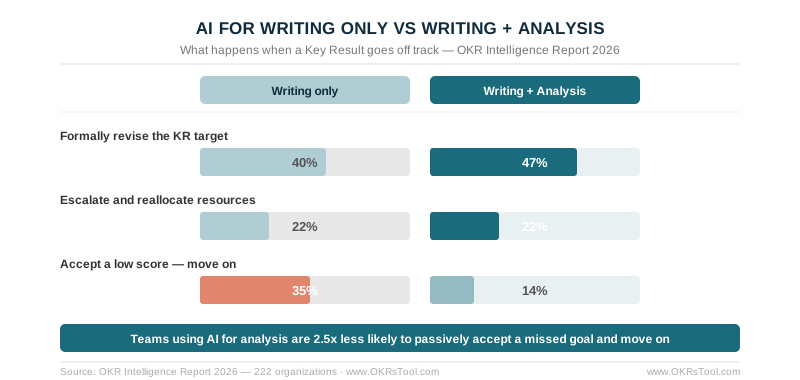
83% of organizations now use AI in their OKR process, and most of it goes into writing better goal sentences. The data puts the return elsewhere — teams using AI for mid-cycle analysis accept a low score on a missed goal 14% of the time, against 35% for teams using it only to draft.
The OKR Intelligence Report 2026 — 222 organizations across the technology sector, 51–200 employees, all confirmed active OKR implementation — is the first study to measure how AI is actually being used in OKR programmes, not just whether it's been adopted.
The headline finding: 83% of organizations are actively using AI in their OKR process this quarter. Not piloting, not planning to — using it now.
The more important finding: the split between writing (51% impact) and analysis (49% impact) is closing fast. AI is already operating as a strategic lens, not just a drafting assistant.
The State of AI in OKRs: What the Data Shows
Adoption is high. Trust is not.
83% adoption sounds like AI is embedded in most OKR programmes. But the trust data tells a more nuanced story:
The 13% using AI as-is represent a risk pattern. Their biggest complaint: generic goals. They're accepting shallow output because refining feels like more work than it's worth — which means AI is actively degrading the quality of their Key Results rather than improving it.
The 47% who always refine represent the best practice. AI reduces the friction of getting to a first draft. Human judgment improves it. The combination produces better goals faster than either alone.

The biggest AI concern is data privacy — not output quality
When organizations cite barriers to AI adoption in OKR programmes, the #1 concern is data privacy and security — cited by 25% of respondents. Output quality comes second at 19%. Leadership trust in AI output third at 16%.
This matters for how AI in OKR software should be designed. Strategic goal data — company priorities, revenue targets, competitive positioning — is among the most sensitive data an organization holds. AI that processes this data externally, trains on it, or stores it outside organizational control creates a legitimate security risk.
The implication: purpose-built AI that runs within a dedicated OKR platform with data isolation is structurally safer than general-purpose AI tools applied to OKR workflows.
Where AI Creates the Most Value in OKR Programmes
Layer 1: Goal Writing
The most widely understood AI application in OKRs. AI generates role-specific Objectives and Key Results based on company context, function, and cycle priorities.
The value isn't automation — it's the blank page problem. Teams that spend 30+ minutes debating goal wording in planning sessions use that time reviewing rather than writing when AI handles the first draft. The constraint our analysis of 20,952 Key Results identified — 52% were tasks or KPIs in disguise — is directly addressable through AI that enforces outcome-based phrasing from the first draft.
The limitation: goal-writing AI is only as good as the refinement layer. A team that accepts AI output without applying the outcome test ("can I track this metric every week forever without it being 'done'?") is importing the KPI-as-KR problem in a different form.
Layer 2: Initiative Recommendations
Once Key Results are set, AI can recommend the specific work — campaigns, sprints, experiments — most likely to move each metric based on current progress, team activity, and what high-performing teams in similar situations have done.
This closes the most common mid-cycle gap: the Key Result exists on the dashboard, but the specific work connected to it was never defined. The benchmark data on why this matters: high-performing teams attach 2–3 initiatives per Key Result within the first week of the cycle. Teams that delay this step almost never recover momentum.
Layer 3: Mid-Cycle Analysis
This is where AI creates value that manual review cannot match at scale.
The Intelligence Report found that 93% of organizations modify OKRs at least occasionally after the cycle starts. The 7% who quietly abandon off-track goals — the Invisible OKR pattern — could be identified and interrupted by AI that flags Key Results going stale: no updates in 14 days, progress velocity projecting a miss, owner not engaging with check-in prompts.
The teams generating the best AI value are the ones using it for analysis, not just writing. Among organizations using AI for both:
- Accept a low score on missed OKRs: 14%
- Formally revise or escalate off-track goals: 69%
Among organizations using AI for writing only:
- Accept a low score on missed OKRs: 35%
- Formally revise or escalate off-track goals: 51%
The analysis layer — misalignment detection, at-risk flagging, cycle synthesis — is where AI creates the most durable execution improvement.
Layer 4: Performance Synthesis
At cycle end, AI can synthesize check-in patterns, completion rates, ownership data, and retrospective responses into specific improvement recommendations for next cycle.
This addresses the most common retrospective failure: teams score their OKRs, identify that something went wrong, and then start next cycle the same way. AI synthesis identifies the pattern across cycles — not just "we missed this KR" but "teams consistently miss KRs in this function when initiatives aren't attached in week one."
The same synthesis capability applies to 360 feedback and performance reviews — identifying consistent themes across multiple reviewers without the recency and salience bias that affects manual synthesis.
The Writing vs Analysis Split: Why It Matters
The Intelligence Report finding that the writing/analysis impact split is closing — from a writing-dominant majority to near parity — reflects a maturity shift in how organizations are using AI in their OKR programmes.
First-generation AI OKR usage: "Write my goals for me."
Second-generation AI OKR usage: "Tell me which goals are at risk before I find out at quarter end."
The second generation is where the return on AI investment compounds. Writing assistance saves 20–30 minutes per planning session. Analysis assistance changes mid-cycle behavior — the point where most OKR ROI gets lost or recovered.
The benchmark data on what mid-cycle behavior drives: teams with a weekly check-in habit complete 43% more OKRs than those reviewing monthly. Teams that skip the weekly rhythm entirely are 3x more likely to abandon OKRs.
AI that makes the weekly check-in more useful — by surfacing which goals need attention before the check-in starts — is AI that directly addresses the biggest driver of OKR failure.
How OKRs Tool Builds AI Into the Execution Layer
Most AI in goal-setting software stops at writing suggestions. OKRs Tool builds AI into seven distinct points across the OKR cycle — addressing both layers the Intelligence Report identifies as high-value.
The design principle: every AI feature addresses a specific failure pattern from the benchmark data. Not AI for its own sake — AI that closes measurable gaps in OKR execution.

What Good AI OKR Usage Looks Like
Based on the Intelligence Report data, the organizations generating the best results from AI in their OKR programmes share four characteristics:
They use AI for both writing and analysis. The 14% vs 35% proactive response finding isn't explained by better goals — it's explained by better mid-cycle behavior. Analysis AI changes what teams do when something goes wrong.
They always refine AI output. The 47% who treat AI as a strong starting point that always needs human refinement are extracting more value than the 13% using output as-is. AI reduces friction. Human judgment improves quality. Neither works as well without the other.
They treat data privacy as a non-negotiable. The #1 concern in the dataset — 25% cite data privacy — reflects something real. Strategic goal data is sensitive. Organizations with mature AI OKR usage have explicit data handling policies for which goal data leaves organizational control and which doesn't.
They've moved past the drafting phase. First-generation AI usage (write my goals) is useful. Second-generation AI usage (tell me what's going wrong before I find out at quarter end) is where the compounding return lives. The organizations generating the most durable improvement from AI are the ones that have reached the analysis layer.
The AI OKR Maturity Model
Based on the Intelligence Report data, AI adoption in OKR programmes follows a consistent maturity pattern:
Most organizations are between Stage 1 and Stage 2. The opportunity — and where OKRs Tool's AI is designed to operate — is Stage 3 and Stage 4.
From Writing Goals to Catching Drift
AI adoption in OKR programmes has been faster than almost any other change in goal-setting practice. 83% in a single measurement cycle is not gradual diffusion — it's rapid adoption driven by genuine utility.
The frontier is not writing. The benchmark data on OKR failure is consistent: goals don't fail in planning sessions, they fail between planning sessions. The Invisible OKR — quietly abandoned mid-cycle — is the pattern that costs the most. AI that surfaces this pattern while there's still time to act is the highest-value application in the dataset.
The organizations that will generate the most from AI in their OKR programmes over the next two years are the ones moving from the drafting layer to the analysis layer — using AI not to write better goal sentences, but to change what happens when goals drift.
Data: OKR Intelligence Report 2026 — 222 organizations, technology sector, 51–200 employees, all confirmed active OKR implementation. Independent research — no OKRs Tool customers included. Additional data: The ROI of OKRs: 2026 Benchmark Report (330 respondents) and The 2026 OKR Benchmark Report (200+ organizations).