
In the Strategy Execution Benchmark, 60% of strategy and operations leaders said failing priorities are never cleanly resolved, and 39% said priorities simply disappear without a decision. Nobody announces the end, so the priority keeps its place on the slide, its budget line and its owner's calendar long after the work has stopped. Ending one on purpose takes kill criteria, a named decision-maker and a short closing record.
The quarterly business review deck still lists five strategic priorities. Two of them haven't had real work behind them since spring, because the team moved on, the owner got pulled into something urgent and nobody said the priority was over. When the board asks how they're going, the person running strategy ends up defending work that stopped months ago.
That pattern is the norm in the Strategy Execution Benchmark, a survey of 180 strategy and operations leaders at companies of 50–200 people. This piece covers how failing priorities fade out without a decision, what letting them linger costs, and a five-step playbook for ending one deliberately: the kill criteria, who decides, when to check, how to make the call and what to record.
Six in Ten Failing Priorities Are Never Cleanly Resolved
A failing priority usually dies in stages, and the benchmark found a gap at every one of them.
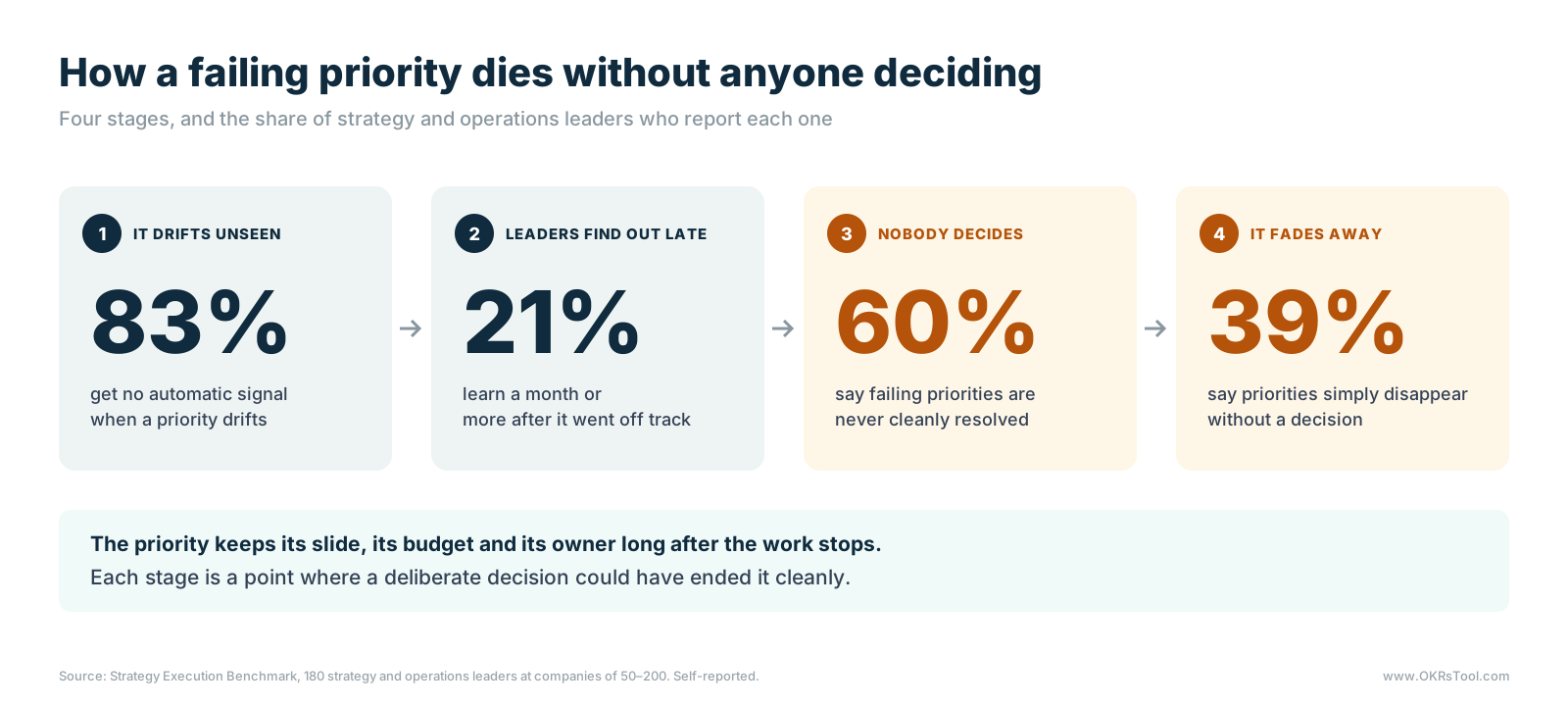
The drift starts unseen, because 83% of leaders get no automatic signal when a priority goes off track, and 21% learn about it a month or more after it slipped. By then the priority has lost momentum, and the decision that should follow often never comes: 60% of leaders said failing priorities are never cleanly resolved, and 39% said they simply disappear.
The priority isn't cancelled, so it stays on the strategic pillars slide, keeps its owner and holds onto its budget, and nobody can say for certain whether it's still alive.
What a Priority Nobody Ends Costs
A priority left in limbo costs more than the work that stopped. People keep reserving time for it, budget stays allocated to it, and teams that weren't told it ended keep building on assumptions that no longer hold. In the Goal-Setting Benchmark, 66% of leaders said they see duplicated work when priorities aren't visible, and a priority whose status nobody knows is the least visible kind.
It also blurs the strategy itself. The Strategy Execution Benchmark found that only 7% of leaders say most of their company's work ladders up to strategy, and 86% of employees can't name it. A list of seven priorities with three of them abandoned gives people seven things to remember and no way of knowing which four matter.
For the person accountable for strategy, the cost is personal as well, because every dead priority still on the list is one they'll be asked to explain at the next quarterly business review.
Why Priorities Fade Out Without a Decision
Ending a priority feels like admitting a failure, so leaders put the decision off, and putting it off is easy when nothing forces it. Three conditions make the fade almost automatic.
No signal. With 83% of leaders getting no automatic warning, a priority can slide for weeks before anyone with authority notices, and by then letting it fade feels less awkward than calling it.
No decision owner. The priority has an owner who runs it, but often nobody holds the authority to stop it. The owner rarely volunteers to end their own work, and leadership assumes the owner will raise it.
No checkpoint. The most common reason goals get missed in the Goal-Setting Benchmark was that priorities shifted, cited by 46% of leaders. Weekly reviews didn't protect against those misses (47% against 51%), because a shift in direction needs a deliberate decision about what to change, and a status check doesn't make one.
A Five-Step Playbook for Ending a Priority
Each step closes one of the gaps that let priorities fade.
1. Write Kill Criteria When the Priority Is Created
Decide at the start what failure looks like, while nobody has anything invested in defending the priority. Two or three criteria are enough: a leading indicator that should have moved by a set date, a threshold that triggers a review, and a ceiling on the time or budget the priority can absorb before it has to prove itself.
The OKR Pacing Benchmark gives a useful model for the first one. Key results at 50% or more by week four hit their target 84% of the time, against 55% for those below halfway, so a priority whose key results are still under halfway a third of the way in has met a sensible review trigger.
2. Name Who Can End It
Give every priority a decision owner in addition to the priority owner running it, usually the executive who sponsored it. The decision owner's job is to make the call when a kill criterion is met, which takes the weight off the priority owner and stops the decision falling between two people. It's the same principle as leadership accountability for goals: one named person answers for the outcome.
3. Check at Fixed Points
Put the kill criteria in front of the decision owner at scheduled moments instead of waiting for someone to raise a concern. The mid-quarter review is the natural checkpoint for quarterly priorities, with a lighter check in the weekly report between reviews. An automatic drift signal does the rest, so the 21% who find out a month late hear about it within a week.
4. Make the Call: Continue, Change or Stop
When a kill criterion is met, the decision owner chooses one of three outcomes and makes it explicit. Continuing is a legitimate choice if the evidence supports it, as long as it's a decision with a new checkpoint attached. Changing the priority means rewriting its target or scope, and stopping it means ending it formally. The table sets out the signals behind each choice.
5. Close It With a Record
A stopped priority needs a short closing record that says what was decided, why, and what happens next, so the decision outlives the meeting it was made in.
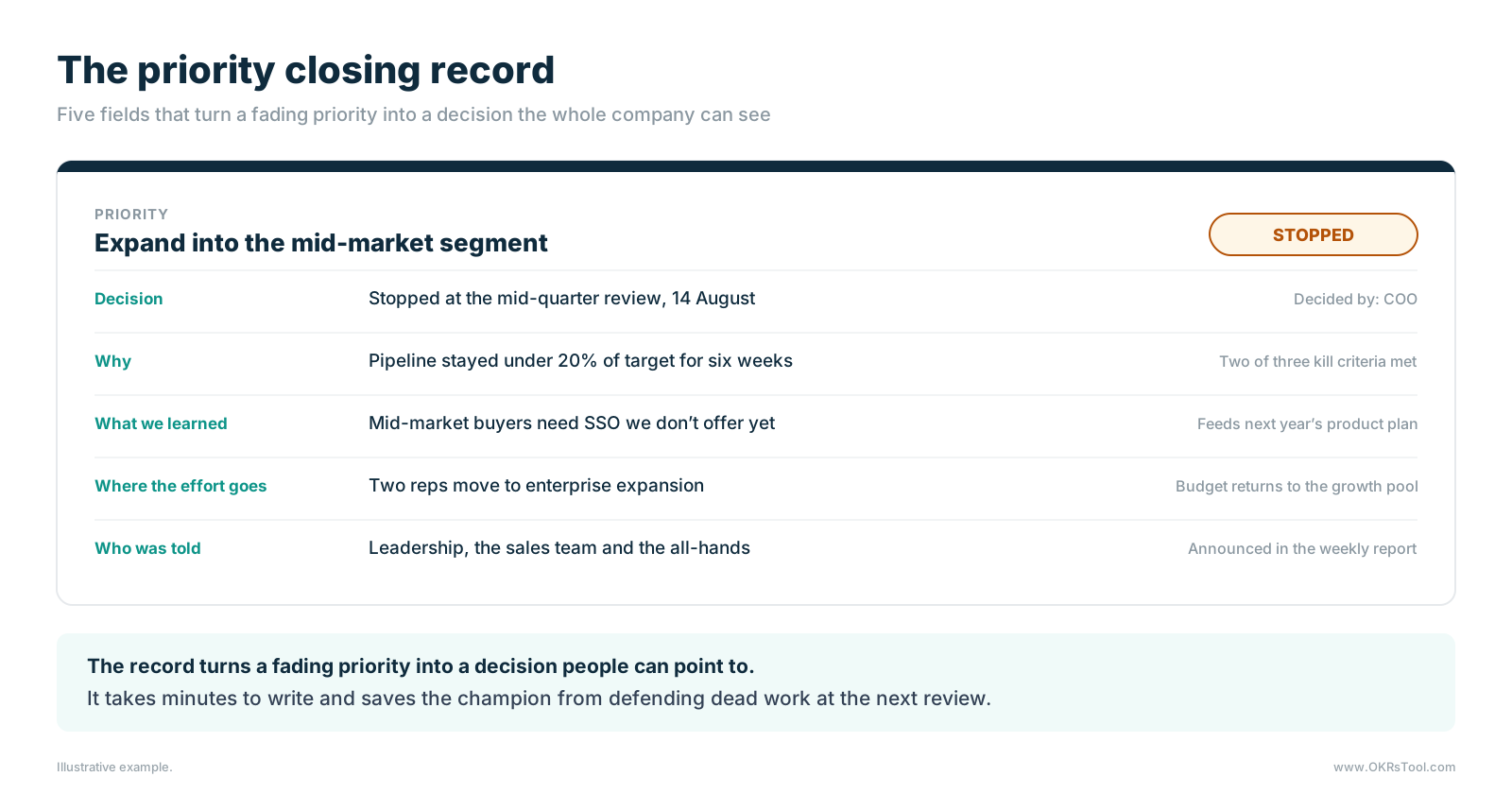
The record answers the questions people would otherwise ask in corridors: was it stopped, who decided, what did we learn and where did the effort go. Share it in the same places the priority was announced, so the teams who built plans around it hear about the change at the same volume. The lessons feed into the end-of-cycle reflection, where they shape the next set of strategic goals.
A Shorter List Makes the Strategy Believable
Ending priorities on purpose makes the remaining ones credible. A strategy with four live priorities, each with an owner, a decision owner and kill criteria, is one people can repeat and act on. A list that only grows tells everyone the priorities are aspirations, and it pushes the company toward the misalignment that ruthless prioritization is meant to prevent.
For the person running strategy, the playbook comes down to a few habits: write the exit conditions at the start, give someone the authority to use them, check at fixed points and close what's finished with a record. A platform that connects each priority to the OKRs beneath it and flags drift automatically puts the signal in front of the decision owner while there's still time for a clean call, so priorities end by decision instead of fading away.
Data: Strategy Execution Benchmark, The Goal-Setting Benchmark and the OKR Pacing Benchmark.