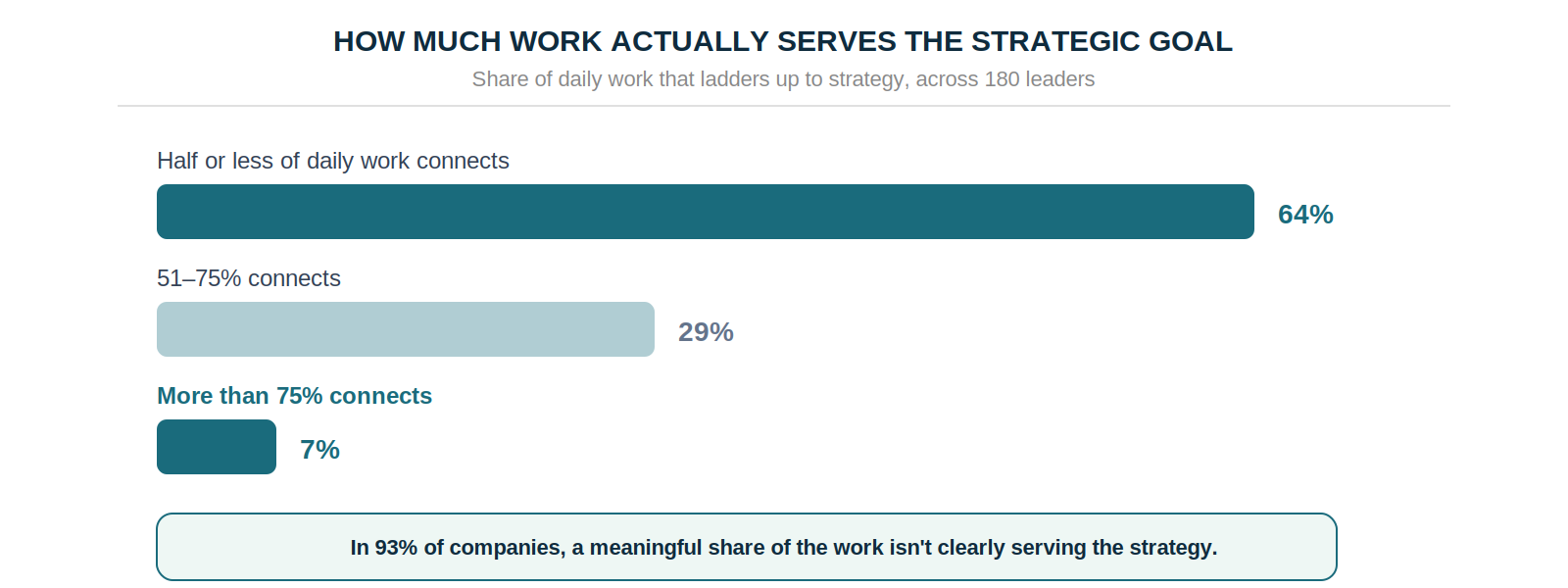
Strategic goals rarely fail because they were written badly. They fail in the gap between the plan and the work: only 7% of leaders say most daily work ladders up to strategy, and 86% run companies where most employees can't even name it. The goal is fine — the chain connecting it to Monday morning is what breaks.
By week six of the quarter, the strategic goals are still in the planning deck and the team is working on whatever was most urgent that morning. Nobody decided to abandon the strategy. It simply lost every weekly contest against the merely urgent, until the document and the day-to-day had quietly separated.
That separation is the most expensive gap in a growing business, and it's measurable. When the Strategy Execution Benchmark 2026 surveyed 180 strategy and operations leaders, only 7% said most of their teams' daily work ladders up to strategy. This guide covers what strategic goals are, how to write them, how to cascade them across teams, and how to build the execution rhythm that keeps strategic goals from going dark mid-quarter.
What Are Strategic Goals?
Strategic goals are the outcomes an organization commits to over a defined horizon — usually one to three years. They describe where the business is going rather than what it does day to day, and a good one answers a single question: if we succeed this year, what will be true that isn't true today?
"Become the default platform for mid-market compliance teams in EMEA" is a strategic goal. So is "grow annual recurring revenue from $8M to $20M," or "reduce churn below 3% and turn retention into a defensible advantage." Each is a business goal stated as a position, not an activity. Each describes a position the company doesn't yet hold, not the work of getting there.
That last distinction is where the trouble starts. Strategic goals sit above the operational layer — they're the outcomes that projects produce, not the projects themselves. The moment a strategic goal gets written in operational language, it stops being a destination and becomes a to-do item, and the whole chain below it inherits the confusion.
Strategic Goals vs Operational Goals
Organizations routinely blur these two, and the blur is where execution starts to break. A strategic goal names a destination; an operational goal describes how the machine runs while you head there.
The common mistake is writing a strategic goal in operational clothing. "Improve customer satisfaction" is an activity — you could do it forever and never arrive anywhere. "Become the highest-rated platform in our category by year-end" is a position you either reach or don't. The first can't fail; the second can, which is exactly what makes it strategic.
How to Write Strong Strategic Goals
Strong strategic goals share four traits, and each one is a defence against a specific failure.
Outcome-focused, not activity-focused. A strategic goal describes a changed state of the world, not the work done to reach it. "Launch a new product line" is activity; "capture 15% of the enterprise segment with the new line by Q4" is an outcome. The test is the one you'd apply to a key result: if you could track it as a health metric forever, it's operational, not strategic.
Measurable, eventually. A strategic goal doesn't need the precision of a quarterly metric, but it has to be verifiable. "Become a market leader" isn't; "reach a top-3 category ranking and $15M ARR" is. The difference between an outcome and an output is what keeps the goal honest.
Ambitious but grounded. The completion sweet spot is 70–80%. Goals hit at 100% every year were set too low; goals never hit at all breed the quiet fatalism that kills engagement. Ambition anchored to a real baseline is what produces movement.
Few enough to remember. Past three strategic goals, an organization effectively has none — everything is equally important, so nothing is. Choosing two or three forces the honest argument about what matters most, and that constraint is the same discipline behind limiting how many OKRs a team runs.
The Bridge Between Strategic Goals and Daily Work
The most common failure isn't a badly written strategic goal. It's the absence of a system connecting the goal to what teams do each week — and the benchmark shows how wide that absence runs.
That connecting system is OKRs — the translation layer between strategic intent and quarterly execution. Each strategic goal becomes a company-level objective, each objective gets two or three key results that measure this quarter's progress, and each team's OKRs connect upward to those key results. The cascade looks like this:
Each level gets more specific and more owned, and every key result carries a named person. When the cascade works, anyone can trace their weekly priorities up to the strategic goal. When it doesn't, you get the 65% of teams who admit their goals aren't linked to company strategy — and the return that good execution generates stays out of reach.
Cascading Strategic Goals Across Teams
Cascading is the process of turning a company-level strategic goal into team-level execution. Done well it produces alignment without micromanagement; done badly it produces teams copying the company goal word for word and losing the local thinking that makes execution smart.
Three principles separate the two:
- Company sets direction, teams interpret contribution. Leadership defines the strategic goal and the company objective. Each team then answers: given this priority, what are we uniquely positioned to move? That question produces team objectives that contribute rather than echo.
- Align horizontally, not just vertically. Most cascades chase top-down alignment and miss the lateral kind — sales and marketing, product and engineering, optimising for metrics that pull against each other. The most expensive misalignments are usually sideways, between departments, not up and down.
- Limit the depth. Company to department to team is usually enough. Adding individual OKRs on top of team OKRs creates more coordination cost than alignment benefit for most organizations under 200 people.
Where Strategic Goals Actually Break
The benchmark reframes "why strategic goals fail" from a single alignment number into a measured, four-stage breakdown. The goal survives planning intact and then decays at four predictable points.
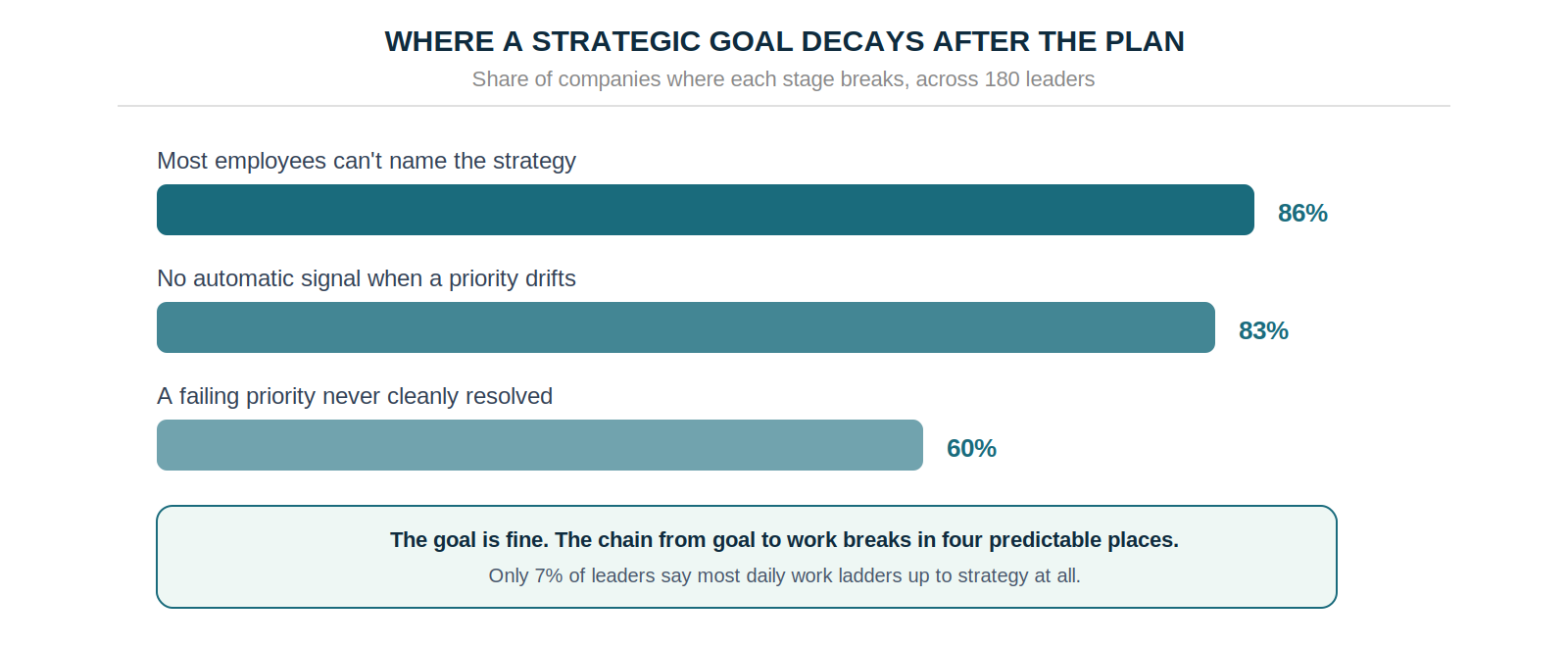
The first break is naming. In 86% of companies, most employees can't state the strategy — a goal nobody can articulate can't guide a single decision. The second is laddering: only 7% of leaders say most daily work connects to the strategy, so even where the goal is known, the work isn't pointed at it. The reasons employees can't name the strategy and the laddering gap are two views of the same disconnection.
The third break is visibility. 83% of leaders get no automatic signal when a strategic priority starts drifting — they find out at a review, if at all, which is the strategy visibility gap that turns a recoverable slip into a quarter-end post-mortem. The fourth is resolution: 60% say a clearly failing priority never gets cleanly resolved. It's quietly dropped or limps to the end of the cycle, because a problem nobody sees is a problem nobody decides.
Underneath all four sits a measurement failure. Teams that track activity — campaigns launched, features shipped — instead of outcomes never build the layer that would surface any of this, which is what the strategy execution metrics come down to.
The Execution Rhythm That Keeps Strategic Goals Alive
Strategic goals fail in execution, not planning, so the rhythm after the planning session decides everything. Three habits separate the organizations that hit their strategic goals from those that don't.
Weekly check-ins. Teams reviewing their goals in a weekly check-in complete 43% more of them than those reviewing monthly or ad hoc. The mechanism is early detection — weekly visibility catches drift before it hardens into a miss, and keeps the strategic goal present in the conversations where work gets prioritised. It needn't take longer than 20 minutes: what moved, what's at risk, what's next, where help is needed.
Named ownership. Every key result needs one named owner — not a team, not "leadership," one person. Teams with clear single ownership complete 26% more of their goals than those with shared or vague accountability. A strategic goal stays abstract until a name sits beside the metric it moves.
End-of-cycle retrospectives. Teams running a structured retrospective each quarter complete 30–45% more the following one. The retro is where the strategic goal gets re-examined — did this quarter's OKR actually move us toward the annual goal, and what does next quarter's need to look like as a result?
Why the Rhythm Has to Outlast the First Cycles
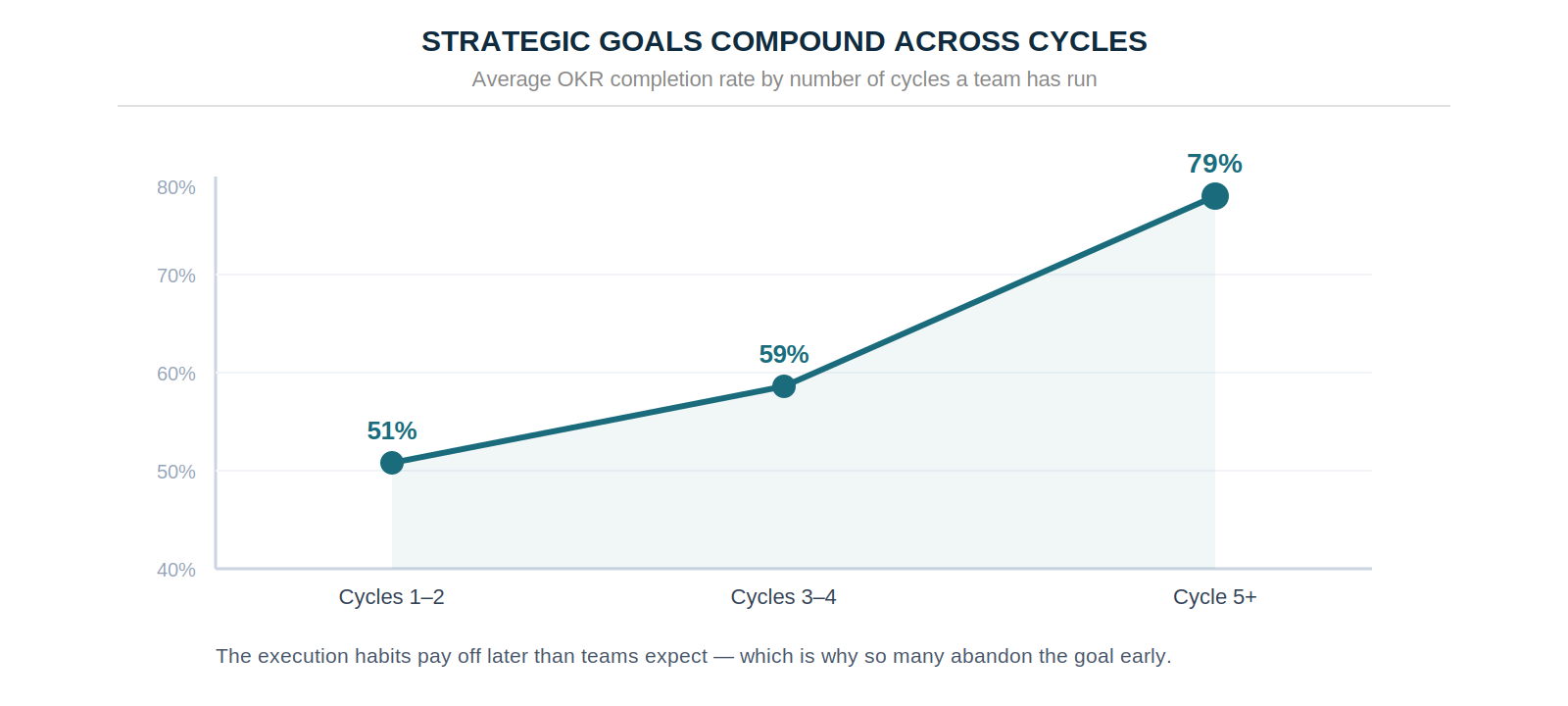
The habits compound, which is the part most teams miss. Average completion climbs from 51% in a team's first two cycles to 79% by the fifth — but the payoff arrives after the point where many teams conclude the goal isn't working and walk away. Sticking with the rhythm through the flat early cycles is itself the discipline.
Strategic Goals and the Software That Runs Them
For strategic management at 50 to 200 people, the priority is visibility and connection — seeing how every team's work ties to the strategic goal without enterprise-software overhead. That's the gap purpose-built strategy execution software fills, and the return difference is real: organizations on purpose-built goal software report a 1:88 return against 1:25 on spreadsheets. The gap isn't the licence cost — it's that purpose-built tools make the weekly habit structurally easier to keep.
Larger organizations with heavy reporting requirements may need deeper analytics and HRIS integration at correspondingly higher cost, which the best OKR software comparison breaks down by size.
The Goal Was Never the Problem
Strategic goals are only as valuable as the system that connects them to execution. The organizations generating the highest returns from planning aren't better at writing goals — they're better at the habits that keep goals alive between planning sessions: weekly visibility, named ownership, honest measurement, and a retrospective that makes each cycle sharper than the last.
The four places strategy decays — nobody can name it, work doesn't ladder up, drift goes unseen, failure never gets resolved — are all downstream of the same absence. Not a worse goal, but no rhythm carrying it into the week. Set the strategic goal, translate it into quarterly OKRs, cascade it to teams, check in weekly, and reflect at cycle end, and the gap between what the company says it's doing and what it's actually doing closes one week at a time.
Data: Strategy Execution Benchmark 2026 (180 strategy and operations leaders), OKRs Tool platform data (876 organizations, 20,952 key results), The ROI of OKRs 2026 Benchmark Report (330 organizations), The 2026 OKR Benchmark Report (200 organizations).