Strategy execution is the discipline of turning a plan into the work that delivers it — and it's where most strategy dies. Across 180 strategy leaders, only 7% say daily work ladders up to strategy, and 68% say strategy breaks downstream in sustaining and measuring, not at the initial handoff. The failure isn't the plan. It's everything after it.
Every company sets strategy. Far fewer execute it. The gap between a plan that reads well at the offsite and the work that actually happens over the following twelve weeks is where competitive advantage is won or lost — and it's a gap most organizations never close.
Strategy execution is the set of practices that turn strategic intent into coordinated action: translating priorities into measurable goals, connecting daily work to those goals, keeping progress visible, and deciding what to do when something drifts. It is not planning, and it is not project management. It's the operating layer between them — and it's the layer that determines whether a strategy produces results or just documents.
This guide covers what the discipline is, why it fails, and the system that makes it work — drawing on the Strategy Execution Benchmark 2026, a survey of 180 strategy and operations leaders at companies of 50–200 people, alongside platform data from 876 organizations and the ROI research behind purpose-built execution.
What Strategy Execution Actually Is
A useful definition separates three things organizations routinely conflate. Strategy is the set of choices about where to play and how to win. Planning is the act of writing those choices down. Execution is everything that happens between the plan being set and the outcome being measured — the weekly translation of intent into action.
The distinction matters because organizations invest heavily in the first two and almost nothing in the third. They run offsites, build strategy decks, and set annual goals. Then the deck goes in a drive, the goals go in a tracker, and the connection between them dissolves over the quarter. Execution is the discipline of keeping that connection alive.
Four properties define whether it holds. A strategy has to stay named — recallable by the people meant to deliver it. It has to stay connected — daily work visibly laddering up to it. It has to stay visible — progress and drift surfacing without anyone hunting for them. And it has to stay decided — failing priorities getting a real ending rather than quietly disappearing. Where any of the four lapse, execution decays.
The Four-Part Decay
The Strategy Execution Benchmark measured each of those four properties across 180 leaders, and the gaps are wide.
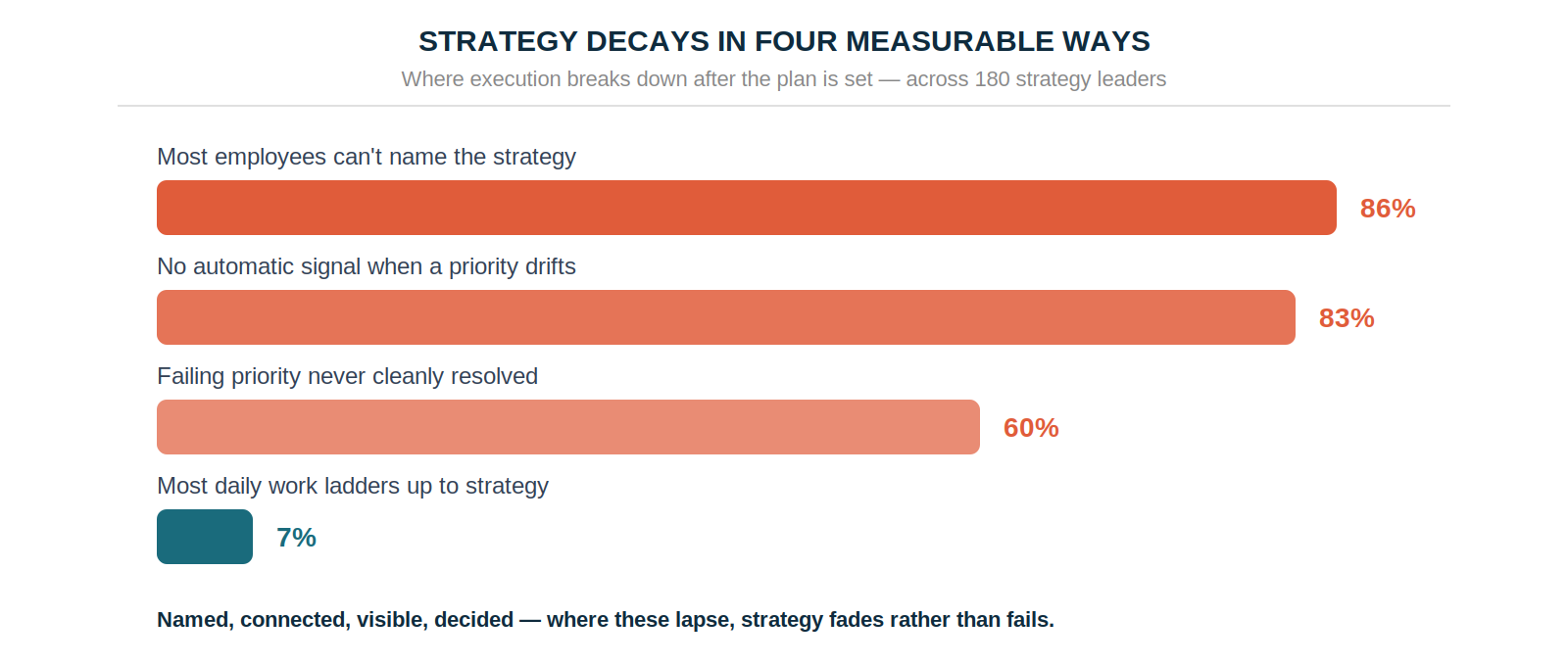
In 86% of companies, most employees can't name the top strategic priorities. Only 7% of leaders say most daily work ladders up to strategy. 83% get no automatic signal when a priority drifts off track. And when a priority is clearly failing mid-cycle, 60% say it's never cleanly resolved — it's quietly dropped or limps to the end of the quarter.
None of these is an effort problem. The leaders in the study review execution weekly or monthly and feel confident in their view. The failure is structural: nothing in the operating system around the strategy keeps it named, connected, visible, and decided once the quarter is underway. Strategy doesn't fail loudly at the whiteboard. It fades quietly in the weeks after.
Why Strategy Breaks Downstream, Not at the Offsite
The most useful finding in the benchmark is about where execution breaks. Asked to name the single point of failure, only 23% of leaders pointed to the initial translation of strategy into team work. 68% pointed downstream — to sustaining attention over time and measuring whether the strategy is actually progressing.
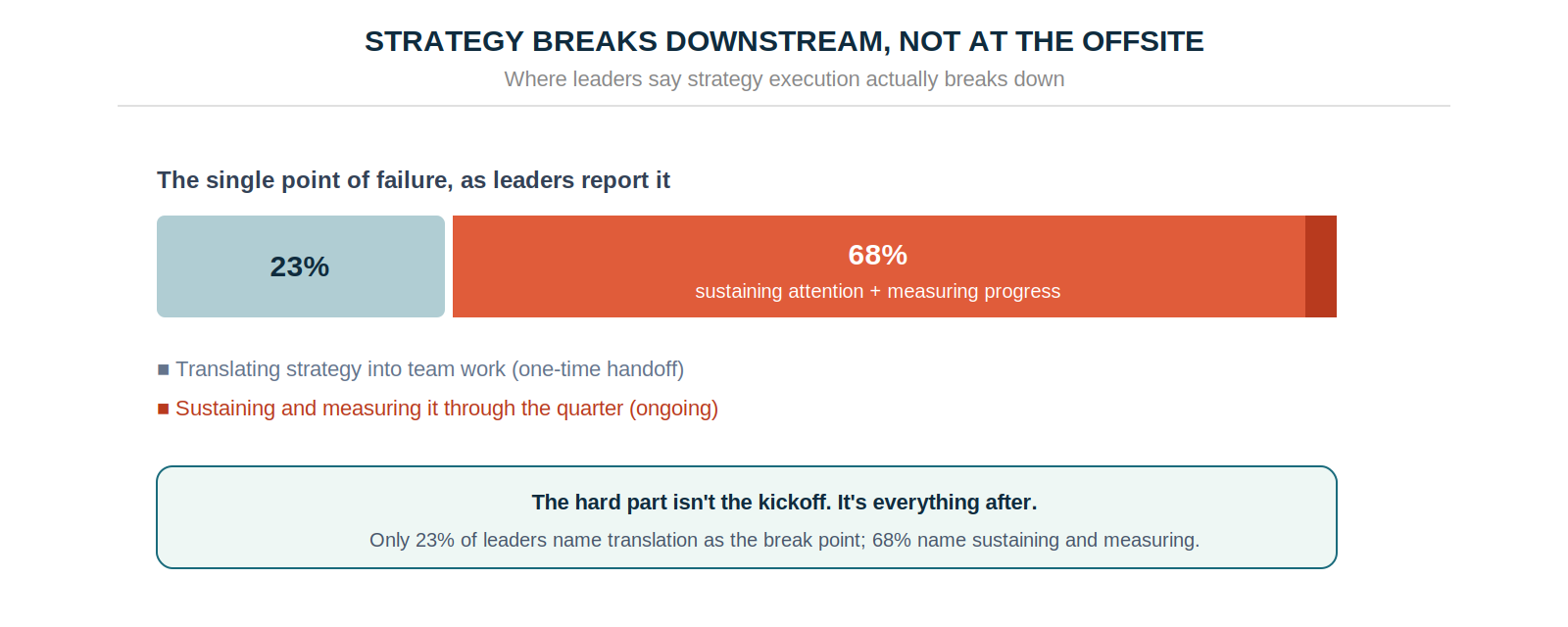
This inverts how most organizations invest. Enormous effort goes into the kickoff — the offsite, the cascade, the alignment workshop — because translation feels like the hard part. But the translation is a one-time cost. Sustaining and measuring are ongoing, and they're where the strategy actually comes apart.
The mechanism is visibility. Only 17% of leaders learn a priority is off track from a tool that surfaces it automatically. The other 83% find out at a scheduled review, through an escalation, when a metric finally moves, or from a customer — by which point the drift has already happened. Visibility is pull rather than push, and the detection lag it creates is what lets a strategy die without anyone deciding to kill it. 21% of leaders say a priority is typically off track for a month or more before they personally know.
The Operating System That Works
Organizations where strategy stays load-bearing aren't running better strategy. They're running a better system around it — four disciplines, each of which closes one of the four decay points, and each with a number behind it.
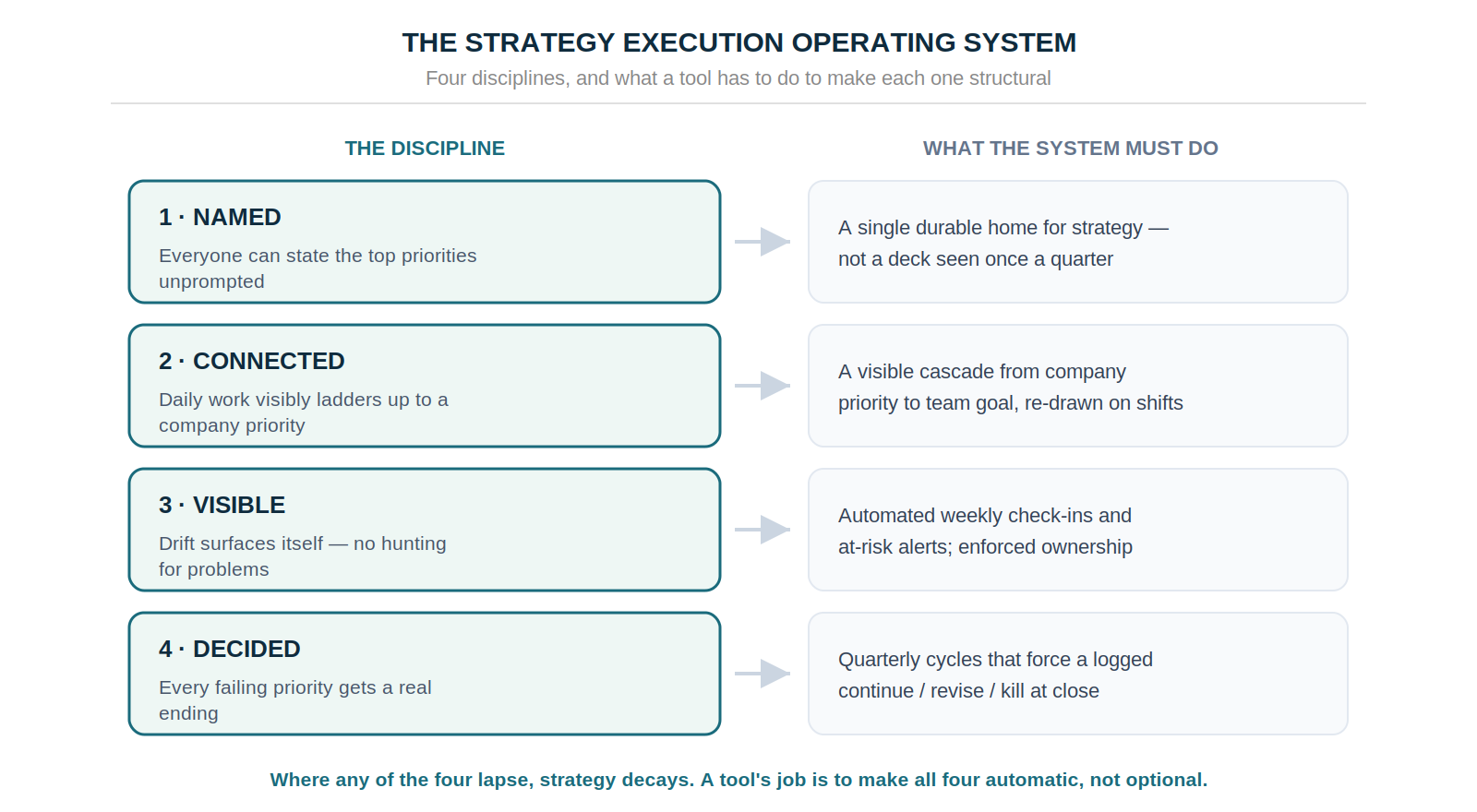
Name it once, and keep it visible. A strategy nobody can recall can't be pursued deliberately. It needs a single durable home every team goal links back to — not a slide deck seen once a quarter. The recall gap (86%) is the precondition for every other failure, because work can't ladder up to a strategy people can't state.
Connect the work to it. Every team goal should visibly ladder up to a company priority, and the cascade should be re-drawn when priorities shift rather than left to drift. This is where OKRs earn their place: the framework exists to make the line from daily work to strategic intent explicit and trackable.
Make drift surface itself. The single highest-leverage change is turning visibility from pull to push. A weekly check-in that surfaces a stalling priority automatically shrinks the detection lag that kills strategy quietly — and teams with the habit complete 43% more goals than those reviewing monthly or ad hoc. Named ownership is its partner: half of all goals have no owner, and single ownership drives 26% higher completion.
Give every priority a real ending. A failing priority should get a logged decision — continue, revise, or kill — every time, so the choice is visible rather than avoided. The 60% that never cleanly resolve are running an unaccountable strategy, where bets die without a retrospective and nobody learns from the miss.
Execution Compounds Over Time
One reason strategy execution is underinvested is that its returns aren't immediate. The first cycle is messy — teams are learning to write goals, calibrate targets, and hold the cadence. The payoff arrives later, and it compounds.
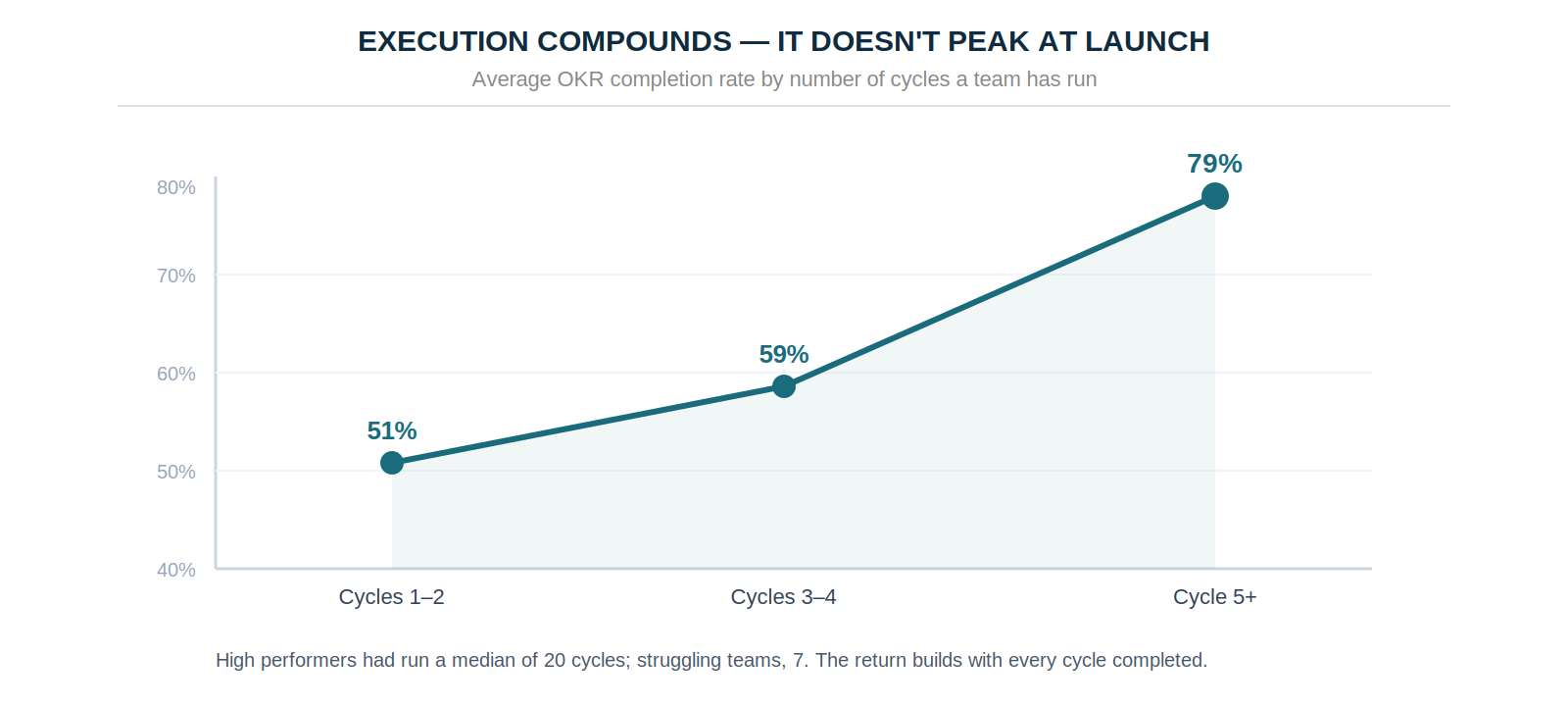
Across 876 organizations, average completion climbs from 51% in a team's first two cycles to 59% by cycles three and four, and 79% by the fifth. High-performing organizations had run a median of 20 cycles; struggling ones had run 7. The discipline isn't something you install once — it's a capability that deepens each quarter a team runs it honestly.
This is why abandoning execution after a disappointing first quarter is the most expensive mistake an organization can make. The maturity curve never gets a chance to bend upward, and the strategy reverts to a deck nobody acts on.
What to Run Strategy Execution On
The infrastructure a strategy runs on determines whether the four disciplines are structural or dependent on somebody remembering. 61% of leaders run execution on spreadsheets, docs, or nothing central at all — none of which can send a reminder, surface a drifting priority, or force a continue-revise-kill decision. A spreadsheet creates the appearance of strategic management while leaving every gap in the benchmark wide open.
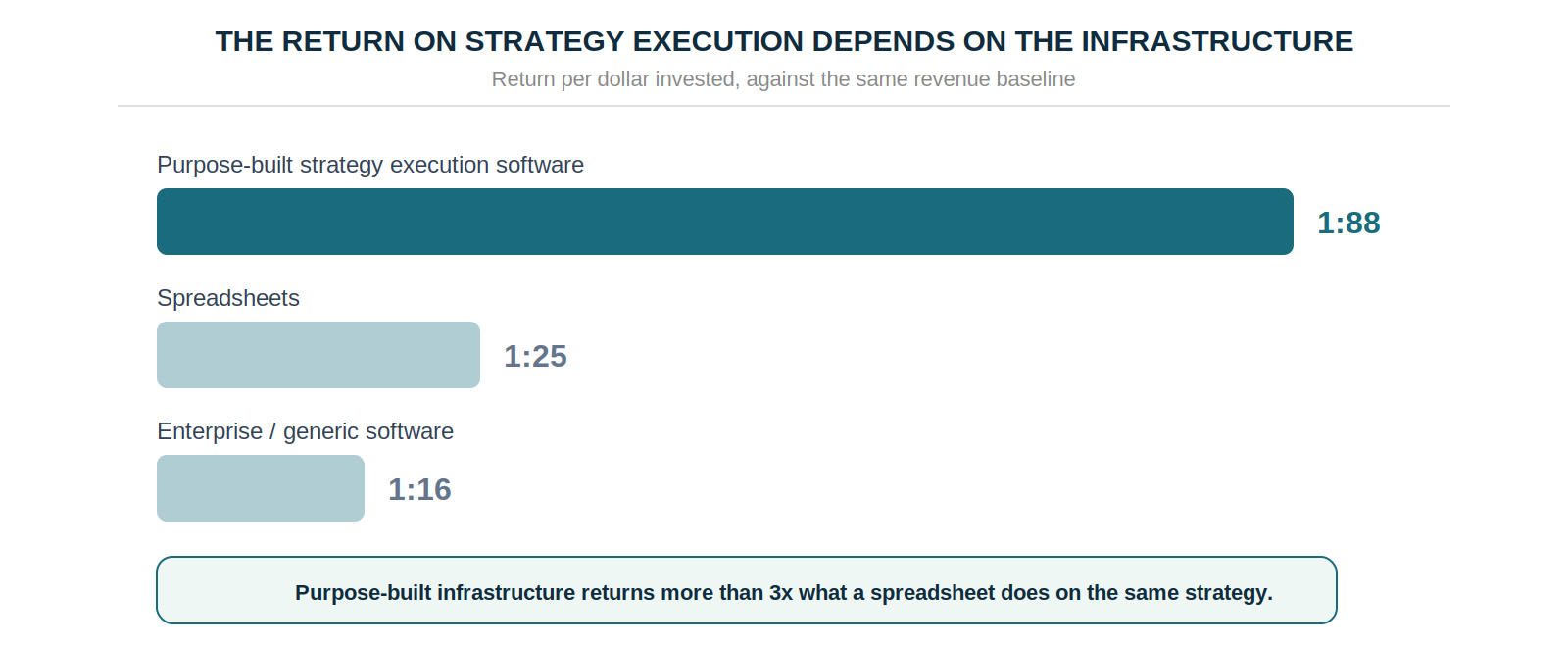
The return data makes the cost of that choice concrete. Organizations using purpose-built strategy execution software generate a 1:88 return against the same revenue baseline, compared to 1:25 on spreadsheets and 1:16 on enterprise or generic software. The tool choice isn't cosmetic — purpose-built infrastructure returns more than three times what a spreadsheet does on the identical strategy, because it makes the naming, connecting, surfacing, and deciding automatic instead of manual.
The features that matter map directly onto the four disciplines: a durable home for strategy that everyone can see, a visible cascade from company priority to team goal, automated weekly check-ins that surface drift, enforced ownership, and quarterly cycles that force a decision at close. Everything else is documentation.
A Strategy Execution Checklist
The disciplines are simple to state and hard to sustain, which is exactly why a standing checklist beats good intentions. Run a strategy through these before, during, and at the close of every cycle.
None of these is exotic. Name it, connect it, make drift surface itself, and give every miss a real decision. The organizations that run these disciplines don't have better strategy than everyone else — they have strategy that's still alive at quarter-end.
Strategy That Survives Contact With the Quarter
The data names the system precisely: named, connected, visible, decided. Organizations that build those four properties into how they operate turn strategy into results; the ones that don't produce beautiful plans nobody acts on.
For a deeper look at the failure points, the full Strategy Execution Benchmark 2026 breaks down all four gaps and includes a free strategy execution template. And to see how the four disciplines work in one connected system, how OKRs Tool runs strategy from priority to weekly check-in to cycle close — free for up to 5 users.
Data: Strategy Execution Benchmark 2026 (180 strategy and operations leaders), OKRs Tool platform data (876 organizations, 7,419 objectives, 20,952 key results), and The ROI of OKRs 2026 Benchmark Report (330 organizations).