Across 180 strategy leaders, 83% get no automatic signal when a strategic priority starts drifting — they have to go looking for it. For 1 in 20, the first signal comes from a customer or a board member. The gap isn't blindness; it's that nothing in the system is built to tell them.
Ask a strategy leader whether they can see how execution is going, and most will say yes. They review progress weekly or monthly, they have dashboards, they talk to their teams — 88% describe themselves as at least somewhat confident in their view of execution. That confidence is the problem.
The Strategy Execution Benchmark 2026 asked 180 strategy and operations leaders a more specific question: how do you usually find out a priority is off track? Only 17% said something tells them. The other 83% find out by attending a review, being escalated to, watching a metric finally move, or — for 5% — hearing it from a customer or the board. They aren't blind. They're just never notified. Visibility exists, but only when they go and pull it.
What the Visibility Gap Is
The visibility gap is the distance between a leader believing they can see execution and the system actually telling them when it breaks. It's not an information problem — the data usually exists somewhere. It's a direction problem: the information sits still and waits to be retrieved, rather than moving toward the person who needs it.
Every other critical system in a company works the other way. Revenue misses a forecast and someone gets an alert. A server goes down and a page fires at 3am. A customer churns and it lands in someone's inbox. Strategy is the one system where a priority can quietly stop moving for weeks and produce no signal at all.
That's the gap: not that leaders don't care or don't look, but that looking is the only mechanism available. And looking is expensive — it costs a meeting, an ask, a report someone has to prepare. So it happens on a cadence, which means drift is only ever discovered on that same cadence, never sooner.
How Leaders Actually Find Out
The benchmark asked leaders to name the single most common way they learn a strategic priority is off track. The distribution shows how thoroughly pull has replaced push.

Nearly half — 47% — find out at a scheduled review, which means the news is as old as the gap between reviews. 21% learn when someone escalates it, which depends on a person deciding the problem is worth surfacing. 11% find out when a key metric finally moves, by which point the drift has already converted into a result.
And 5% hear it first from a customer or a board member. That's 1 in 20 leaders whose earliest signal that their own strategy is failing comes from outside the company. Only 17% have a tool that surfaces it — the single group whose visibility doesn't depend on someone remembering to look.
Why Pull Fails: The Detection Lag
Every pull mechanism shares the same flaw: it introduces a delay between when a priority starts drifting and when anyone with the authority to act finds out. That delay is the real cost of the visibility gap.
Between planning cycles, 62% of leaders say execution progress reaches them only when they ask or when a scheduled review comes around. Just 35% can see it live, any time. The default state of strategy execution — the state it's in on a random Tuesday in week six — is dark.

The consequence is measurable: 21% of leaders say a priority is typically off track for a month or more before they personally know. In a 12-week cycle, a month of undetected drift is a third of the quarter gone before anyone can intervene. By the time the review surfaces it, the options have narrowed from "adjust course" to "explain the miss."
This is also why so many failing priorities never get a real decision. 60% of leaders say a clearly failing priority is never cleanly resolved — it's quietly dropped or limps to the end of the cycle. Late detection and no forced decision are the same mechanism seen at two moments: you can't decide about a problem you don't know you have, and by the time you know, deciding feels pointless.
What Push Looks Like
Closing the visibility gap doesn't mean more reviews or better dashboards — a dashboard is still pull, because someone has to open it. It means the system raising its hand.
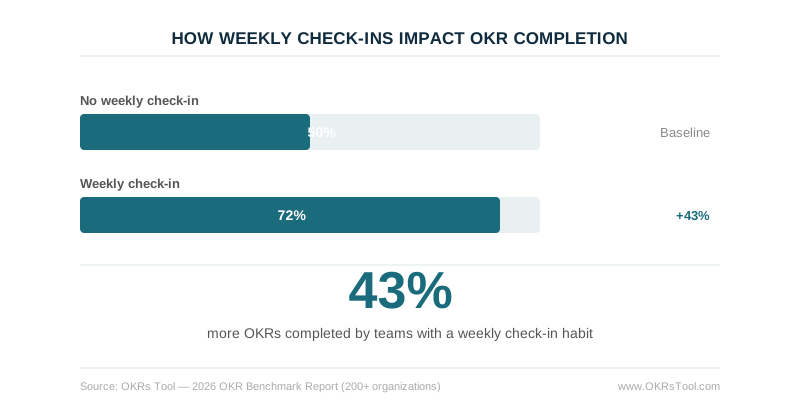
The mechanism is a weekly check-in that produces a signal rather than a report. When every key result gets updated weekly, a priority that stops moving becomes visible as an absence, automatically, without anyone assessing anything. Teams with the habit complete 43% more goals than those reviewing monthly or ad hoc — partly because problems surface while they're still small.
Push also requires named ownership. A signal needs a recipient: "this key result hasn't moved in three weeks" is only actionable if there's one person accountable for it, not a team. And it requires the strategy to be somewhere live rather than somewhere stored — which is the same reason the naming gap and the visibility gap tend to appear together. A strategy in a slide deck can't send you anything.
The infrastructure matters here more than the intent. 61% of leaders run strategy execution on spreadsheets, docs, or nothing central — and a spreadsheet has no way to notice that a cell hasn't changed and tell someone. That's not a discipline failure; it's an architecture one, and it's why strategy execution software exists as a category distinct from planning tools.
The Gap Worth Closing First
Of the four ways strategy decays — not named, not connected, not visible, not decided — visibility is the one with the highest leverage, because it's the one that determines how early you can act on the other three. A naming problem you can see is fixable. A cascade that's drifting and visible gets re-drawn. A failing priority that surfaces in week three gets a real decision instead of a quiet death in week eleven.
That's the case for closing this gap before the others: it doesn't just fix visibility, it shortens the response time on everything else. The strategy execution operating model covers all four disciplines and how they connect, the cascade framework covers the connection layer specifically, and the strategy execution template gives you the structure to run it. For the broader discipline this sits inside, see strategic management.
To turn visibility from something you go looking for into something that finds you, see how OKRs Tool surfaces at-risk priorities automatically — free for up to 5 users.
Data: Strategy Execution Benchmark 2026 (180 strategy and operations leaders), The 2026 OKR Benchmark Report (200 organizations).