
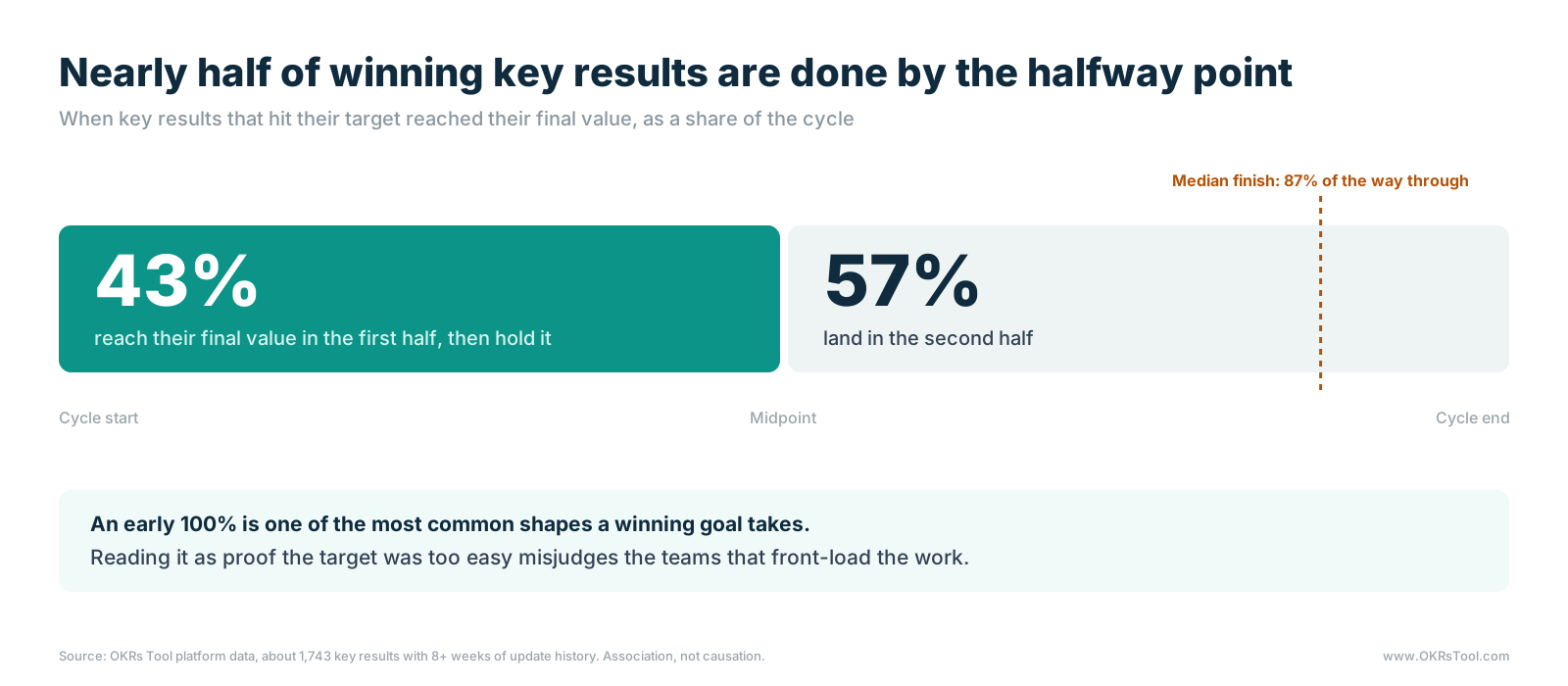
Of the key results that hit their target on OKRs Tool, 43% reached their final value in the first half of the cycle and held it. An early 100% is one of the most common shapes a winning goal takes, and the usual verdict, a target set too low, is often wrong. What a team does in the weeks after an early finish matters more than the verdict on the target.
Week six, mid-quarter review. One key result already shows 100%, and the first comment in the room is that the target must have been set too low. The owner, who front-loaded the work and cleared the hard parts in the first month, hears that the win doesn't really count and learns to pace the next goal more slowly.
That reaction comes from a well-known rule of thumb in OKRs: hit 100% and you aimed too low. Data from 29,987 key results on the OKRs Tool platform shows early finishes are normal among goals that land. Below is what the data shows, how to tell a front-loaded goal from a soft one, and the three moves available once a key result lands early.
Early Finishes Are Common Among Winning Key Results
We looked at when key results that hit their target reached their final value, measured as a share of the cycle.
43% of winning key results reached their final value before the midpoint and then held it for the rest of the quarter. The other 57% landed in the second half, and the median winner locked in its result 87% of the way through the cycle, so there are two common patterns: the goals that land early and stay there, and the goals that land close to the deadline.
The early pattern matches the OKR Pacing Benchmark, where key results that hit their target were typically at 50% by week four and 74% by week eight. Goals that land are front-loaded, so a key result that reaches its target in the first half of the quarter is following the winning curve a little faster than usual.
Where the "100% Means Too Easy" Rule Comes From
The rule has a sound origin. For stretch goals, the OKR Benchmark Report identifies 70–80% completion as the band that signals ambitious, well-owned goals, and a stretch goal that lands at 100% every quarter probably wasn't stretching anyone.
The trouble starts when the rule gets applied to every key result. A committed key result, the kind a team has promised to deliver, is supposed to reach 100%, and the distinction between committed and aspirational OKRs decides how an early finish should be read.
Penalizing early completion on a committed goal punishes the owners who did what the pacing data rewards, and it teaches the whole team that a slower, later finish looks safer in the scoring conversation.
How to Tell a Front-Loaded Goal From a Soft One
An early finish can mean a team front-loaded real work, or it can mean the target was set below what the team was already delivering. A few checks tell them apart.
A key result that passes most of these checks was front-loaded, and the owner deserves credit for it. One that fails most of them probably had a sandbagged target, which is worth fixing in the next planning cycle without discounting the work already done this quarter.
Three Moves After an Early Finish
Whatever the verdict on the target, the more useful question is what happens over the remaining weeks of the quarter. Three questions settle it.
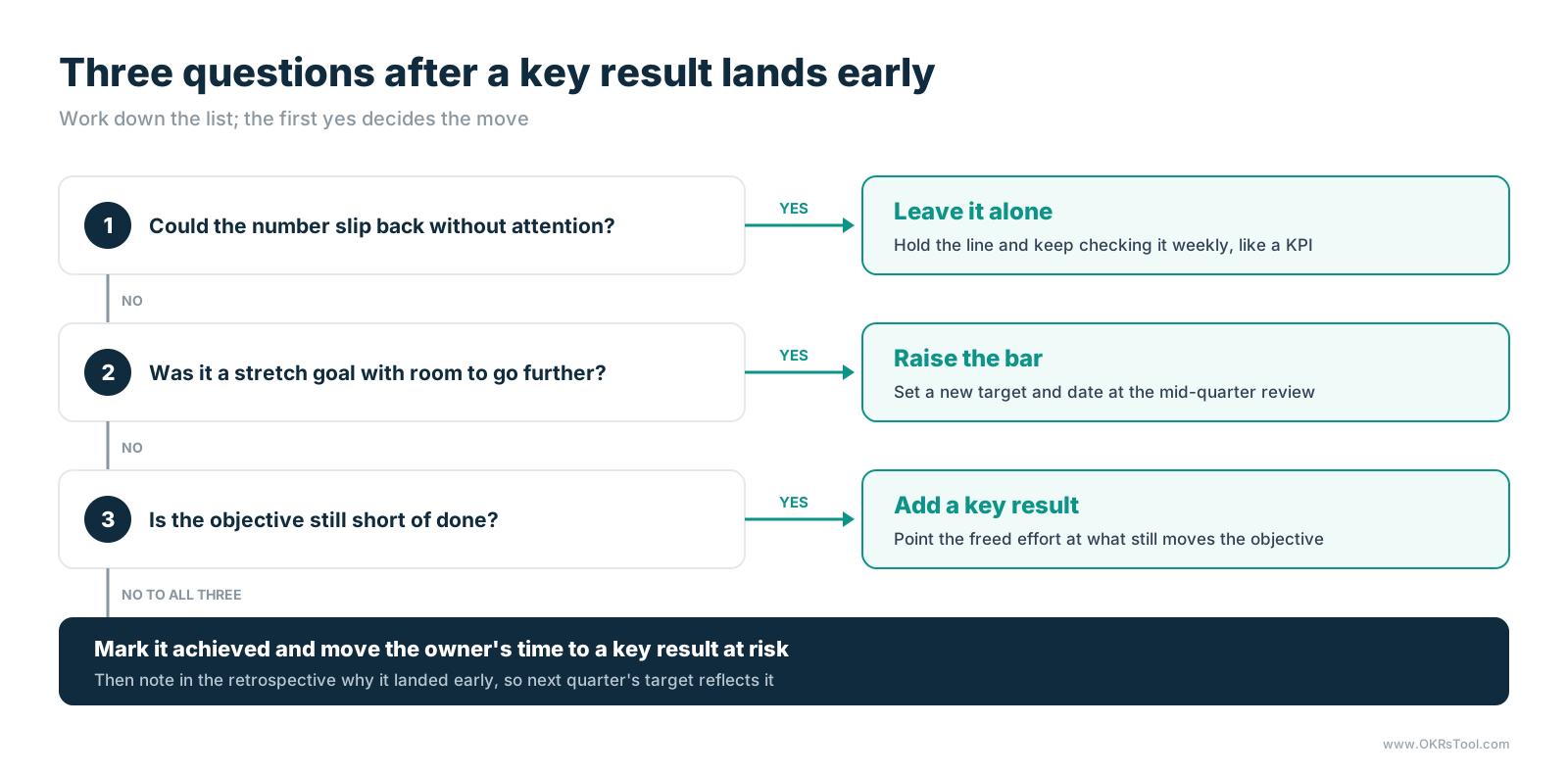
Leave it alone when the number could slip back without attention. A customer satisfaction score or a retention rate that reached its target in week five still has to stay there until week twelve, so the owner keeps checking it in the weekly check-in the way a team watches a KPI. Holding a number is work too, and it should count as success.
Raise the bar when the key result was a stretch goal and the team has room to go further. Set the new target formally at the mid-quarter review, record the original target alongside it, and give the new number an explicit date. In the platform data, key results with a stated timeframe hit their target 67% of the time, against 51% without one, so a raised target without a deadline loses much of its force.
Add a key result when the early finish hasn't completed the objective. If one key result landed but the objective it serves is still short, a new key result can point the freed effort at what still moves it. A documented change through updating OKRs keeps the scoreboard accurate about what was added mid-quarter.
When the answer to all three questions is no, mark the key result achieved and move the owner's time to a key result that's at risk. That last move matters for the whole program, because in the same platform data, top-quartile organizations left a median of 8% of their key results at zero all cycle while bottom-quartile organizations left 56%. Effort freed by an early finish is the cheapest way to rescue a goal that hasn't started moving and lift the team's completion rate.
What an Early Finish Should Change Next Quarter
The end-of-cycle reflection is where an early finish turns into better targets. Record which key results landed early, which checks from the table they passed, and whether the target or the approach explains the speed. A soft target gets a stretch next quarter; a front-loaded one gets repeated, because the team found a way of working that lands goals early.
For the person accountable for OKRs, the bigger risk is cultural. If early finishers get told their targets were too easy, owners learn to spread progress across the quarter so it looks earned, and the early-warning value of the OKR dashboard disappears with it. Protecting the owners who front-load keeps the behavior the data rewards visible.
Treat an Early Finish as a Decision Point
A key result at 100% by week six raises a question, and the question is what the owner does next. The data says early finishes are common among the goals that land, so the default response should be curiosity about how it happened and a quick decision about the weeks that remain: hold the number, raise the bar, add a key result, or move the effort to something at risk.
A platform that tracks progress weekly makes that decision easy to spot, because the key results that landed early and the ones still at zero show up side by side, with enough quarter left to act on both.
Data: OKRs Tool platform data, the OKR Pacing Benchmark and The OKR Benchmark Report.