
In 86% of companies, most employees can't state the top strategic priorities unprompted. It isn't a memory problem or a communication problem — it's a storage problem. A strategy that lives in a slide deck seen once a quarter is structurally impossible to recall, and a strategy nobody can recall can only be reported on, never pursued.
Ask a leadership team whether their people know the strategy and you'll hear yes. Ask those people to name the top three priorities, unprompted, and the number collapses. The Strategy Execution Benchmark 2026 put this to 180 strategy and operations leaders directly: what share of your employees could state the company's top three priorities right now, without prompting?
Only 14% said more than three-quarters could. In the other 86% of companies, most of the workforce cannot name the strategy they're supposedly executing. This is the first and most fundamental break in strategy execution — because everything downstream depends on it. Work can't ladder up to a plan people can't state, and only 7% of leaders say most daily work ladders up to strategy at all.
What "Can't Name the Strategy" Actually Looks Like
The 86% figure is a threshold: the share of companies where fewer than three-quarters of employees can name the top priorities. The full distribution is worse than the headline suggests.
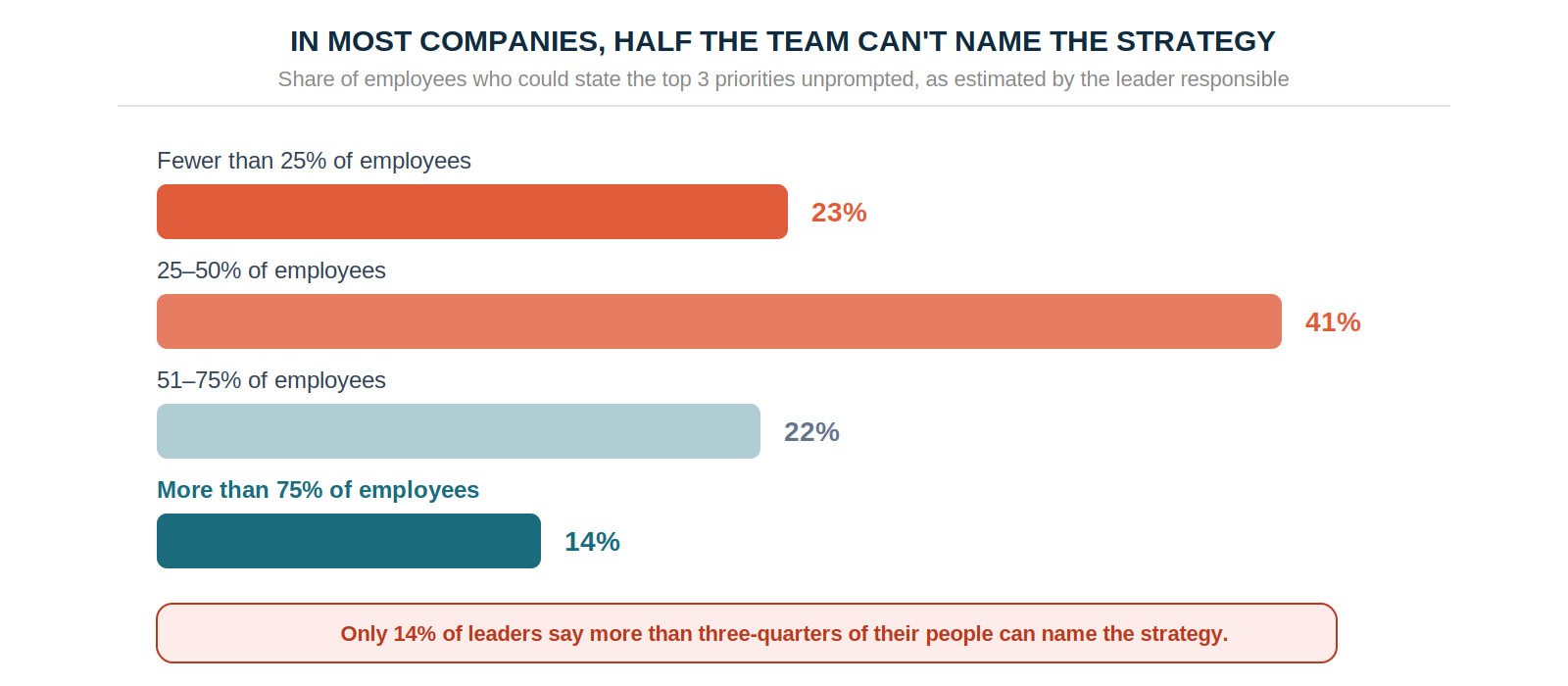
Nearly two-thirds of leaders — 64% — say half or fewer of their people can name the strategy. Almost a quarter say fewer than 25% can. These aren't estimates from disengaged managers; they come from the leaders directly responsible for execution, describing their own organizations. If anything, the numbers are generous, because a leader's estimate of recall tends to run ahead of the reality on the floor.
A strategy at this level of recall isn't guiding decisions. It's a document that gets referenced at the quarterly review and forgotten in between — which means the work happening day to day is being steered by something other than the plan.
It's a Storage Problem, Not a Memory Problem
The instinct is to treat low recall as a communication failure — leaders didn't repeat the strategy enough, didn't cascade it clearly, didn't get buy-in. That framing leads to more all-hands meetings and more strategy emails, and it doesn't work, because the real cause is structural: the strategy has no durable home people can return to.
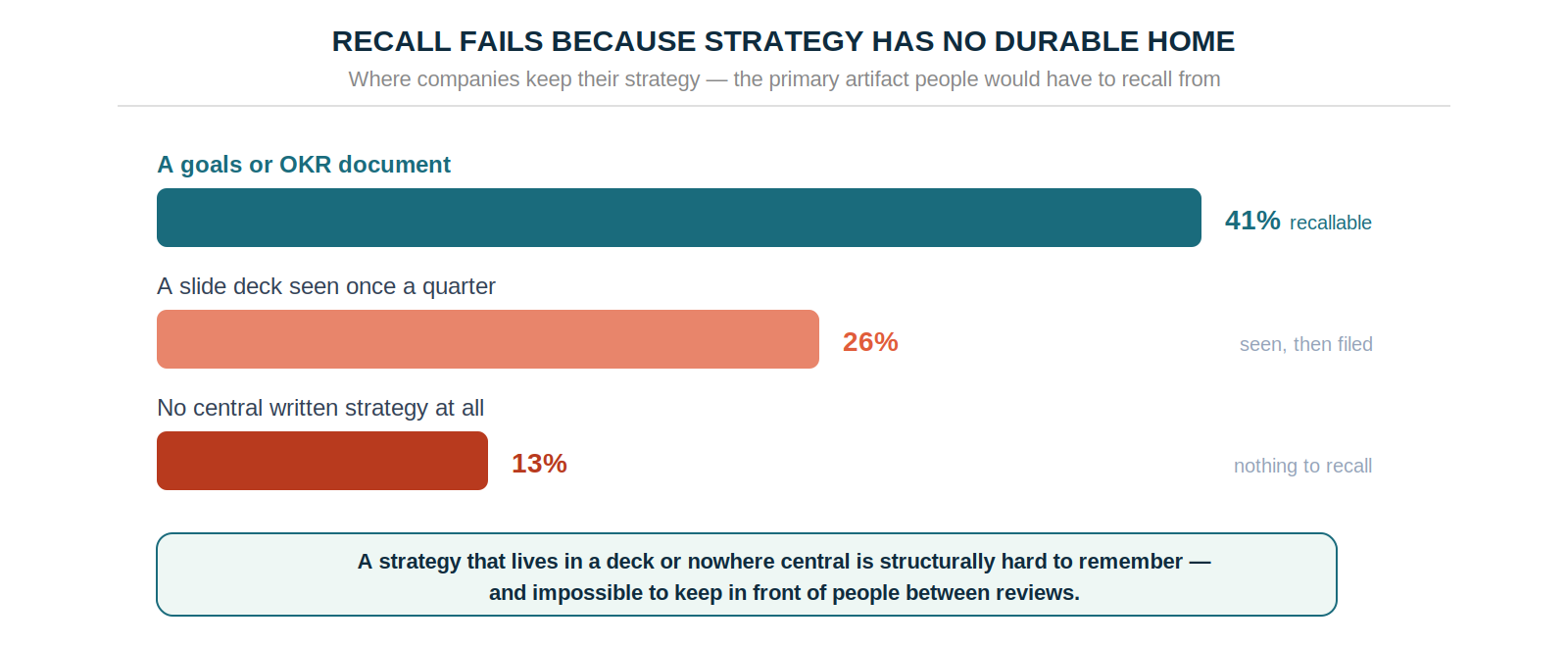
Only 41% of companies keep their strategy in a goals or OKR document — something structured, can be referenced, and tied to the actual work. 26% rely on a slide deck as the primary artifact, and 13% have no central written strategy at all: it lives in the founder's head or the exec team's, and nowhere everyone can reach.
The deck is the crux of the problem. A strategy presented once at a kickoff and then filed in a drive is seen, not held. Nobody re-opens a slide deck on a Tuesday to check whether their work matches the plan. The information exists, but not in a form anyone can recall or act on — and that's the difference between a strategy that's documented and one that's live.
Why It Matters: You Can't Execute What You Can't Recall
A strategy that can't be named can only be performed at review time. When priorities live somewhere people can't easily reach, they stop functioning as a guide for daily decisions and become a reporting obligation instead — something you assemble evidence for at the end of the quarter rather than something that shapes what you do during it.
The downstream cost is the laddering gap. If people can't state the top priorities, they can't connect their own work to them, which is exactly what the benchmark finds: only 7% of leaders say most daily work ladders up to strategy. The naming gap and the alignment gap are the same gap viewed from two angles — you cannot align work to a target nobody can name.
This is why the naming problem is the one to fix first. Every other execution discipline — cascading priorities to teams, tracking progress, deciding what to cut — assumes people know what the priorities are. Fix recall and the rest becomes possible. Skip it, and every downstream effort is building on a foundation most of the organization can't see.
How to Make Strategy Nameable
The fix isn't more communication. It's giving strategy a structural home and keeping it in front of people through the work, not just at the review.
Put the top three to five priorities in one place every team can reach — a single durable home, not a deck, not the exec team's shared understanding. This is the difference the 41% who use a goals or OKR software already have over the 26% relying on a deck: the strategy is somewhere you can open, reference, and check your work against on any given day.
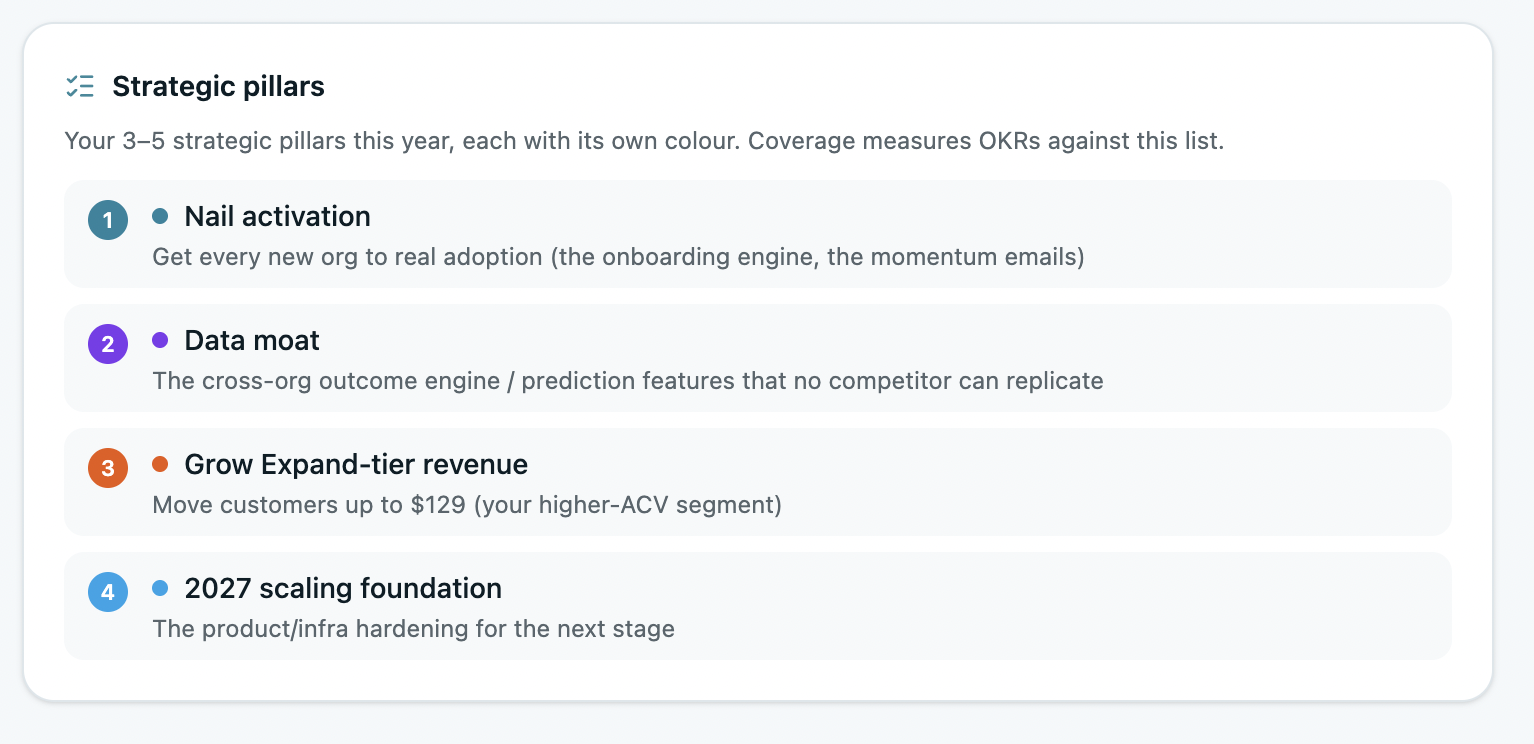
Then connect the work to it visibly, so the priorities aren't just stored but used. When every team goal links back to a company priority, people encounter the strategy in the course of doing their jobs — not as a thing to memorize, but as the frame their own goals hang on. A weekly check-in keeps it present between reviews, so the strategy stays in working memory instead of fading the week after the offsite.
None of this requires people to try harder to remember. It requires the strategy to live somewhere they naturally return to — which turns recall from an act of memory into a property of the system.
The First Gap to Close
The 86% naming gap is the opening crack in a four-part decay: strategy that isn't named can't be connected, and what isn't connected can't be made visible or decided. It's the cheapest of the four to fix and the one that unlocks the rest — a strategy people can name is the precondition for everything else in strategy execution.
For the full picture of how strategy decays after the offsite — and the scorecard to see where your own organization stands — the complete benchmark breaks down all four gaps. And to give strategy the durable, always-visible home the naming gap demands, see how OKRs Tool keeps priorities named, connected, and in front of every team — free for up to 5 users.
Data: Strategy Execution Benchmark 2026 — 180 strategy and operations leaders at companies of 50–200 employees, all confirmed accountable for strategy execution. Independent research, no OKRs Tool customers included. Findings are self-reported and describe association, not causation.