The cost of misaligned teams stays invisible until a company crosses roughly 50 people, then shows up everywhere at once — duplicated work, decisions that stall waiting for validation, and revenue that leaks between functions chasing different numbers. None of it lands on a balance sheet, but it's real: a 60-person company can lose six figures a year in payroll capacity to nothing more than unclear priorities.
When a company is small, misalignment barely registers. At 10 people you overhear everything; at 20, leadership still sees into most of the work. Past that, keeping everyone aligned on strategy takes deliberate effort. Somewhere between 50 and 80 employees that changes, and the cost of misaligned teams stops being a nuisance and becomes measurable — teams multiply, priorities diverge, and meetings pile up. What breaks down is direction, and it happens even when everyone is working hard.
This guide breaks down the real cost of misaligned teams for growing, execution-heavy companies — in time, revenue, decision speed, and leadership bandwidth — and then walks through what changes when goals are made explicit. Where the numbers come from external research they're marked as estimates; where they come from our own benchmark data, the report and sample size are named.
The Cost of Misaligned Teams Starts With a Productivity Tax
The first cost is time. McKinsey estimates that employees spend 20–30% of the workweek in meetings, with much of it spent clarifying priorities instead of advancing them, and McKinsey has estimated that poor collaboration can waste a comparable share of productivity in complex environments. Those are outside figures, but they point at something any scaling company feels directly.
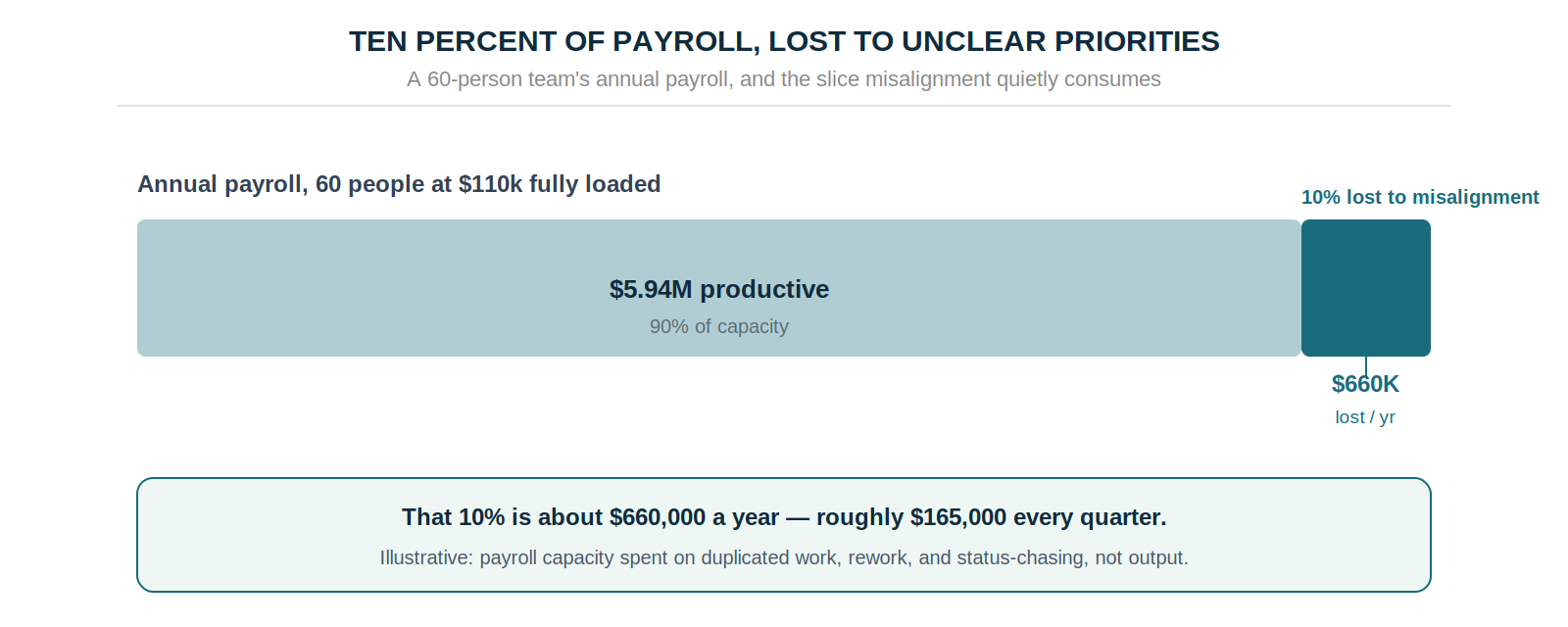
The math makes it concrete. Take a 60-person company at a fully-loaded cost of $110,000 per employee — that's roughly $6.6 million a year in payroll. If even 10% of that time is lost to priority misalignment, the company is spending around $660,000 a year, or $165,000 a quarter, on capacity that produces nothing. That lost capacity shows up as duplicate initiatives, conflicting workstreams, rework from late direction changes, and endless status clarification. It never appears on a balance sheet, and it's very real all the same.
Slower Decision Velocity
As teams grow, decisions slow down unless direction is explicit. Under 30 employees, decisions happen organically. Past 50, cross-functional work becomes the norm — product depends on marketing, sales depends on product, operations depends on everyone — and without clear alignment, every decision needs more stakeholder validation, more documentation, and more cross-department coordination, and more escalation to leadership.
The result is measurable delay. If a product release slips three to four weeks because priorities weren't aligned across teams, the opportunity cost is steep: for a SaaS company at $5–10M ARR, a one-month delay on revenue-driving work can defer hundreds of thousands in revenue.
And the slowdown reaches past execution into learning itself, which for a growing company is a competitive advantage in its own right. Multiple external studies have found that companies with strong cross-functional alignment outperform peers on revenue growth and profitability.
Strategic Drift Between Planning Cycles
Misalignment rarely shows up during planning. It shows up mid-cycle, and it follows a predictable pattern.
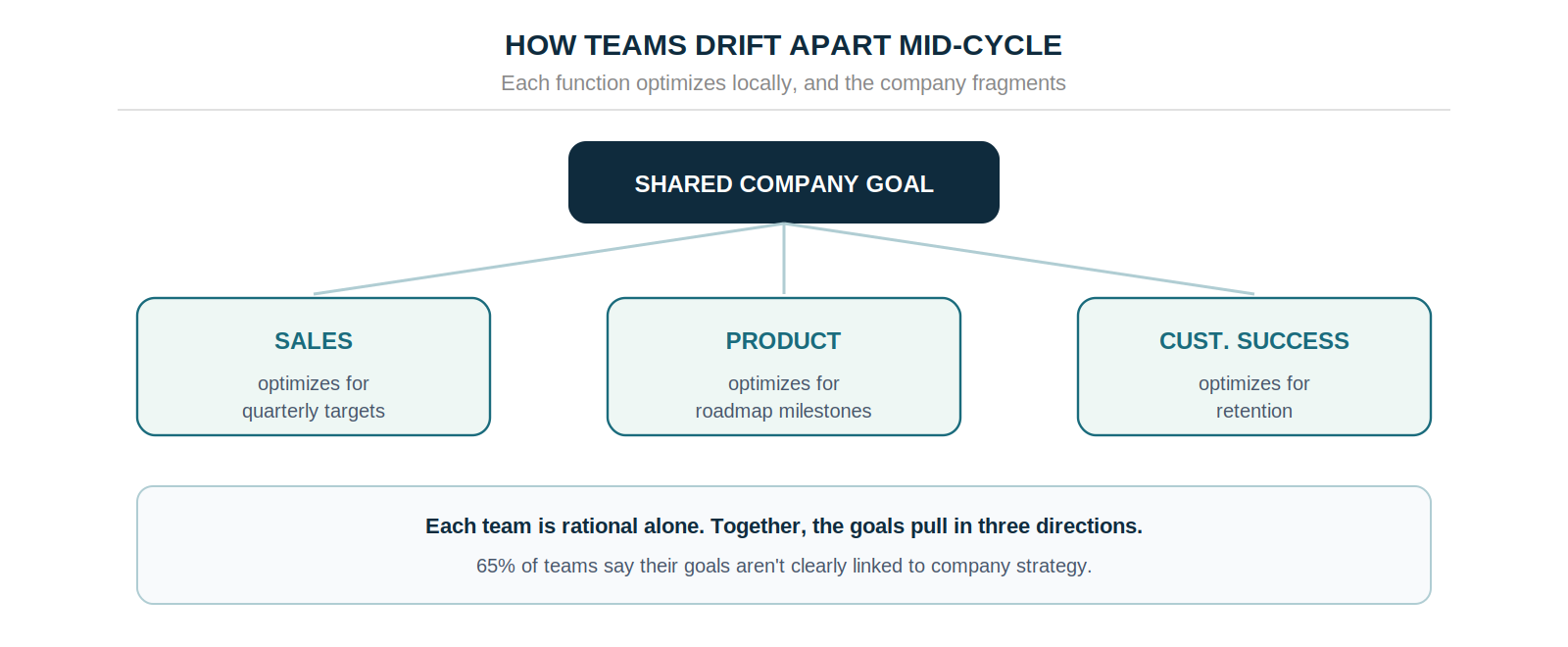
Q1 planning feels aligned. Teams leave with clear objectives. By week five or six, new initiatives surface and local optimizations start overriding company priorities. Product optimizes for delivery speed, sales for quarterly targets, operations for stability — each team rational in isolation, the organization fragmenting collectively.
That fragmentation produces measurable effects: lower OKR completion rates, more outcome-based objectives abandoned mid-cycle, and wider variance between teams. It's backed by our own data — in the 2026 OKR Benchmark Report, 65% of teams admitted their goals aren't clearly linked to company strategy. The gap between stated priorities and lived ones is where drift compounds, silently, until it's too late in the quarter to recover.
Revenue Leakage Through Cross-Functional Friction
For growing companies the most expensive misalignment is structural — built into how teams are incentivized. Picture three teams: sales prioritizes short-term revenue, product prioritizes roadmap milestones, customer success prioritizes retention. Each hits its own numbers. But if those numbers aren't aligned around a shared objective, the system leaks.
The result is features built that don't serve the highest-revenue customers, deals closed that strain onboarding capacity, and retention risk quietly absorbed by support. Even a one-to-two-point rise in churn caused by misaligned team metrics can mean six or seven figures in lost annual revenue for a $10M ARR company. Alignment here means synchronized execution against a shared outcome, which is a harder thing to achieve than simple agreement.
Leadership Bandwidth Drain
The most overlooked cost is executive attention. In aligned organizations, leaders spend their time on strategy and leverage. In misaligned ones, they spend it resolving conflicts between teams, clarifying the same priorities repeatedly, re-explaining quarterly intent, and mediating resource disputes — reactive work that crowds out the proactive kind.
The leverage math is unforgiving. If a CEO or VP spends 30–40% of their time re-aligning teams instead of driving strategy, the company's effective execution capacity shrinks at exactly the level where leverage is highest.
External research on alignment and turnover adds a further cost: when employees perceive a gap between their work and company direction, voluntary turnover can rise sharply, which brings its own hiring, onboarding, and productivity drag. Alignment, in other words, is a leadership multiplier as much as an operational one.
How OKRs Close the Misalignment Gap
Misalignment persists when direction is implicit. When priorities live in decks and meetings, teams interpret them differently, and that interpretation gap widens over time. Making goals explicit and measurable is what closes it.
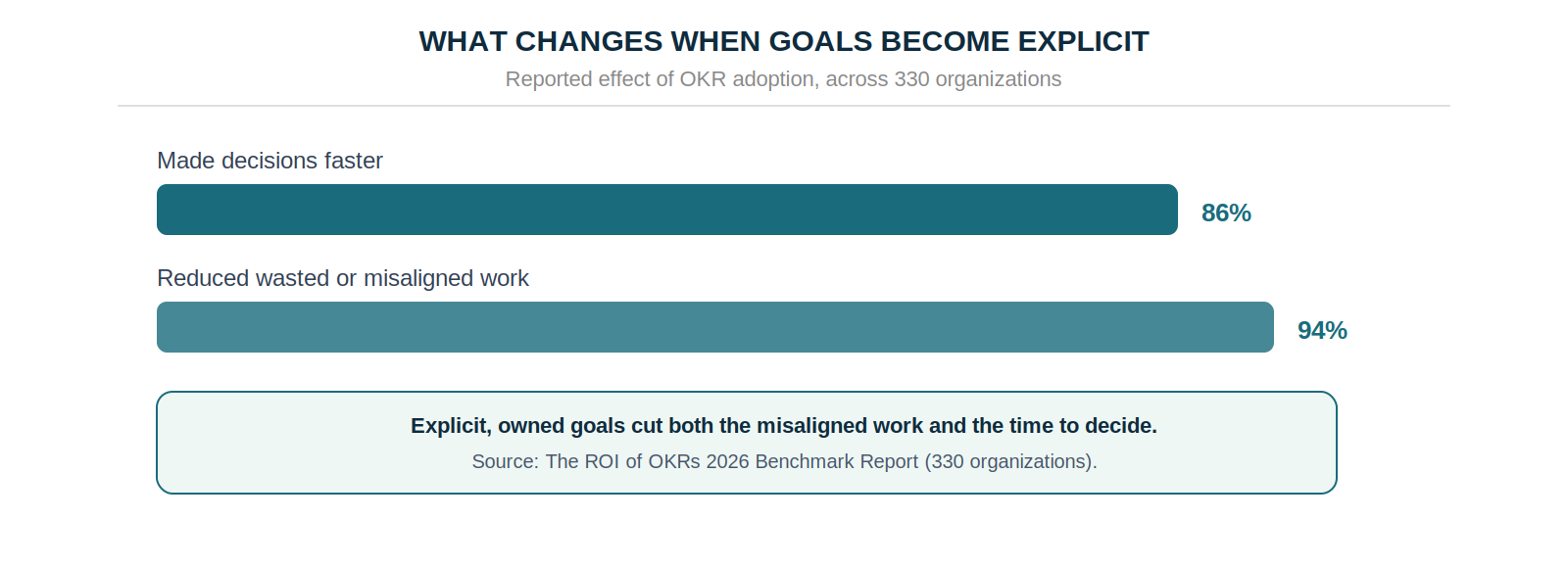
The benchmark data shows what shifts. In the ROI of OKRs 2026 report, 86% of organizations said implementing OKRs made their decisions faster, and 94% said it reduced wasted or misaligned work — with none reporting it made things worse.
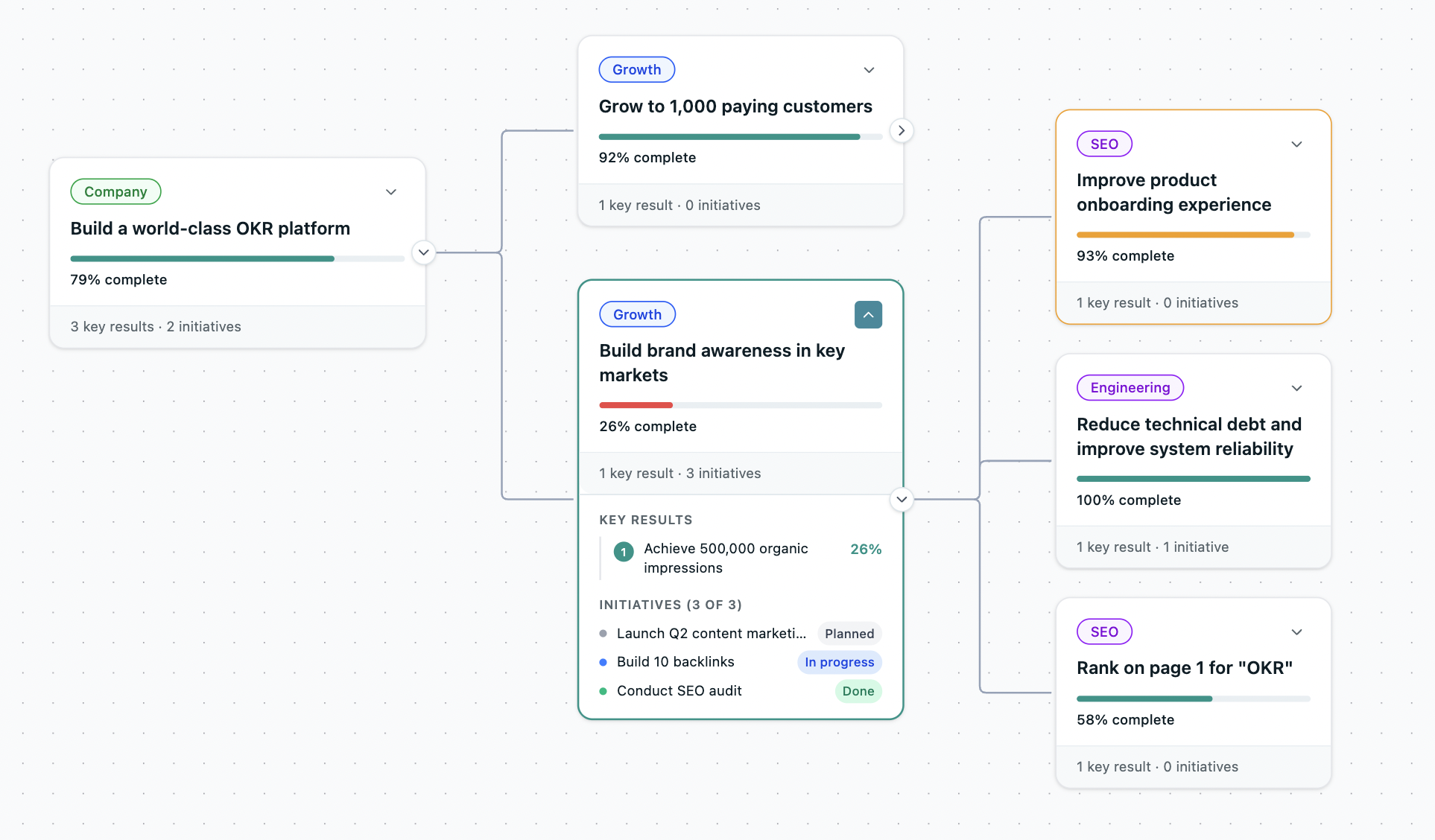
The mechanism is plain: clear key-result ownership reduces ambiguity, shared visibility reduces duplication, and a regular weekly check-in reduces drift. Instead of discovering fragmentation at quarter-end, teams see it mid-cycle, while correction still matters. Alignment stops being rhetorical and becomes operational.
Where Misalignment Shows Up, and How OKRs Address It
The patterns below are where misalignment typically emerges in growing teams, with the cost of each and the mechanism that reduces it.
The point of OKRs is to make direction unavoidable without adding heavy process. When goals connect across company, team, and individual levels and get reviewed on a consistent review cadence, fragmentation becomes visible before it becomes expensive.
Design Alignment Into the System
Misalignment is a systems gap that comes from how a growing company is wired. As companies grow, informal coordination breaks down, priorities multiply, and execution complexity rises — and without shared visibility, even strong teams start optimizing locally instead of collectively. The cost of misaligned teams is measurable, in productivity, revenue, and leadership bandwidth.
OKRs close that gap when they're run with ownership, visibility, and rhythm: they connect planning to execution and execution to reflection, shorten feedback loops, and keep drift from hardening into strategy.
Misalignment doesn't vanish overnight, but when direction is explicit and progress is transparent, teams find it much harder to pull apart. The companies that scale cleanly are the ones that build alignment into the system deliberately, complexity and all.
Data: The ROI of OKRs 2026 Benchmark Report (330 organizations), The 2026 OKR Benchmark Report (200 organizations). External estimates (meeting time, McKinsey collaboration figures, alignment-turnover research) are third-party and cited as approximate.