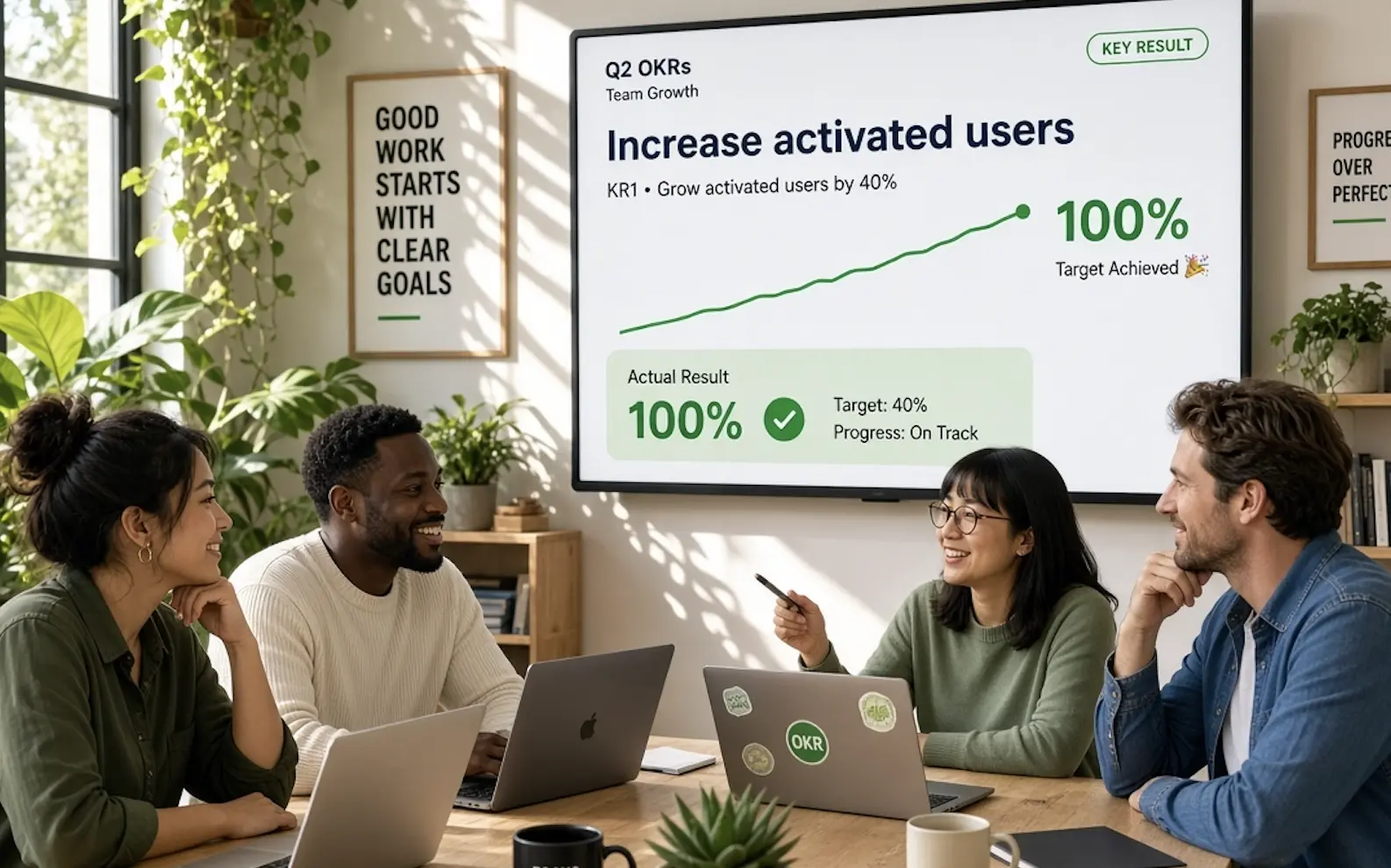
Teams that run structured end-of-cycle reviews complete 30–45% more OKRs the following quarter. The template isn't the hard part. The hard part is asking the right questions — and committing to changes before the session closes.
Most quarterly business reviews follow the same structure: leadership presents results, the team discusses what went well and what didn't, and everyone leaves with good intentions for next quarter. Three months later, the same problems appear.
The issue isn't effort. It's that most QBRs are retrospective without being generative. They document what happened without producing the specific structural changes that would make next quarter different.
The 2026 OKR Benchmark Report across 330 organizations found that teams running structured end-of-cycle retrospectives complete 30–45% more OKRs the following cycle. The difference isn't the review itself — it's whether the session ends with three to four committed structural changes rather than a summary of what was learned.
What Is a Quarterly Business Review?
A quarterly business review is a structured end-of-cycle session where leadership and teams assess what was achieved, understand why outcomes were or weren't reached, and commit to specific changes for the next cycle.
In organizations running OKRs, the QBR and the OKR retrospective are the same session. Key Result scores are the primary data source. The review doesn't start with a narrative — it starts with numbers.
The distinction that matters: a QBR is not a performance review. It's a systems review. The question isn't whether people performed well. It's whether the OKR structure — the goals, the ownership assignments, the cascade, the check-in rhythm — was set up to succeed. Most of what goes wrong in a quarter is structural, not motivational. The QBR is where that distinction gets made explicitly.
The Free QBR Template: 60-Minute Agenda
Run this session in the final week of the quarter — before next quarter's planning begins. 60 minutes is sufficient for most teams at 50–200 people.
0–10 min: Score the Key Results
Every Key Result scored 0.0–1.0 before any discussion. Scoring happens individually and silently — each owner scores their own KR, then scores are shared simultaneously. This eliminates anchoring bias and surfaces genuine disagreement where it exists.
The target range for well-written Key Results is 0.6–0.8. Consistent 1.0 scores mean targets weren't ambitious enough. Consistent 0.0 scores mean structural problems — poor ownership, unclear baselines, or goals that were never actively tracked. The OKR scoring guide covers what each score range means in practice.
10–25 min: What worked — and why
Start with wins before moving to misses. The question isn't "what went well" in a general sense — it's "what structural condition produced this result?" A Key Result that scored 0.9 is worth understanding as carefully as one that scored 0.2. The habits and decisions that drove strong results are the ones to replicate.
25–45 min: What didn't work — and why
Focus on structural causes, not individual performance. Were ownership assignments clear? Did the weekly check-in rhythm hold for the full 12 weeks? Were any goals quietly abandoned without a formal decision? The OKR Intelligence Report 2026 found 7% of off-track Key Results are simply abandoned mid-cycle — informally dropped with no revision or escalation. The QBR is where that pattern gets named.
45–55 min: Committed changes for next cycle
This is the session's most important ten minutes. Every QBR should end with three to four specific structural changes committed for next cycle — not intentions, not themes, but decisions. "Cap each team to 2 Objectives next cycle." "Require a named owner before any KR goes live." "Run the mid-cycle review at Week 6 — calendar invite goes out today."
If the session ends without committed changes documented before everyone leaves the room, the review generated insight but not improvement.
55–60 min: Next cycle preview
A brief preview of the company priorities heading into next quarter. Not a full planning session — just enough context that teams can start thinking about their cascade contribution before the planning session begins.
The QBR Scoring Table
Use this table to structure the scoring segment. Complete it before the discussion begins.
The "Primary cause" column is the most important. One sentence per Key Result — what was the single most significant factor in the outcome, positive or negative? This is the data that feeds into the committed changes section and makes the next cycle structurally different.
What Good QBR Output Looks Like
A QBR that produced real improvement looks like this at the end of the session: every Key Result scored, wins documented with causes, misses documented with structural explanations, and three to four specific changes committed with names and dates attached.
A QBR that generated insight but no improvement looks like this: good discussion, strong observations, a general sense that next quarter will be better, and no documented changes before the session closed.
The OKR maturity curve is the clearest signal of whether QBRs are working. First-cycle teams average 51% completion. Teams in cycle five average 79%. The organizations that make that jump run QBRs that produce committed structural changes — not ones that produce polished slide decks.

QBR Questions That Drive Structural Change
The difference between a QBR that improves next cycle and one that doesn't is the specificity of the questions. Generic questions produce generic answers. Structural questions produce structural decisions.
On goals: Were the Key Results outcome-based — or were they tasks in disguise? Did the cascade connect every team's work to a company priority before the cycle started? Were targets calibrated at the right level of ambition — not too easy, not unreachable?
On ownership: Did every Key Result have a single named owner before the cycle went live? Were there any Key Results that drifted because ownership was shared or assumed? How often did named owners update progress without being prompted?
On rhythm: Did the weekly check-in run for all 12 weeks — or did it lapse after the first month? Was the mid-cycle review at Week 6 run on time? Were stalled Key Results addressed before Week 10?
On the next cycle: What is the single most important structural change to make before next quarter's OKRs go live? Which Key Results from this cycle should be continued, revised, or retired? What is the one thing this team will do differently in the first two weeks of next cycle?
Running the QBR in OKRs Tool
OKRs Tool builds the QBR into the OKR cycle structurally. At cycle end, the platform surfaces OKR scores, check-in completion rates, at-risk history, and AI-generated cycle themes — so the data for the QBR is ready before the session starts, not compiled during it.
The 60-minute agenda above maps directly to the platform's end-of-cycle flow. Scores are populated. Check-in history is visible. The committed changes from the session feed directly into the next cycle's planning. The review becomes a 60-minute session rather than a two-hour data compilation exercise.
Teams that run the full QBR cycle — planning, weekly check-ins, mid-cycle review, end-of-cycle retrospective — generate the 1:88 return on investment the ROI data associates with purpose-built OKR software. The QBR is the mechanism that closes the loop.
Data: The ROI of OKRs: 2026 Benchmark Report (330 respondents), The 2026 OKR Benchmark Report (200+ organizations), OKR Intelligence Report 2026 (222 organizations).