
Teams running four or five core goal habits hit their goals very consistently 82% of the time, against 4% for teams running none. As companies finalise their 2027 targets, our research points to six decisions made in December and January that decide whether those targets land, from how many goals there are to how fast leaders hear when one slips.
By mid-December, the 2027 plan at a company of 150 people usually exists as a spreadsheet tab and a slide: revenue up 40%, a second market opened, a product launch in the spring and churn down to 5%. The leadership team has argued about the numbers for weeks, and the plan goes to the whole company in the first week of January.
Our research across close to 900 companies, alongside data from our own platform, keeps finding the same thing about plans like this one. The gap between teams that hit their goals and teams that miss sits mostly in what happens after the targets are set: how many goals there are, who owns each one, how often anyone looks at them and how quickly the plan changes when the year does.
1. Choose Fewer Goals Than Feels Comfortable
A plan only works if the people carrying it out can remember it. In the Strategy Execution Benchmark, 86% of strategy and operations leaders said their workforce can't name the company's top priorities, and in The State of Goal Management, only 30% of employees could name all of their company's top goals.
Three to five company priorities for the year is a number people can repeat, and each one becomes a quarterly objective that teams can build their own goals under. Cutting the list is the hardest part of December planning, and ruthless prioritization gives the leadership team a test for each item: what would the company stop doing if this priority disappeared?
Written as quarterly company OKRs, each priority gets an objective and a few measurable key results that teams can build their own goals under.
2. Put One Name on Every Goal
Shared ownership feels collaborative in a planning meeting and turns into nobody's job by March. In the OKR Benchmark Report, our survey of 420 companies running OKRs, teams that gave every goal one named owner hit their goals very consistently 65% of the time, against 17% where only some goals had an owner.
The owner is the person who updates the number each week, raises a hand when it stalls and answers for it at the quarterly review, which is why naming them belongs in December alongside the target itself. A team that shares a goal can still assign each key result to one person.
3. Decide How You'll Track the Goals
Companies put most of their planning energy into writing good goals, and the data shows tracking matters at least as much. In The Goal-Setting Benchmark, our survey of 280 operations and strategy leaders, we compared teams by how well they set goals and how well they tracked them.

Teams with well-set goals hit them very consistently 51% of the time when they tracked them well, against 29% when they tracked them poorly, and poorly set goals that were tracked well still reached 33%. Poor tracking also has a cost in time: 59% of leaders lose an hour or more each month chasing goal status.
Where the goals live makes a difference too. Among teams already reviewing weekly and tracking continuously, those using dedicated software hit their goals very consistently 74% of the time, against 33% for teams tracking in spreadsheets, because the spreadsheet depends on one person copying numbers across every week.
4. Hold the First Check-In in Week One
The first weeks of the year set the pace for the rest of it. Teams that hold a weekly check-in hit their goals very consistently 60% of the time, against 30% for teams checking in monthly, and the OKR Pacing Benchmark found that key results at 50% progress by week four hit their target 84% of the time, against 55% for those below.
Launching in the first week matters as much as the cadence after it. Teams that went live with their goals in under a week hit them very consistently 64% of the time, against 44% to 46% for every slower rollout, so a plan presented in January and put into the goal system in February has already given up its best start.
On the OKRs Tool platform, where owners have logged about 24,000 progress updates, key results touched once during a cycle hit their target 48% of the time, while those updated repeatedly climb past 70%.
5. Plan for the Plan to Change
Every 2027 plan will meet something it didn't expect. In The Goal-Setting Benchmark, "priorities shifted" was the most common reason goals were missed, named by 46% of leaders, and a weekly review on its own did little to protect against it.
What helps is changing the goal when the facts change. In the OKR Benchmark Report, teams that adjust goals often hit them very consistently 72% of the time, against 30% for teams that hardly ever adjust, as long as each change has an owner, a reason and a record.
Agreeing in December how a goal gets changed mid-year, and who approves it, turns the first surprise of 2027 into a quick, recorded decision, and a clear process for adjusting OKRs when priorities change gives each of those decisions a set of steps.
6. Make Drift Visible to Leaders Within a Week
A goal can slip for weeks before anyone at the top hears about it. In the Strategy Execution Benchmark, 83% of leaders said they get no automatic signal when a priority starts to drift, and 21% said a priority can run off track for more than a month before leadership finds out.
Leadership teams that review goals every week see their teams hit goals very consistently 65% of the time, against 33% for those reviewing quarterly, yet only 26% of companies hold that weekly review. It takes about ten minutes when owners update their numbers beforehand and the meeting covers only what's at risk, which is the approach behind leadership visibility without status meetings.
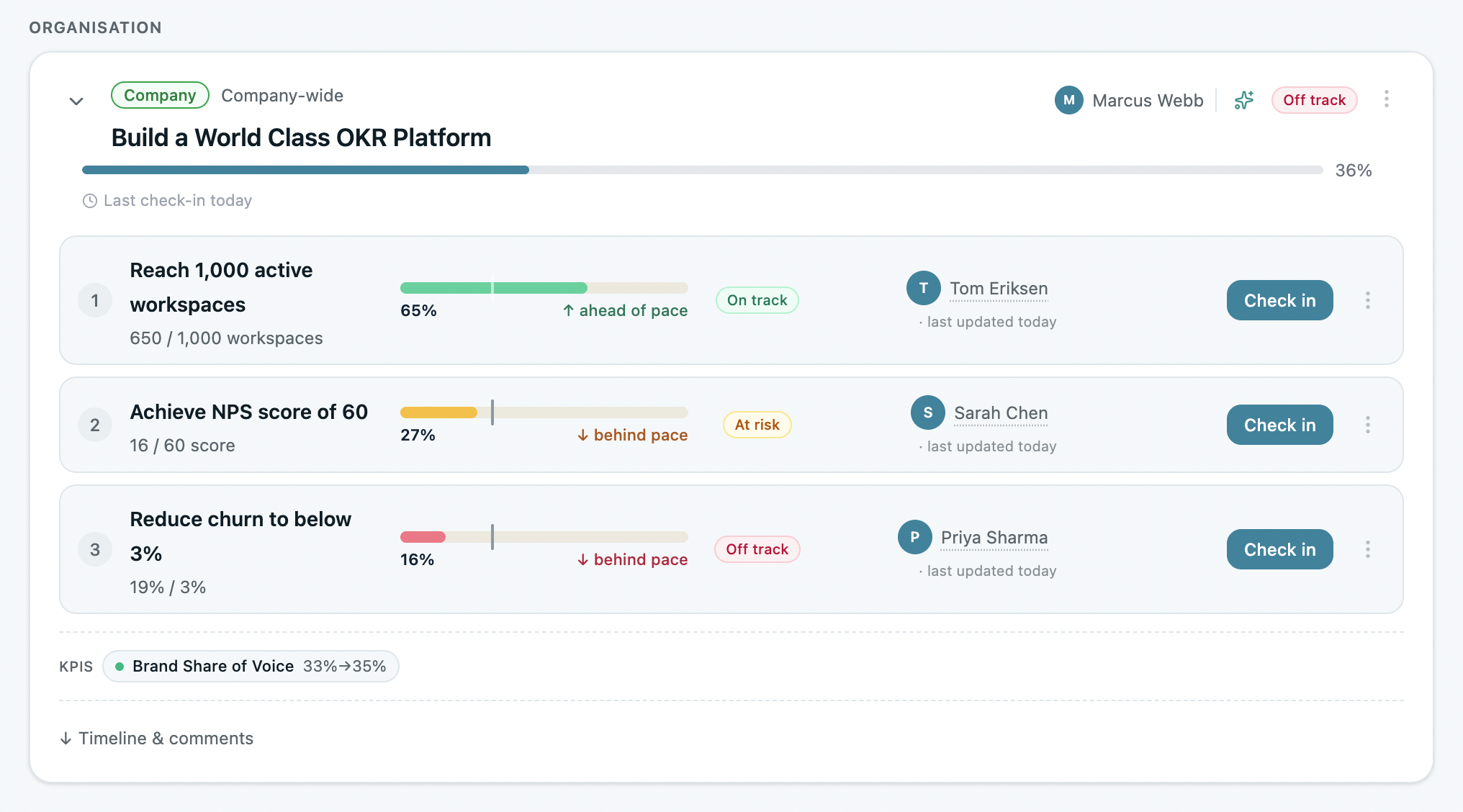
A live OKR dashboard that shows every goal's status and owner gives that review its agenda without anyone preparing a report. More than 300 teams across 26 countries run their goals on OKRs Tool, which holds a 4.6 rating on both G2 and Gartner Peer Insights.
The Six Decisions at a Glance
Each decision has a natural deadline in the planning calendar, and most of them fall before the year starts. The table brings them together with the finding behind each one.
All six can be in place before the end of January, whatever the size of the 2027 targets, and together they cover the habits behind the 82% figure at the top of this article.
Your 2027 Goal Calendar
The six decisions fit a calendar that runs from December planning to the retro that feeds the 2028 plan. The targets get set once, and the habits underneath them run every week.

The quarterly business review at the end of each quarter is where priorities get continued, changed or stopped, and the mid-year review in July checks the whole plan against results while there's still half a year left to act. The year closes with a retrospective that records what each goal achieved, which becomes the first input to the 2028 plan.
Ambitious Targets Need Ordinary Habits
The 2027 plan will get most of the attention in December, and the targets in it matter. Whether they land depends on six ordinary decisions: a short list of priorities, one owner per goal, a clear way to track them, a check-in from the first week, an agreed way to change the plan and a weekly look from leadership.
Teams that run four or five of those habits hit their goals very consistently 82% of the time, and every one of them can be in place by the end of January. A platform that holds the goals, owners and weekly updates in one place, at pricing that stays flat per organization, makes the habits the default from the first week of the year.
Data: The OKR Benchmark Report, The Goal-Setting Benchmark, The Strategy Execution Benchmark, The State of Goal Management, The OKR Pacing Benchmark and OKRs Tool platform data.