
Half of the OKR programs that end in our research end without anyone deciding to stop: 32% are dropped and another 18% are left in place but unused. A pause for a busy quarter, with no restart date and no owner, is one of the easiest ways to get there, while a smaller cycle through the busy stretch keeps the weekly habit alive.
The conversation usually happens in the second week of a hard quarter. A product launch has slipped, two senior hires are late, and the leadership meeting has turned into an hour of firefighting, so someone suggests parking OKRs until things calm down. Everyone agrees with visible relief, and the plan is to pick them back up next quarter.
Nobody sets a date, names an owner or decides what happens to the goals already in the system, and the next quarter turns out to be busy too. In our survey of 420 companies running OKRs, half of the programs that ended did so with no decision at all, which is where a pause with no restart date tends to lead.
Why the Pause Feels Like the Responsible Choice
A busy quarter puts real pressure on the weekly routines around OKRs. The check-in feels like one more meeting, the key results set three weeks ago already look out of date, and the people who own them are the same people dealing with the launch, the reorganisation or the hiring push. Pausing looks like a way to protect the team's time and come back to goal-setting with a clearer head.
A pause also removes the one thing a busy quarter needs most, which is a short, regular look at whether the work is moving the numbers that matter. Teams under pressure make more trade-offs than usual, and without a weekly check-in those trade-offs happen in hallway conversations that nobody records.
How OKR Programs End
The Death of OKRs, our study of 420 companies, asked leaders whose programs had stopped on at least one team how the program ended. The answers split almost evenly between endings someone decided on and endings that simply happened.
Half of all endings, the 32% dropped and the 18% left unused, happened with no decision at all. A pause with no restart date belongs in those two rows from the day it starts, because nothing about it requires anyone to decide whether OKRs come back, and that missing decision sits behind many of the reasons OKRs die.
Why Paused Programs Stay Paused
The pause usually has a reason, and that reason often outlasts the quarter. In The Goal-Setting Benchmark, "priorities shifted" was the single most common reason goals were missed, named by 46% of leaders, so the quarter after a busy one tends to bring its own shifts, launches and hires.
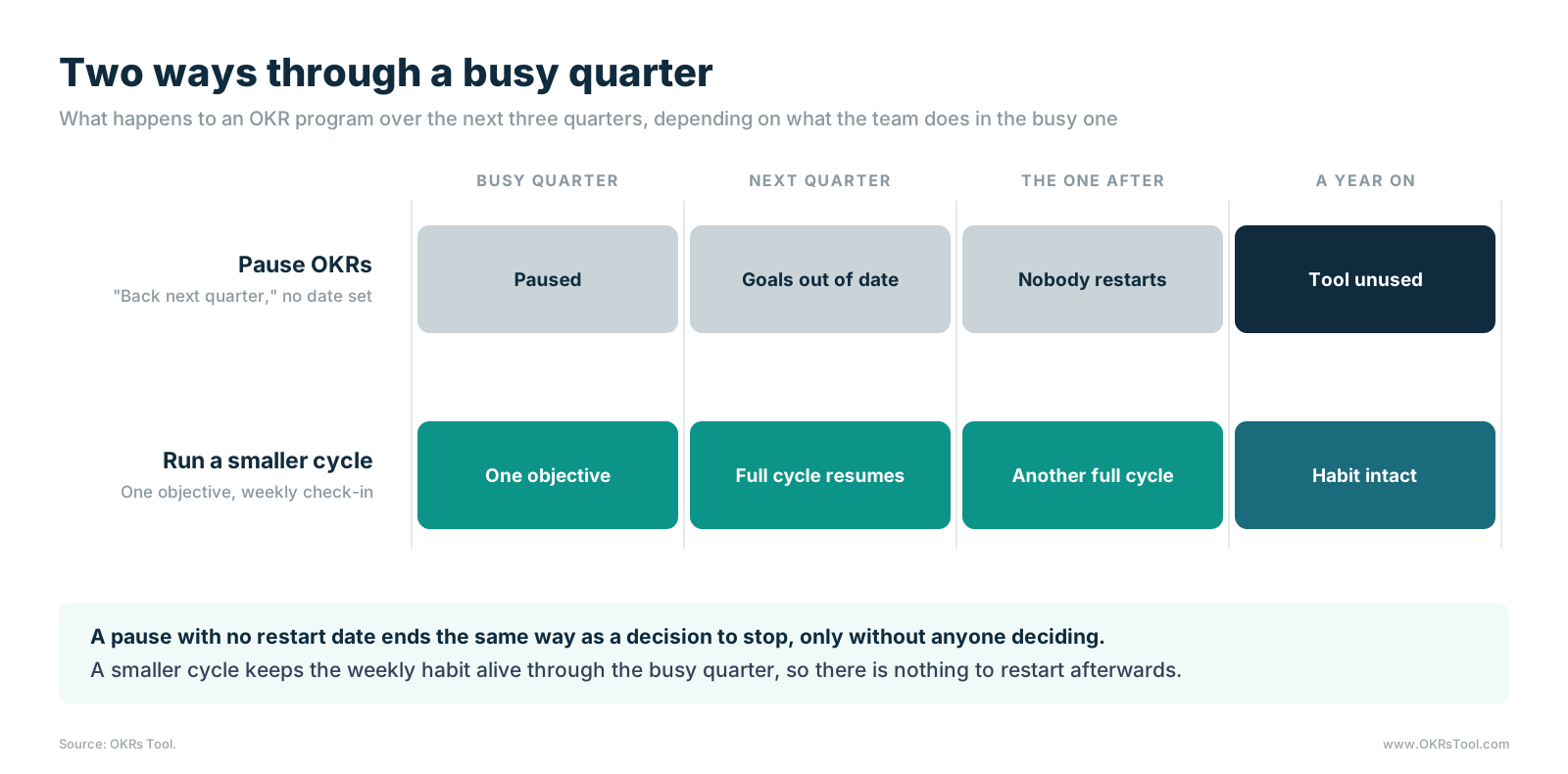
Goals also go stale faster than teams expect. On the OKRs Tool platform, 35% of key results that went flat were never updated again, so a key result left alone for a quarter is often a key result that won't be touched for the rest of the cycle. By the time anyone suggests restarting, the goals in the system describe a quarter that has already passed, and rewriting them feels like starting from scratch.
The timing works against a restart too. In The Death of OKRs, 35% of programs that stalled did so after two or three cycles, the stretch where the launch energy has faded and the habit hasn't yet settled, which is also when a first busy quarter tends to arrive. The OKR champion who pushed for the rollout is often the person most stretched by that quarter, so the restart has nobody to drive it.
Run a Smaller Cycle Instead
The alternative to a pause is a cycle cut down to what the busy quarter can carry. Pick one objective tied to the thing making the quarter hard, such as landing the launch or getting the new hires productive, and give it two or three key results with one owner each. The right number of OKRs is the number a team can review every week, and in a busy quarter that number is small.
Keep the weekly check-in, shortened to ten minutes on the one objective, and keep it on the same day so the cadence survives the quarter intact. Leaders matter here as well: in The Death of OKRs, programs where leaders reviewed OKRs weekly ended silently 43% of the time, against 55% where leaders reviewed monthly.
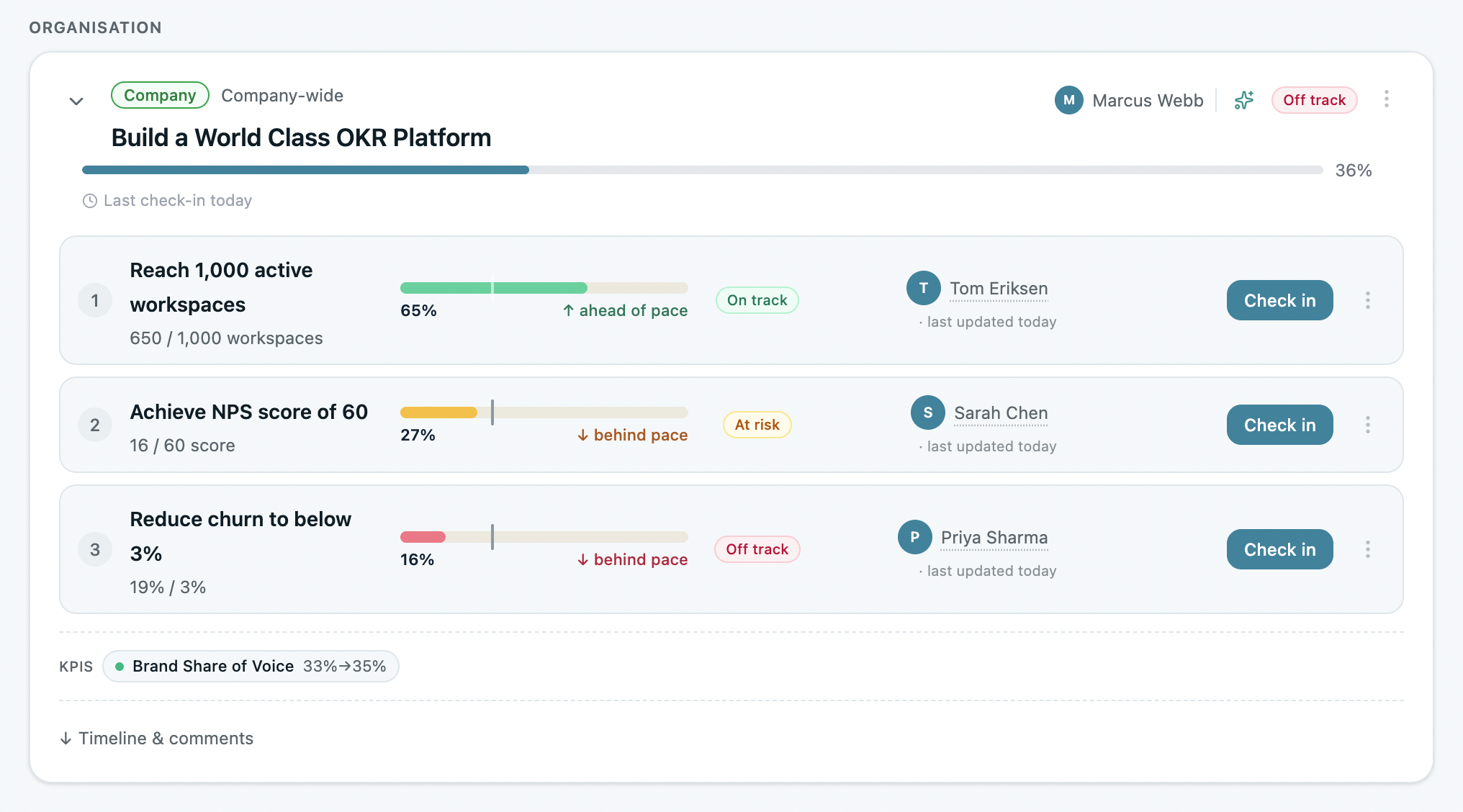
Change targets openly when the quarter changes around them. In the OKR Benchmark Report, teams that adjust goals often when the facts change hit them very consistently 72% of the time, against 30% for teams that hardly ever adjust, and a clear process for adjusting OKRs when priorities change keeps each change on the record. The mid-quarter review is the natural point to check whether the team can take on a second objective before the quarter ends.
Every Cycle Kept Counts
A pause also breaks the count that makes OKRs easier over time. Teams get better at writing, tracking and hitting their goals with each cycle they complete, and an earlier edition of the OKR Benchmark Report, covering 200 organizations, measured how much.
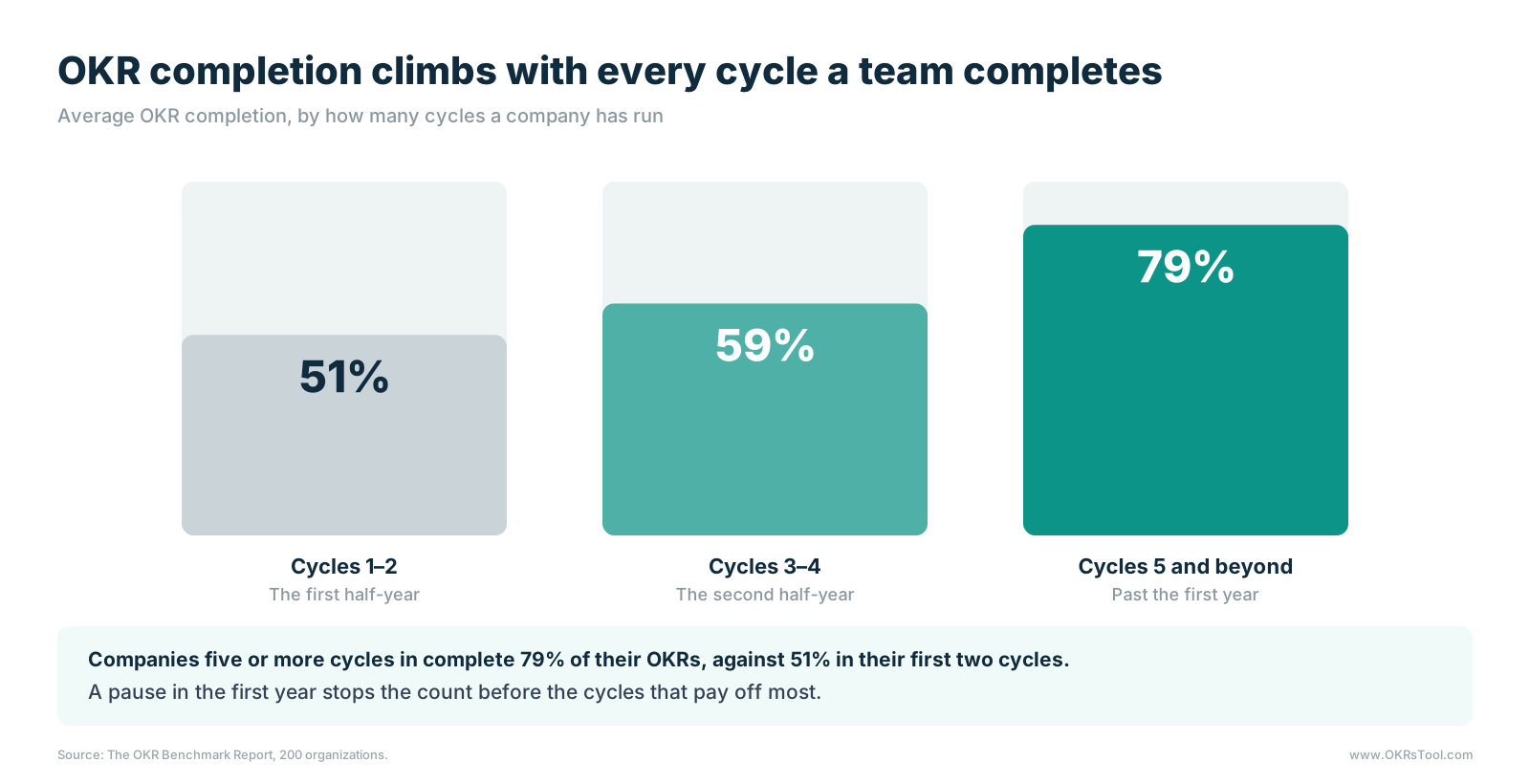
Companies in their first two cycles completed 51% of their OKRs on average, rising to 59% at cycles three and four and 79% from cycle five onward. The OKR maturity curve rewards teams that keep going, and a smaller cycle in a busy quarter still counts as a cycle completed, with its habits intact, while a pause sends the team back toward the start of that curve.
If the Team Has to Stop, Stop on the Record
Some quarters do call for a full stop, and the difference between a pause and a silent ending is a decision written down. Close the current cycle with a short retrospective that records what each OKR achieved, set a restart date and name the person responsible for restarting, then tell the company what's happening and why.
A restart with a date and an owner turns the pause into a planned gap, and the playbook for bringing OKRs back after they've died gives that owner a starting point when the date arrives. More than 300 teams across 26 countries run their OKRs on OKRs Tool, rated 4.6 on both G2 and Gartner Peer Insights, and its owners have logged about 24,000 progress updates.
Keep the Habit Running Through the Hard Quarter
A pause for a busy quarter sounds temporary, but nothing about it guarantees a restart, and half of the OKR programs that end do so with no decision at all. The safer choice is a smaller cycle: one objective tied to what's making the quarter hard, two or three key results with owners, and a ten-minute check-in on the same day every week.
That keeps the habit alive, counts toward the cycles that make programs stable, and leaves nothing to restart when the quarter ends. A platform that sends the check-in and collects the updates takes the remaining upkeep off a team that has no time for it.
Data: The Death of OKRs (and How to Revive Them), The Goal-Setting Benchmark, The OKR Benchmark Report and OKRs Tool platform data.