
Teams that go live with OKRs in under a week hit their goals very consistently 64% of the time. Every slower rollout lands between 44% and 46%, so the weeks a leader spends perfecting the structure before inviting anyone buy nothing back, and the team loses a month or more of real progress data, early wins and check-ins while it waits.
A head of operations signs up for an OKR tool on a Tuesday and writes the company objectives that evening. Then the careful part begins: departments, teams, a cascade three levels deep, naming rules, draft key results for teams nobody has spoken to yet, and a dashboard laid out for a board meeting that's still two months away. The invitations go out in week five, or week nine, and in some accounts they never go out at all.
The instinct is easy to understand, because nobody wants to launch something half-built in front of the whole company. The data points the other way. Launch speed is one of the few setup choices with a clear link to results, and the line falls at one week.
Why Leaders Hold Back the Launch
The leader building alone, often the OKR champion who pushed for the rollout in the first place, usually has good reasons. A first impression matters, the org chart has to be represented, and a half-finished goal system invites the very questions the leader hasn't answered yet, such as which team owns a shared target or how a department objective links to the company one. Waiting until the strategy offsite, the new quarter or the next all-hands feels like the responsible choice.
The work that decides whether OKRs succeed is the weekly habit of updating, discussing and acting on progress, and that habit can only start once the team is inside the system. In The Death of OKRs, our study of 420 companies, 18% of leaders said their OKRs stalled during the rollout itself, before a single cycle had finished.
One Week Is the Line
The OKR Benchmark Report, drawn from the same survey, compared teams by how long their rollout took from sign-off to the whole team working in the system.
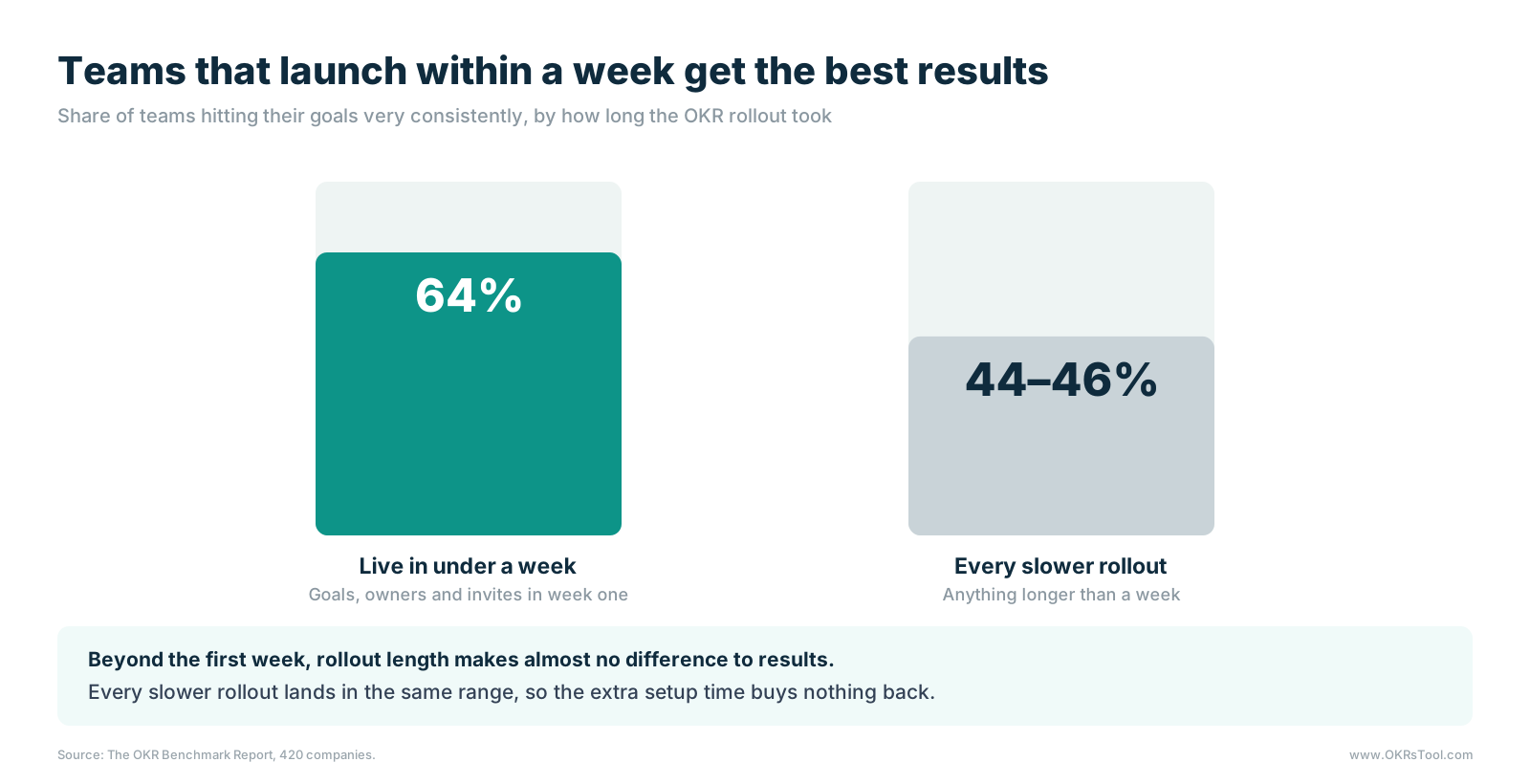
Teams that went live in under a week hit their goals very consistently 64% of the time. Every slower group landed between 44% and 46%, so the length of a slow rollout makes almost no difference once it passes the one-week mark. Fast launchers may also be more committed to begin with, which explains part of the gap, but the flat line after week one shows that extra setup time does nothing to close it.
What the Waiting Costs
The first weeks of a goal system decide whether it becomes a habit. Across 3,527 organizations on the OKRs Tool platform, organizations whose first key result stayed at zero stopped adding goals after a median of four days, against 32 days for those whose first key result moved. Momentum in the first week is what keeps people coming back to the second, which makes the first month the period that decides OKR adoption.
The same data shows how early the signal arrives. Key results already moving at their first check-in hit their target 62% of the time, against 27% for those still at zero, and when an organization sees its first key result through, later ones hit 53% of the time, against 24% when the first falls short. A team invited in week six has spent those weeks producing no progress, no check-ins and none of the early wins that make the second cycle easier.
The structure the leader builds alone also tends to be wrong in ways only the team can spot. Owners who never helped write a key result often find in week one that the metric doesn't exist yet, or that two teams are counting the same thing, and a week of live check-ins surfaces those problems faster than a month of planning.
What Needs to Be Ready on Day One
Very little has to exist before the invitations go out. The table separates what a team needs in its first week from what can wait until the first retrospective, when the team has real data to shape it.
The left column takes an afternoon, and it's everything a team needs to start producing progress data. The right column improves with that data, which is why it's easier to build in week four than in week minus four.
Screenshot suggestion: the OKRs Tool goals view in a new workspace on day one, showing two company objectives with an owner and a start value on each key result. Alt text: A new OKR workspace ready on day one, with two company objectives and one owner on every key result.
A One-Week Launch
A launch inside a week follows a simple order. The leadership team sets two or three company objectives on day one, and on day two every team gets invited to draft its own key results against them, a top-down and bottom-up split that gives each team a hand in its own numbers.
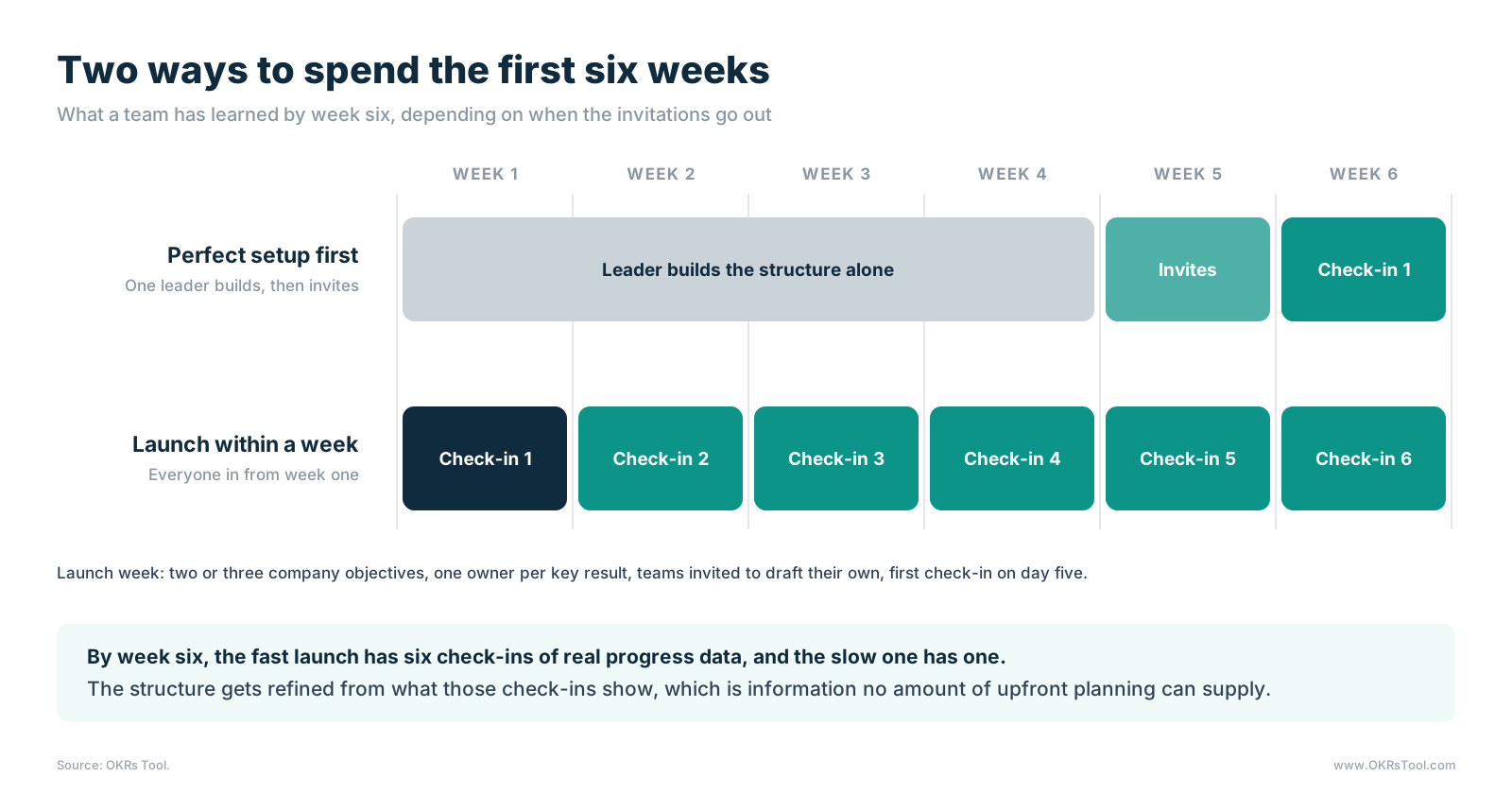
By day four, every key result should have one owner and a start value, and the first check-in happens on day five, even if half the key results are still at zero. Holding it on the same day every week after that keeps the check-in cadence steady. That first check-in is the most useful meeting of the quarter, because it shows which goals are moving, which owners are unsure what to measure and which key results need rewriting while there's still time.
From week two, the structure grows from what the check-ins reveal. A department that keeps raising the same dependency gets its own objective, a key result nobody can measure gets rewritten around a metric the team can track weekly, and the cascade deepens only where teams need it.
More than 300 teams across 26 countries run their OKRs on OKRs Tool, which holds a 4.6 rating on both G2 and Gartner Peer Insights, and a new team can go live in about 15 minutes. Every week saved before launch is a week of check-ins the team gets back.
Launch Before It Feels Ready
The perfect setup feels like progress because it produces a polished structure, but the team can't hit goals it hasn't seen. Teams that launch within a week reach very consistent results 64% of the time, and every week of waiting after that leaves results flat while removing check-ins, early wins and the corrections only a live team can make.
The practical rule is to launch with the minimum that produces progress data, and let that data shape everything else. A platform built for a same-day setup makes that easier, and the first OKR cycle then becomes the place where the structure gets built properly, with the whole team in the room.
Data: The OKR Benchmark Report, The Death of OKRs (and How to Revive Them) and OKRs Tool platform data.