
The hardest OKR cycles are the first two, and that's exactly when most teams give up. New research across 420 companies shows completion climbing from 51% in the early cycles to 79% by the fifth, and trust in the process rising right alongside it. The teams that quit at cycle two, frustrated by a middling result, walk away one or two cycles before the method starts to compound.
If you're the person who rolled OKRs out, this is the fear that keeps you up: the rollout stalls on your watch, the numbers come in soft, and someone asks whether this was worth it. The data says that soft early result is normal, not a verdict. Completion in the first two cycles sits around 51% for almost everyone, because the team is still learning the habit while running it. The teams that break 75% aren't better at goal-setting. They've simply run more cycles.
This piece covers why confidence in OKRs lags the results, what the maturity curve actually looks like cycle by cycle, and why the exit point most teams pick is the worst possible one. It draws on the Growing Pains of OKRs study.
The Payoff Arrives Just After the Exit
Completion doesn't jump the moment a team adopts OKRs. It climbs as the team accumulates cycles, and the shape of that climb is the whole story.
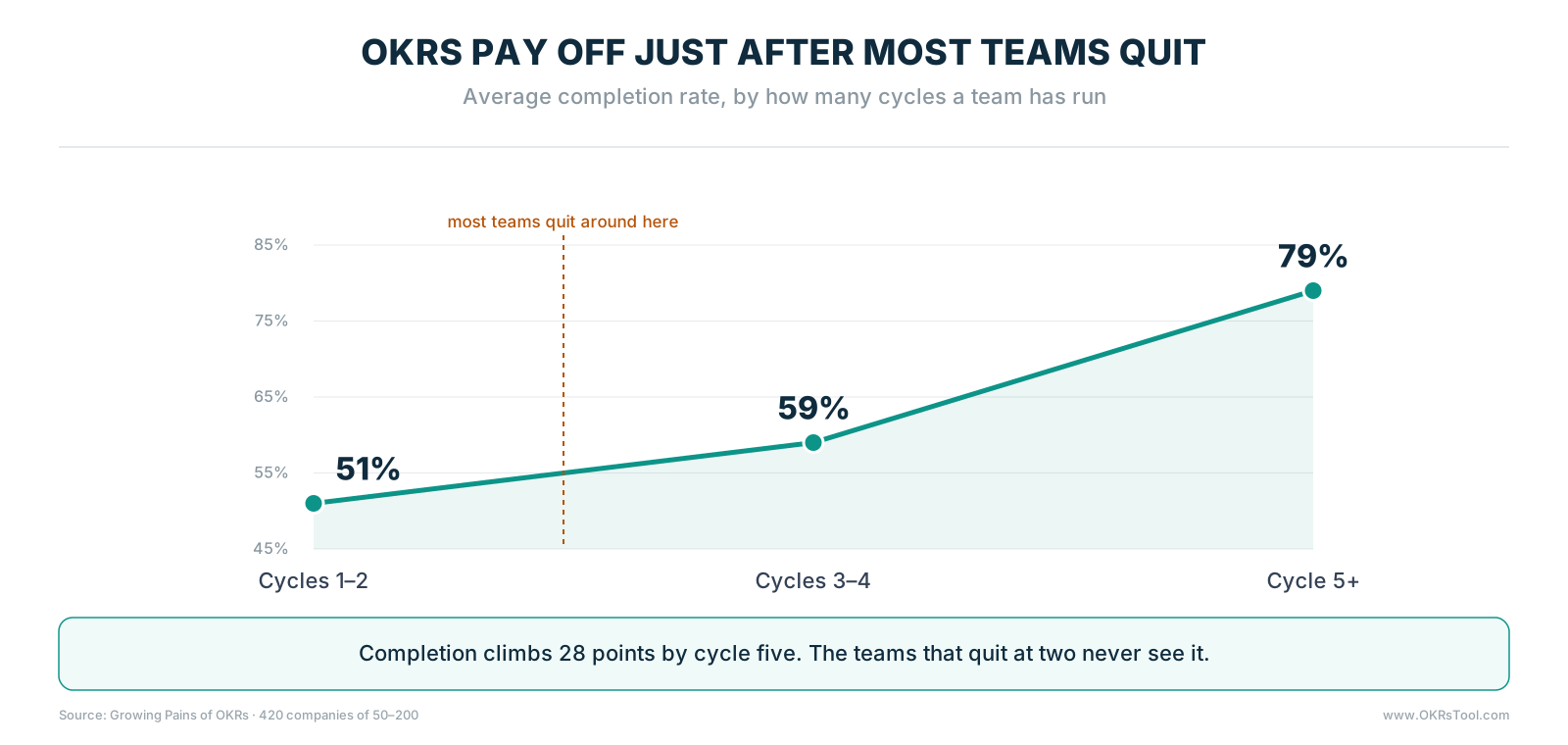
In the first two cycles, average completion sits at 51%. By cycles three and four it reaches 59%. By the fifth cycle and beyond it hits 79%. That 28-point climb is the return on sticking with the method, and almost none of it is visible in the window where most teams decide whether to continue.
A team looking at a 51% first cycle sees a coin flip and concludes OKRs don't work here. A team that pushes through to cycle five sees four goals in five landing, the completion the curve rewards. Same method, same company, different number of cycles behind them.
Confidence Lags the Results
Trust in the process follows the same curve, one step behind the completion number. The State of Goal Management and the benchmark data both show confidence as something earned on the far side of consistency, not granted at the kickoff.
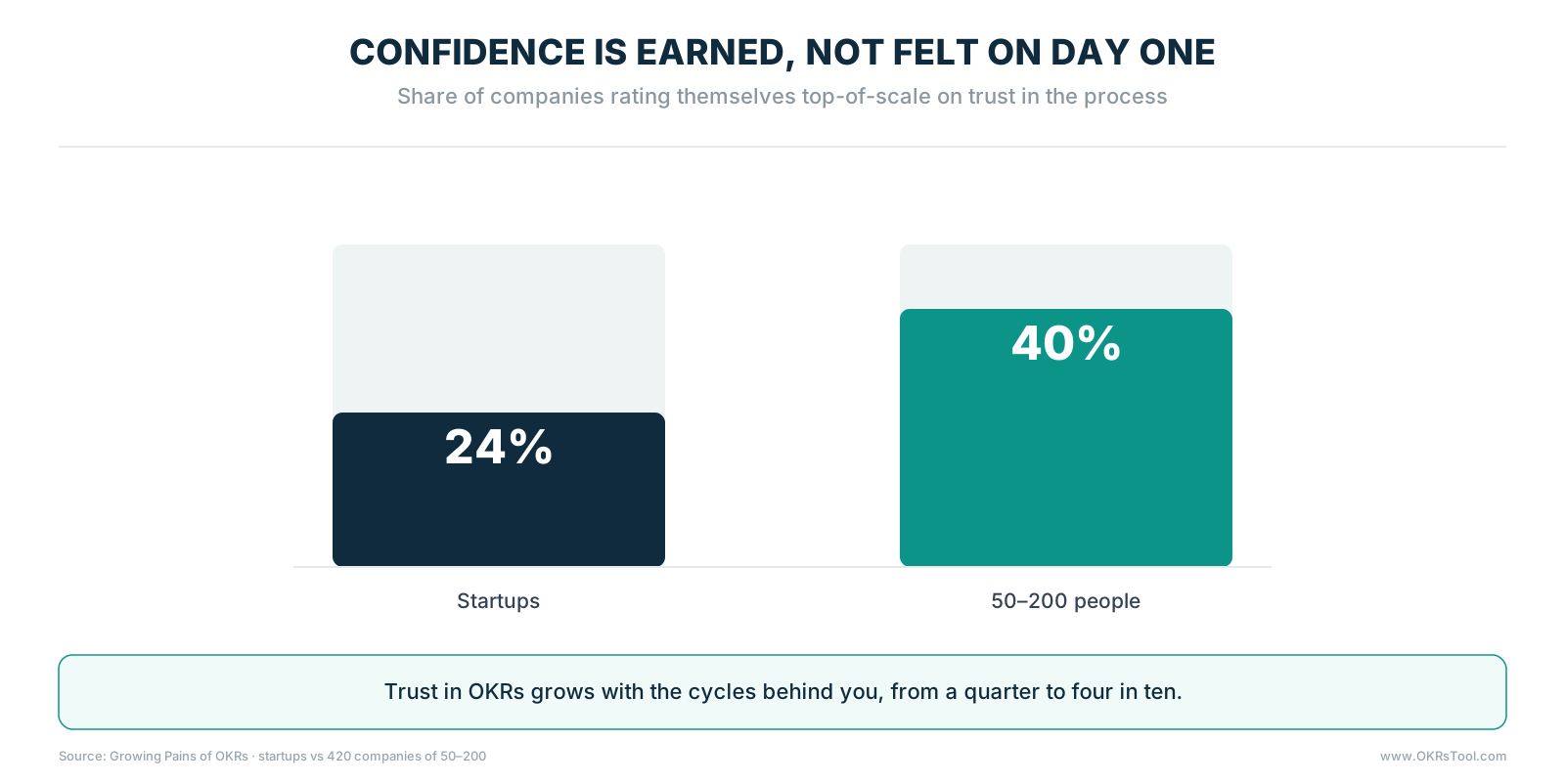
A quarter of early-stage teams rate themselves top-of-scale on confidence in their OKR process. Among larger, more cycle-experienced companies, that rises to four in ten. More cycles completed means more evidence the thing works, which means more willingness to set ambitious goals the next time, which lifts the result again.
The loop compounds, but it only starts once a team has enough cycles behind it to trust what it's seeing. In the first two cycles there's no track record to draw on, so the natural read of a middling result is doubt, and doubt is what drives the early exit.
What Quitting at Each Cycle Costs
The decision to abandon OKRs almost always lands in the same window, and it lands there because the team is judging the method on its weakest data. What it walks away from depends on when it quits.
The cruelty of the curve is that the exit point most teams pick, cycle two or three, is the point of maximum discouragement and minimum evidence. The result is mediocre, the habit is still effortful, and there's no track record yet to suggest it gets better. Everything the team would need to justify continuing lives one or two cycles further on, on the other side of the decision they're about to make.
Why the Early Cycles Feel So Flat
Understanding why the first cycles underperform makes it easier to hold the line through them. The early completion number is low for structural reasons, not because the goals were bad.
In cycle one, the team is doing everything for the first time at once: writing outcome-based key results, learning the weekly check-in, figuring out ownership, scoring honestly for the first time. Every one of those is a skill, and the team is building all of them simultaneously while also doing its actual job. A 51% result under those conditions isn't failure. It's a team learning to run OKRs while running them.
By cycle three, the mechanics have stopped costing attention. The check-in happens without anyone scheduling it, ownership is understood without a conversation, and the retrospective from the last cycle has already removed a few of the obvious mistakes. That's what the climb is made of: not better goals each quarter, but less friction around the same goals, cycle after cycle, as the maturity curve takes hold.
How to Survive the First Two Cycles
If the payoff is real and it arrives at cycle five, the practical question is how to make sure the team gets there. Three things separate the teams that reach the compounding zone from the ones that quit short of it.
Set the expectation before cycle one. Tell the team, and tell leadership, that the first two cycles are the learning tax and that 50-something percent completion is the normal early number, not a warning sign. A team braced for a middling first result doesn't panic at it. The ones that quit are almost always the ones who expected cycle one to look like cycle five.
Make the habit cost as little as possible early. The early cycles are hard because the mechanics are effortful, so the fastest way to flatten the learning curve is to take the manual work out of it. When the check-in fires on its own and the tracking picture stays current without anyone compiling it, the team spends its limited early energy on the goals themselves rather than on the overhead of tracking them. Fewer teams quit when the habit isn't also a chore.
Close every cycle with a real retrospective. The compounding depends on it: each cycle reflection removes a few of the mistakes that held the last one back, which is precisely the mechanism that turns 51% into 79%. Skip the retro and the team restarts from the same baseline every quarter, and the curve never bends. Teams that run structured retrospectives complete 30 to 45% more goals the following cycle.
The Advice Is Simple: Don't Quit at Two
Almost everything written about OKRs is about how to run them well. The single most valuable thing a growing team can know is more basic than that: the method compounds, the payoff is real, and it arrives at roughly cycle five, which is one or two cycles past where most teams give up. The teams staring at a 51% first cycle and wondering whether to pull the plug are, without knowing it, standing right at the bottom of the climb.
For the person accountable for the rollout, that's the reassurance worth holding onto. A soft first cycle is the method working as designed, not the initiative failing on your watch. Brace the team for it, take the friction out of the early cycles so the habit survives them, the heart of real goal management, and close each one honestly enough to carry the learning forward. Do that, and the company crosses into the cycle where OKRs stop being an experiment and become how the place runs.
Data: the Growing Pains of OKRs study, based on 200+ early-stage startups and 420 technology companies of 50–200 employees.. No OKRs Tool customers were included.