TLDR Expanding OKRs company-wide at the 50-to-80-person stage fails for predictable reasons - too much cascade, too little ownership, and a planning process that can't scale without collapsing under its own weight. These steps fix the expansion before it breaks the programme.
The first cycle went well. One team, clear objectives, a check-in cadence that actually held. Leadership saw the results and made the call: roll it out company-wide next quarter.
That decision is where most OKR programmes hit their first serious wall.
Not because the framework stops working at scale. But because the things that made the first cycle work - tight scope, clear ownership - don't automatically replicate when you add five more teams, three layers of management, and forty people who have never written an OKR before.
Company-wide expansion isn't a bigger version of the first cycle. It's a different problem entirely. Here's how to solve it.
1. Resist the Urge to Cascade Everything
The most common expansion mistake is treating company-wide OKRs as a cascade exercise - starting with company objectives and working down through every layer until every individual has a personal OKR that traces back to the board's priorities.
Full cascade sounds like alignment. In practice it produces the opposite - team leads writing objectives that satisfy the cascade requirement rather than reflecting what their team actually needs to accomplish.
The further the objectives travel from the company level, the more they lose the context that made them meaningful at the top.
At the 50-to-80-person stage, two levels are enough for most companies: company objectives and team objectives. Individual OKRs come later - once the cadence is established and the organization has a cycle or two of experience to learn from.
Start with the level that has the most leverage and add complexity only when the simpler version has proven it works.
2. Train Team Leads Before the Planning Session, Not During It
Company-wide expansion fails most visibly in the planning session.
Fifteen people in a room, half of whom have never written an OKR, trying to produce objectives that are meaningful, measurable, and connected to the company's priorities - all in a single afternoon.
The result is usually one of two things. Either the objectives get written by the loudest voices in the room while everyone else nods along, or the session drags past its timebox and produces a set of goals that feel like compromises rather than commitments.
The fix is to do the work before the room fills up. Run a two-hour training session with every team lead in the week before the planning workshop. Cover the framework, show examples of strong and weak objectives, and ask each lead to come to the workshop with a draft objective for their team.
The planning session then becomes a conversation about refining and aligning drafts rather than creating from scratch - which is significantly faster and produces significantly better output.
3. Appoint an OKR Lead for the Expansion Quarter
Company-wide rollouts need a single person accountable for the process.
Not the outcomes, but the mechanics. Who has submitted their objectives. Which teams are behind on their check-ins. Where the conflicts between team objectives need resolution before the quarter starts.
This doesn't need to be a permanent role. For the expansion quarter, it's a coordination function - someone with enough organizational credibility to chase team leads who are behind and enough process knowledge to spot problems before they compound.
In many companies at this stage, it sits with a senior operator, a chief of staff, or the leader who ran the first successful cycle..
Without this role, the expansion quarter becomes a collective action problem. Everyone assumes someone else is tracking the process, and by week two the objectives are incomplete, the check-ins haven't been scheduled, and the momentum from the first cycle has already dissipated.
4. Standardize the Check-In Format Across Teams
In a single-team cycle, the check-in format can be informal - whatever works for the group.
At company-wide scale, informal check-ins produce inconsistent data. Some teams update weekly with context and confidence ratings. Others update monthly with a percentage and no explanation. The leadership view becomes impossible to interpret because every team is reporting differently.
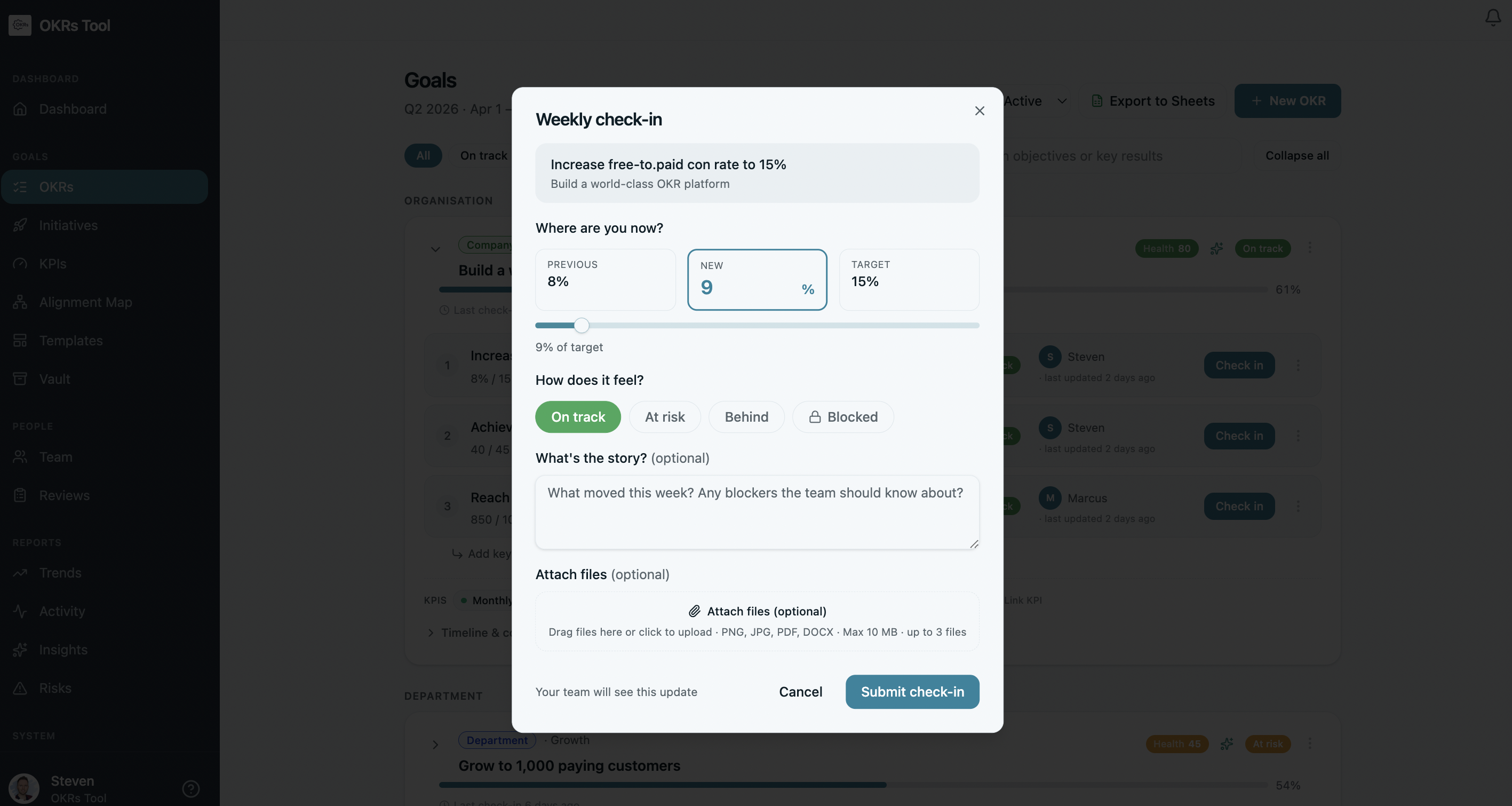
Before the expansion quarter starts, agree on a standard check-in format across all teams. Not a lengthy template - a simple structure that every team uses. Progress against each key result.
A confidence rating - on track, at risk, or off track. One line explaining the rating. That's enough to give leadership a consistent picture without creating reporting overhead that kills adoption.
Standardization doesn't mean rigidity. Teams can add context beyond the standard format. But the minimum viable check-in needs to be the same across every team for the company-wide view to mean anything.
5. Run a Cross-Team Conflict Review Before the Quarter Opens
At the single-team level, conflicts between objectives are rare. At company-wide scale, they're almost guaranteed - and they're invisible until someone tries to execute against them mid-quarter.
Product wants to slow down to reduce technical debt. Sales wants to accelerate with new features. Marketing is planning a campaign that needs engineering resource nobody has allocated. Each team's objectives look reasonable in isolation. Together, they're incompatible.
The week before the quarter starts, run a cross-team conflict review. Put every team's objectives on the same page and ask explicitly:
- Where are the dependencies?
- Where are the resource conflicts?
- Where are two teams optimising for outcomes that pull in opposite directions?
Resolve those conflicts before the quarter opens, not after they've derailed someone's key result in week seven.
6. Give Leadership a Company-Wide View From Day One
One of the most important things company-wide OKRs are supposed to produce is a leadership view - a single, consistent picture of where every team stands at any given moment.
At the single-team level, this happens naturally. At company-wide scale, it requires infrastructure.
Without an OKR software that aggregates progress across teams, the leadership view has to be assembled manually - someone collects updates from every team lead, compiles them into a slide, and presents them at the monthly review.
That process is slow, inconsistent, and always slightly out of date by the time the slide is ready.
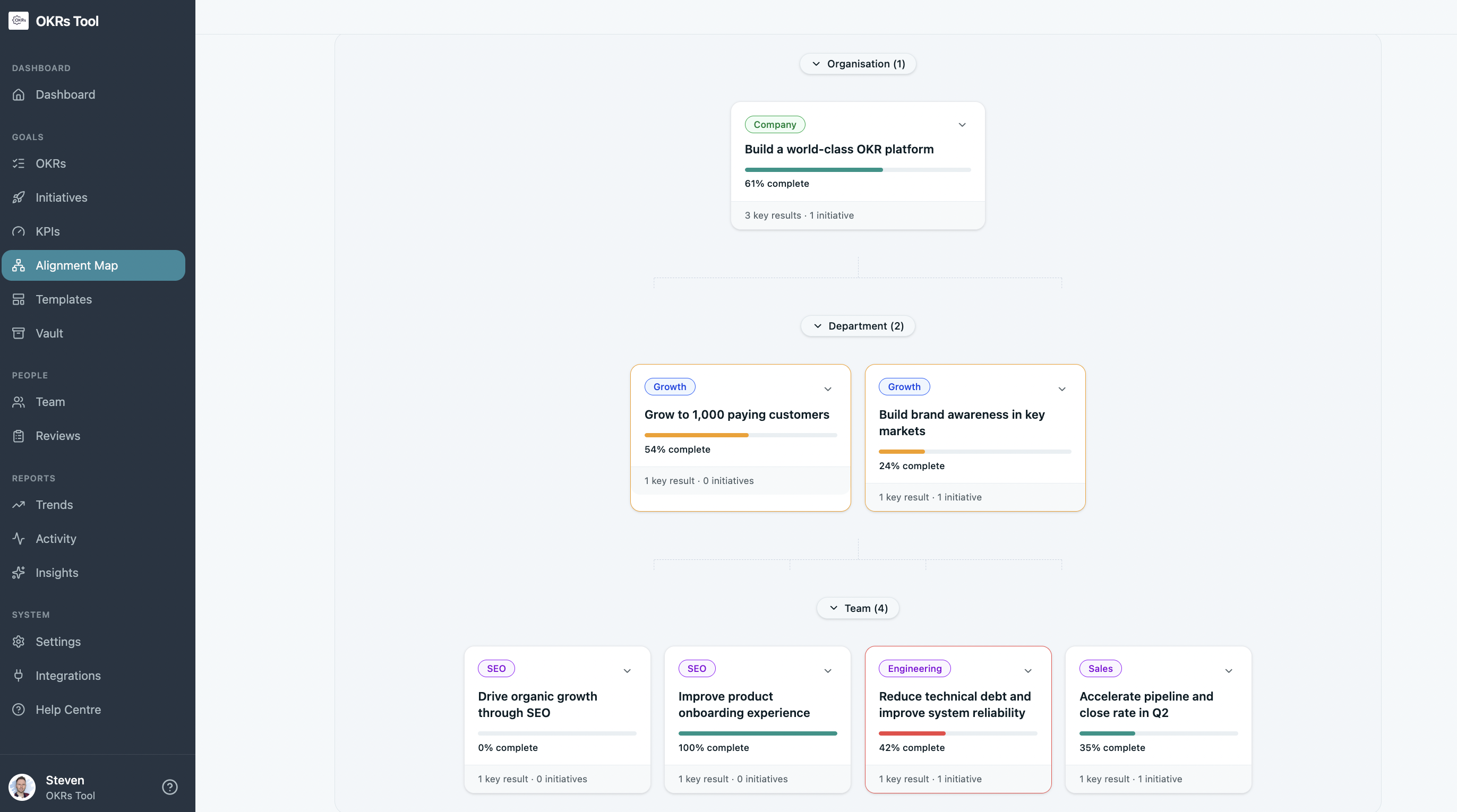
The right infrastructure makes the leadership view real-time and automatic - progress updates from every team visible in a single dashboard, without anyone having to compile them. It means leadership can see where intervention is needed in week four rather than week ten, and decisions can be made when they still have time to matter.
7. Run a Cross-Company Retrospective at the End of the Quarter
The single-team retrospective is a relatively contained conversation - what worked, what didn't, what to do differently next cycle. The company-wide retrospective is harder to run well, and most organizations skip it or compress it into a single slide at the all-hands.
That's a significant missed opportunity. The expansion quarter produces more organizational learning than almost any subsequent cycle - because it's the first time the full company has been through the process together, and the problems it surfaces are the ones that will repeat if they're not addressed explicitly.
Run a proper cross-company retrospective at the end of the expansion quarter. Ask:
- What did the planning process get right and where did it break down?
- Which teams ran the check-in consistently and which didn't - and what was different about them?
- Where did the cascade produce meaningful alignment and where did it just produce paperwork?
The answers shape cycle two in ways that compound across every subsequent cycle.
Where OKRs Tool Makes the Expansion Work
Company-wide OKR expansion has one infrastructure requirement above all others: an OKR platform that scales with the organization without scaling the overhead.
OKRs Tool is built for exactly this stage. The Alignment Map connects every team's objectives to the company-level goals, so the cross-team view is always current without anyone maintaining it manually.
Weekly check-in nudges keep every team on the same cadence regardless of how each team lead prefers to work. And the dashboard gives leadership the real-time company-wide view that makes the expansion worth running in the first place.
At $129 per month flat for teams of 51 and above, it removes the per-user pricing that makes most OKR platforms expensive to expand. Every new team added to the programme costs nothing extra - which means the infrastructure decision and the expansion decision can be made together, rather than sequentially.
The first cycle proved OKRs work for one team. The expansion proves they work for the company. Get the infrastructure right and the second proof point is significantly easier to reach.