Teams that check in weekly complete 43% more OKRs than those reviewing monthly or ad hoc. Tracking — not setting — is where most of the return on an OKR program is won or lost.
OKR tracking is the in-cycle work of keeping Key Results visible, owned, and honestly updated between the planning session and the result. It's a separate discipline from setting goals, and it's the one most teams skip. Goals get written at a kickoff, reviewed at the quarterly business review, and left untouched in between.
The data on what that costs is precise. The 2026 OKR Benchmark Report found that teams with no fixed check-in cadence complete a fraction of the goals that weekly teams do, and a meaningful share of off-track Key Results are simply abandoned mid-cycle with no decision attached.
This guide covers the mechanics of tracking OKRs through a full cycle — the cadence, the ownership, the honest status, and the at-risk intervention that keep goals moving.
Tracking Is Not Setting, and Not Management
These three terms describe different parts of the same system, and conflating them is why tracking gets neglected. Setting defines what to change this quarter. Tracking is the in-cycle discipline that keeps the work visible. Goal management is the full loop from setting through to closing.
A goal set in January and reviewed in March wasn't tracked — it was reported. Tracking is specifically what happens in the eleven weeks between, and it's where the completion difference is generated.
Most teams invest in goal setting and skip the tracking layer entirely. The benchmark data shows what closes that gap, and none of it is the goal-writing itself — it's the in-cycle mechanics that the wider discipline of goal tracking depends on.
Cadence Is the Single Highest-Return Variable
How often a team tracks its goals isn't a preference — it's a structural variable with a measurable consequence. Teams that check in weekly complete 43% more OKRs than those reviewing monthly or ad hoc, and the gap widens as the quarter progresses.
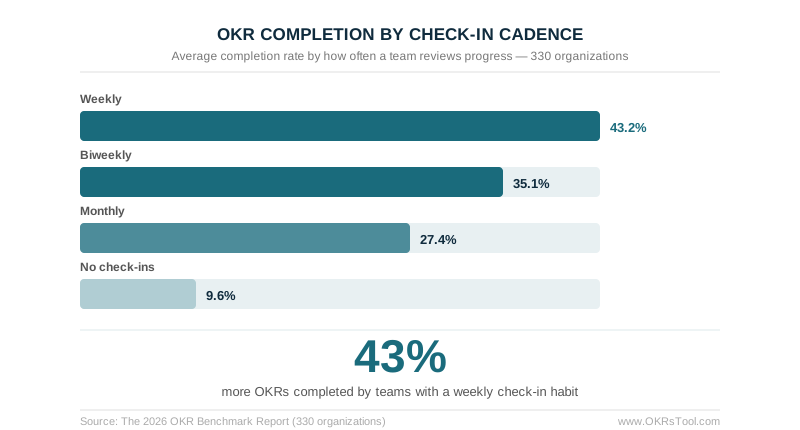
The reason weekly beats monthly isn't the quality of information a check-in produces — it's timing. A Key Result drifting in week four is recoverable; the same drift discovered in week eleven isn't. Monthly tracking turns goal management into a series of post-mortems, while a structured weekly check-in turns it into real-time steering. The right check-in cadence is the one a team can sustain every week without it becoming a meeting.
Name One Owner Per Key Result
The OKR Intelligence Report 2026 found that half of all Key Results across growing organizations have no named owner — not shared ownership, no owner at all. A goal tracked by nobody isn't tracked, because no single person updates it, escalates it, or owns its score at cycle end.
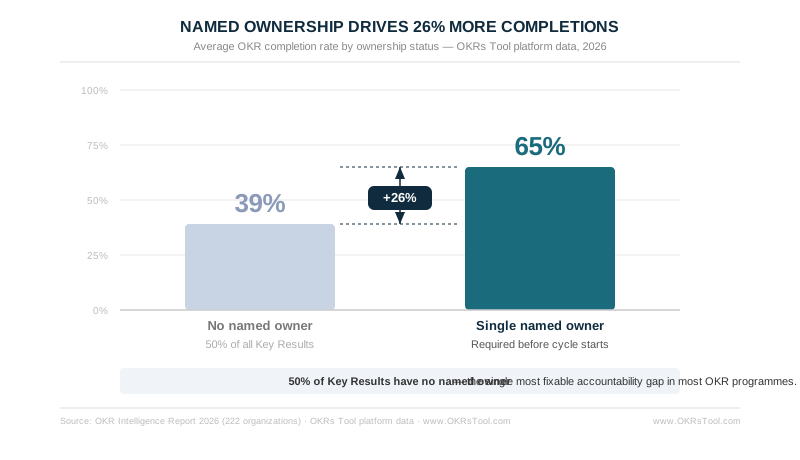
Ownership isn't about blame. It's about having one person whose name is attached to the honest progress number every week, which changes how a goal gets updated more than any reporting format does. Enforcing clear ownership at goal creation — before the Key Result goes live — is what removes the ambiguity that lets goals drift from owned to assumed to invisible, and it's a core part of building real leadership accountability into the cycle.
Track Honest Status, Not a Narrative
The most common tracking failure isn't a missed update — it's a goal reported as healthier than it is. Showing a Key Result green while the underlying reality is red is the watermelon pattern, and it's widespread: the proprietary survey behind The State of Goal Management found that 70% of employees have reported a goal as healthier than they knew it to be.
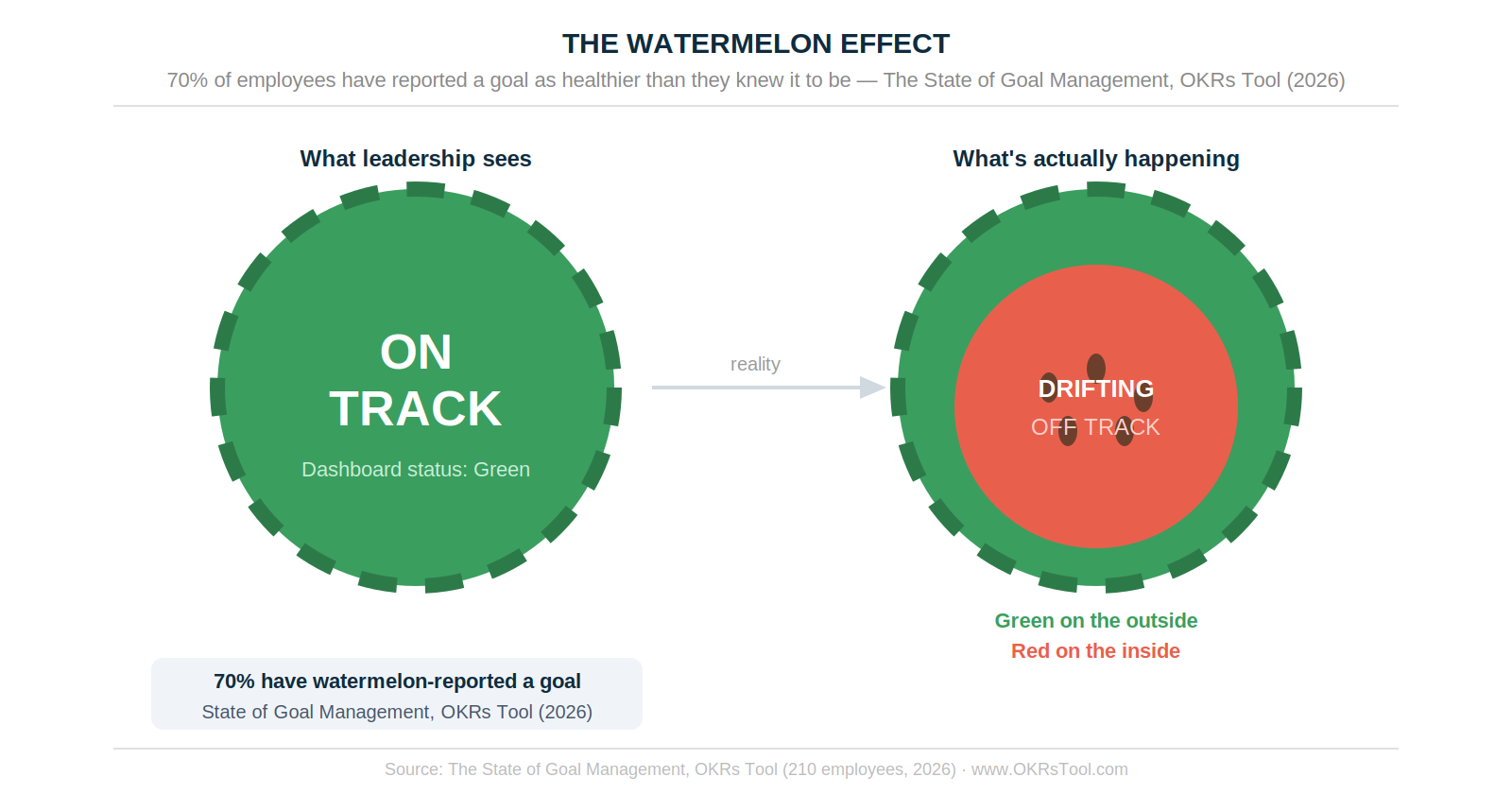
The fix is structural, not motivational. An OKR scoring system on a 0.0–1.0 scale, where the honest number is visible to the whole team rather than assembled into a narrative before the review, makes inflation immediately apparent. When the score is visible continuously, a Key Result that hasn't moved in three weeks can't quietly be reported as on track.
Flag At-Risk Goals Before the Cycle Ends
Effective tracking includes a mid-cycle intervention point — typically week six of a twelve-week quarter. Every Key Result below halfway at that point should leave the mid-cycle review with one of three outcomes: a revised target, an escalated blocker, or a formal close.
Goals that stay at-risk with no explicit decision become the abandoned-mid-cycle Key Results the benchmark identifies — quietly dropped with no revision and no consequence. The discipline of spotting an OKR going off track early is what separates a recoverable miss from an invisible one. Catching drift in week six leaves time to act; catching it at cycle close leaves only a post-mortem.
What OKR Tracking Software Should Enforce
A spreadsheet stores an honest Key Result as easily as an inflated one, and it has no opinion on whether a goal has an owner or whether it's been updated this week. The mechanics above all depend on discipline — and discipline-dependent tracking collapses under quarterly pressure.
Purpose-built OKR tracking software enforces them instead. Automated weekly nudges replace scheduled meetings as the check-in trigger, firing through Slack or Microsoft Teams without anyone scheduling them. Required ownership before a goal goes live prevents the no-owner problem at the source. And a live view of progress across the cascade lets the team — and leadership — see what's drifting without a status meeting.
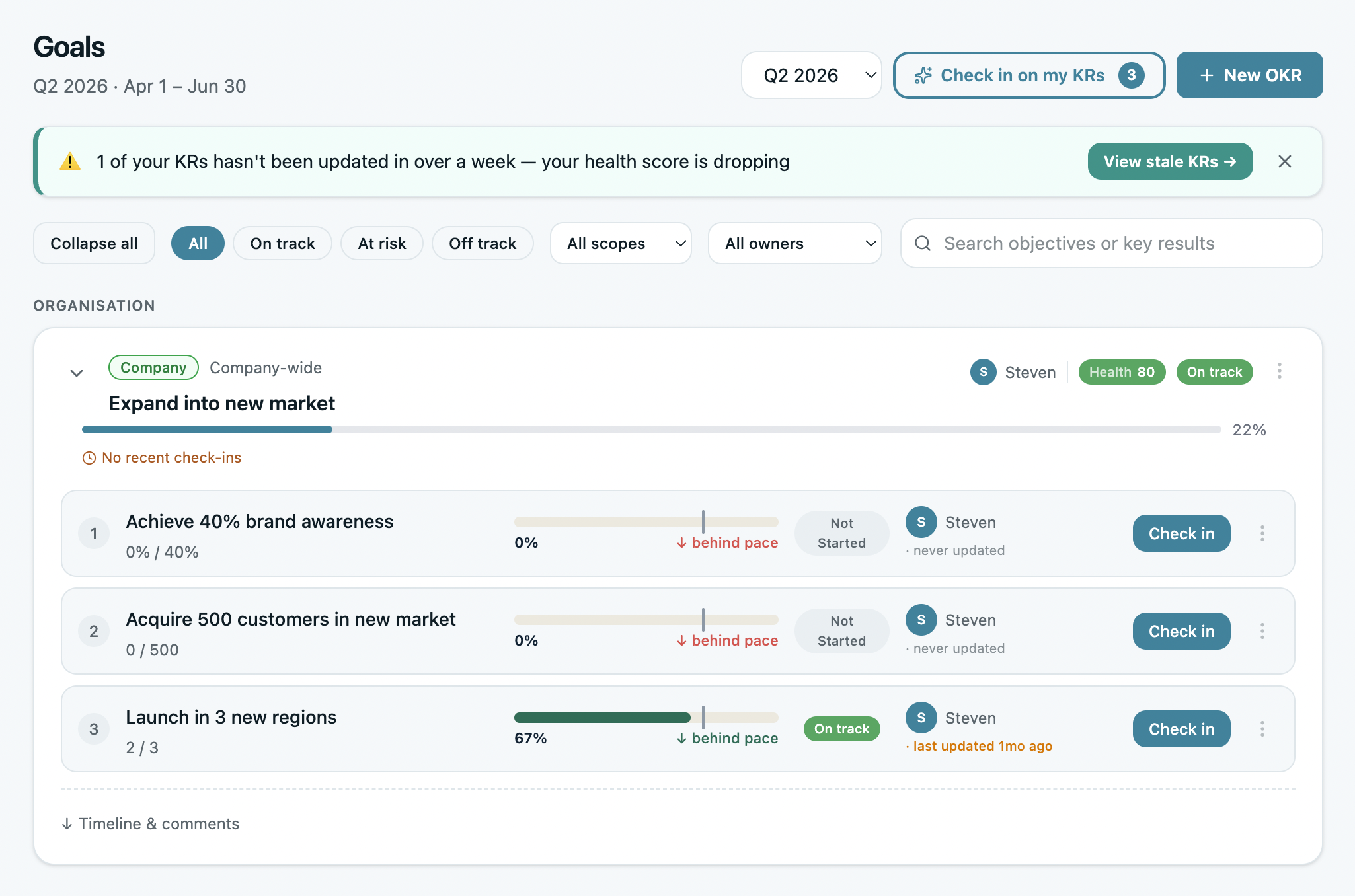
Organizations using purpose-built platforms generate a 1:88 return versus 1:25 on spreadsheets, and the gap isn't the software cost — it's the tracking infrastructure spreadsheets can't provide. See how the OKRs Tool platform runs automated check-ins, required ownership, and at-risk flagging as one connected system, or compare it against a spreadsheet directly.
A Tracking Checklist for the Full Cycle
A working tracking system has a small number of structural properties, each tied to a finding in the data. A shared, live source of truth for every Key Result. One named owner per goal with no ambiguity. A weekly or biweekly review rhythm rather than an end-of-cycle scramble. Early detection of stalled Key Results with an explicit decision attached. Progress-based decisions rather than gut feel. A clear line from each person's work to a company goal. And an end-of-cycle reflection that improves the next quarter's planning.
Teams that close that gap — weekly cadence, named ownership, honest status, mid-cycle intervention — complete 43% more goals, see 26% higher completion from ownership alone, and compound across cycles as the maturity curve takes hold. None of it requires more process. It requires a system that makes the weekly habit structural rather than dependent on someone remembering to chase it.
Tracking Is What Turns Goals Into Results
Setting an OKR is a statement of intent. Tracking it is what converts that intent into a result, and the difference between the two is measured in completion rates, not effort. The teams that track consistently aren't more disciplined — they've built a system where the cadence runs on its own.
Outcome-based goals, named owners, honest weekly status, and a real mid-cycle decision point are the mechanics. Put them inside infrastructure that enforces them, and tracking stops being overhead and becomes the clearest signal a growing company has of whether its strategy is actually moving.
Data: The 2026 OKR Benchmark Report (330 organizations), OKR Intelligence Report 2026 (222 organizations), The State of Goal Management (210 employees), The ROI of OKRs: 2026 Benchmark Report (330 organizations).