
An OKR consultant and OKR software solve different halves of the problem. A consultant is worth the fee for the one-time strategy work — choosing the framework, aligning the leadership team, running the first cascade. Software is what makes the goals survive every week after that. And the data is clear on which half decides the outcome: teams that track goals closely hit them 51% of the time against 29% for a well-set goal left to drift, so for most growing teams the durable spend is software plus discipline, with a consultant optional at the start.
Teams weighing OKRs usually hit the same fork: hire a consultant to set it up, buy OKR software and run it themselves, or piece it together in spreadsheets. The honest answer depends on where the gap actually is, and it's rarely the same for every team. A consultant fixes a strategy and alignment gap. Software fixes an execution and tracking gap. The typical 50-to-200-person team has more of the second than the first, which is why so many can self-serve.
This guide draws the line concretely, with what each option costs and when it earns its place.
What Each One Actually Fixes
An OKR consultant sells expertise for a problem you have once: how to translate strategy into objectives, how to get a leadership team to agree on three priorities instead of eleven, how to run the first planning session so the cascade actually connects. That work is genuinely hard the first time, and a good consultant compresses months of trial and error into a few weeks of OKR adoption. It's front-loaded — most of the value lands in the first cycle or two.
OKR software solves a problem you have every week for as long as you run OKRs: keeping goals owned, visible, and honestly updated between planning sessions. Automated weekly check-ins, required ownership on every key result, and a live cascade from company objective to team goal — the execution infrastructure that a slide deck and a shared doc can't provide. Its value compounds; it's worth more in cycle five than in cycle one.
The Data Says the Weekly Habit Decides It
The reason this matters for the decision: the outcome is driven far more by the execution half than the strategy half. The Goal-Setting Benchmark, an independent survey of 280 operations and strategy leaders, split teams by how well they set goals and how well they track them.
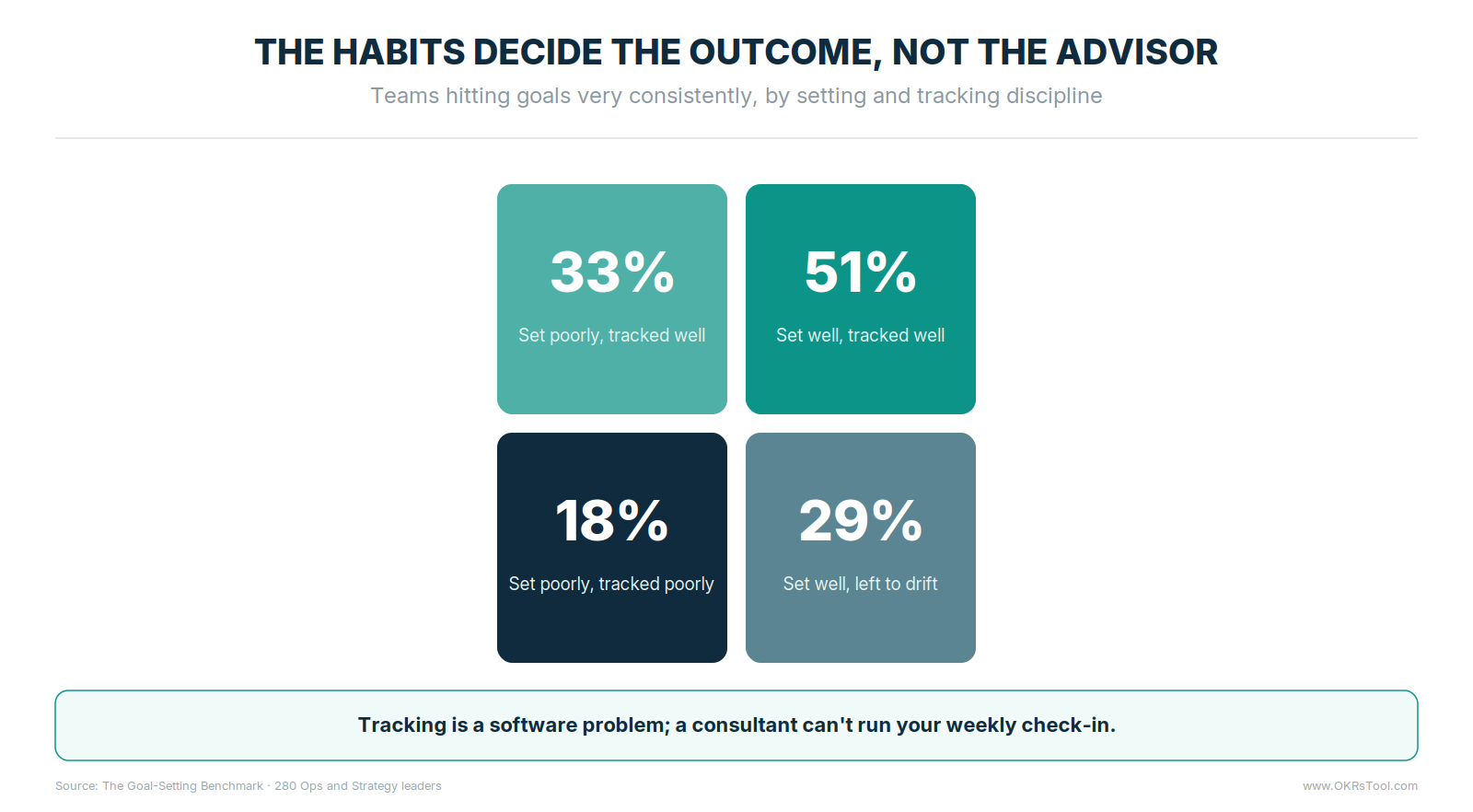
A well-set goal left to drift lands at 29% — barely above the 18% floor where nothing is done well — while a roughly set goal tracked closely reaches 33%. Setting and tracking both well hits 51%. The benchmark also found teams running three or four core habits hit their goals 2.9x more consistently than teams running none.
A consultant can sharpen the setting half in a few weeks; the tracking half is a weekly discipline nobody can run for you, and it's the half software is built to hold. That's the practical case for leaning on software: it addresses the part of the problem the data says is decisive.
Cost and Fit: Consultant vs Software vs DIY
The costs aren't comparable line items — a consultant is a one-time project fee, software is an ongoing subscription, and a spreadsheet is free but carries no execution infrastructure. For a 90-person team, a $20,000 consulting engagement buys a strong first cycle; a software subscription at a fraction of that annual cost buys the habit that carries every cycle after. The two aren't mutually exclusive, but if the budget only stretches to one, the data points to the recurring execution layer.
When a Consultant Is Worth It
There are real cases where the consulting fee pays for itself, and it's worth being honest about them:
Your leadership team can't align on priorities on its own. If every planning session ends with eleven "top" objectives and no agreement, an outside facilitator who has run the conversation a hundred times is worth the money — that's a people problem software can't solve.
You're rolling out across a large, multi-level organization. Above roughly 300 people, cascading strategy through divisions and departments is genuinely complex, and the strategy execution work benefits from someone who has done it at scale.
You've tried OKRs twice and they didn't stick. If two rollouts failed, a consultant can diagnose whether the problem was the goals, the cadence, or the culture — though often the answer is a missing weekly habit, which is a tooling fix more than an advisory one.
Outside those cases, most growing teams are buying expertise for a problem they could solve with a good template and a tool that enforces the habits. When a consultant is the right call, working with one who runs OKRs Tool keeps the strategy work and the execution layer in the same place — several do, through our partner network.
When Software Alone Is Enough
For the majority of 50-to-200-person teams, software plus a small amount of self-education covers it. You already know your priorities — you don't need a consultant to tell you revenue and retention matter. What you need is the structure that keeps the goals alive: one named owner per key result, a weekly check-in that runs on its own, honest scoring at each cycle close, and a visible cascade on one platform so everyone sees how their work connects.
Goal management software enforces those structurally, and the free resources to write good OKRs — the how-to-write guide, examples, and the wider goal setting practice — are a search away. The teams that self-serve well are spending deliberately on the layer that compounds rather than the one that front-loads, which is a smart trade, not a corner cut.
Among teams already doing the weekly work, those on dedicated software hit their goals very consistently 74% of the time against 33% on spreadsheets — the tool, not the advisor, is what raises that ceiling.
The Practical Recommendation
Start with software and self-education. Run one full cycle. If the goals stick and the weekly check-in habit holds, you never needed the consultant. If you hit a wall that's clearly about strategy or executive alignment rather than execution — priorities nobody can agree on, a rollout too complex to run yourself — bring in a consultant for that specific gap, with the tooling already in place so their work has somewhere to live.
The mistake is paying for expensive advice before you've found out whether execution was the real gap all along. For most growing teams, it is — and execution is the half a tool holds, not a consultant. Run a cycle, see where you actually get stuck, and spend against that.
Data: the Goal-Setting Benchmark (280 operations and strategy leaders) and OKRs Tool platform data (876 organizations, 20,952 key results).