Almost every goal-setting tool nails the planning session and goes unopened by week four. This guide tests 9 platforms on the one thing that actually moves completion — whether the tool makes the weekly check-in happen on its own. Teams that build that habit finish 43% more of their goals; the rest watch them expire.
The tool rarely deserves the blame. Nearly every employee goal setting platform is built for the planning moment rather than the weekly execution habit that actually decides whether goals get hit. The 2026 OKR Benchmark Report makes the stakes concrete: half of all goals have no named owner, and teams without a weekly check-in ritual are far likelier to abandon their goals outright.
The newest data puts a number on how much the tool matters. In the Goal-Setting Benchmark (280 leaders), teams that already review weekly and track continuously hit their goals 74% of the time on dedicated software versus 33% on spreadsheets — and the ROI of OKRs Benchmark (330 respondents) turns that into a 1:88 return against 1:25. What decides the outcome is rarely the feature list; it's whether the weekly check-in becomes automatic instead of something one more person has to chase.
So I signed up for all ten platforms — real accounts, not demos — wrote objectives and key results, logged updates, and pushed each one the way a real team would. (And yes, one of them I built.)
Quick Summary: Top 3 Picks
Why Trust This Guide?
This guide comes from hands-on testing, not feature pages. Before recommending a single tool, I signed up for every platform on this list with a real account — created objectives and key results, logged weekly updates, and pushed each one the way a team actually would. (And yes, one of them I built: OKRs Tool.)
The benchmark data behind this guide comes from three studies: the ROI of OKRs Benchmark (330 respondents), the 2026 OKR Benchmark Report (200 organizations), and the Goal-Setting Benchmark (280 leaders).
That hands-on testing is one half of the picture. The other half is what happens once a team commits, because the tool that wins the demo and the tool still in use by cycle two are often different tools. Nick Howes runs LMI UK on OKRs Tool, and his team came in already disciplined about goals — which makes what changed for them the useful part.
"We were already big on setting and tracking goals, but the simplicity and clarity OKRs Tool brings has made all of these much easier to create, update and track."

What to Look For in Employee Goal Setting Software
Before comparing tools, it's worth being specific about what makes employee goal setting software actually work, since evaluations tend to focus on features when outcomes are what count.
The benchmark data points to four behaviors that predict whether an employee goal program generates results:
1. Outcome-based goal writing. An analysis of 20,952 key results across 876 organizations found that 52% were tasks or KPIs in disguise. Software that pushes teams toward outcome-based goals, rather than accepting a task list, produces meaningfully better results.
2. Single named ownership. 50% of all goals have no named owner. Software that requires ownership before a goal goes live closes this gap structurally. Teams with clear ownership see 26% higher completion rates.
3. Weekly check-in infrastructure. Teams with a weekly check-in habit complete 43% more goals. The right software makes this habit easy — automated nudges, lightweight update flows, no manual chasing.
4. Alignment visibility. 65% of teams admit their employee goals aren't linked to company strategy. Software with an alignment map or cascade view closes that gap automatically.

At a Glance: Pricing and Key Strengths
The 10 Best Employee Goal Setting Software Tools
1. OKRs Tool
Best for: Team leads and department heads inside growing companies (50–200 people)
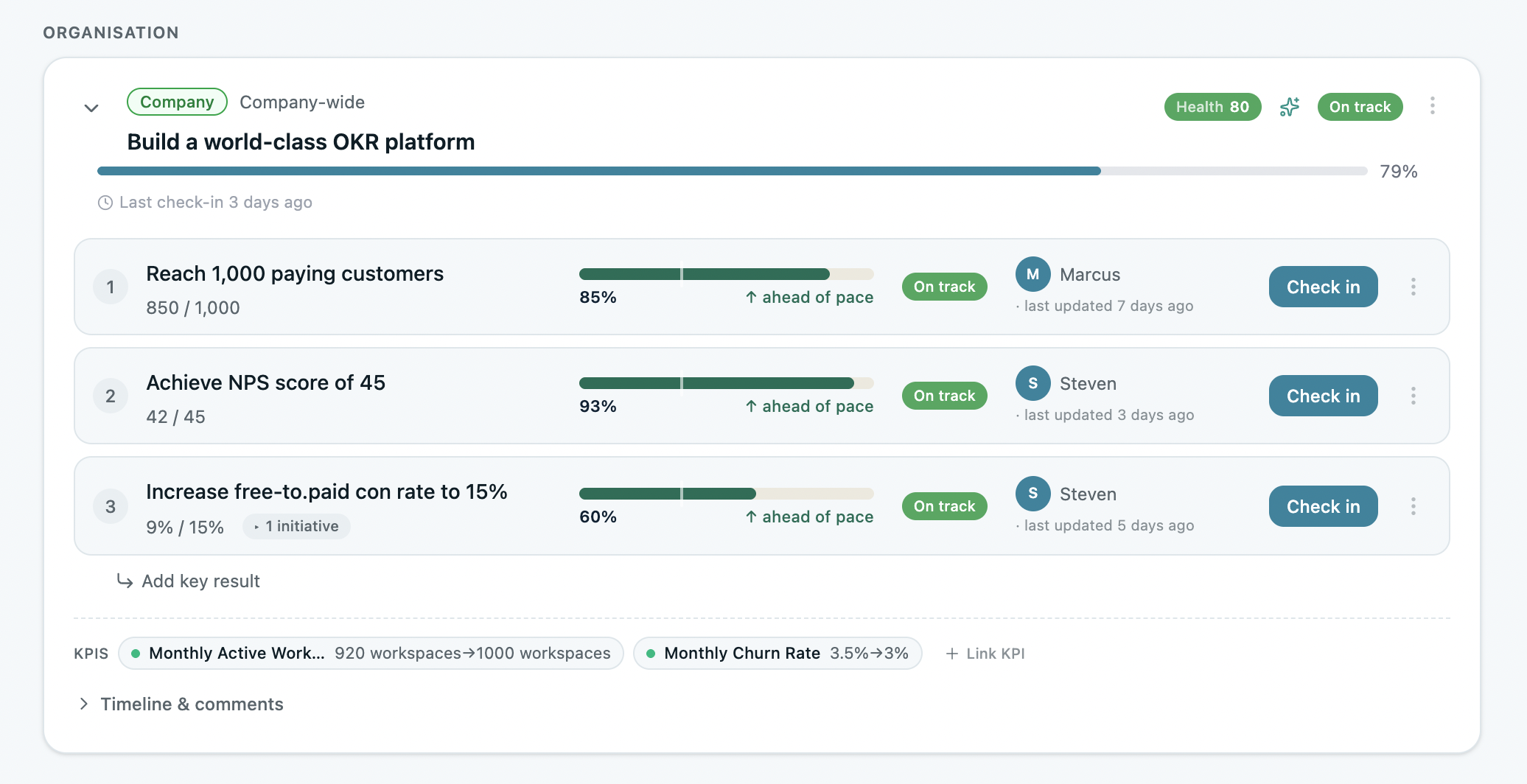
OKRs Tool is employee goal setting software built for the senior operator who needs their team aligned this quarter — without IT approval, procurement cycles, or a consultant. It's the right fit if you're outgrowing spreadsheets, replacing a tool that shut down, or implementing employee goals properly for the first time.
What makes it different from every other tool on this list: flat organization pricing (no per-user fees), required single ownership on every goal before it goes live, and a weekly check-in system that runs automatically without anyone chasing updates.
The data backs the approach. Organizations using OKRs Tool generate a 1:88 return on investment against the same revenue baseline — more than five times the return of enterprise software. Trillium ran their first cycle with 130 employees and zero training sessions. Sensys Gatso moved from Confluence and hit their Q1 targets.
Key features:
- AI-generated employee goals tailored to role and company context
- Required ownership on every Key Result — the 26% completion lift, built in structurally
- Automated weekly nudges via Slack and Microsoft Teams
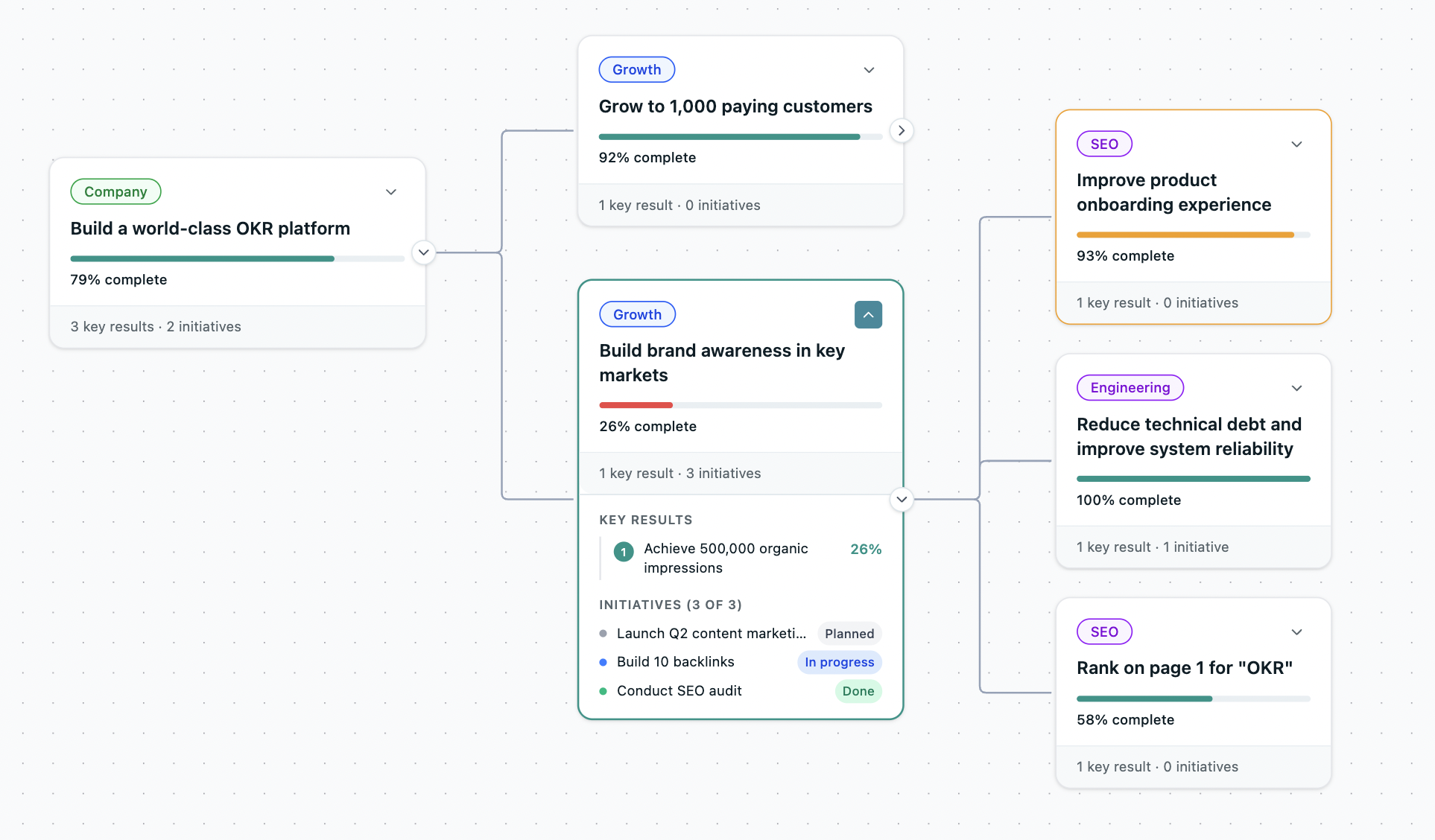
- Alignment map — every employee goal connected to company priorities in one view
- KPI tracking and performance reviews in the same platform
Pricing: Free for 1–5 users. $49/month Scale (6–50). $129/month Expand (51+, SSO + concierge onboarding). G2 Rating: 4.6/5 — "OKRs Tool is extremely cost effective and easy to use — I can set it up in minutes without training anyone. Suitable for our organisation of 150 people." — Mahir, Trillium.
2. Falen
Best for: Growing teams between 20–45 people that have outgrown spreadsheets
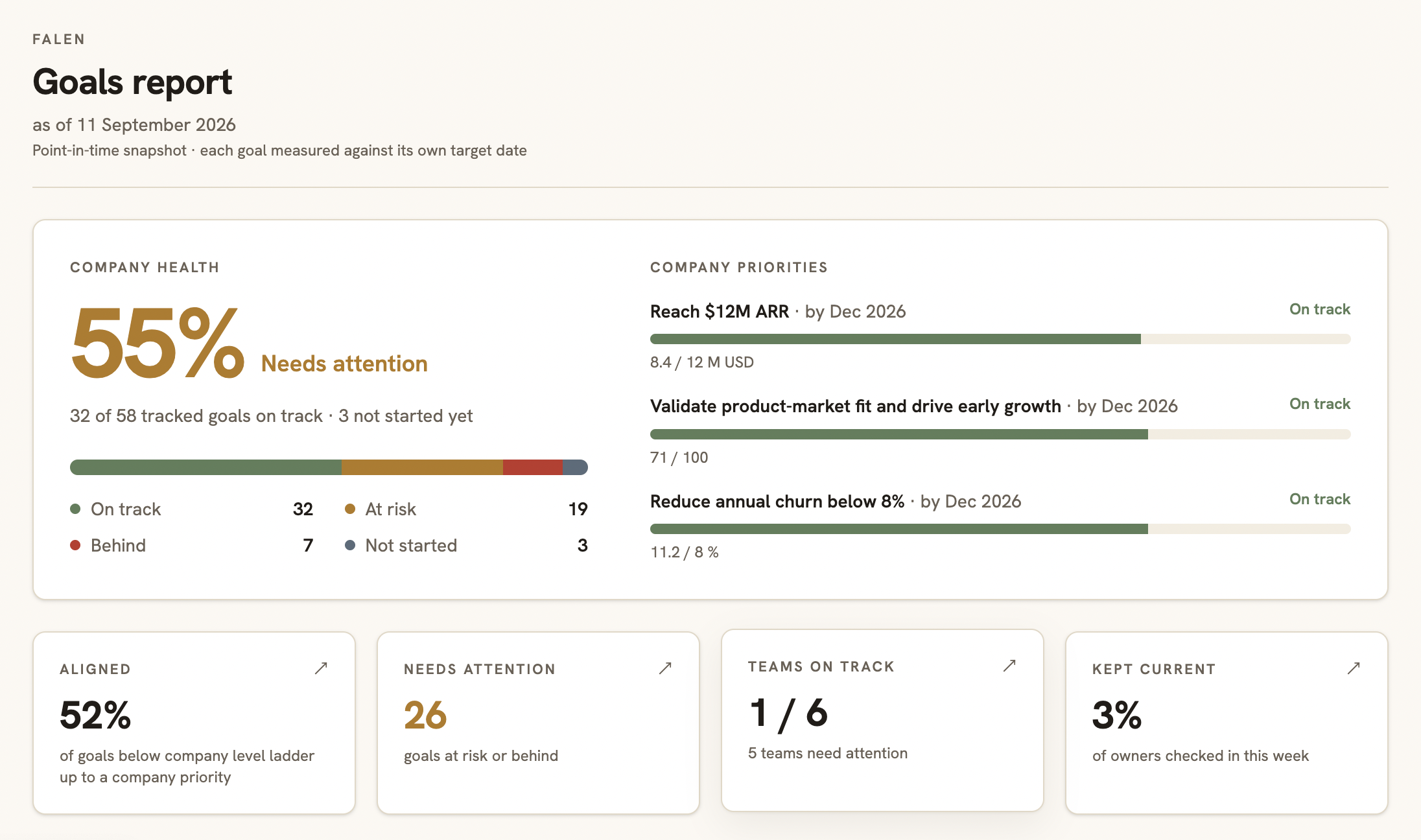
Falen is employee goal setting software built around one specific problem: the spreadsheet that worked at ten people is a mess at twenty. Every hire past your twentieth adds another tab, and half the cells go stale. Falen gives teams one live view of every goal — how they connect, what's at risk, and who owns what — at a flat monthly price with no per-user fees.
What makes it different: at-risk goals surface automatically the moment they slip, not at the quarterly review when it's too late. Each owner gets a one-tap email that opens straight to their goals — just theirs — so updates take seconds and managers stop being the ones chasing.
What I liked: The at-risk flagging is the standout feature — goals that slip surface immediately, not at the end-of-quarter review when there's nothing left to do. The flat pricing model is genuinely refreshing: add your whole team without watching the bill climb with every hire.
What could be improved: It's a thin feature set by design — no KPI tracking, no performance reviews, no structured goal methodology. For teams that just need goal visibility and accountability, that's fine. For teams that need more, it won't be enough.
Pricing: Flat $89/month for your whole company. G2 Rating: N/A
3. Tability
Best for: Metrics-driven teams that want frictionless weekly check-ins
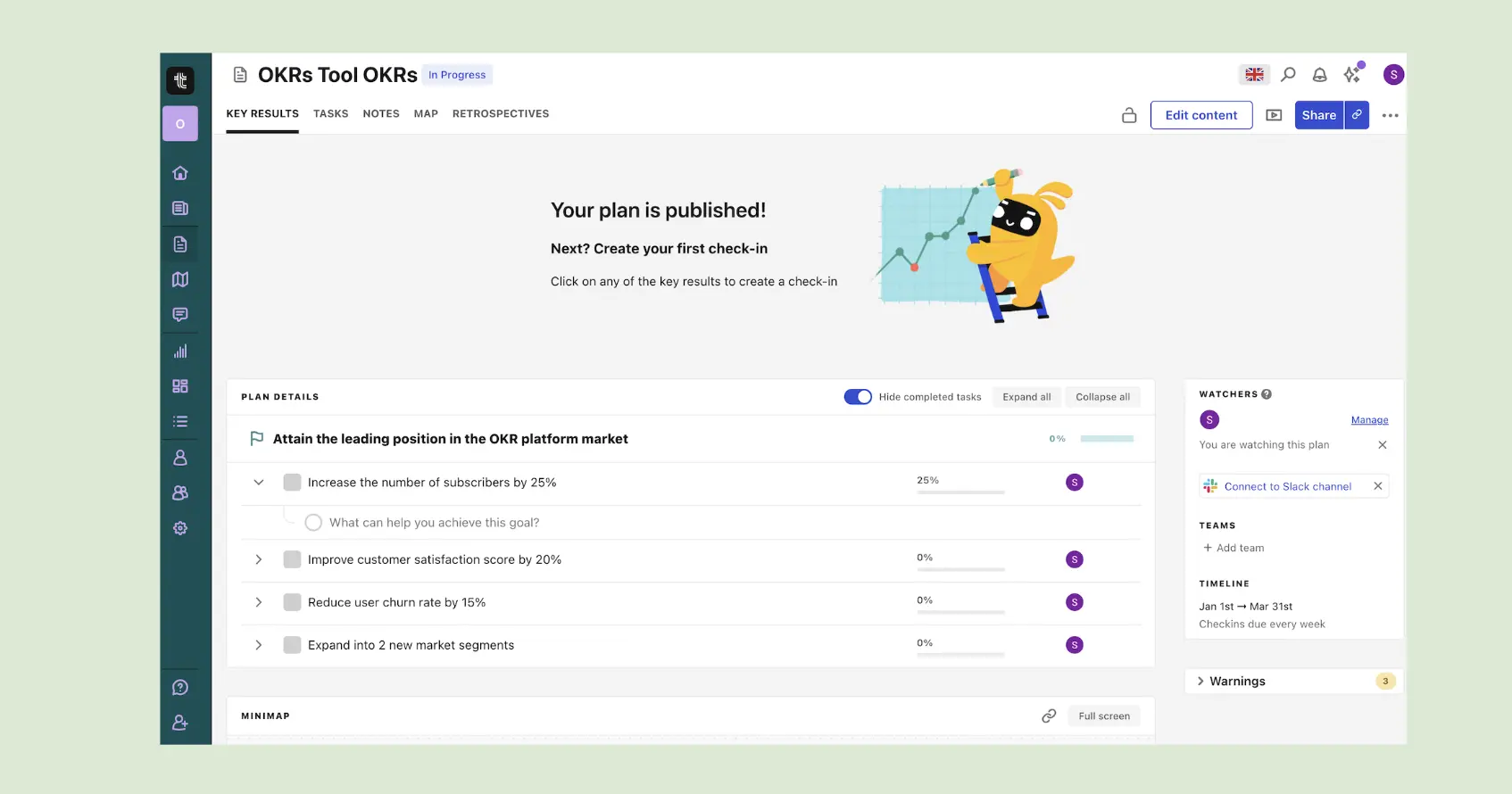
Tability is intuitive employee goal setting software with a motto — "OKRs that don't suck" — that tells you exactly what they're going for. Real-time progress tracking, automated weekly check-ins, and a UI that makes updating employee goals the path of least resistance.
The onboarding was the smoothest of any tool I tested. I had my first objective and key result set up within minutes — no tutorials, no steep learning curve.
What I liked: The user interface is genuinely beautiful, and the onboarding process is the best on this list. Automated weekly check-ins mean employees don't have to be chased — the tool builds the habit for them.
What could be improved: Navigation has a lot of options — sidebar, sub-sidebar, multiple navigation elements — which can overwhelm new users before they find what they need.
Pricing: From $6/user/month. 14-day free trial (credit card required). G2 Rating: 4.7/5
Read our OKRs Tool vs Tability comparison →
3. Perdoo
Best for: Strategy-heavy organizations that want employee goals connected to company KPIs
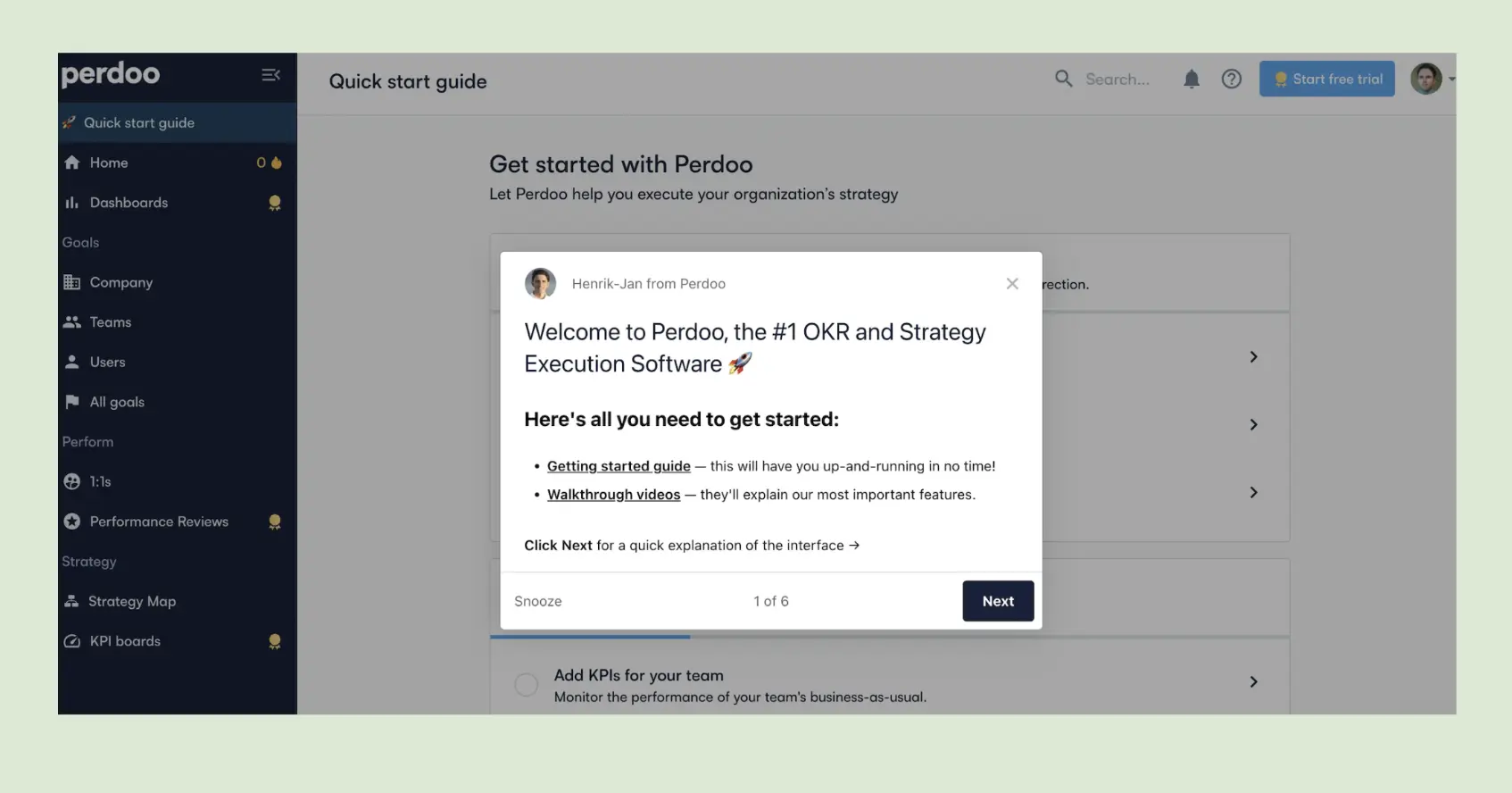
Perdoo is a goal-setting platform that connects employee-level objectives to company strategy through a visual strategy map. If your organization needs every employee goal to ladder up to a KPI or strategic priority — and leadership wants that connection visible — Perdoo delivers it cleanly.
The "Give Kudos" feature is a genuinely nice touch: employees can react when colleagues update their goals, keeping engagement high mid-cycle.
What I liked: The strategy map gives leadership a clear view of how every employee goal connects upward — without a meeting. The Kudos feature keeps motivation high through the messy middle of a cycle.
What could be improved: KPIs take up a lot of space in the dashboard — sometimes more prominent than the OKRs themselves, which felt off for a tool primarily used for employee goal setting.
Pricing: Free for up to 5 users. From €8/user/month (10-seat minimum). G2 Rating: 4.5/5
Read our OKRs Tool vs Perdoo comparison →
4. Weekdone
Best for: Execution-focused teams that want weekly reporting built into the goal system

Weekdone is employee goal setting software with a weekly reporting cadence at its core. It's designed for teams that want to know — every single week — which employee goals are on track, which are behind, and who needs unblocking.
The statistics view is a genuine differentiator: you can see user logins, goal updates, and goals needing attention all in one engagement snapshot. For managers who want to spot disengagement before it becomes a completion problem, this is valuable.
What I liked: The statistics view gives managers an engagement picture that most goal setting tools don't offer. Weekly reporting is baked in — not an add-on.
What could be improved: Navigation gets cluttered quickly past the clean onboarding. It took longer than expected to feel comfortable moving between views.
Pricing: Free for up to 3 users. From $10/user/month. G2 Rating: 4.3/5
Read our OKRs Tool vs Weekdone comparison →
5. Synergita
Best for: HR-led organizations that want employee goals linked to performance development
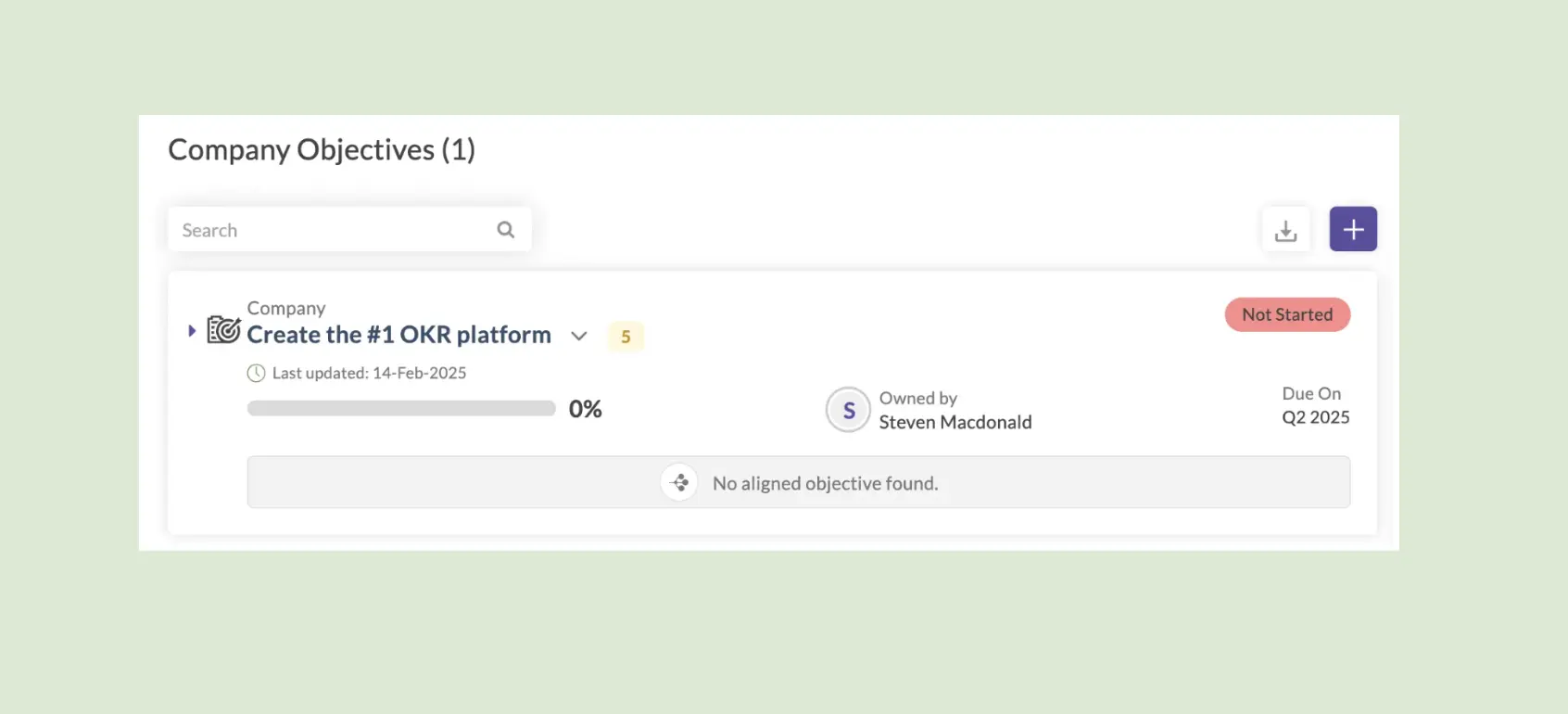
Synergita combines employee goal tracking with performance management and development plans — making it the natural choice for HR teams that want goals to feed directly into review cycles. Setting up a goal was faster here than on almost any other platform I tested.
What I liked: Incredibly fast goal creation — up and running in under 2 minutes. The simplicity is genuine, not stripped-down.
What could be improved: Updating goals proved trickier than creating them. I couldn't find a straightforward way to track progress mid-cycle, which is a significant gap for a tool whose core job is employee goal management.
Pricing: Free forever (limited to 1 company objective). Paid plans on request. G2 Rating: 4.5/5
6. PeopleGoal
Best for: Organizations that want customizable employee goal workflows without rigid processes

PeopleGoal is a performance management platform with a built-in App Store — letting organizations add goal setting, feedback, engagement surveys, and onboarding workflows without coding. What makes it unique: instead of locking you into a rigid process, it gives you the flexibility to build a goal system that fits how your team actually works.
What I liked: The App Store is genuinely differentiated — no other employee goal setting platform offers anything like it. Combined with OKRs, feedback, and engagement tools, it goes well beyond basic goal tracking.
What could be improved: The platform has a learning curve, especially figuring out which apps to set up and how they fit together. Without dedicated onboarding support, the flexibility can become friction.
Pricing: From $4/user/month (minimum $199/month). G2 Rating: 4.6/5
7. Range
Best for: Remote-first teams that want async employee goal check-ins
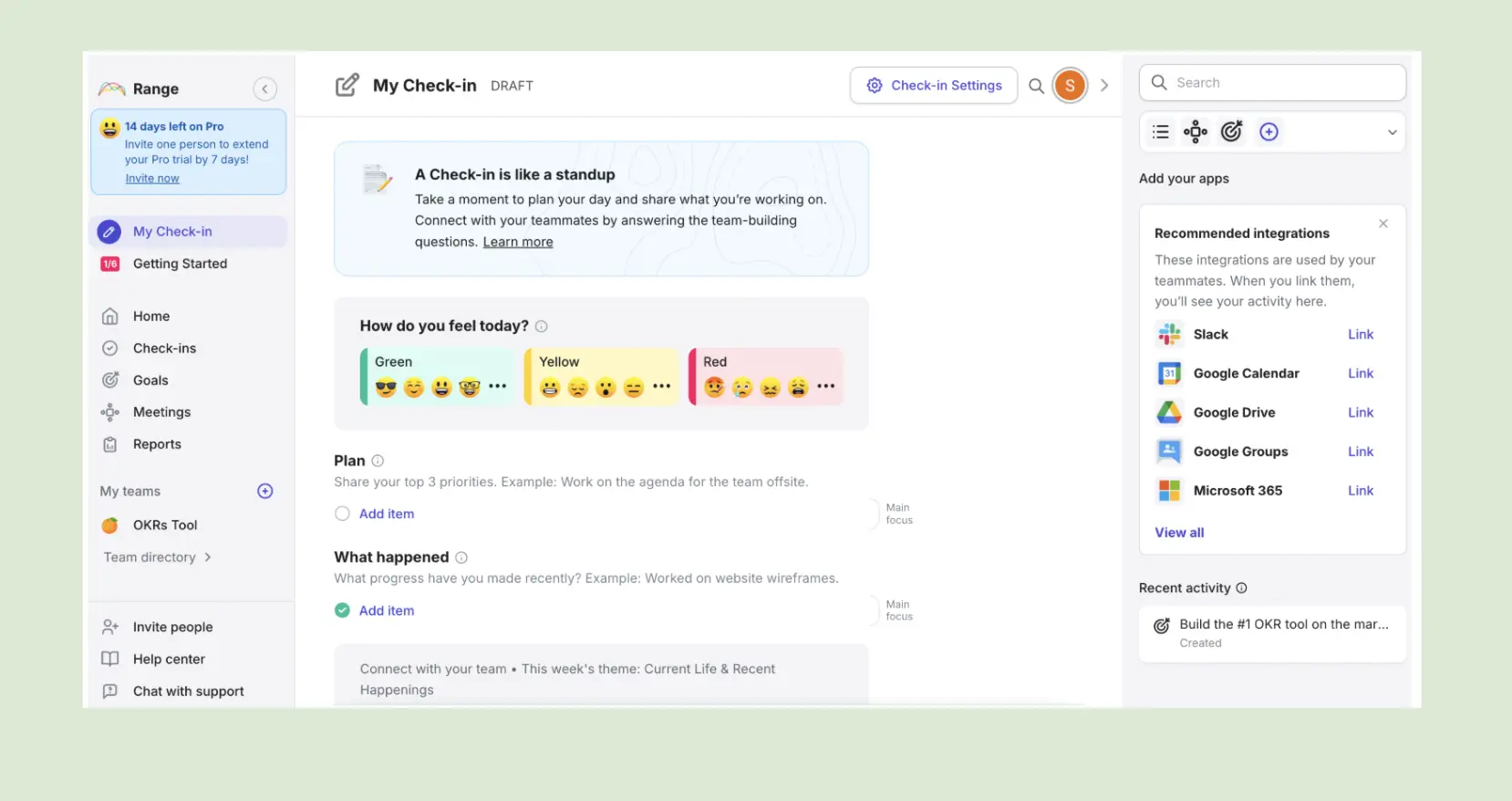
Range is employee goal software built around the belief that synchronous work should feel more asynchronous — and more human. It combines OKRs, async check-ins, mood sharing, and meeting agendas into one workspace. For distributed teams where employees are rarely in the same timezone at the same time, Range provides the goal visibility that would otherwise require a synchronous meeting.
What I liked: Fast, snappy interface — every click feels responsive. Setting up a goal was straightforward, and the in-app support chat made the experience feel personal.
What could be improved: No clear progress forecast or visualization for goals over time. The Key Results section wasn't immediately obvious — sub-goals seem to serve the same purpose but the distinction wasn't clear.
Pricing: Free for up to 12 users (3-goal limit). From $8/user/month. G2 Rating: 4.5/5
8. Effy AI
Best for: Small people ops teams that want AI-assisted employee goal setting and reviews

Effy AI is lightweight performance management that brings AI-powered reviews, goal tracking, and 360° feedback into a simple, approachable workspace. For small teams that need fast, structured goal cycles without the overhead of enterprise HR systems, it's genuinely good value.
What I liked: Extremely easy to use — onboarding a team takes minutes. AI-generated templates reduce review-writing fatigue. The structured employee review form with clear rating scales makes evaluations quick but thorough.
What could be improved: Clearly built for smaller teams — it lacks robust analytics, deeper goal dashboards, and meaningful integrations beyond Slack.
Pricing: Free for up to 5 users. Paid plans on request. G2 Rating: 4.4/5
9. Teamflect
Best for: Organizations where employees live in Microsoft Teams and want goals in the flow of daily work
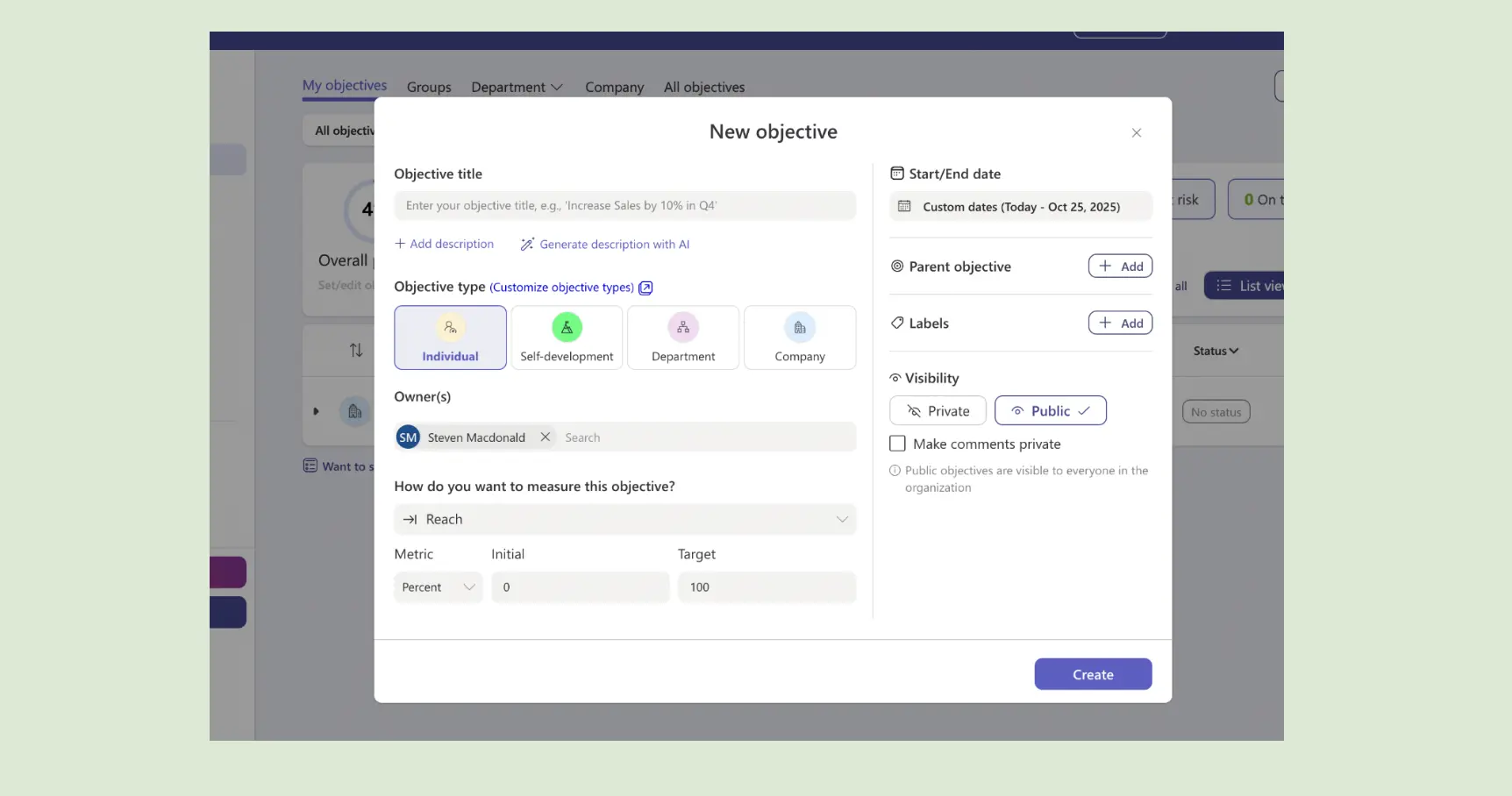
Teamflect is employee goal setting software purpose-built for the Microsoft 365 ecosystem. Employees set, update, and review goals entirely within Microsoft Teams — no context switching, no extra login, no separate tool to open.
For organizations where Microsoft Teams is the primary workspace, this is the strongest option on the list. The Microsoft integration is the best I tested — no other platform comes close.
What I liked: The Microsoft integration is world-class. The ability to toggle goal visibility between private and public during creation is a smart touch. Status filters showing which goals are on-track, behind, or at risk give managers an instant snapshot without opening a separate dashboard.
What could be improved: The progress update pop-up felt cluttered. Choosing goal cycles (monthly vs quarterly) wasn't straightforward — required setting custom dates manually rather than selecting from a standard cadence.
Pricing: Free for up to 10 users. From $7/user/month. G2 Rating: 4.8/5
What the Data Says About Employee Goal Setting
When an employee goal setting program falls apart, the habits around the software are usually the cause, while the software itself is doing what it was built to do.

The benchmark data tells a consistent story: teams in their first goal-setting cycle average 51% completion. By cycle 5+, that rises to 79%. The improvement comes from accumulated habits — the weekly check-in that runs itself, the ownership structure that's understood without explanation, the retrospective that sharpens next quarter's goals automatically.
The implication for software choice: the platform that makes those habits structurally easy to maintain is more valuable than the platform with the longest feature list.
Three questions worth answering before choosing:
Where does friction live? If employees forget to update goals — go for automated check-ins (Tability, OKRs Tool). If leadership lacks visibility — go for alignment mapping (OKRs Tool, Perdoo). If employees are in Microsoft Teams all day — go for embedded (Teamflect).
What's the ownership model? What's the ownership model? Nearly all tools allow shared ownership; only OKRs Tool requires single named ownership before a goal goes live. That structural constraint, rather than any single feature, is what drives the 26% completion lift.
Will the weekly habit hold? The tool that makes weekly updates the path of least resistance is the one your employees will actually use. The 43% completion lift from weekly check-ins is only available if the check-in actually happens.
The Tool You'll Open Every Week Wins
Every platform here has the features. What separates them is what happens after the planning session: the weekly update either keeps happening or it doesn't, and once it stops, the goals go cold no matter how good the tool looked in the demo. The one worth choosing makes the weekly rhythm — write an outcome-based goal, name an owner, check in, close the cycle with a retrospective — the easiest thing to keep doing, not the first thing to fall off.
Where a team lands depends on where it already works. Growing companies of 50–200 people get the most from OKRs Tool, because flat pricing and enforced ownership remove the two things that usually stall a rollout. Teams that live inside Microsoft 365 are better served by Teamflect, metrics-driven scaleups by Tability's frictionless check-ins, and strategy-heavy organizations by Perdoo's alignment map.
The maturity curve rewards whichever tool your team actually keeps using — completion climbs from 51% in cycle one to 79% by cycle five, and that gain comes almost entirely from habits compounding over time. Pick the tool that fits this quarter, start this week, and let the goal setting habits underneath it do the rest.
Data: the ROI of OKRs: 2026 Benchmark Report (330 respondents), the 2026 OKR Benchmark Report (200 organizations), the Goal-Setting Benchmark (280 operations and strategy leaders), and OKRs Tool platform data (876 organizations, 20,952 key results).