OKR coaching runs $1,500 for a single session to $30,000+ for a full quarter — and it's the right spend when the problem is knowledge. When the real problem is that nobody updates progress between check-ins, no facilitator fixes it: teams with a weekly check-in habit complete 43% more OKRs, and that's infrastructure, not instruction.
Teams searching for an OKR coach have usually already done the reading. They've been through Measure What Matters, they've run the offsite, they can define an objective and a key result without hesitating. What they want is someone who can make the programme work — and keep it working once the engagement ends.
That's a fair thing to want, and a good coach delivers it. But the money only buys a result if it's pointed at the actual problem. Coaching fixes what a team doesn't know. It doesn't fix what a team doesn't do — and at the 50-to-200-person stage, the second is far more common than the first. This guide covers what an OKR coach does, what the engagements cost, how to find a good one, and how to tell which of those two problems you have before you spend anything.
What Is OKR Coaching?
OKR coaching is a structured engagement - usually with an external consultant or facilitator - designed to help a team implement or improve their OKR programme.
Depending on the coach and the scope, it typically includes some combination of framework training, facilitated planning sessions, check-in design, and ongoing advisory support.
Some coaches work with leadership teams only. Others work across the full organization, running workshops with department heads and individual contributors. Some engagements are one-off - a single planning session or a half-day workshop. Others run for a full quarter or longer, with regular touchpoints between cycles.
The common thread is that an OKR coach brings outside expertise and an outside perspective - someone who has seen the framework work in multiple contexts and can help a team avoid the mistakes that typically kill programmes in the first two cycles.
What Does an OKR Coach Do?
In practice, an OKR coach does some or all of the following - depending on the scope of the engagement and where the team is starting from.
They teach the framework. The difference between an objective and a key result, the logic of stretch goals, how to score OKRs honestly without tying them to performance reviews - these are learnable concepts that benefit from instruction and practice rather than just reading about them.
They facilitate planning sessions. A skilled coach can run a workshop that produces sharper objectives and more honest key results than a team would write on their own. They challenge vague language, push back on targets that are really standing responsibilities dressed up as quarterly bets, and help the room reach alignment before the session ends.
They design the check-in cadence. How often, in what format, who attends, what gets discussed - the check-in is where OKR programmes succeed or fail, and a coach who has seen both outcomes can help a team build a rhythm that actually holds.
They diagnose what went wrong. If an OKR programme has already failed and the team isn't sure why, a coach provides an outside perspective that internal stakeholders are too close to offer.
How Much Does OKR Coaching Cost?
OKR coaching varies significantly in cost depending on the scope, the coach's experience, and the size of the organization.
For a single facilitated planning session with a freelance OKR coach, expect to pay between $1,500 and $5,000. For a full-quarter engagement that includes training, facilitation, and ongoing advisory, costs typically range from $10,000 to $30,000. Enterprise-level programmes with a named consultancy can run significantly higher.
As a benchmark, OKRs.com founder Ben Lamorte - one of the most recognized names in OKR coaching - prices workshops from $7,500 and full engagements from $12,000, typically structured around a single-cycle commitment.
For teams at the 50-to-80-person stage, the more relevant question is whether the return justifies the investment - and that depends entirely on what problem the coaching is solving.
A $5,000 facilitated planning session that produces objectives the team actually owns and tracks for a full quarter is excellent value. The same spend on a team whose real problem is that nobody updates progress between check-ins is less likely to move the needle.
Do I Need an OKR Coach or a Better Tool?
This is the question most teams should ask before committing to a coaching engagement — and the honest answer requires being precise about what's actually broken.
The 2026 OKR Benchmark Report across 200 organizations makes the infrastructure case precisely: teams with a weekly check-in habit complete 43% more OKRs than those reviewing monthly or ad hoc. Teams that launch OKRs in under a week achieve up to 50% higher completion rates. Teams with a single named owner per Key Result see 26% higher completion rates — a structural fix, not a coaching conversation.
From the OKR Intelligence Report 2026: 83% of organizations are now using AI in their OKR process — including AI that drafts goals, flags at-risk Key Results mid-cycle, and synthesizes retrospective themes. For most teams at the 50–200 person stage, AI-powered OKR software is a faster and more durable solution to the problems coaching is hired to solve.
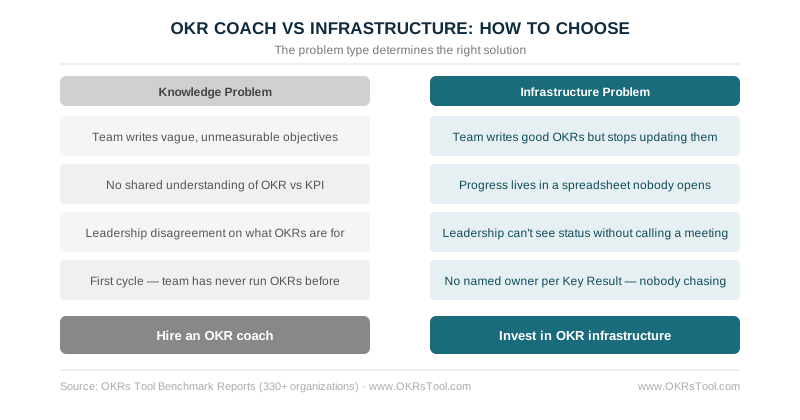
If the team consistently writes objectives that are too vague to be meaningful, doesn't understand how to score key results, or has philosophical disagreements about what OKRs are for — those are knowledge and alignment problems. Coaching is the right investment.
If the team knows how to write good objectives but the check-in never happens, progress lives in a spreadsheet nobody opens, and leadership can't see where things stand without calling a meeting — those are infrastructure problems. A better OKR platform will solve them faster and more durably than a coaching engagement.
At the 50–200-person stage, the majority of teams who think they need OKR coaching actually need three things: an OKR tool that makes progress visible without manual effort, a check-in cadence that runs on nudges rather than willpower, and an alignment view that connects individual work to company objectives without a meeting to maintain it.
The honest middle ground is both — coaching for the foundation, infrastructure for the execution. A skilled coach runs the first planning session and teaches the team to write objectives worth tracking. A well-chosen tool keeps those objectives visible, the check-in alive, and the progress honest between sessions.
How to Find an OKR Coach
The best OKR coaches come from one of three places: direct referral from a founder or operator who has worked with them, the certified coach networks run by organizations like There Be Giants, OKR Institute, or What Matters, or the growing community of independent consultants who specialize in the framework.
When evaluating a coach, the most important question isn't their certification — it's their experience with companies at your stage. An OKR coach who has primarily worked with enterprise organizations will bring different instincts to a 70-person team than one who has run programmes at the 50–200-person level repeatedly.
Ask for specific examples. Ask what went wrong in past engagements and how they handled it. The answer tells you more than any credential.
How to Get Started With OKR Coaching
If you've decided that coaching is the right investment, the most effective way to structure the engagement is to start narrow and expand based on results.
Begin with a single facilitated planning session for the leadership team. Use that session to produce company-level OKRs for the next quarter — and to give the leadership team a direct experience of what well-facilitated OKR planning feels like. If the session produces better goals and more honest conversation than your last planning cycle, the case for a deeper engagement becomes easy to make internally.
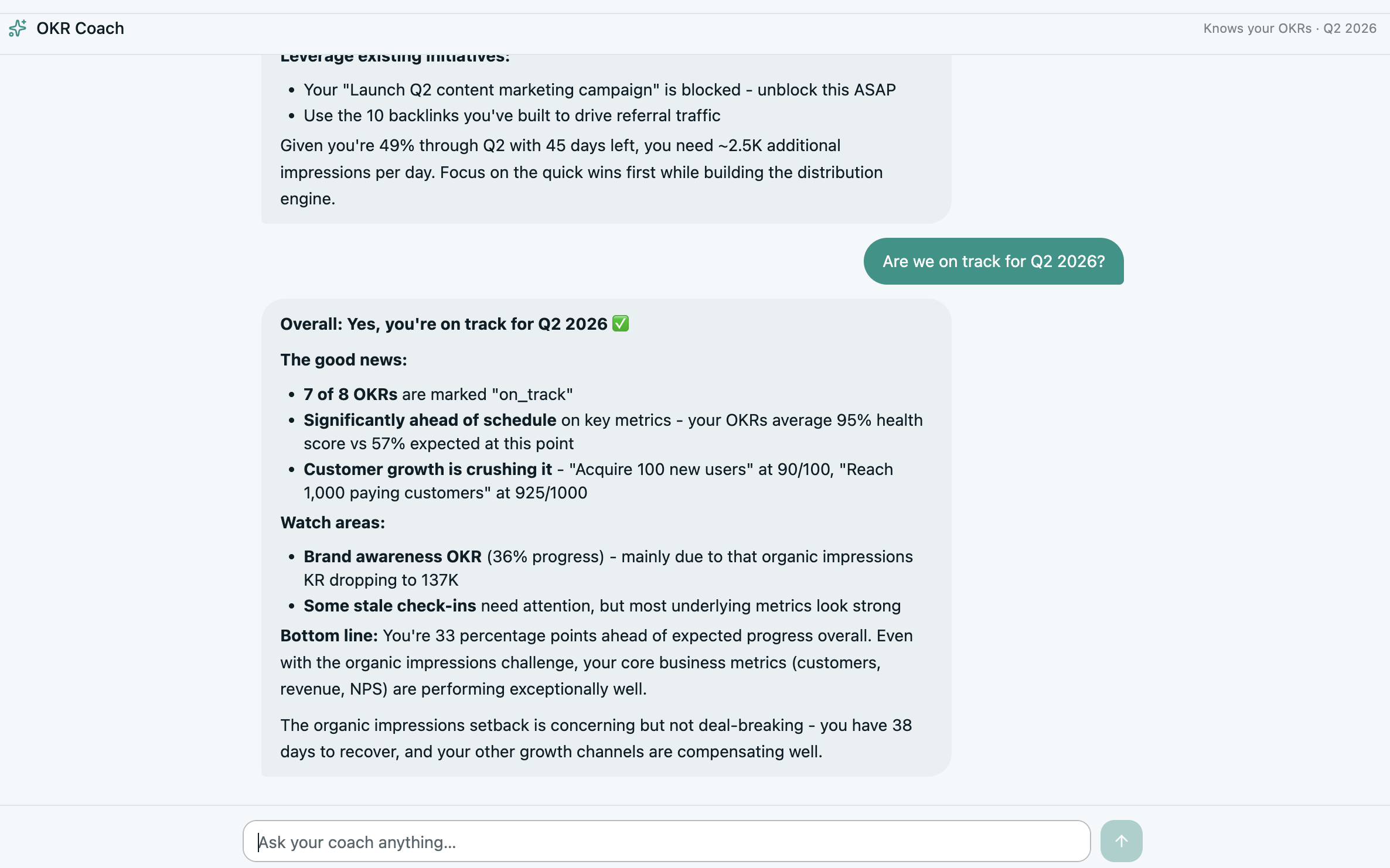
Pair the coaching engagement with a tool from day one. The objectives produced in the planning session should live somewhere the team can see them, update them, and be nudged about them — not in the slide deck from the workshop. The combination of good facilitation and a lightweight OKR tool is what separates programmes that take hold from ones that fade after the first cycle.
The goal of OKR coaching isn't dependency on a coach. It's a team that can run the process independently — writing meaningful objectives, running honest check-ins, and using the retrospective to improve each cycle. A good coach works toward making themselves unnecessary. The right tool makes sure the habits they build don't disappear when the engagement ends.
Data: The 2026 OKR Benchmark Report (200 organizations), OKR Intelligence Report 2026 (222 organizations). Coaching cost ranges based on published pricing from OKRs.com and market rates for freelance and consultancy OKR engagements.