
At 50–200 people, you're past the scrappy early stage but nowhere near enterprise scale. You need OKR software that makes alignment visible, enforces ownership, and keeps the weekly execution habit alive — without a four-week implementation project or a per-user cost that compounds every time you hire. This guide covers why the 50–200 stage is different, what the data shows, and how OKRs Tool is built specifically for it.
The 50–200 person stage is the most underserved segment in the OKR software market.
Tools built for small teams — five or ten people — are too lightweight. They lack the alignment visibility, ownership enforcement, and cascade infrastructure that become critical once you have four or five departments running parallel OKR cycles. Tools built for enterprise — 500 to 5,000 people — are engineered for governance, compliance, and executive reporting. At 80 people, you don't have those problems. You have different ones.
The result: growing organizations at this stage consistently overpay for complexity they don't need or underpay for tools that can't keep pace. The ROI data puts a number on the cost: organizations using enterprise OKR software generate a 1:16 return on investment. Organizations using purpose-built tools designed for the growth stage generate 1:88 — more than five times the return from the same revenue baseline.
The gap isn't features. It's fit.
Why the 50–200 Person Stage Is Different
At 50 people, three things happen at the same time that don't happen at 15 or at 500.
Alignment becomes a structural problem. At 15 people, everyone knows what the company is working on — you can shout it across the office. At 50, that stops working. The product team's quarterly priorities and the sales team's quarterly priorities can diverge significantly without leadership realizing it until a missed quarter surfaces the gap. 65% of teams admit their goals aren't linked to company strategy — and this becomes especially acute in the 50–100 person range, when the organization is large enough to silo but not yet large enough to have dedicated alignment infrastructure.
Ownership accountability can't be assumed. At 15 people, everyone knows who owns what. At 80 people, shared ownership becomes the default — and shared ownership means no ownership. 50% of all Key Results across growing organizations have no named owner. The structural fix — requiring one named person per Key Result before the goal goes live — needs to be built into the software, not enforced through culture.
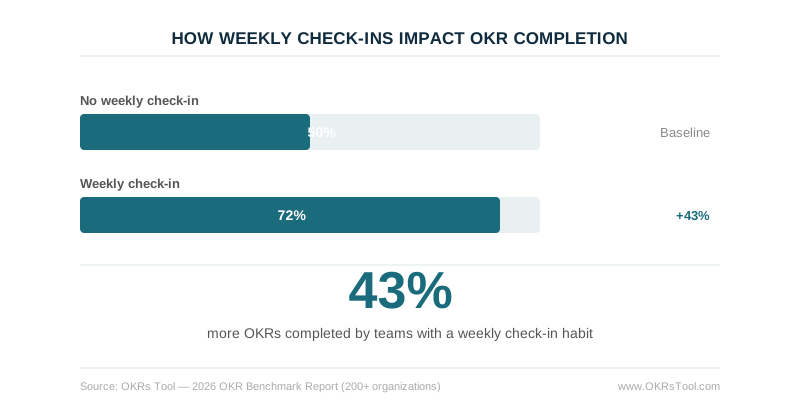
The weekly habit needs infrastructure, not discipline. A 12-person team can maintain a weekly OKR check-in through sheer discipline. A 120-person organization cannot. The check-in needs to run automatically — nudging named owners, surfacing at-risk goals, and delivering progress to leadership — without anyone scheduling it. Teams with an automated weekly check-in habit complete 43% more OKRs than those reviewing monthly or ad hoc.
What the Benchmark Data Shows About This Stage
The 2026 OKR Benchmark Report across 330 organizations and the OKR Intelligence Report 2026 across 222 organizations in the 51–200 employee range tell a consistent story about what drives results at this stage.
Speed of launch predicts completion. Teams that complete the full OKR cascade — from company objectives finalized to all team Key Results set — within the same week see up to 50% higher completion rates. Only 16% of organizations currently achieve this. The other 84% spend the first three to four weeks of the quarter catching up.
Ownership is the highest-leverage structural fix. Teams with a single named owner per Key Result see 26% higher completion rates. The organizations generating the best results treat ownership as a hard gate — a Key Result that can't go live without a named person accountable — not a field that can be left blank.
The maturity curve is real and compounding. Cycle 1–2 teams average 51% completion. Cycle 5+ teams average 79%. The improvement doesn't come from writing better goals each quarter. It comes from the accumulated discipline of weekly check-ins, honest OKR scoring, and end-of-cycle retrospectives that produce three specific changes per cycle.

AI is now standard — but the analysis layer matters more than the writing layer. 83% of organizations at this stage use AI in their OKR process. The OKR Intelligence Report 2026 found that teams using AI for both writing and mid-cycle analysis accept a low score on missed goals only 14% of the time — compared to 35% for writing-only teams. The AI that flags at-risk goals mid-cycle changes behavior. The AI that just helps write goals doesn't.
The Five Features That Define OKR Software for This Stage
Every OKR platform has a feature list. The features that actually predict results at 50–200 people are more specific.
Required ownership — not optional assignment
The difference between a tool that asks you to assign an owner and a tool that requires one before the goal goes live is the difference between a suggestion and a structural fix. At this stage, the soft prompt gets ignored. The hard gate doesn't.
OKRs Tool treats ownership as a required field. Every Key Result must have a named owner before it enters the active cycle. That owner receives automated check-in nudges, appears in the alignment map, and owns the OKR score at cycle end.

Automated weekly check-ins — not meeting-dependent rhythm
At 100 people across five teams, a weekly check-in that requires someone to schedule it will eventually stop being scheduled. Automated nudges — delivered via Slack or MS Teams at the same time every week — remove the dependency on discipline and replace it with infrastructure.
OKRs Tool's Slack integration delivers nudges to named owners weekly, surfaces at-risk Key Results to leadership automatically, and compiles a cycle summary without anyone pulling a report.
Live alignment map — not a quarterly planning slide
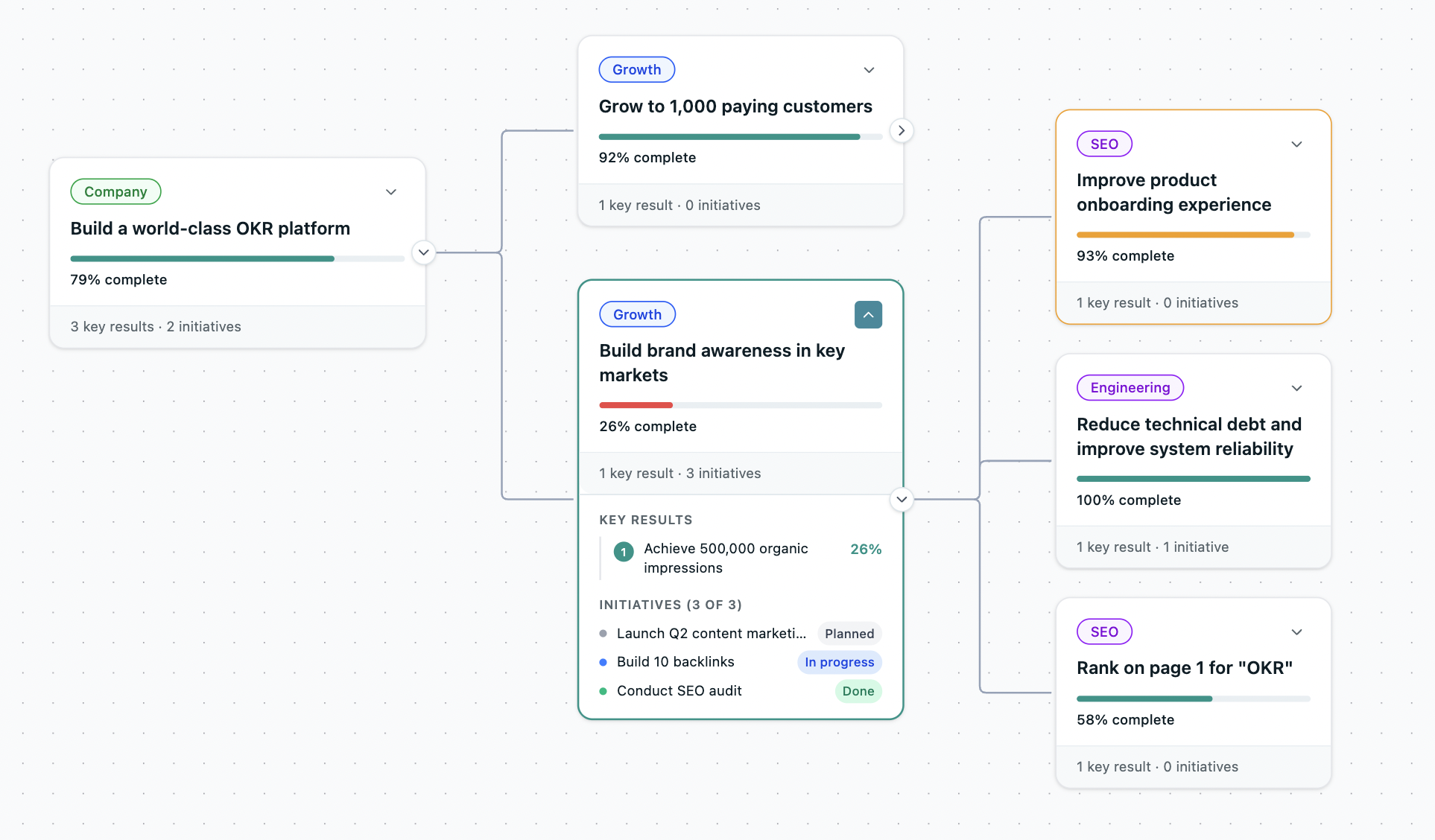
The alignment map is the feature that makes the 50–200 person stage manageable. Every team's Key Results connected to company priorities in a single live view — updated automatically as goals are created and progress is tracked — means leadership sees where the quarter is going without a status meeting.
AI that flags at-risk goals — not just drafts them
AI-generated OKRs reduce first-cycle friction. But the AI feature that changes mid-cycle behavior is at-risk flagging — surfacing which Key Results are below the progress trajectory needed to hit their target, before week ten when intervention is no longer possible.
OKRs Tool's AI Coach analyzes check-in frequency, progress velocity, and KR quality to flag goals that are drifting — and suggests specific recovery actions. The OKR Intelligence Report 2026 finding: 7% of off-track Key Results are simply abandoned with no revision or escalation — the Invisible OKR pattern. AI flagging closes this structurally.
Flat pricing — not per-user growth tax
Per-user pricing that looks manageable at 30 people becomes a material budget decision at 100. OKRs Tool's flat pricing — $49/month for 6–50 users, $129/month for 51+ — means the cost doesn't change as headcount grows within each tier. A 45-person team and a 50-person team pay the same amount.
For choose okr software decisions at this stage, pricing predictability is underweighted in most evaluations and overweighted in practice — because it determines whether the tool gets expanded to the full team or quietly limited to a subset of leaders.
How OKRs Tool Is Built for This Stage
OKRs Tool was designed specifically for the 50–200 person problem. Not a simplified enterprise tool. Not a scaled-up small-team tool. A platform built from scratch around the execution habits the benchmark data shows generate the highest returns at this specific size.
The full feature set at this stage:
OKR planning and writing — AI-assisted goal drafting, cascade structure from company to department to team, and the baseline-to-target formula built into the KR creation flow. Our analysis of 7,857 Key Results found 52% were tasks or KPIs in disguise — the AI writing layer addresses this at the source.
KPI tracking — KPIs tracked alongside OKRs in the same workspace. Health metrics and outcome metrics visible together without switching tools.
Performance reviews and 360 feedback — OKR delivery scores connected to performance review cycles. KR completion rates surface automatically alongside competency ratings — no manual compilation.
1:1 meetings — structured check-ins between managers and team members, built around OKR progress and weekly priorities. Action items tracked week to week.
Mid-cycle and end-of-cycle reviews — MBR, QBR, and retrospective formats built into the cycle. OKR data ready before the session starts, no manual compilation required.
Real Results at This Stage
Trillium — 130 employees Ran their first cycle with zero training sessions. The alignment map replaced the all-hands as the primary visibility mechanism for leadership. First-cycle completion rate above the benchmark average.
Tinaba — Italian fintech Started top-down on the free plan. By cycle two, KR owners were driving their own updates. Weekly reviews shifted from status reporting to outcome conversations.
Firmaway — 27 employees Previous OKR platform removed them mid-cycle with no warning. Two years of OKR history migrated to OKRs Tool, 27 people set up, full system live within days. "Simple yet impactful." — Guido, HR Manager.
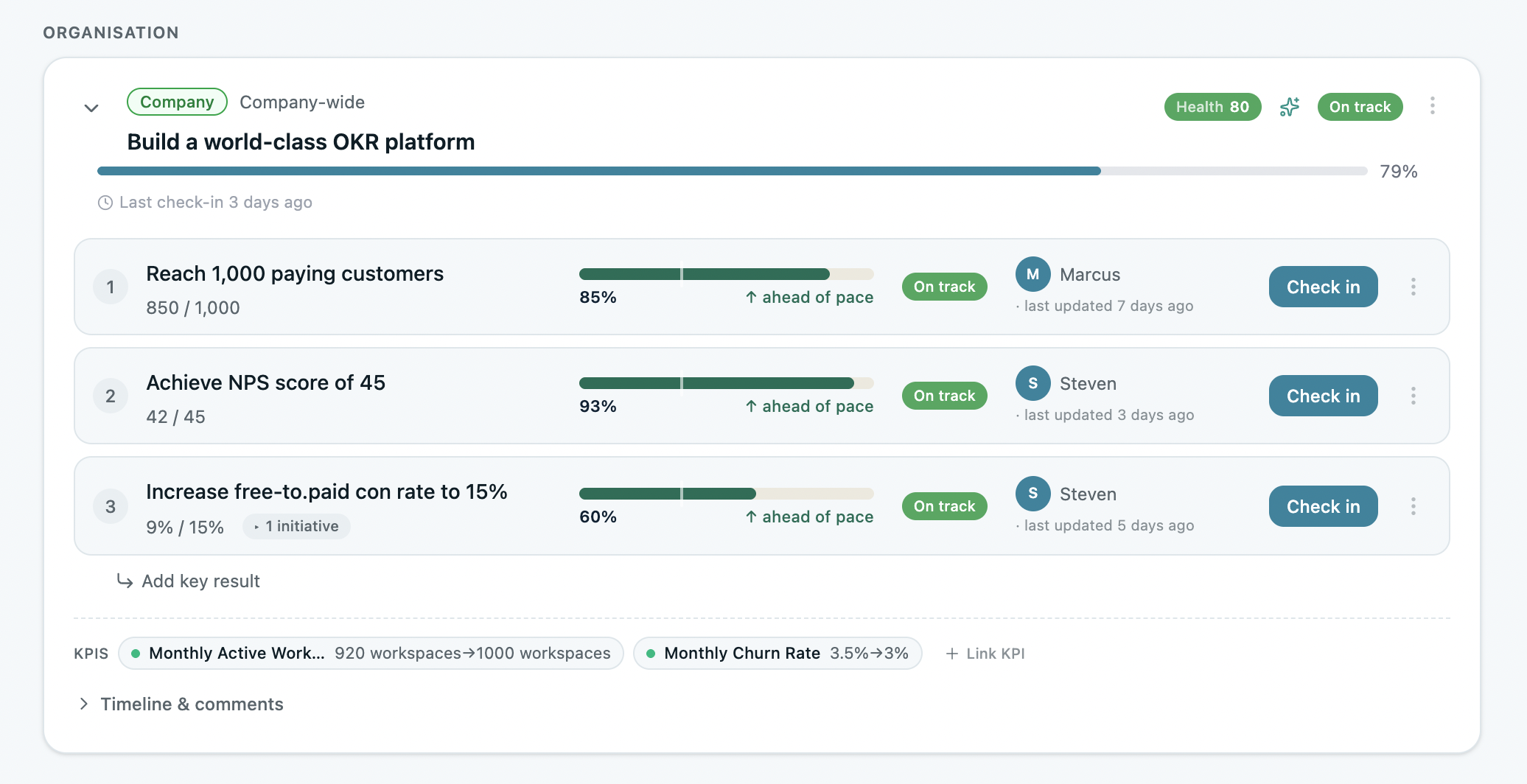
The OKR adoption data across OKRs Tool customers at 50–200 people shows a consistent pattern: first-cycle completion averages 51%, consistent with the benchmark. By cycle five, the same organizations average 79%. The compounding effect of required ownership, automated check-ins, and honest retrospectives is visible in the data within three cycles.
OKRs Tool vs Enterprise Alternatives at This Stage
Final Thoughts
The 50–200 person stage is where OKR software choices have the most impact on organizational performance — and where the market has historically offered the least relevant options. Enterprise tools are overbuilt and underperform on ROI. Small-team tools are underbuilt for the alignment and ownership requirements that emerge past 50 people.
OKRs Tool was designed for this gap. The benchmark data — 1:88 ROI, 43% check-in lift, 26% ownership lift, 50% fast-launch lift — is produced by organizations running the structural habits the platform is built to enforce.
The best OKR software for a 50–200 person company isn't the tool with the longest feature list. It's the one that makes the weekly execution habit structurally unavoidable — and gets your team to a live first cycle before the quarter is already a third over.
Data: The ROI of OKRs: 2026 Benchmark Report (330 respondents), The 2026 OKR Benchmark Report (200+ organizations), OKR Intelligence Report 2026 (222 organizations, 51–200 employees, technology sector).