Built from 20,952 real Key Results, where 52% were tasks in disguise. 40+ outcome-based examples across six functions, with the data behind each.
Steven Macdonald
5 Mins read
July 12, 2026
Across 20,952 Key Results written by real teams, one finding dominates: 52% were tasks or KPIs in disguise. The examples below show what outcome-based Key Results actually look like across six functions — each describing a measurable change from a baseline to a target, not a piece of work to be completed.
The difference between a Key Result that drives performance and one that doesn't is usually a single sentence — the line between an OKR that shapes the quarter and one that gets ignored. "Launch new onboarding flow" describes work. "Increase Day 7 activation from 34% to 52%" describes impact. The first is a task; the second is a commitment the whole team can track weekly.
The most common underperforming verbs in the platform data are Complete, Launch, Conduct, Implement, and Build. They describe work being done, not what changes as a result. Teams with clear single ownership on each Key Result see 26% higher completion, and teams that skip the weekly check-in are 3x more likely to abandon their OKRs entirely. The examples below are built from what actually performed.
Free OKR Writing Guide
Step-by-step formulas for outcome-based Key Results, common mistakes with before-and-after fixes, and templates you can copy for your next cycle.
There's one question that separates a Key Result from a metric: can you track this every week forever? If yes, it's a KPI rather than a Key Result — a health metric that runs continuously. A Key Result describes a time-bound change from a specific baseline to a specific target, and then it's done.
The formula every example below follows is the same: improve a business outcome for a specific segment, from a baseline, to a target, by the end of the quarter. "Improve Day 7 activation rate for new sign-ups from 34% to 52% by end of Q3" carries all four elements. "Improve onboarding" carries none of them.
The Output Trap: What Most Teams Write
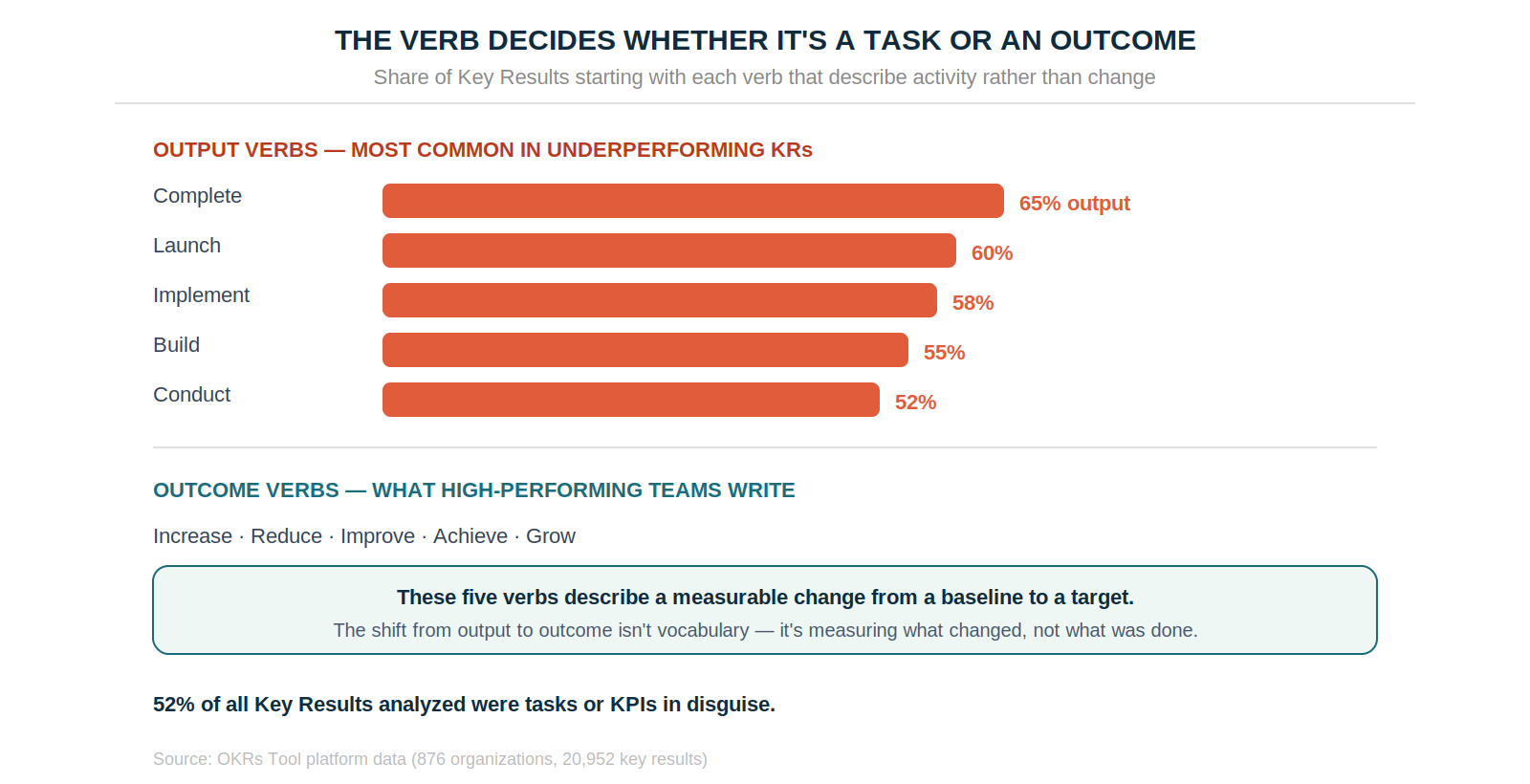
The verb a Key Result starts with is the strongest early signal of whether it's an outcome or a task. A verb analysis across the platform data makes the pattern visible.
The five verbs most common in activity-based Key Results are Complete (65% output), Launch (60%), Implement (58%), Build (55%), and Conduct (52%). Each describes an action being taken rather than a result being produced. The five verbs most associated with Key Results that actually move metrics are Increase, Reduce, Improve, Achieve, and Grow.
The shift from output to outcome isn't about vocabulary. A team can write "Increase feature usage" and still be measuring the wrong thing if there's no baseline, no target, and no owner. But the verb is where the diagnosis starts — and 52% of all Key Results analyzed failed this first test.
Key Results Examples by Function
The 40+ examples below are grouped across six functions — Sales, Product, Marketing, Engineering, Customer Success, and People. Each Objective carries three outcome-based Key Results, every one written as a measurable movement from a baseline to a target. Note where each function tends to slip: sales toward continuous quota metrics, product toward sprint deliverables, marketing toward publishing cadence, engineering toward shipping counts, customer success toward activity like QBRs completed, and people toward process completion like reviews delivered.
Sales
Objective
Build an enterprise pipeline that funds Q4 growth
Increase enterprise MQL-to-SQL conversion from 18% to 32%
Reduce average MQL-to-first-touch time from 3 days to same day
Achieve 70%+ of SQLs meeting ideal customer profile criteria
Objective
Convert our best-fit accounts faster without discounting
Reduce enterprise sales cycle from 95 days to 65
Increase demo-to-proposal rate from 45% to 70%
Shorten proposal-to-signature cycle from 14 days to 8
Objective
Make expansion revenue a reliable second engine alongside new business
Grow expansion MRR from 18% to 28% of total new MRR
Increase upsell rate among month 6–12 accounts from 14% to 24%
Close tier-upgrade conversations with 30 qualifying accounts
Objective
Recover churned accounts that left for the wrong reasons
Re-engage 60 churned accounts from the last 12 months
Achieve win-back rate of 12%+ among contacted accounts
Reduce average win-back sales cycle to under 30 days
Product
Objective
Make the path to value so clear new users don't need support
Increase Day 7 activation from 34% to 52%
Reduce time-to-first-value from 6 days to 2
Reduce onboarding-related support tickets by 40%
Objective
Improve product stickiness so users keep coming back
Increase DAU/MAU ratio from 0.22 to 0.35
Reduce Day 30 churn from 42% to 28%
Increase average sessions per active user per week from 2.1 to 3.4
Objective
Make the product fast enough that speed becomes a differentiator
Reduce p95 page load time from 3.2s to under 1.5s
Achieve 99.9% uptime across all core product surfaces
Reduce critical bug reports post-release by 60%
Objective
Turn our most powerful feature into our most-used one
Increase feature adoption among active users from 22% to 45% within 30 days
Achieve 4.5+ CSAT among users who have used the feature 3+ times
Reduce support tickets related to feature confusion by 50%
Marketing
Objective
Make organic search a predictable, scalable acquisition channel
Grow organic MQLs from 90 to 180 per month
Increase top-3 keyword rankings from 14 to 35
Achieve 40%+ of total website traffic from organic by Q4
Objective
Turn content into a conversion asset, not just a traffic source
Increase blog-to-trial conversion from 0.8% to 2.1%
Grow email subscribers from organic content from 320 to 800
Achieve average time-on-page of 3:30+ across top 20 articles
Objective
Make paid acquisition profitable enough to scale with confidence
Achieve blended paid ROAS of 4.2x (up from 2.8x)
Reduce cost-per-trial from $68 to $40 across Google and LinkedIn
Increase paid trial-to-paid conversion from 11% to 18%
Objective
Increase brand visibility among high-intent buyers in our category
Grow branded search impressions from 40K to 80K per month
Increase direct traffic from 12K to 20K sessions per month
Earn 10 new media placements in relevant B2B publications
Engineering
Objective
Build a platform customers can depend on without thinking about it
Achieve 99.95% uptime across all production services
Reduce mean time to recovery from 45 min to under 10
Reduce P1 incidents from 8 per month to 2
Objective
Remove the bottlenecks that slow down shipping
Reduce commit-to-production cycle time from 4 days to 1
Increase deployment frequency from 3 per week to daily
Reduce failed deployments from 18% to under 5%
Objective
Reduce the cost of defects by catching them earlier
Increase test coverage from 42% to 75% across core services
Reduce critical post-release bugs by 60%
Achieve zero P0 regressions in production for 8 consecutive weeks
Objective
Reduce technical debt without stalling product delivery
Reduce average page load time from 3.2s to under 1.5s
Migrate 100% of legacy authentication flows to new system
Reduce infrastructure cost per active user by 30%
Customer Success
Objective
Make the first 90 days so strong churn becomes an exception
Increase 90-day retention from 68% to 80% across all segments
Achieve NPS of 45+ among customers active for 60–90 days
Reduce churn among accounts with health score below 60 from 35% to 18%
Objective
Turn successful customers into a growth engine
Increase net revenue retention from 104% to 118%
Close tier-upgrade conversations with 25 qualifying accounts
Generate 40+ referral leads from existing accounts this quarter
Objective
Turn at-risk accounts into deeply engaged ones
Increase product adoption (3+ features) among at-risk accounts from 20% to 40%
Achieve 85%+ QBR completion rate across enterprise accounts
Reduce time-to-value for new enterprise accounts from 30 days to 14
Objective
Make support so good customers stop needing it
Reduce average first response time from 8 hours to under 2
Achieve CSAT of 92%+ across all support interactions
Reduce repeat tickets from the same account by 45%
People & HR
Objective
Build the team that makes next year's growth possible
Hire 8 senior ICs with under 45 days average time-to-fill
Achieve offer acceptance rate of 85%+
Increase qualified applicants per role from 12 to 30
Objective
Build a culture people choose to stay in
Improve employee eNPS from 28 to 45 by next survey cycle
Reduce voluntary attrition from 18% to under 10% annualized
Achieve 90%+ participation in quarterly engagement survey
Objective
Make performance conversations specific, fair, and useful
Achieve 100% of employees with a named OKR owner before cycle start
Increase average OKR completion across the org from 51% to 70%
Complete performance reviews for 100% of team within a 2-week window
Objective
Invest in the team's growth before they go looking elsewhere
Achieve internal promotion rate of 25%+ for open roles
Complete individual development plans for 100% of the team by Q2
Reduce skills-gap score (from quarterly assessment) by 30%
Across all six functions the pattern holds: every Key Result names a metric, a starting point, and a destination. None of them describes the work — the campaigns, sprints, and hires that move these numbers live in the initiatives layer underneath, where tactical work belongs.
The Key Result Quality Checklist
Before finalizing any Key Result, run it through six checks — from the outcome test to the 70–80% ambition target. One that fails more than two is a task list in disguise.
Check
Question
If it fails
Outcome test
Does it describe a changed business state, not a completed task?
Rewrite as "Improve [outcome] for [segment] from [X] to [Y]"
Forever test
Could you track this metric every week forever without it being "done"?
It's a KPI — move it to the KPI layer, not the OKR
Baseline test
Does it have a specific current baseline and a specific target?
Go get the number — no baseline means no way to know if it moved
Ownership test
Is there one named person — not a team — responsible for it?
Assign one owner before the cycle starts
Initiative test
Are campaigns, sprints, and features listed as initiatives under the KR — not as the KR itself?
Move tactical work to the initiatives layer
Ambition test
Would hitting this at 70–80% represent genuine progress?
If 100% is trivially achievable, raise the target
What High-Performing Teams Do Differently
The benchmark data from 200 organizations is consistent on what separates teams with strong Key Results from those still writing activity metrics — and it comes down to four habits.
They write the outcome first, then backfill the work. The campaign, the sprint, the experiment — that's how you move the Key Result, not the Key Result itself. High-performing teams write the outcome they want, then ask what the highest-leverage work is that could move that number.
They start from a baseline, because "Improve NPS" with no starting point is untrackable while "Increase NPS from 32 to 50" is a commitment. They name one owner per Key Result — 50% of Key Results across growing organizations have none, and single ownership drives 26% higher completion. And they check in weekly: teams with the habit complete 43% more OKRs than those reviewing monthly or ad hoc, because a Key Result nobody looks at between planning and the quarterly review isn't driving anything.
The Difference Is One Sentence
Across 20,952 Key Results, 52% were written as tasks rather than outcomes. Most teams aren't bad at OKRs — they're bad at the Key Result layer specifically. "Launch new onboarding flow" describes work; "Increase Day 7 activation from 34% to 52%" describes impact. The rewrite takes thirty seconds and changes what gets prioritized, what gets measured, and what gets learned.
Fix that one layer and the rest of the OKR framework works the way it was designed to. See how OKRs Tool catches output-based Key Results before they go live and enforces a named owner on each — free for up to 5 users.
Write better Key Results from day one
OKRs Tool flags output-based Key Results before they go live, requires a single owner on each, and sends weekly nudges that keep them visible all quarter. Free for up to 5 users.
Steven is the founder of OKRs Tool, OKR software built for senior operators inside growing companies. Trusted by 350+ teams to run OKRs that survive beyond the first cycle — with weekly check-ins, required KR ownership and a visual alignment map that shows how every goal connects.