At around 100 employees, most companies hit a strange tipping point.
Goals stop aligning as cleanly as they used to. Execution slows down even though everyone is working harder. Teams start building in parallel but not together. Leadership feels the drag first: more meetings, more updates, more friction - yet less clarity.
This is where OKRs often begin to fail.
Not because the framework is wrong, but because the organization has outgrown the system it used when it was 40 people shipping in tight loops.
Between 100 and 200 employees, companies cross an important structural threshold: more teams, more dependencies, more management layers, and more horizontal complexity. Every one of those things changes how OKRs behave.
For growth-stage companies - especially those scaling fast - this inflection point is predictable. It’s also survivable. But only if you understand why OKRs break here, and the structural shifts required to keep them effective.
Below are the real reasons OKRs fail at this stage, along with the three organizational fixes that allow fast-growing companies to regain alignment, momentum, and strategic clarity.
The Hidden Dynamics That Break OKRs at 100–200 Employees
1. Team Count Explodes Faster Than Leadership Capacity
At 40–80 employees, most companies can keep OKRs aligned through conversation.
By 100+, the number of independent teams often doubles or triples. New functions emerge - RevOps, Platform Engineering, Enablement, Product Marketing - each with legitimate priorities but limited context.
The problem isn’t that teams are misaligned; it’s that alignment becomes invisible. Strategy no longer cascades naturally through a room - because the room is now 15 rooms.
Without a structural reset, OKRs fragment into:
- Team wishlists
- Activity trackers
- KPIs disguised as outcomes
- Quarterly plans disconnected from company-level strategy
This is the point where leaders start thinking “Why does planning take so long now?” The answer: the organization has grown, but the alignment architecture hasn’t.
2. Layers of Management Introduce Signal Loss
A common pattern:
- At 25 people → everyone understands the CEO’s priorities.
- At 100 → most people understand their manager’s priorities.
- At 200 → teams understand their team’s priorities, but not the company’s.
This isn't incompetence. It’s geometry.
Every new layer dilutes context by one degree. Strategic clarity decays unless systems intentionally reinforce it. OKRs are supposed to carry strategy down through teams - but without a hierarchy that makes relationships visible, the message gets garbled and teams optimize locally.
This is exactly where what looks like “misalignment” is actually signal decay.
3. Cross-Functional Dependencies Multiply (Silently)
SaaS, fintech, manufacturing tech, and logistics companies all share a scaling reality: as the product and customer base grow, work stops being contained within single functions.
- Activation requires Marketing + Product + Data.
- Revenue efficiency requires Sales + Ops + Platform Engineering.
- New markets require GTM + Legal + Product.
When dependencies increase but OKRs remain team-centric, execution slows down. Teams set goals they cannot deliver independently. Initiatives stall waiting for other teams. Priorities conflict. And leaders feel like they’re “coordinating the entire company manually.”
The OKR system hasn’t broken.
The org structure has changed, and the OKR system hasn’t been updated to match it.
The 3 Structural Fixes That Restore OKR Effectiveness
Companies that successfully scale OKRs through the 100–200 employee stage don’t write “better” OKRs. They adopt different structures around OKRs. These three changes account for almost all successful transitions.
1. Introduce Hierarchical OKRs (Not More OKRs)
This is the most important fix.
At scale, teams cannot rely on implicit alignment. They need a clear structural map of how goals connect:
Company OKRs → Function OKRs → Team OKRs
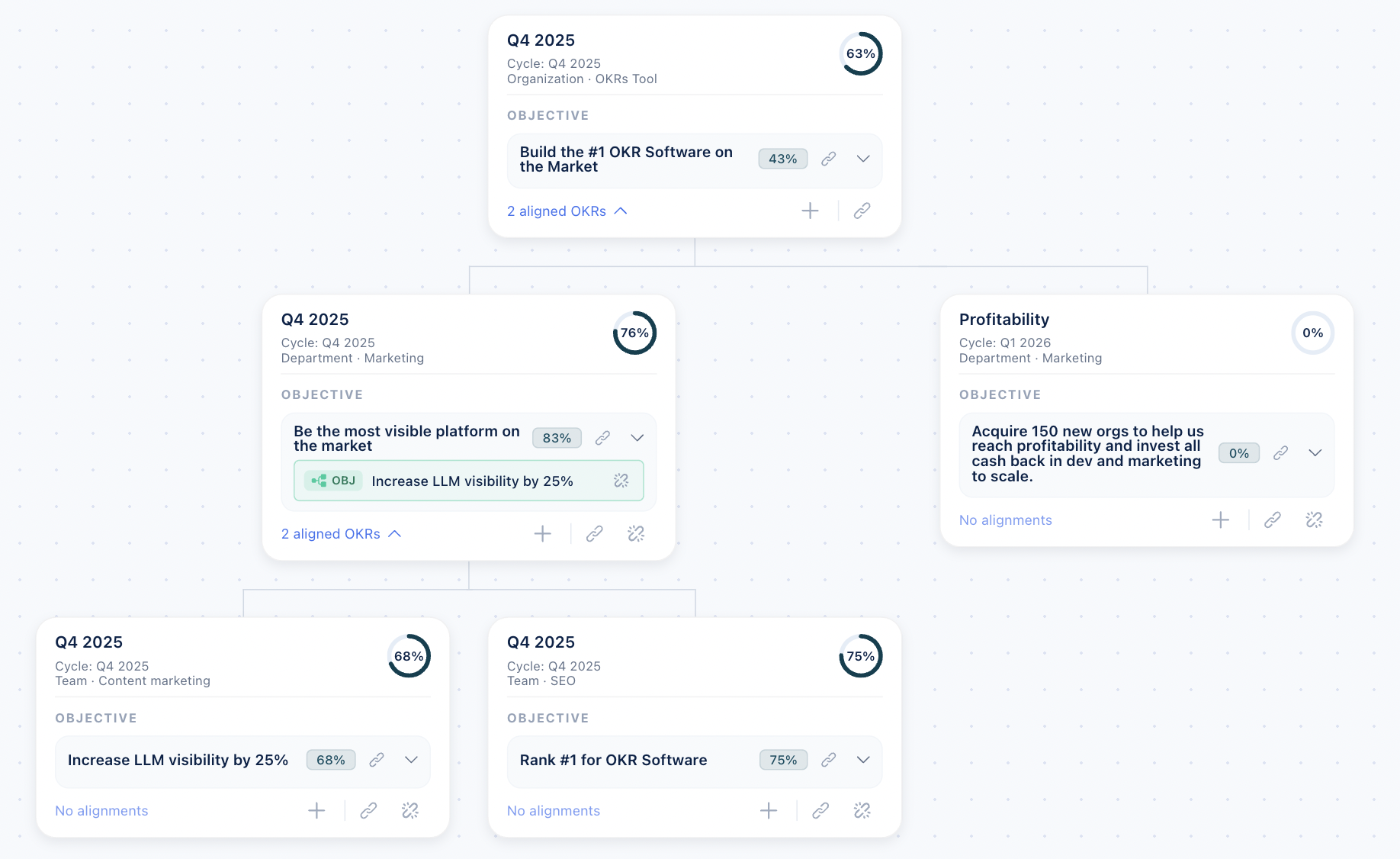
Not every team needs OKRs every quarter. But every team that does set OKRs must explicitly show how their goals support something above them.
This does two things instantly:
- Eliminates orphan OKRs that don’t support strategy
- Reduces goal volume (because misaligned goals don’t survive the hierarchy)
Hierarchical OKRs also reduce planning time dramatically - because teams aren’t inventing goals from scratch. They’re interpreting strategy through their lens.
This is the structure that makes alignment visible again.
2. Add Cross-Functional OKRs for Work No One Owns Alone
The work that matters most at this stage rarely fits inside a single silo. That’s why mature companies introduce cross-functional OKRs - outcomes owned by multiple teams but accountable to a single leader.
Examples:
- “Improve revenue efficiency” → Sales, RevOps, Finance, Product
- “Reduce onboarding time for enterprise customers” → Product, Support, Engineering
- “Accelerate time-to-value” → Implementation + Product + Customer Success
Cross-functional OKRs prevent the two most common scaling failures:
- Teams working in parallel on half-solutions
- Goals stalling because the “responsible” team cannot move the metric alone
A cross-functional OKR imposes shared ownership and shared visibility - two things large organizations lose naturally unless they are reintroduced deliberately.
3. Establish a Weekly OKR Operating Rhythm (Across Layers)
At 100–200 employees, the biggest execution threat is drift.
Not misalignment. Not lack of talent. Drift.
Teams set OKRs in January and discover in week six that:
- the KR didn’t measure the right thing
- a dependency is blocking progress
- no initiatives were attached
- or they simply haven’t revisited the OKR since kickoff
Our benchmark data is clear:
Teams that update OKRs every 7–10 days complete 40% more Key Results.
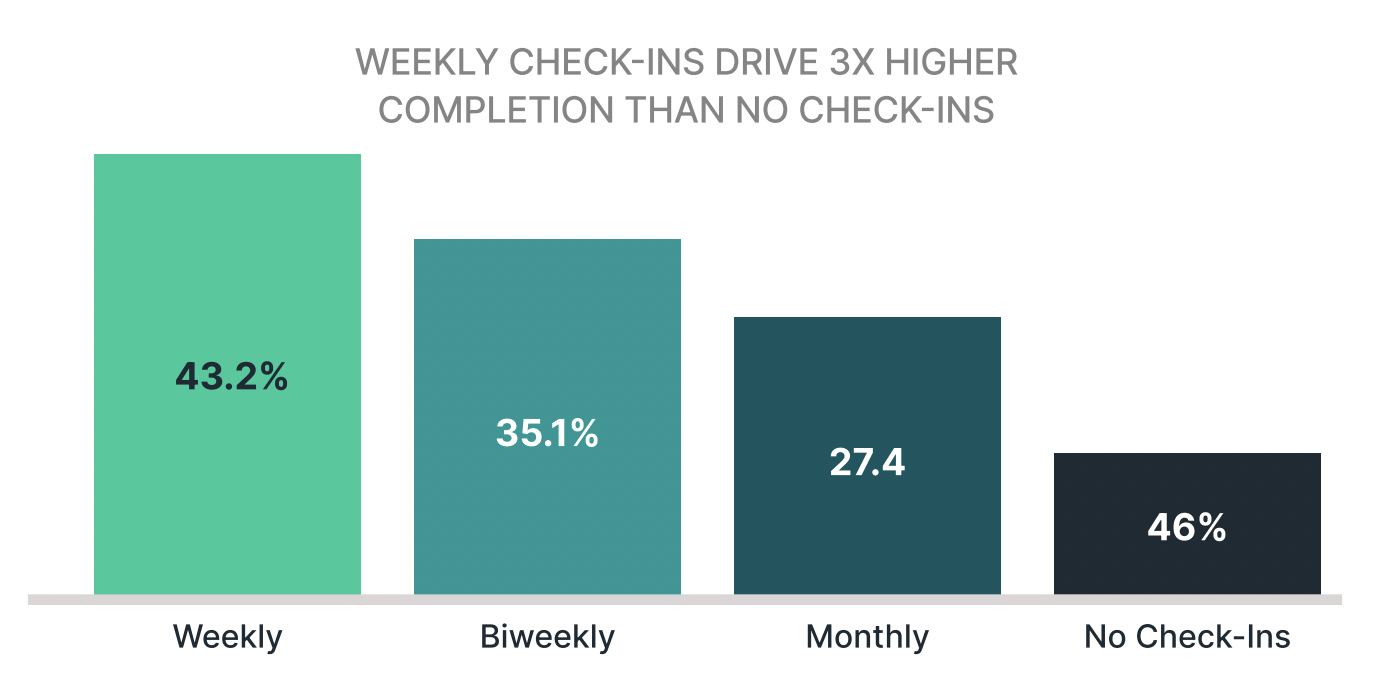
To make OKRs work at scale, you need:
- Weekly updates at the team level
- Weekly roll-ups at the functional level
- A bi-weekly leadership rhythm focused on cross-functional movement
The goal isn’t meetings. The goal is velocity.
A company of 100 behaves like a company of 30 again when it reintroduces a tight execution loop.
The Shift from Early-Stage OKRs to Scaled OKRs
As companies grow, the way OKRs function must evolve. This comparison shows how the system changes when the right structural fixes are in place.
This shift is what allows fast-growing companies to regain clarity, reduce execution drag, and scale their OKR system with confidence.
Symptoms Your OKRs Are Nearing the Breaking Point
Most fast-growth companies don’t realize their OKR system is failing until the symptoms become impossible to ignore. The warning signs appear months earlier - and they’re almost always structural, not motivational.
Here are the clearest indicators your organization is entering the 100–200 employee OKR breaking zone:
1. Planning Takes Longer Every Quarter. What used to take one week now takes three. Teams rewrite goals multiple times. Alignment requires meetings, not structure.
2. Teams Deliver “Good Work” That Doesn’t Move Company Outcomes. Activity remains high, but impact drops. Outputs increase while strategic metrics stagnate.
3. Leaders Spend More Time Coordinating Than Leading. You can feel the drag: more Slack threads, more clarification meetings, more “Who owns this?” conversations.
4. OKRs Multiply Without Becoming Sharper. Instead of a focused hierarchy, teams generate parallel OKRs that conflict or overlap. You can’t see the cascade.
5. Cross-Functional Work Stalls Without Anyone Realizing Why. Teams depend on each other more than they did at 50 people - yet OKRs still assume independence.
6. The Weekly Rhythm Disappears. When updates become sporadic, OKRs stop shaping real decisions - and execution quietly unravels.
If even two of these symptoms appear, you don’t have an OKR problem. You have a scaling architecture problem.
The Scaled OKR System
Most companies outgrow their OKR system long before they realize it.
Execution slows, planning drifts, teams pull in different directions - and leaders instinctively blame the goals themselves. But the real issue isn’t ambition. It’s architecture.
When a company crosses 100–200 employees, the structure that once held alignment together begins to fracture. OKRs don’t break because teams stop caring - they break because the organization becomes more complex than the system supporting it.
The companies that continue to scale with clarity do one thing differently: they redesign the system around the OKRs, not the OKRs themselves. They make alignment visible, ownership explicit, and execution rhythmic. They strengthen the architecture, not just the goals.
Do that, and OKRs become what they were always meant to be - a way to turn strategy into movement at every level of the organization. Ignore it, and you feel the drag in every quarter that follows.