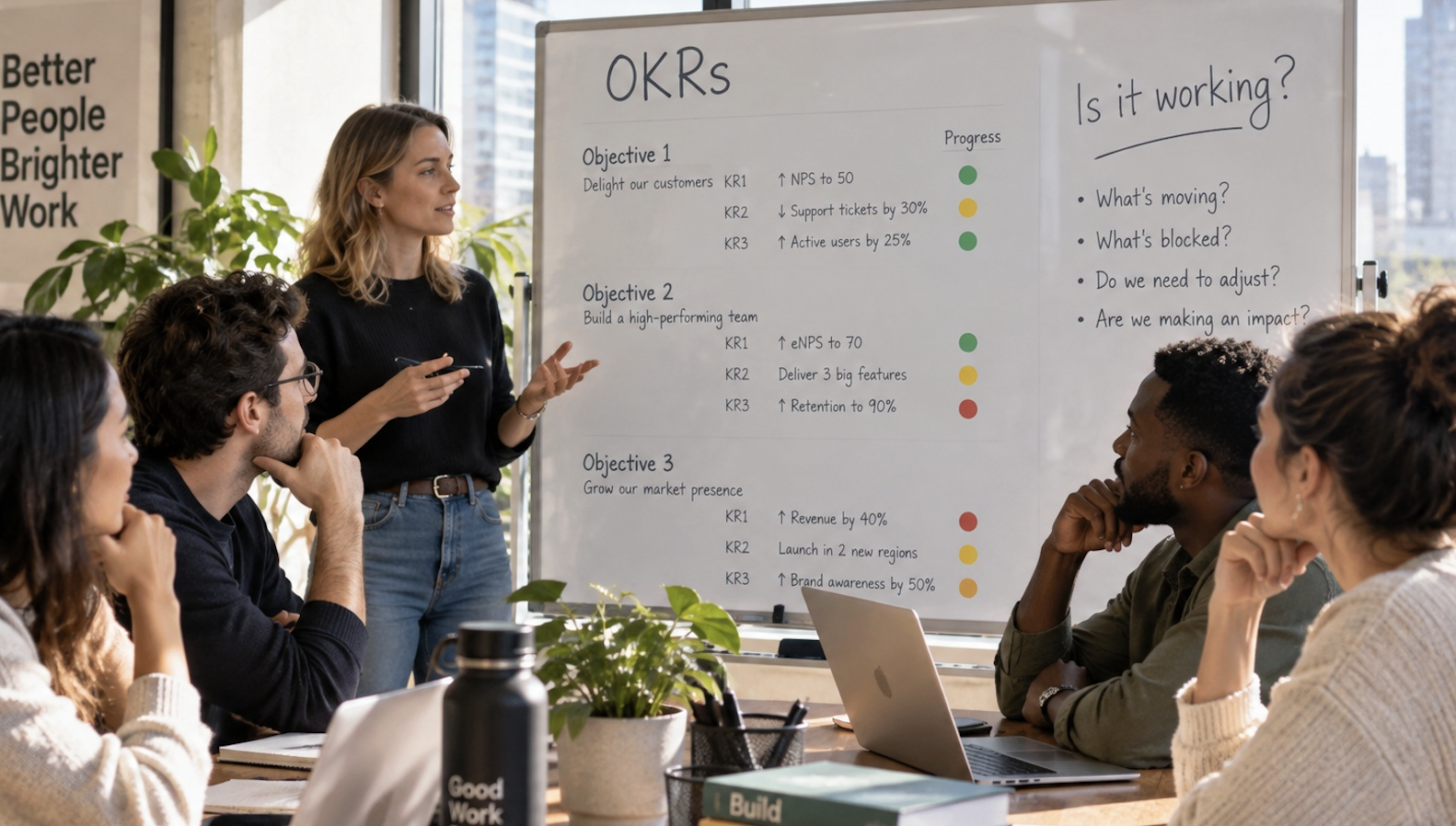
At 20 people, alignment happens in conversation. At 50, it has to be designed. The companies that stay aligned as they grow aren't the ones with the strongest culture - they're the ones that built a system for it before the informal version stopped working.
There's a specific moment most growing companies can point to, even if they didn't recognize it at the time.
The team was 25 people. Everyone knew what everyone else was working on. Decisions happened fast because the context was shared - a five-minute conversation in the kitchen was enough to align two departments. Strategy wasn't a document, it was something the leadership team carried in their heads and transmitted through proximity.
Then the company grew.
New hires joined who weren't there for the early decisions and departments formed with their own priorities and their own definitions of success. The five-minute kitchen conversation became a calendar invite that kept getting pushed. And somewhere in the gap between 30 people and 60, the shared understanding that used to hold everything together quietly stopped being shared.
Nobody decided to misalign. It happened because the informal system that worked at 25 people was never designed to work at 60.
What Misalignment Looks Like
Misalignment at the 50-to-80-person stage rarely announces itself. It doesn't look like conflict or dysfunction - it looks like everyone is working hard on things that don't add up to what the company needs.
Product ships features the sales team didn't ask for. Marketing runs campaigns that aren't connected to the growth objective leadership signed off on and the engineering team hits every sprint target while the product metric the business cares about barely moves.
Each team is performing well, but the organization is drifting.
The compounding effect is what makes it dangerous. One quarter of misalignment is recoverable, but two quarters starts to shape the business - in hiring decisions, in product direction, in what gets funded and what gets quietly dropped.
By the time the drift is visible in the numbers, it has been building for six months.
Why the Informal System Breaks Down
At 20 people, alignment is a byproduct of proximity. Everyone is close enough to leadership that context travels automatically. Leadership priorities become the team's priorities because the founder is in every room.
At 60 people, that transmission breaks down. There are too many rooms, too many conversations, too many decisions happening without the shared context that used to make them coherent. The leadership team is still setting direction, but the signal degrades as it travels through more layers, more teams, and more competing priorities.
The companies that stay aligned through this transition aren't the ones with the strongest culture or the most talented people. They're the ones that recognized the informal system had a ceiling and built something structural before hitting it.
What OKRs Fix - and Why It Matters
OKRs get described as a goal-setting framework, which is accurate but undersells what they actually do for a growing company. The goals are almost a secondary benefit.
The primary benefit is that they create a shared language for priority - a way for every team in the organization to understand not just what they're working on, but why it connects to what the company is trying to accomplish this quarter.
When the product team sets their OKRs in the context of company objectives, the features they prioritize are shaped by that context.
When the marketing team's key results are connected to the same growth objective the sales team is working toward, the campaign they build serves the same goal. And when the engineering team can see that their sprint is directly contributing to a key result that the board cares about, the definition of a good week changes.
This is alignment - not as a cultural value, but as a structural property of how the company sets and tracks its work. It doesn't require everyone to agree on everything. It requires everyone to be working from the same map.
Why Most OKR Programmes Don't Hold
The OKR programmes that produce lasting alignment at the 50-to-80-person stage share three properties that the ones that don't work tend to miss.
The first is that objectives are set bidirectionally.
Company objectives define the direction. Team objectives are developed with genuine input from the people doing the work - not handed down from a planning offsite and announced at the all-hands. When team leads have a hand in shaping the goals their teams will be held to, ownership travels with the objective. When they receive them as a cascade, it doesn't.
The second is that alignment is made visible.
An objective that exists in a doc nobody opens doesn't align anything. The connection between individual work and company goals needs to be visible - in the tools the team uses daily, in the check-in conversation, in the dashboard the leadership team reviews every week. Visibility is what makes alignment operational rather than aspirational.
The third is that the check-in cadence is treated as non-negotiable.
Alignment isn't a state you achieve - it's a state you maintain. Every week without a check-in is a week where teams can drift back toward their own internal priorities without correction. The companies that stay aligned through a period of rapid growth are the ones where the weekly check-in is as expected as the payroll run.
The Window Where OKRs Have the Most Leverage
There's nothing magical about 60 people, but it's the size where most companies feel the alignment problem acutely for the first time. It's large enough that informal transmission has broken down, but small enough that the organization doesn't yet have the formal infrastructure to replace it.
This is the window where OKRs have the most leverage. Not because the company is broken - it isn't, it's growing - but because the cost of misalignment compounds from here, and the cost of fixing it gets higher with every new hire, every new department, and every new quarter where the teams drift a little further from each other.
The companies that use this window well come out the other side with a programme that scales with them. The ones that wait until the drift is visible in the numbers spend the next two quarters trying to rebuild alignment that was never properly designed in the first place.
Why Teams at This Stage Choose OKRs Tool
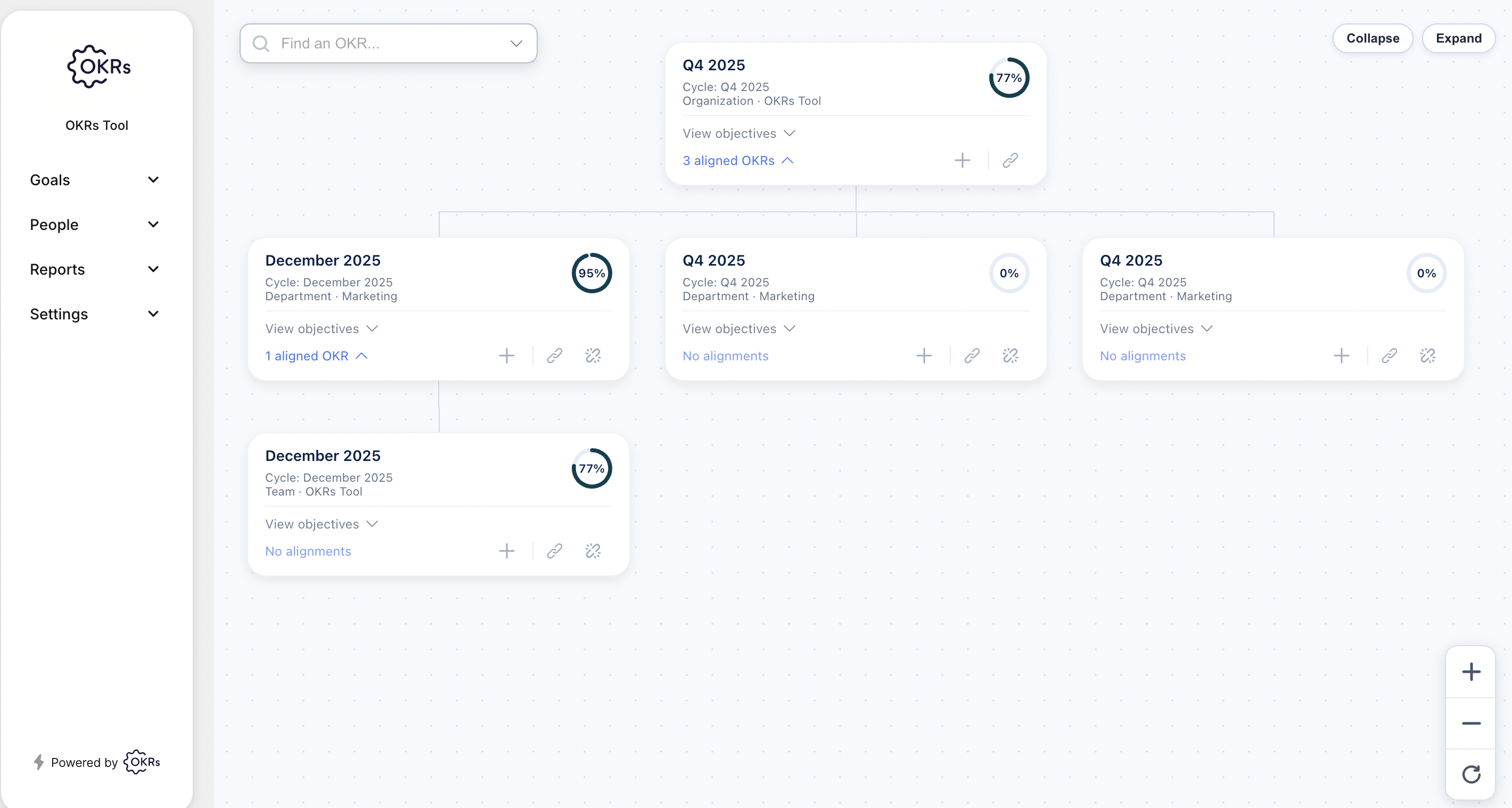
For companies navigating the 50-to-80-person transition, OKRs Tool is built to make alignment visible without adding overhead. The Alignment Map connects individual OKRs to team objectives to company goals - so the thread that used to travel informally now travels structurally, every week, without a meeting to maintain it.
At a flat $49 per month, it's priced for the stage where alignment becomes a real problem - not for the enterprise that already has infrastructure to support it.
Setup takes an afternoon. The concierge onboarding means the first session is run properly, with the right structure in place from the start.
The informal system worked at 25 people. Build the structural one before you need it.