Teams that check in weekly complete 43% more OKRs than those reviewing monthly or ad hoc. Completion climbs from 51% in cycle one to 79% by cycle five. Half of all key results are set with no owner, and teams that fix that complete 26% more of their goals. Every one of those gains depends on a weekly rhythm across teams — the one thing a manual spreadsheet cannot sustain past a single small group.
A spreadsheet tracks OKRs. It holds objectives, lists key results, and costs nothing. For a team of five running two shared goals, it is the correct tool, and a dedicated platform would only add friction.
The manual method breaks at a specific, measurable point: when a weekly check-in has to run across more than one team. That is where the numbers turn, and the numbers are the reason the choice matters.
When a Spreadsheet Is the Right Tool
A spreadsheet holds a list of objectives and key results with no learning curve and no cost. For a team of five running two shared goals, that covers the job. Everyone sees the sheet, the whole team fits in one conversation, and alignment happens in that conversation rather than in a tool. A sheet is equally fine for tracking a KPI or two alongside the goals at that size.
At that scale the coordination problem a platform solves does not yet exist. The team already knows what everyone is working on. The spreadsheet records the goals; it does not need to maintain them, because five people holding two goals can maintain them by memory.
A team in that position should stay on the spreadsheet. The decision changes when the team grows, and it changes for one specific reason.
The Break Point: A Weekly Rhythm Across Teams
Goals do not get harder to store as a company grows. A spreadsheet holds a hundred rows as easily as five. They get harder to keep current, and goal tracking is a weekly task, not a storage task.
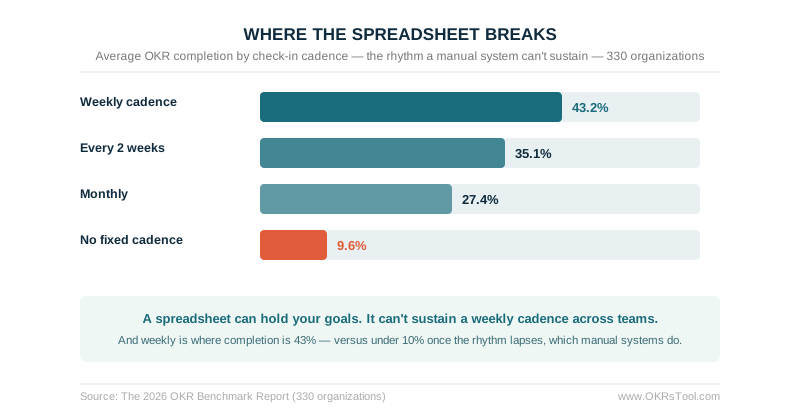
Teams that check in weekly complete 43% of their OKRs. At a monthly cadence that falls to 27%, and with no fixed rhythm it drops to under 10% — a 3× gap driven by nothing but how often the goals get touched, per the 2026 OKR Benchmark Report. The value of tracking OKRs sits entirely inside that weekly habit.
A manual system cannot hold the weekly habit once more than one team depends on it. Each week, one person chases every owner for a number, merges the tabs, repairs the broken formula, and rebuilds the summary. For one team that is a chore. For four it is a standing job nobody was hired to do, and in a busy week it is the first thing dropped.
The check-in slips from weekly to occasional, the sheet goes stale, and by mid-quarter the numbers are green on the surface and untouched underneath. Weak execution against goals is the most-cited reason OKRs fail, and the manual method fails there structurally: it cannot sustain the cadence the completion rate is built on.
Two Failures a Spreadsheet Cannot Prevent
Beyond cadence, two structural gaps open up as teams multiply — and a spreadsheet has no mechanism to close either.
The first is alignment. When each team keeps its own tab, the connections between goals are invisible. A team can spend a full cycle on a key result that ladders up to nothing and no one sees it until the retrospective. Across 876 organizations in the platform data, 65% of teams report their goals are not clearly linked to company strategy. A spreadsheet cannot flag an orphaned goal, because it does not know goals are meant to connect.
The second is ownership. 50% of key results are set with no named owner, and a spreadsheet does nothing to prevent it — a cell does not require a name. Teams that assign a single owner to every key result complete 26% more of their goals. The manual method leaves that 26% on the table, because it has no way to enforce the accountability that produces it — the same accountability gap performance management software exists to close.

The Test for Whether You've Outgrown It
Seat counts and feature lists are the wrong measure. One question decides it: can a weekly check-in run across every team, by hand, without one person dreading the job?
If yes, stay on the spreadsheet. If no, the choice is not between a spreadsheet and software — it is between a weekly rhythm and a manual process that abandons it by mid-quarter. That is the point OKR software pays for itself: it automates the cadence, the alignment, and the ownership that manual effort cannot hold across teams. A tool the team never opens does not clear that bar either, so software adoption is part of the switch — but the tool removes the manual upkeep that kills the rhythm in the first place.
The Gains Compound — If the Rhythm Survives
The completion gains from OKRs are not one-time. They build across cycles as a team gets better at running them.
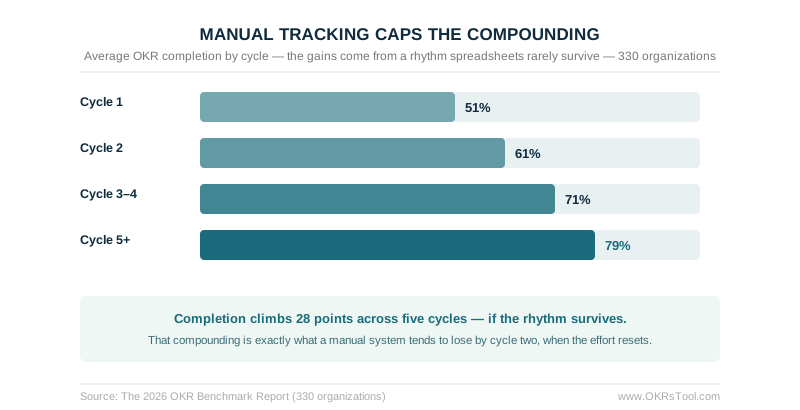
Completion rises from 51% in the first cycle to 79% by the fifth as teams climb the maturity curve — a 28-point gain. That climb requires the rhythm to survive from one cycle to the next, reinforced by a structured retrospective at each cycle's close — the kind of OKR habit a manual system rarely keeps. A manual system resets each quarter, because the effort of rebuilding it by hand caps how far a team can climb. Software carries the rhythm across cycles, which is what protects the compounding.
Where Each Approach Fits
Every software case above is about sustaining a rhythm and a structure across teams — not about features a spreadsheet lacks.
What Switching Involves
The switch is lighter than the fear of it. Moving off a spreadsheet is a copy-paste of goals already written, and the cycle structure maintained by hand is the structure a tool maintains automatically. The team keeps the OKR process it already runs; what changes is that the weekly upkeep stops being a manual job — check-in nudges send on their own, tracking updates in real time, and every key result carries an owner without anyone enforcing it by hand.
That is the whole decision. A spreadsheet is the right tool for a small team holding a couple of goals it can maintain by memory. Past that — multiple teams, a weekly cadence, goals that have to ladder up and stay owned — the manual method breaks at the exact point the completion data says matters most, and it breaks structurally, not for lack of effort. What decides it is whether the weekly rhythm survives a busy quarter. Past one team, maintained by hand, it doesn't.
The OKRs Tool platform automates that rhythm and imports existing goals in an afternoon. It's free for up to five users, enough to confirm the rhythm holds before scaling it.
Data sources: The 2026 OKR Benchmark Report (330 organizations); OKRs Tool platform data (876 organizations, 20,952 key results).