
Companies on OKRs Tool whose first-ever key result finished at 70% or more of its target went on to hit 53% of their later key results. Companies whose first key result fell short hit 24%. Across 29,987 key results from 3,527 organizations, whether the first goal gets seen through is one of the clearest early signals of whether an OKR program takes root, and leadership sets it.
Companies launching OKRs often call the first quarter a pilot: a low-stakes trial where the goals matter less than learning the process, with the real program starting once everyone has the hang of it. The data from our platform suggests the opposite treatment. The first key result an organization ever sets turns out to be one of the most consequential it will set, because its outcome predicts how the goals after it will go.
We looked at 29,987 key results from 3,527 organizations on OKRs Tool and found two patterns that point the same way. The first goal's outcome tracks the hit rate of everything that follows, and key results inside the same objective tend to succeed or fail together. Put side by side, they turn a familiar piece of OKR advice, that leadership has to go first, into something the numbers support.
The First Key Result Predicts the Rest
For every organization on the platform, we found its first-ever key result, recorded whether it hit its target, and then measured how the organization's later key results performed.
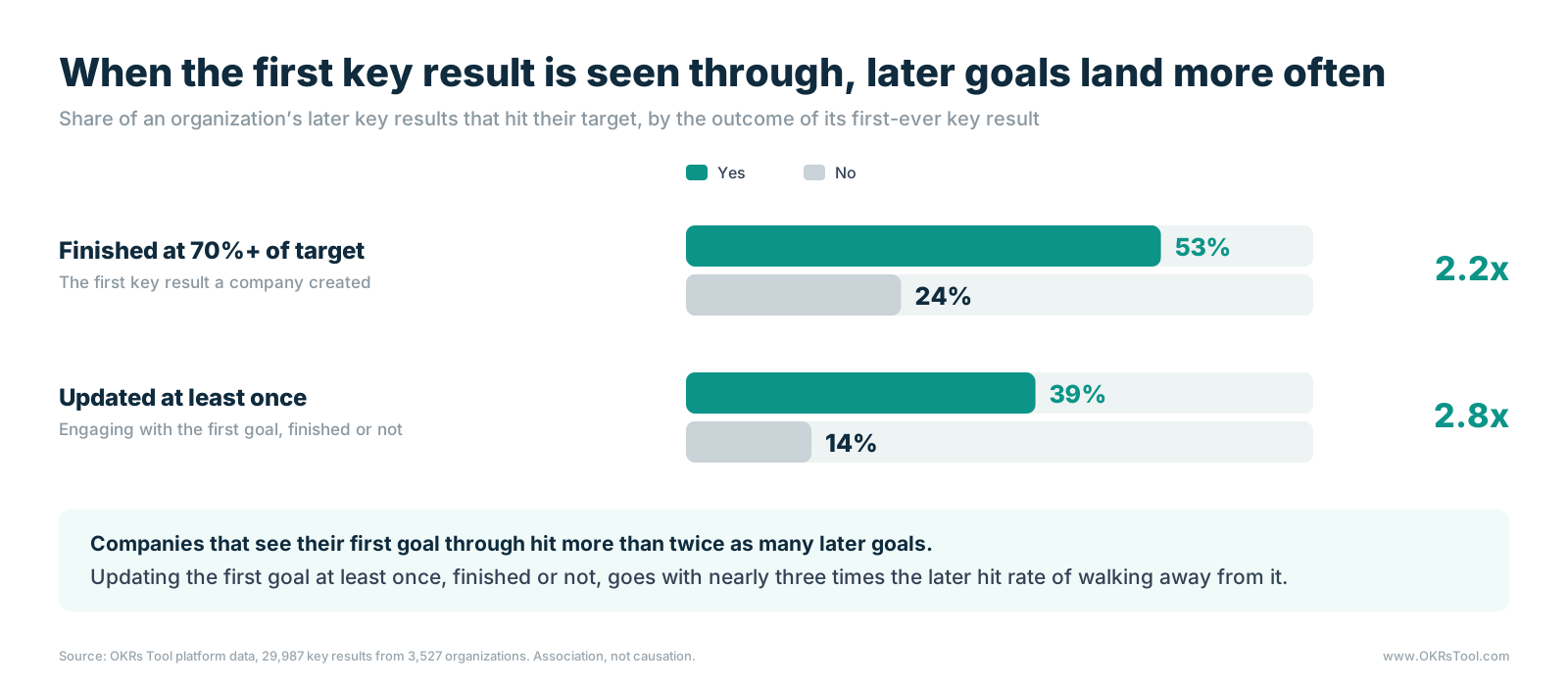
For each company, we took the first key result it ever created, counted it as a hit if it finished at 70% or more of its target, and measured how the company's later key results performed.
Companies whose first key result was seen through went on to hit 53% of their later goals, against 24% for companies whose first key result fell short. The pattern held when we defined "first" as the first key result a company updated (55% against 23%), so it doesn't depend on how the first goal is picked.
Even engaging with the first goal matters. Companies that updated their first key result at least once, whether or not it finished, hit 39% of their later key results, against 14% for companies that never touched it again, so walking away from goal number one predicts more walking away. The finding fits what our platform data shows about early momentum elsewhere, where key results already moving at their first check-in hit their target 62% of the time, against 27% for those still at zero.
Why the First Goal Carries So Much Weight
A first key result is the first piece of evidence a team gets about whether OKRs are worth the effort. If it lands, the practice looks real: the check-ins led somewhere, the number moved and someone noticed. If it misses without comment, the team learns that goals can be set and left, and that lesson is hard to unlearn.
Our wider research shows how quickly that verdict spreads. In The Death of OKRs, 49.5% of companies had stopped using OKRs on at least one team, and stalls peaked after two or three cycles, once the launch energy had faded. A stalled team signals to every other team that OKRs are optional.
The OKR Benchmark Report found the reverse pattern for programs that keep going, with average completion rising from 51% in a team's first two cycles to 79% by cycle five along the OKR maturity curve. The first goal sits at the start of whichever path a program takes.
Goals Move Together Inside an Objective
The second finding explains how one outcome can shape the next. Key results inside the same objective tend to land close together.
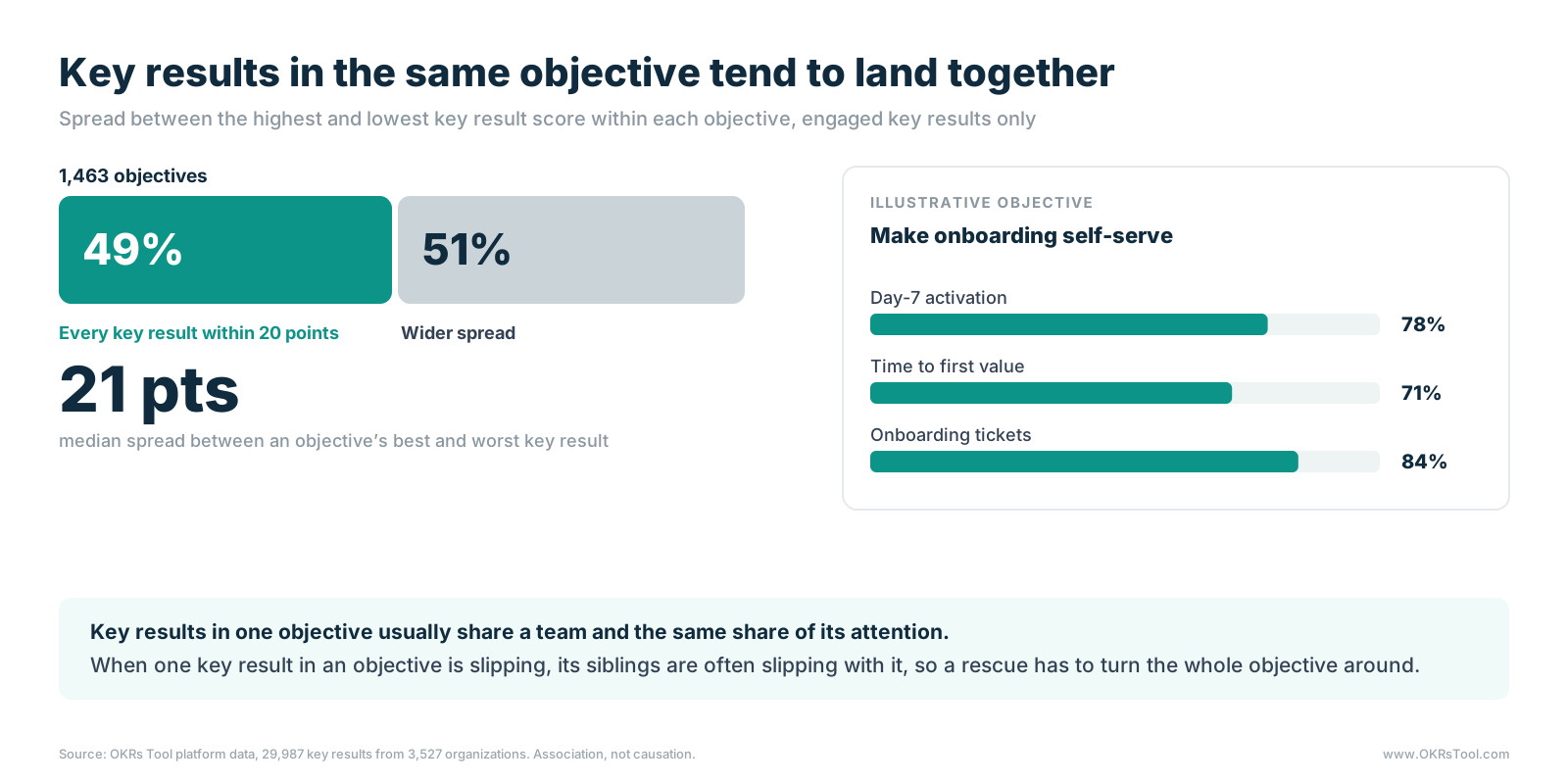
Across 1,463 objectives with actively tended key results, 49% had every key result finish within 20 points of the others, and the median gap between an objective's best and worst key result was 21 points. At the team level, the extremes are rare: 2% of teams hit every goal, while 22% hit none. Key results in one objective usually share a team, a stretch of the quarter and the same share of attention, so when one is slipping, its siblings are often slipping with it.
That changes how a stalled goal should be handled. A rescue at the mid-quarter review that fixes one key result in isolation leaves the conditions that stalled it in place. Looking at the whole objective, including whether its owner has the time and attention to carry all of it, gets closer to the cause.
Leadership Has to Go First
Put the two findings together and the case for leaders going first gets concrete. The first goals a company sets are usually the leadership team's, and those goals are the most visible in the business. If they're tended every week and land, every team that follows inherits a pattern of goals that get done. If they're set and left, the next team inherits that pattern instead.
The Death of OKRs points the same way from the survey side. Among companies that had already stopped OKRs on a team, lack of leadership buy-in rose to 41% as a named cause, the largest rise of any cause.
Where leaders review OKRs weekly, 43% of leaders describe silent endings, against 55% where leaders review them monthly. And where one leader sets strategy alone, 74% of companies had stopped OKRs on a team (a small group of 34), against 40% where strategy is set collaboratively. Leaders who go first, visibly and with the team, give the program its best start.
How to Set a First Key Result That Lands
The goal is a first key result that matters to the business and has a realistic chance of landing in the quarter, owned by someone everyone can see.
Make it committed, with a stretch goal later. The first key result is the wrong place for a moonshot. Write it as a committed goal the team intends to reach in full, and save stretch goals for the cycles that follow, once the team has a track record. The difference between types of OKRs matters most in cycle one.
Give it a deadline and a baseline. Key results with an explicit timeframe hit their target 67% of the time on the platform, against 51% without one. A clear baseline and target make the first win measurable, so nobody argues about whether it counted.
Put a leader's name on it. A key result owned by a member of the leadership team shows everyone else that the practice matters at the top, especially when that one name sits on the OKR dashboard with weekly updates the whole company can see.
Get it moving in the first two weeks. The first check-in is the earliest read on whether a goal is in trouble, and a first key result still at zero by then needs a first step and a date before the meeting ends.
Keep the first cycle small. Teams running one or two objectives per quarter are twice as likely to achieve them as teams running three or more, according to The OKR Benchmark Report. Setting the right number of OKRs matters most when the team is still learning the rhythm.
Close it out loud. When the first key result lands, say so at the end-of-cycle reflection and in front of the company. Celebrating first OKR wins turns one result into evidence the whole organization can see.
What the Data Can't Tell Us
Both findings are associations. A first win predicts a stronger trajectory, and it doesn't prove that engineering an easy first win would create one. A team that hits its first key result may simply be the kind of team that was going to do well anyway, with leaders who were already engaged and goals that were already well written.
That caveat points to the right reading. A first key result set deliberately low, so the dashboard shows green, teaches the team that targets are negotiable and does little for the cycles after it. The useful version is a meaningful goal, set carefully, owned visibly and tended every week, which is what the engaged teams in the data were doing.
Treat the First Cycle as the Launch
A first OKR cycle labeled as a pilot invites the behavior that sinks programs: goals set without much care, check-ins that slip and a quarter that ends without anyone saying what happened. The platform data says the first key result deserves the opposite, because its outcome predicts the next several quarters, and because goals inside an objective tend to rise or fall together.
For the person launching OKRs, that means asking the leadership team to set the first goals, own them in public and update them every week, starting in week one. A platform that asks every owner for a weekly update and shows the leadership team's goals to the whole company makes that example visible from the first week.
Data: OKRs Tool platform data, The Death of OKRs (and How to Revive Them) and The OKR Benchmark Report.