Across 876 organizations, 7,419 objectives, and 20,952 key results, one variable predicted goal success more reliably than any other: whether Key Results ever got updated during the cycle. Teams that kept them moving hit their goals 68% of the time. Teams whose Key Results went dark hit 35%. Every habit below is measured against that outcome.
OKR failures rarely announce themselves. They happen in the middle of the quarter, when goals stop influencing daily decisions. At kickoff the Objectives feel sharp. By week four, execution pressure takes over and the goals recede. By cycle close the outcome feels inevitable — but the failure happened weeks earlier.
That pattern is not random, and the habits that prevent it are measurable. The nine below come from the 2026 OKR Benchmark Report across 330 organizations and OKRs Tool's platform data across 876. Each carries a number.
The Levers, Ranked by Evidence
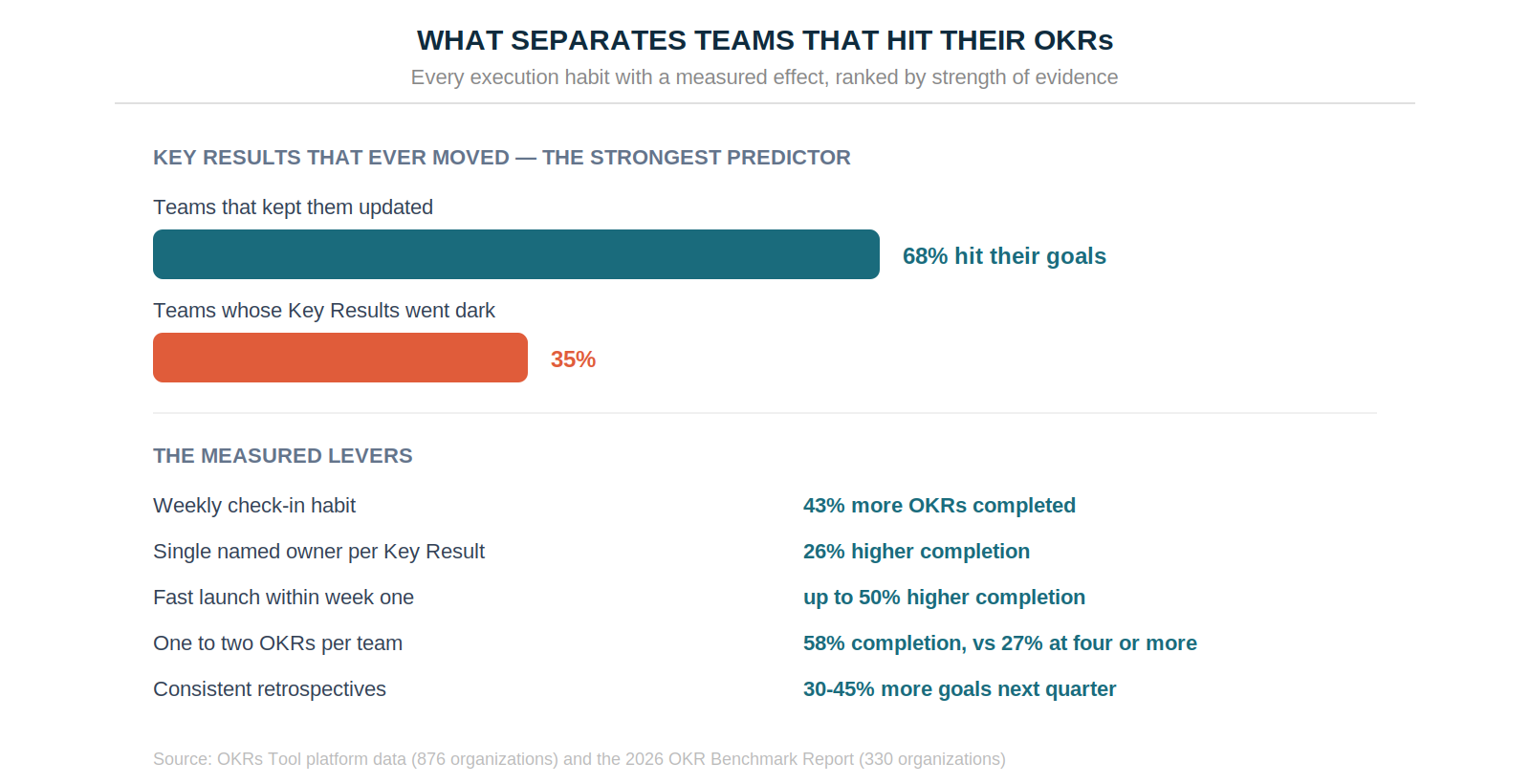
High performers kept 71% of their Key Results moving through the cycle. Struggling teams updated 25%. They left 31% of their objectives frozen at zero progress across the entire quarter; high performers left 4%. Nothing else in either dataset comes close to that gap.
1. Run a Weekly Check-In
Teams that check in weekly complete 43% more OKRs than those reviewing monthly or ad hoc. Teams that skip check-ins entirely are 3x more likely to abandon OKRs before the quarter ends.
The weekly check-in works because it keeps goals connected to reality. Risks surface in week three, when a correction is still possible, rather than in week eleven when the only option is lowering the target. Fixed day, three prompts: current number, blocker, decision.
Duration matters as much as frequency. Teams spending more than 30 minutes a week on OKR review perform worse than those spending less. Intentional time, not more time.
2. Write Outcome-Based Key Results
OKRs Tool's analysis found 52% of Key Results were tasks or existing metrics in disguise — numbers teams already monitored rather than outcomes they were actively trying to change.
The distinction isn't the metric. It's intent. KPIs monitor steady-state health. Key Results describe a specific, time-bound change moved from a baseline toward a target. A Key Result that could live forever in a dashboard is not a Key Result.
Catch task-shaped Key Results during the planning session. Catch them at cycle close and the team has spent a quarter measuring activity.
3. Give Every Key Result One Named Owner
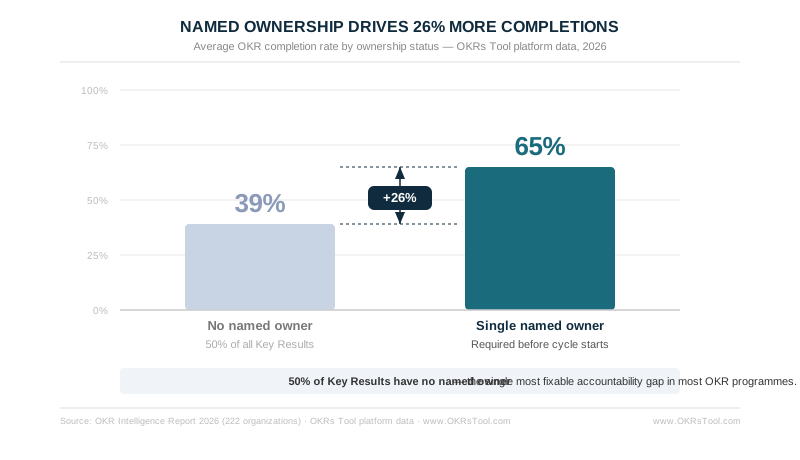
Roughly 50% of Key Results in the platform data have no named owner at all. Required single ownership drives 26% higher completion.
The owner doesn't do all the work. They own one thing: the number is current and honest every week, and a blocker gets named when one exists. Shared ownership is the failure mode — when two people "sort of" own a Key Result, both assume the other will update it.
The rule costs nothing: no Key Result goes live without a name attached.
4. Cap the Board at Two OKRs
Teams running one or two OKRs per quarter reach high completion 58% of the time. At three it drops to 38%. At four or more it falls to 27% — and 8% abandon the cycle entirely. Despite this, 35% of teams still set three or more.
The mechanism is attention, not capacity. Every Key Result a team actively tracks competes for the same finite weekly focus. Doubling the goals doesn't double the attention available to move them.
The same holds one level down. High performers ran a median of 2.9 Key Results per Objective; struggling teams ran 3.5. More Key Results per goal correlated consistently with worse outcomes.
5. Launch Fast
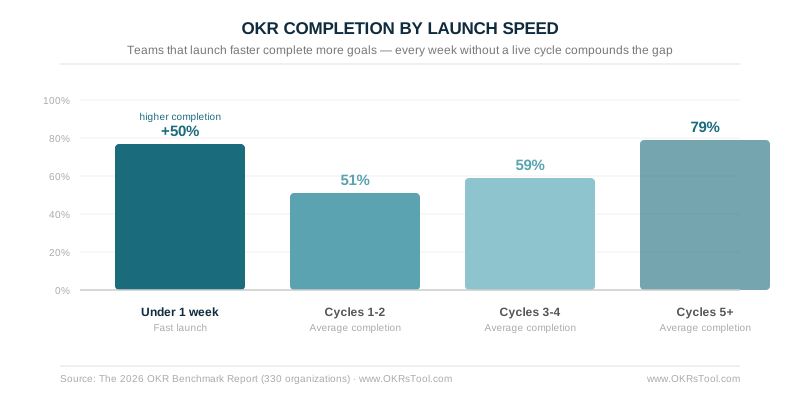
Starting the cycle within the first week of the quarter produces up to 50% higher completion than extended rollouts.
Late starts don't just compress the timeline — they change how the team operates. Work begins without clear priorities, and the OKRs end up chasing reality rather than shaping it. A cycle finalized in week three has already spent a quarter of its runway.
Treat the start as non-negotiable. Objectives and Key Results defined in the first days, before execution noise takes over.
6. Review Movement, Not Activity
Most check-ins ask what shipped. The question that matters is what changed.
A team can run five campaigns, ship three features, and hold ten customer calls while every Key Result stays flat. Output looks impressive; outcomes don't move. Anchoring the weekly review on whether the number moved — and specifically what caused the movement — surfaces problems weeks earlier than reviewing activity does.
Activity hides problems. Movement exposes them. The check-in that asks "what moved, and why?" produces decisions. The one that asks "what did you work on?" produces a status report.
7. Treat 70–80% as the Target
Perfect scores are a warning sign. The benchmark data identifies 70–80% completion as the sweet spot for genuinely ambitious goals — far enough beyond current capability to require real change, close enough to realistic that the team commits.
Teams consistently hitting 100% are setting targets they already knew how to reach. Teams below 50% usually have an ownership or clarity problem, not an ambition problem. The State of Goal Management is direct about what drives the first pattern: 96% of employees sandbag when goal scores affect their performance rating, versus 81% when goals are kept separate.
Honest scoring requires the score to be decoupled from the review. That is the structural precondition, and Andy Grove built it into the framework in the 1970s for exactly this reason.
8. Run More Than One Cycle
OKRs do not deliver their full value in the first quarter. Completion climbs from 51% in cycles one and two to 79% by cycle five.
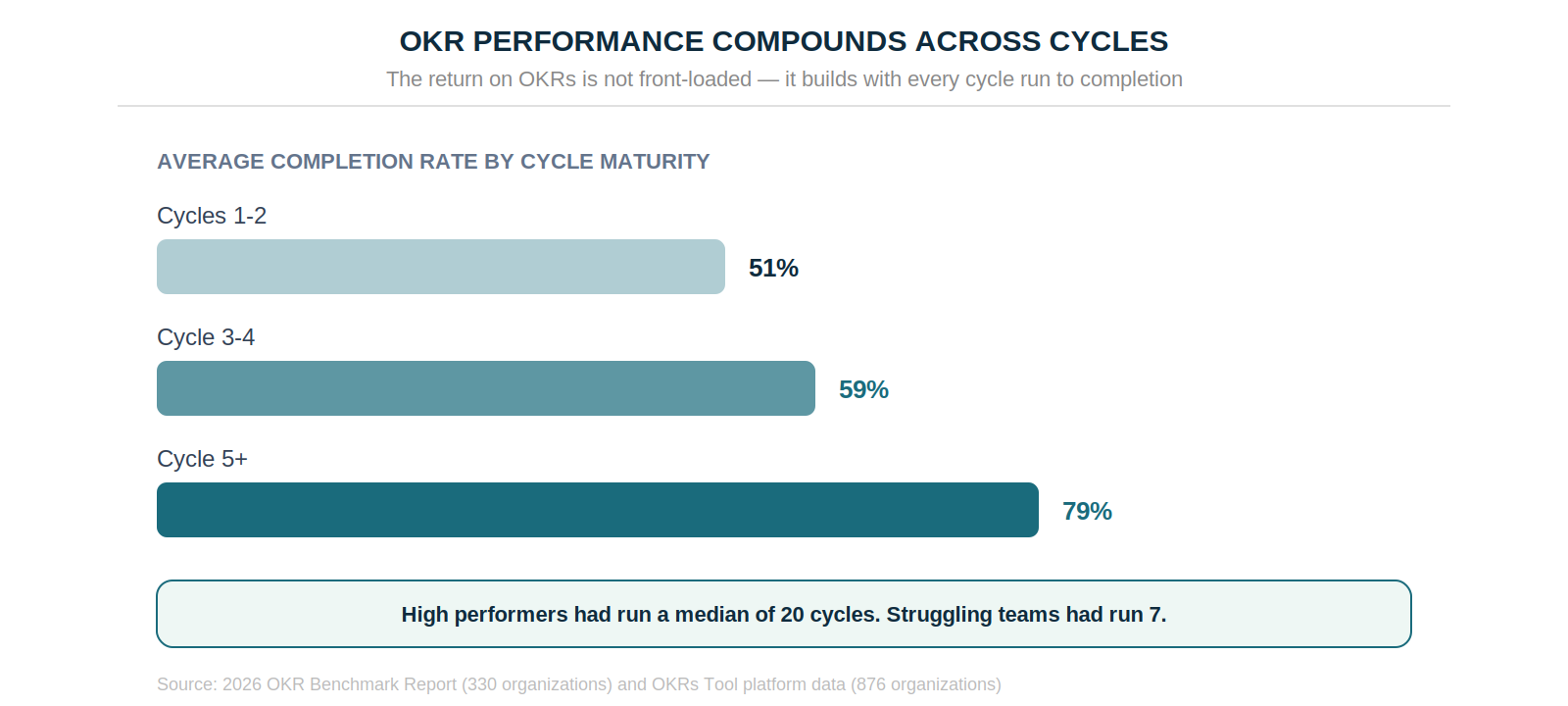
High-performing organizations in the platform data had run a median of 20 OKR cycles. Struggling ones had run 7. The return on OKRs is not front-loaded — it compounds as each retrospective sharpens the planning that follows.
Early cycles are messy. Teams are learning to write Key Results, calibrate targets, and hold the weekly cadence. Quitting after a disappointing first quarter prevents the compounding from ever appearing.
9. Close Every Cycle Honestly
Teams that run consistent retrospectives complete 30–45% more goals the following quarter, because the retrospective converts a missed target into diagnostic data rather than an unexplored gap.
A 0.65 tells a team exactly which Key Result stalled, who owned it, when the drift started, and what to change. A 1.0 on a safe target tells them the target was wrong. The end-of-cycle review is where the maturity curve is actually built.
Skipping the retro doesn't save time. It costs the next quarter.
The Playbook at a Glance
Habits, Not Better Goals
The teams that hit their OKRs don't write sharper goals or set more aggressive targets. They keep the numbers moving. Whether Key Results ever got updated predicted success more reliably than team size, cascade depth, goal count, or how the Objective was worded.
None of the nine habits above requires ambition anyone doesn't already have. They require a structure that makes the weekly update easier than skipping it, a name on every Key Result, and a board short enough that two goals get genuine attention instead of five getting none. See how OKRs Tool builds all nine into the default cycle — free for up to 5 users.
Data: OKRs Tool platform data (876 organizations, 7,419 objectives, 20,952 key results), The 2026 OKR Benchmark Report (200 organizations), The State of Goal Management (210 full-time employees at growing companies, 2026).